
This site is written from a family-caregiver perspective. The operator is not a medical professional or an insurance, legal or financial adviser. Use this guide to organize questions for the relevant service.
Match each fee to its billing entity
Use this follow-up record alongside the guide below. It does not determine medical suitability, insurance eligibility or legal rights, and it does not guarantee a price.
- Keep together
- Facility estimate, professional estimate, service details, identifiers and any deposits.
- Unanswered question
- Who bills this component, what does it include and where will my payment be credited?
- Next contact and owner
- Ask each billing office for its own explanation and reconcile the account records.
- Recheck when
- Billing entity, setting or included service changes.
For each response, record its date, source, reference number and what remains uncertain. Agree the next follow-up date instead of treating silence as confirmation. Use official contact channels and keep identifying health, account and policy information out of public comments.

Medical Billing Decision Guide
Hospital Facility Fee vs Surgeon Fee: What’s the Difference?
A surgeon can perform one operation, in one operating room, on one day, yet you may receive more than one bill. That isn’t automatically duplicate billing. The surgeon’s professional service and the hospital or surgical facility’s resources are commonly billed as separate parts of the same episode of care.
The practical problem is that an estimate labeled “surgery cost” may describe only one of those parts. A surgeon’s quote can leave out the operating facility, anesthesia, imaging, pathology, implants, assistants, or other services that may generate separate claims.
This guide shows you how to separate those charges, identify the bills that may still be missing, compare sites of care, and ask for a more useful estimate before you commit to an elective procedure.
The useful question isn’t simply “What does the surgery cost?” It is “Which people and facilities will bill for this episode, and what will my plan allow for each?”
Snapshot
Who this is for: U.S. patients comparing surgery or procedure costs. The problem: a surgeon quote may not represent the full episode of care. What changes the answer: site of service, insurance network, procedure, facility contract, anesthesia, implants, and other professionals involved. Your goal: identify every likely bill before deciding what the procedure may actually cost you.
Before You Act
Medical billing depends on your specific health plan, provider contracts, place of service, and the services actually performed. Use this article to organize your questions, not to predict a personalized benefit determination. Before elective care, confirm both the facility and each important professional with your insurer, and compare estimates with your plan’s own cost information when available.
Table of Contents
Hospital Facility Fee vs Surgeon Fee: The Short Answer
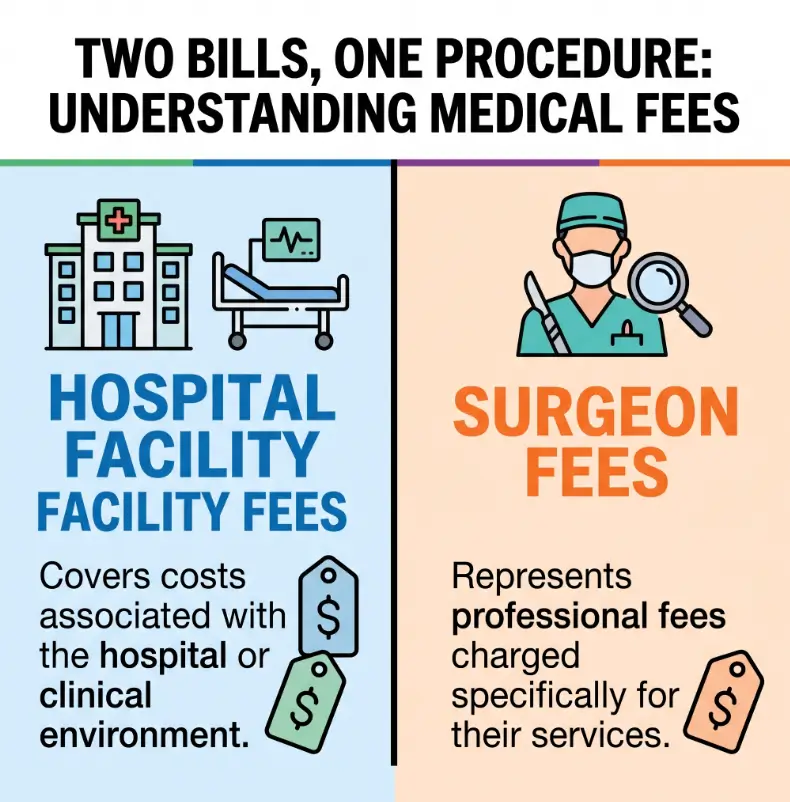
A surgeon fee generally pays for the surgeon’s professional work. A hospital facility fee pays the hospital or other facility for the institutional resources used to provide your care. Under Medicare’s payment structure, physician professional services and hospital outpatient services are paid through different payment systems, which illustrates why the two charges can exist side by side.
Think of the episode as two layers. One layer is the clinical professional performing the procedure. The other is the place, staff, equipment, supplies, and infrastructure that allow the procedure to happen.
Those layers can be financially separate even when they feel inseparable to the patient.
One procedure can create several billing streams
Professional evaluation and procedural work.
Operating space, staff, equipment, recovery resources, and facility services.
Anesthesia, pathology, imaging, assistants, labs, or other services when applicable.
This is why asking only the surgeon’s office, “How much is the surgery?” can produce an answer that is technically correct but financially incomplete.
What Does a Hospital Facility Fee Actually Cover?
A facility fee represents the hospital’s or facility’s side of providing care. It can reflect the institutional resources needed for the procedure rather than the surgeon’s personal professional service.
Depending on the procedure and how the facility bills, those resources may involve operating or procedure rooms, nursing services, recovery areas, equipment, supplies, medications furnished by the facility, monitoring, and other hospital services. The precise components and how they are bundled vary by setting, payer, contract, and procedure.
Importantly, “facility fee” is useful everyday language, but your bill may not contain one tidy line literally named facility fee. Hospital charges may appear through multiple institutional claim lines or bundled payment categories.
A facility charge can appear even when you never spend the night
Outpatient care can still involve a hospital facility charge. “Outpatient” describes your status and setting of care, not an absence of institutional costs. CMS maintains a separate Hospital Outpatient Prospective Payment System for many Medicare hospital outpatient services.
This can surprise patients who picture a facility charge as something associated only with an inpatient room.
If you’re trying to understand a specific orthopedic bill, the site’s guide to facility fees in orthopedic care can help you inspect that part of the charge more closely.
What may not be included
Do not assume the hospital charge includes every person involved in your care. A physician, anesthesia group, radiologist, pathologist, or other professional may bill separately depending on the episode.
The safer question is:
“Which services are included in this facility estimate, and which services are expected to be billed by separate organizations?”

What Does the Surgeon Fee Pay For?
The surgeon fee is generally the professional charge for the physician’s work rather than the hospital’s physical and institutional resources.
For Medicare, professional physician services are primarily paid under the Physician Fee Schedule. Medicare also distinguishes between professional services delivered in a facility setting and those delivered in a non-facility setting because the resources borne by the physician practice differ.
Commercial insurance contracts use their own payment arrangements, but the practical patient-facing distinction remains important: the surgeon and the hospital may submit separate claims even though both claims relate to the same operation.
The surgeon’s quote is not necessarily the procedure’s total price
A quoted surgeon charge can answer one question very well: “What is this professional charging?” It may answer the broader question, “What will the entire episode cost me?” rather badly.
Before relying on the number, ask whether it includes or excludes:
- the hospital or ambulatory surgery center;
- anesthesia services;
- an assistant surgeon or other professional;
- implants or special supplies;
- pathology or laboratory services;
- imaging or image interpretation;
- post-anesthesia recovery services;
- preoperative testing;
- postoperative visits or separately billable follow-up services.
Not every procedure uses all of these. The point is to identify the ones relevant to yours rather than assume that “surgery estimate” is a universal package.
Why Can One Surgery Produce Several Bills?
One episode of care can involve several legally and financially distinct providers. Each may have its own tax identity, insurance contract, claim, negotiated rate, and patient cost-sharing.
| Possible bill | What it generally represents | What to verify |
|---|---|---|
| Surgeon | Professional surgical service | Network status, procedure, allowed amount |
| Hospital or ASC | Facility resources and institutional services | Site of service, network, facility estimate |
| Anesthesia | Anesthesia professional services | Group name, network treatment, expected claim |
| Pathology or imaging | Testing or professional interpretation when needed | Whether expected and separately billed |
| Other professionals | Assistant or specialty services when applicable | Who will participate and how the claim is processed |
If your bill already looks like a small parade of unfamiliar organizations, see the guide to why an orthopedic procedure can generate bills from multiple providers. A separate anesthesia bill is another common source of confusion.
Short Story: The quote that answered only half the question
Illustrative scenario: A patient schedules an outpatient orthopedic procedure and calls the surgeon’s office for a price estimate. The office gives a professional estimate and confirms that the surgeon participates in the patient’s insurance network.
The patient reasonably interprets that number as “the cost of surgery.” After the procedure, a second claim arrives from the hospital, followed by an anesthesia claim.
Nothing in this scenario proves the bills are incorrect. The mistake happened earlier: the patient asked one organization for a total that required information from several organizations.
A better pre-procedure question would have been: “Please list every facility and professional group expected to bill separately, and tell me whom I should contact for each estimate.”
Technical note: Why a physician payment can change by place of service
Medicare’s Physician Fee Schedule can use different payment amounts for professional services depending on whether the service occurs in a facility or non-facility setting. In a facility setting, some of the practice resources used to furnish the service are borne and paid through the institution rather than the physician’s professional claim.
Hospital outpatient departments, meanwhile, are generally paid under a separate hospital outpatient payment system. This helps explain why comparing only the surgeon’s professional reimbursement does not reveal the entire economic cost of the encounter.
Private insurers may structure contracts differently, so Medicare’s methodology should not be treated as a prediction of your commercial plan’s payment.
What Changes Your Out-of-Pocket Cost?
The sticker price of either bill is usually not enough to predict what an insured patient will owe. Your out-of-pocket amount can depend on both the contract and where you are in your benefit year.
Check these variables before assuming one quoted number represents your responsibility:
- Facility network status: Is the hospital or ASC in network?
- Surgeon network status: Is the individual surgeon or practice in network?
- Other professional status: How will anesthesia and other expected clinicians be processed?
- Allowed amount: What amount has your insurer negotiated or recognized for the service?
- Deductible: How much remains before your plan begins paying according to its terms?
- Coinsurance or copayment: What cost-sharing applies after the deductible rules are considered?
- Prior authorization: Does the procedure or site require plan approval?
- Benefit design: Does your plan apply different cost sharing by site of care?
- Services actually performed: Did the procedure require additional services that weren’t expected?
If authorization is part of the plan, use the site’s orthopedic prior authorization checklist before the procedure rather than discovering an administrative problem after the claim arrives.
Two patients can face very different decisions
A patient who has already satisfied most of a deductible may care primarily about coinsurance, network participation, and the insurer’s allowed amounts.
A patient early in the year with a high deductible may care much more about the negotiated price, site of care, self-pay alternatives, and how much of any payment will count toward plan cost sharing.
Neither should assume the hospital’s list charge equals the amount ultimately owed.
Hospital vs ASC vs Office: Why the Site of Care Matters
The same general type of procedure may have a different payment structure depending on whether it occurs in a hospital outpatient department, ambulatory surgical center, or physician office. Not every procedure is clinically appropriate or covered in every setting.
For Medicare-covered outpatient procedures, Medicare provides an official Procedure Price Lookup that lets consumers compare cost information for eligible services performed in hospital outpatient departments and ambulatory surgical centers.
| Setting | May fit when | Main cost question | What to verify |
|---|---|---|---|
| Hospital outpatient department | The procedure is scheduled in a hospital setting or hospital resources are appropriate | What is the facility’s allowed charge and your cost share? | Network, authorization, facility estimate |
| Ambulatory surgical center | The procedure is suitable for an outpatient surgical facility | How does the ASC’s contracted cost compare? | Clinical eligibility, facility network, anesthesia |
| Physician office | The procedure can appropriately and safely be performed in an office setting | Which technical or supply charges are included? | Clinical suitability, coverage, professional billing |
Do not select a site solely because it is cheaper. Your surgeon and insurer should confirm that the alternative setting is medically appropriate, available for the procedure, and covered under your plan.
But when more than one clinically appropriate in-network setting exists, comparing them can be worth the phone calls. The facility portion may materially change the financial picture even when the surgeon is the same.
When the cheaper option may be enough
If your clinician says two settings are medically appropriate, both are in network, the needed resources are available, and your insurer confirms coverage, there may be little reason to choose the more expensive site merely because it is attached to a large hospital.
When paying more may make sense
A higher-cost setting may be reasonable when your medical circumstances, procedure complexity, monitoring needs, available services, or clinician’s safety assessment make that setting more appropriate. Cost comparison should inform a clinical decision, not overrule one.
Insurance, Network Status, and Surprise-Billing Protections
Checking that the surgeon is in network is not enough. The facility has its own participation status, and other clinicians involved in the episode may belong to separate groups.
The federal No Surprises Act protects many privately insured patients from specified out-of-network bills for emergency care and non-emergency care at in-network hospitals, hospital outpatient departments, and ASCs. Its scope and exceptions matter. At a covered in-network facility, protected ancillary services such as anesthesiology, pathology, and radiology cannot use notice and consent to waive these protections. This does not eliminate ordinary in-network deductibles or coinsurance, or make every separate bill invalid. CMS explains the protections and their limits.
You can review the current federal rules through the official CMS Medical Bill Rights resource.
What to ask your insurer before scheduled surgery
- Is the surgeon in network for my exact plan?
- Is the hospital or ambulatory surgical center in network?
- Does this procedure require prior authorization?
- Is this specific site of service authorized?
- What procedure information or billing codes can you use to estimate my benefits?
- What deductible remains?
- What copayment or coinsurance applies to the surgeon’s professional claim?
- What cost sharing applies to the facility claim?
- How should anesthesia and other separately billing professionals be processed?
- Can you provide the estimate or benefit information in writing or through my member portal?
Record the date, representative’s name or reference number when available, and what information you supplied. Insurance quotes can still change when the actual claim contains different services, but written notes give you a much better starting point if something later looks wrong.
If you are uninsured or choosing not to use insurance
Federal Good Faith Estimate rules are especially relevant for people who do not have insurance or are not using insurance to pay. CMS explains that a Good Faith Estimate may need to come from more than one provider or facility. Its surgery example specifically notes that a patient may need an estimate from both the surgeon and the hospital.
Use the official CMS Good Faith Estimate guide and the site’s practical guide to an orthopedic Good Faith Estimate.
Under the current federal patient-provider dispute process, an uninsured or self-pay patient may qualify to dispute a charge from a provider or facility when it is at least $400 more than that provider’s or facility’s Good Faith Estimate and the other eligibility requirements are met. CMS currently directs eligible patients to begin that process within 120 calendar days of the date printed on the initial bill—not the date you open it. Keep both the bill date and receipt date in your records.
How to Estimate Your Total Surgery Cost Beforehand
The most useful estimate is not one giant number pulled from a single phone call. It is a small billing map showing who is expected to bill, what each organization estimates, and how your insurance may process each claim.
If you’re preparing for orthopedic surgery, the site’s orthopedic surgery estimate guide provides a related framework.
Step 1: Ask the surgeon for the procedural details
Request the procedure name, scheduled location, and any billing or procedure codes the office can reasonably provide before surgery. Codes can change if the actual procedure changes, so treat them as planning information rather than a guarantee.
Step 2: Identify every expected biller
- surgeon or surgical practice;
- hospital or ambulatory surgical center;
- anesthesia group;
- assistant surgeon, if expected;
- pathology, if expected;
- radiology or imaging services, if expected;
- implant or special supply charges when relevant;
- preoperative testing services;
- other specialty services your care team expects.
Step 3: Get facility and professional estimates separately
Ask each organization what its estimate includes. A beautifully formatted estimate can still be incomplete if its scope is unclear.
Step 4: Replace charges with insurance-relevant numbers
For insured care, ask your health plan about contracted or allowed amounts and expected cost sharing rather than relying solely on a provider’s gross charge.
Step 5: Compare the site of care when there is a genuine choice
Ask whether another in-network setting is medically appropriate for the same planned procedure. Do not assume an alternative exists, but do not assume the first location is the only acceptable location either.
Use this estimate-quality table
| Estimate level | What you have | Main limitation | Next move |
|---|---|---|---|
| Basic | Surgeon quote only | Facility and other bills may be missing | Identify the facility and separate billers |
| More complete | Surgeon + facility estimates | Anesthesia or ancillary claims may remain | Ask who else is expected to bill |
| Insurance-verified | Expected billers + network checks + plan estimate | Actual services can still change | Save documentation and compare with EOBs |
A provider-call script you can use
“I’m trying to estimate the total cost of my scheduled procedure, not only your portion. Can you tell me exactly what this estimate includes, which facility will bill separately, and which other professional groups are expected to submit their own claims? If you have the procedure codes or billing contact information, please provide those too.”
Then ask the facility the mirror-image question: “Does this estimate include only the facility, or does it also include any physicians or anesthesia services?”
CMS requires U.S. hospitals subject to its Hospital Price Transparency rules to make specified pricing information publicly available, including machine-readable standard-charge information and consumer-facing information for shoppable services. Use it as a research tool, but confirm your personalized insurance responsibility separately.
You can start with the official CMS Hospital Price Transparency resource.
Billing Mistakes and Expensive Assumptions to Avoid
The most costly mistakes often happen before the bill arrives. They come from treating one partial answer as though it described the entire episode.
| Mistake | Why it can cost money | Safer move |
|---|---|---|
| Assuming the surgeon’s quote is the total | Facility and other professional claims may be missing | Ask for a list of expected billers |
| Checking only the hospital’s network status | The surgeon or another professional may have a different contract | Verify each important participant |
| Checking only the surgeon | The facility can represent a substantial separate claim | Verify the exact site of service |
| Comparing list prices only | Insured responsibility may depend on negotiated amounts and benefits | Ask the insurer for plan-specific information |
| Ignoring authorization requirements | Administrative rules may affect coverage | Confirm procedure and site authorization |
| Paying immediately because a bill looks official | The claim may not yet match the EOB or may contain an error | Compare bill, EOB, dates, provider, and service details first |
Do not confuse an EOB with a bill
CMS describes an Explanation of Benefits as a notice from your health plan showing how a claim was processed, including services, plan payment information, and the amount you may owe. It is not itself the provider’s bill.
Before paying a surprising post-procedure invoice, compare:
- the provider or facility name;
- date of service;
- procedure or service descriptions;
- billed charge;
- insurance allowed amount;
- plan payment;
- deductible or coinsurance allocation;
- the amount the EOB says may be your responsibility.
If something still does not match, contact the provider’s billing office and your insurer before assuming either document is correct.

Frequently Asked Questions
Is a hospital facility fee the same as the surgeon fee?
No. The surgeon fee generally represents the physician’s professional service, while the facility charge represents hospital or facility resources associated with providing care. They can be submitted as separate claims.
Why did I get a hospital bill if my surgeon already billed me?
Because the surgeon and facility may be separate billing entities. A second bill is not automatically an error. Compare both claims with your Explanation of Benefits and ask each organization what its charge represents.
Does the facility fee include anesthesia?
Do not assume it does. Anesthesia professional services may be billed separately, even if some anesthesia-related drugs, equipment, or facility resources appear on the institutional side. Ask the facility and anesthesia group specifically.
Can I avoid a hospital facility fee by choosing an ambulatory surgery center?
An ASC uses its own facility payment structure rather than eliminating facility costs altogether. If both settings are medically appropriate and covered, comparing your plan-specific cost at each location can be worthwhile.
Can a surgeon be in network while the hospital is out of network?
Yes, network participation should be checked separately. The reverse can also occur. For scheduled care, verify the exact surgeon and exact facility with the insurer rather than relying on a practice’s general statement that it “takes” your insurance.
Should I pay a bill before I receive my EOB?
For insured care, an EOB is useful for checking how the claim was processed and what the plan says you may owe. If a post-service bill arrives before the claim appears to have been processed, contact your insurer or provider rather than guessing. Routine copayments or other amounts requested at the time of care are a separate situation.
Can I get one estimate covering the entire surgery?
Sometimes a health system or insurer can produce a broad estimate, but you should still ask which billing entities and services are included. For uninsured or self-pay care, CMS specifically warns that Good Faith Estimates generally cover a particular provider or facility, so multiple estimates may be necessary.
Your 15-Minute Pre-Surgery Billing Check
You do not need to become a medical coder before an elective procedure. You need a one-page map of who is expected to bill you.
Use the next 15 minutes to write down these six items:
- Procedure: Write the scheduled procedure name and any code the surgeon’s office provides.
- Surgeon: Record the surgeon or practice and confirm network status.
- Facility: Record the exact hospital or ASC and confirm its network status separately.
- Other billers: Ask whether anesthesia, pathology, imaging, assistants, or other groups are expected to bill.
- Insurance: Note your remaining deductible, relevant coinsurance or copayment, and authorization status.
- Estimates: Save the surgeon, facility, and other available estimates in one folder so you can compare them with later EOBs and bills.
If you can fill in all six, you have something far more useful than a single “surgery price.” You have a map of the financial episode, with fewer dark corners for an unexpected bill to hide in.
Final practical rule: Never ask only, “What is the surgeon fee?” or “What is the hospital fee?” Ask who else will bill, which organization each estimate covers, and what your insurer expects you to owe for each part.
Last updated: October 14, 2026
Targeted editorial update: October 21, 2026. Added a topic-specific follow-up record and recheck triggers, revised the title and search description, and removed unverified first-person claims or clarified selected wording where found. The existing body was retained. This update is not a complete legal, coverage or clinical review; confirm current rules and individual decisions with the relevant official source or service.