
This site is written from a family-caregiver perspective. The operator is not a medical professional or an insurance, legal or financial adviser. Use this guide to organize questions for the relevant service.
Clarify what the quote assumes
Use this follow-up record alongside the guide below. It does not determine medical suitability, insurance eligibility or legal rights, and it does not guarantee a price.
- Keep together
- Expected care setting and status, facility, clinical proposal, included billers and plan response.
- Unanswered question
- What status does this estimate assume and who explains cost implications if it changes?
- Next contact and owner
- Ask the care and billing teams to explain the planned arrangement and update the estimate when needed.
- Recheck when
- Admission plan, setting, services or benefits change.
For each response, record its date, source, reference number and what remains uncertain. Agree the next follow-up date instead of treating silence as confirmation. Use official contact channels and keep identifying health, account and policy information out of public comments.
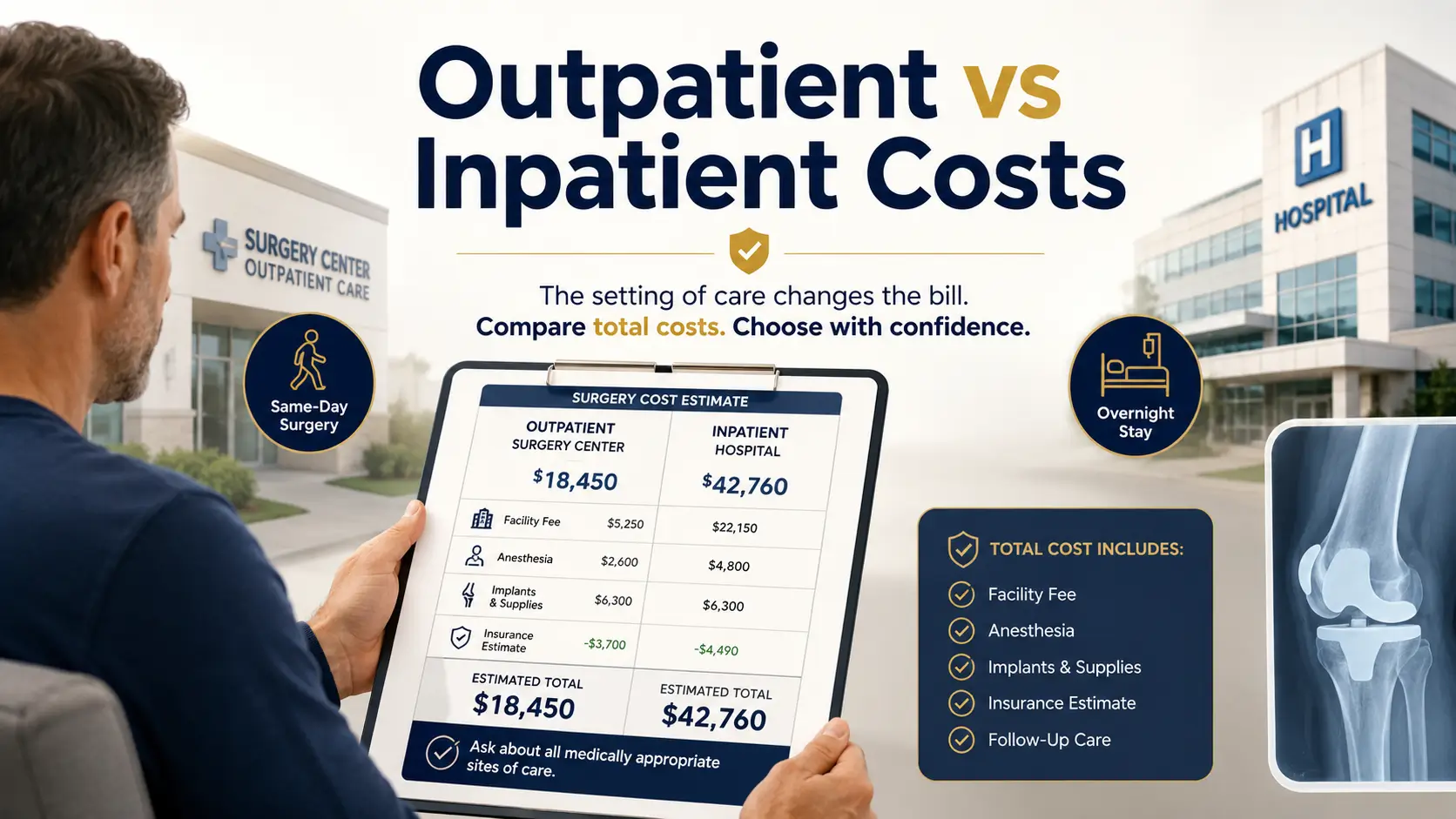
Outpatient vs Inpatient Orthopedic Surgery Cost: What Actually Changes Your Bill?
Outpatient orthopedic surgery is often the lower-cost setting, but “outpatient” is not a price tag. A procedure performed at an ambulatory surgical center can have a very different bill from the same procedure performed in a hospital outpatient department, even when you go home the same day.
Your actual cost depends on more than the surgeon’s fee. Facility charges, anesthesia, implants, imaging, pathology, network status, deductible, coinsurance, prior authorization, and post-surgery care can all move the final number.
This guide is U.S.-focused and helps you compare the financial side without turning a medical decision into a bargain hunt. The goal is to identify the safest clinically appropriate setting, then find out what that setting will actually cost you.
ASC, hospital outpatient, and inpatient are not financially interchangeable.
Check anesthesia, implants, facility fees, and other separate charges.
Turn a vague surgical quote into a usable out-of-pocket estimate.
The most useful comparison is not “inpatient or outpatient?” It is “what will this exact procedure cost at each medically appropriate site of care?”
Snapshot
Who this is for: U.S. patients comparing orthopedic surgery costs before scheduling a procedure.
Short answer: outpatient surgery can cost less, especially at an in-network ambulatory surgical center, but the difference varies by procedure, facility, insurance plan, and patient needs.
Important variable: staying overnight does not automatically mean you are an inpatient. Formal admission status matters.
What you can do next: compare total estimated patient responsibility across clinically appropriate facilities rather than comparing the surgeon’s fee alone.
Before you choose a cheaper setting
Cost should follow the clinical decision, not replace it. Your surgeon and medical team should determine which settings are appropriate based on the procedure, your health, anesthesia needs, expected recovery, and need for monitoring. Once you have medically reasonable options, confirm facility and provider network status, authorization requirements, and estimated patient responsibility with both the insurer and billing offices.
Table of Contents
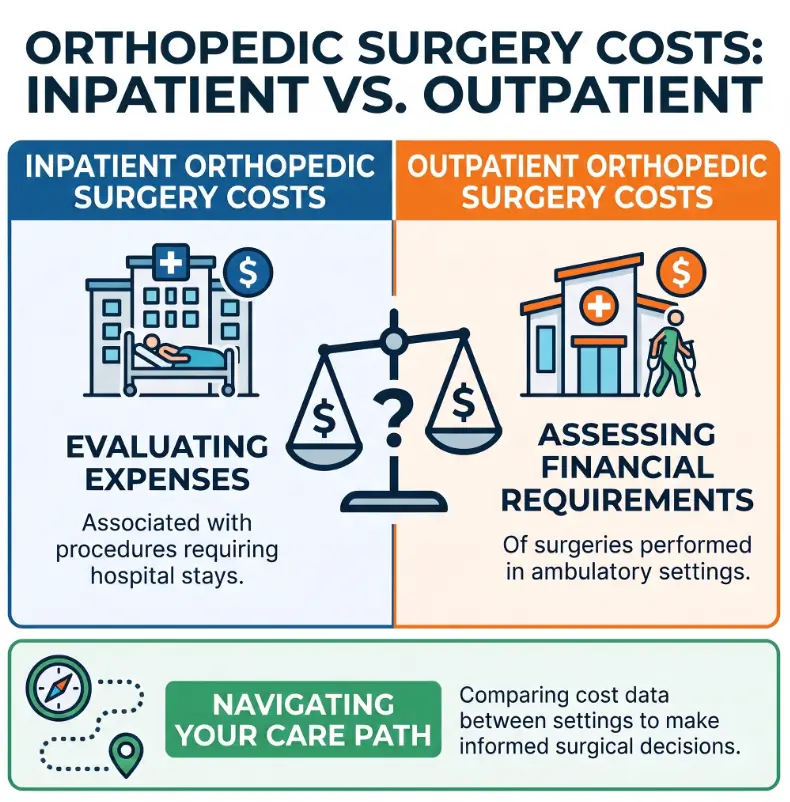
Is Outpatient Orthopedic Surgery Usually Cheaper?
Often, yes. When the same orthopedic procedure can safely be performed in more than one setting, outpatient care may reduce the facility-related portion of the bill. But that does not mean every outpatient surgery is cheaper than every inpatient surgery.
The first distinction to make is between clinical setting and billing status. You can have outpatient surgery in a hospital, spend a night there, and still be considered an outpatient if you were never formally admitted as an inpatient.
Medicare explains that inpatient status begins when a hospital formally admits you under a physician’s order. Observation services and outpatient surgery remain outpatient services even when an overnight stay is involved. You can review the current rule on the official Medicare inpatient versus outpatient status page.
Key takeaway
Do not ask only, “Will I stay overnight?” Ask, “Will I be formally admitted, and where exactly will the procedure be performed?” Those questions are much more useful for estimating cost.
The facility may matter more than the word “outpatient”
An outpatient orthopedic procedure might take place at a freestanding ambulatory surgical center, commonly called an ASC, or in a hospital outpatient department. Those facilities operate under different payment structures and may have very different negotiated rates.
Medicare even provides a Procedure Price Lookup tool that lets beneficiaries compare average costs for eligible outpatient services in ambulatory surgical centers and hospital outpatient departments. That comparison is a useful reminder that “outpatient” is a category containing more than one type of facility.
What Changes the Cost More Than the Inpatient or Outpatient Label?
The biggest financial variables are usually the exact procedure, site of service, insurance contract, network status, and the additional services bundled around surgery. Two patients can have procedures with similar names and face very different out-of-pocket costs.
- Procedure: arthroscopy, fracture repair, joint replacement, tendon repair, and spine surgery use different resources.
- Facility: ASC, hospital outpatient department, and inpatient hospital care are billed differently.
- Insurance contract: negotiated allowed amounts vary across plans and facilities.
- Deductible: someone early in the plan year may owe much more than someone who has already met most of the deductible.
- Coinsurance or copay: benefit design can change how much of the allowed amount becomes the patient’s responsibility.
- Network status: the facility, surgeon, anesthesiology group, and other professionals may not all share the same network status.
- Implants and supplies: hardware, prosthetic components, grafts, braces, or other items may change the total.
- Postoperative needs: therapy, home equipment, medications, imaging, or additional visits can increase the total episode cost.
Technical depth: why the same surgery can generate different payment structures
Medicare uses separate payment systems for inpatient hospital care, hospital outpatient departments, ambulatory surgical centers, and professional services. Commercial insurers also negotiate different contracts with different facilities and clinician groups.
A surgical episode can therefore produce multiple allowed amounts rather than one universal “price.” The facility may bill for operating-room resources, while the surgeon and anesthesiology group submit professional claims. Other services can generate additional claims depending on what was performed.
That is why comparing a surgeon’s quoted fee with a hospital’s facility estimate can create a false comparison. Before choosing between settings, ask for the estimated total patient responsibility across all expected components.
If you already have a quote, the companion guide on how to read an orthopedic surgery estimate can help you identify what has and has not been included.

ASC vs Hospital Outpatient vs Inpatient: How the Settings Compare
An ASC is generally the leanest surgical setting of the three, while a hospital provides a broader range of hospital resources. The right comparison is not which setting sounds more sophisticated, but which medically appropriate setting gives you the necessary care without unnecessary cost.
| Setting | Often fits | Cost tendency | Main limitation | What to verify |
|---|---|---|---|---|
| Ambulatory surgical center | Eligible procedures and patients expected to recover without inpatient admission | Often lower facility cost | Not every procedure or patient is appropriate | Procedure eligibility, network status, anesthesia, backup plan |
| Hospital outpatient department | Outpatient surgery needing hospital-based resources | Can be higher than an ASC | Hospital facility charges may be substantial | Total facility estimate and all participating providers |
| Inpatient hospital | Patients who require formal admission and hospital-level postoperative care | Potentially higher total resource use | More intensive setting than many routine outpatient cases require | Admission status, authorization, benefit structure, expected stay |
A safer way to shop for surgery
Ask which sites are medically appropriate for your procedure and health.
Verify the facility, surgeon, anesthesia, and authorization with your plan.
Compare expected total patient responsibility, not one line item.
For Medicare beneficiaries, ambulatory surgical centers are outpatient facilities covered under Part B when the procedure meets Medicare requirements. Medicare notes that the amount a beneficiary owes can depend on factors including other insurance, provider charges, assignment, facility type, and location. Current ASC information is available on Medicare.gov.
The choice of setting is becoming relevant for more orthopedic procedures. CMS finalized changes for 2026 that allow additional musculoskeletal procedures to be considered for hospital outpatient payment when clinically appropriate, while also expanding the list of procedures eligible for Medicare payment in ASCs. This does not mean every patient should move to an outpatient setting; it means site-of-care choice may exist in more cases.
How Insurance Changes the Outpatient vs Inpatient Cost
Your insurance benefit design can reverse what looks like an obvious price comparison. A facility with a lower total contracted price can still leave you owing more if it is out of network, subject to a different deductible, or billed under a benefit category with higher cost sharing.
Money moment #1: compare patient responsibility, not the hospital’s sticker price
Ask your insurer for your estimated out-of-pocket responsibility for the actual procedure at each candidate facility. A hospital’s published charge, an insurer’s negotiated allowed amount, and the amount you personally owe are three different numbers.
U.S. hospitals are required to make pricing information publicly available under federal hospital price-transparency rules. CMS describes both machine-readable pricing files and consumer-facing information for shoppable services on its Hospital Price Transparency page.
What to ask your insurer
- Is this exact orthopedic procedure covered under my plan?
- Is prior authorization required for the surgery or the specific facility?
- Is the facility in network?
- Is the surgeon in network at this specific facility?
- Can you verify the anesthesiology group or tell me how anesthesia claims are handled?
- What deductible remains?
- What copay or coinsurance applies to the facility and professional services?
- Would my cost-sharing rules change if the procedure were inpatient instead of outpatient?
- Are implants, postoperative braces, physical therapy, or home equipment subject to separate benefits?
- Can you give me a reference number for this call?
If authorization is a concern, use the orthopedic prior authorization checklist before assuming the surgery date means insurance approval is complete.
Medicare and Medicare Advantage are not identical cost questions
Original Medicare and Medicare Advantage can produce different administrative and cost-sharing questions. Medicare Advantage plans may use provider networks, prior authorization, and plan-specific cost sharing, so beneficiaries should check the plan rather than relying solely on Original Medicare rules.
If you use Medicare Advantage, the site’s Medicare Advantage orthopedic care guide covers the additional plan-level questions worth asking.
Do not assume “in network” is one checkbox
Verify the facility and the professionals involved. A surgery can involve separate organizations even when everyone works inside the same building.
What Should an Orthopedic Surgery Estimate Include?
A useful estimate should help you see the expected episode of care, not merely the surgeon’s professional charge. Ask the surgery scheduler or financial counselor which components are included and which will be billed separately.
Your pre-surgery estimate checklist
- Facility fee
- Surgeon’s professional fee
- Assistant surgeon, if expected
- Anesthesia professional charges
- Implants, hardware, grafts, or prosthetic components
- Imaging or image guidance associated with the procedure
- Laboratory or pathology charges if relevant
- Medications administered at the facility
- Postoperative brace, sling, walker, or other equipment
- Physical or occupational therapy
- Follow-up visits and whether they are included in the surgical payment arrangement
- Potential observation or overnight facility charges
Do not expect every item to appear on one estimate. Instead, your job is to identify the organizations likely to bill you and obtain estimates from the major ones.
Money moment #2: ask for both the allowed amount and your estimated share
If you have insurance, a cash quote alone may not tell you what you will owe under your plan. Ask the facility what it expects to bill your insurer and ask the insurer what your estimated patient responsibility will be after applying your current deductible and cost sharing.
If you are uninsured or intentionally self-paying, federal rules generally allow you to request a good faith estimate for scheduled care. CMS explains these protections through its No Surprises resources.
A simple request that improves the estimate
“Please tell me which charges this estimate includes, which providers may bill separately, and whether the amount shown is the total contracted cost or my estimated out-of-pocket responsibility.”
Where Separate Orthopedic Surgery Bills Usually Appear
Orthopedic surgery rarely behaves like buying one product from one seller. The facility, surgeon, anesthesiology group, and other professionals can submit separate claims, so a single prepayment does not necessarily mean the financial side is finished.
Anesthesia
Anesthesia is one of the easiest charges to overlook because patients often focus on the surgeon and hospital. If you are trying to reconcile an estimate, the guide to a separate anesthesia bill explains why that charge may arrive independently.
Facility fees
The building where surgery occurs is not financially neutral. A hospital outpatient department can generate a facility charge separate from professional services. If that term appears on your estimate, see the explanation of facility fees in orthopedic care.
Multiple providers
After surgery, you may see claims or bills from organizations whose names you do not recognize. Before paying, match each charge against the explanation of benefits and the care you actually received. The guide to orthopedic bills from multiple providers can help organize that process.
For people with employer or individual private health coverage, the federal No Surprises Act provides protections from certain unexpected out-of-network bills, including some ancillary services furnished at in-network facilities. Those protections are important, but they do not turn every separate bill into an error. Review the plan’s explanation of benefits before deciding whether a bill is valid.
When the Cheaper Outpatient Option May Be Enough
Spending more does not automatically buy a better orthopedic outcome. If your surgeon considers an outpatient setting appropriate and the less expensive facility is in network, equipped for the planned procedure, and able to provide the necessary postoperative care, a higher-priced hospital setting may offer little financial value for that specific case.
A lower-cost ASC becomes especially worth comparing when:
- Your surgeon says the procedure can appropriately be performed there.
- Your medical history does not require a higher level of hospital monitoring.
- The ASC is in network.
- The surgeon is in network at that location.
- You have clarified anesthesia and other expected professional services.
- Your insurer confirms the procedure and facility meet plan requirements.
- You have adequate transportation and recovery support at home.
The last point is easy to underestimate. Saving on the facility does not help much if your home situation creates avoidable problems after discharge. Depending on the procedure, you may also want to plan seating, mobility, bathroom access, meals, and help during the first part of recovery.
For example, someone preparing for knee surgery may find the site’s guide to the best type of chair after knee surgery useful when planning the home side of the decision.
When spending less is reasonable
If two settings are clinically appropriate, properly equipped, and covered by your plan, paying a higher facility price simply because one setting is attached to a hospital may not be necessary. Compare the actual benefits you are buying.
When a Higher-Cost Hospital Setting May Make Sense
A hospital setting may be the sensible choice when the medical team expects that you could need resources, monitoring, or postoperative care that a lower-intensity setting is not designed to provide. This is where individual health circumstances matter much more than a generic cost comparison.
Relevant considerations can include the complexity of the operation, significant coexisting medical conditions, anesthesia risk, anticipated blood loss, mobility after surgery, complications from prior procedures, and the likelihood that prolonged monitoring will be needed.
These are medical decisions rather than criteria patients should score on their own. A useful question for the surgeon is: “What specific clinical reason makes this setting safer or more appropriate for me?”
Money moment #3: paying more makes sense when the extra resources solve a real risk
The higher-cost option earns its price when you actually need what it provides. That may include hospital-level monitoring, access to additional specialties, treatment of a complication, or formal inpatient recovery. Paying more merely for the idea that “hospital equals better” is a weaker reason.
CMS’s 2026 outpatient policy changes likewise preserve physician judgment about the appropriate site of care. Expanded outpatient eligibility does not require a surgeon to use an outpatient setting for a patient who would be better treated as an inpatient.
Cost Mistakes That Can Turn a Planned Surgery Into an Expensive One
The expensive mistakes are usually not dramatic. They are small assumptions made before scheduling: assuming everyone is in network, assuming authorization is complete, or comparing two quotes that do not contain the same services.
| Mistake | Why it costs money | Safer move |
|---|---|---|
| Comparing surgeon fees only | Facility and anesthesia charges may dwarf the difference | Compare total expected patient responsibility |
| Assuming “outpatient” means ASC | Hospital outpatient departments can have different facility costs | Get the exact facility name and type |
| Checking only the surgeon’s network | Other providers may bill separately | Verify facility and major professional services |
| Assuming scheduling means authorization | A claim can still face coverage problems | Ask for authorization status and reference details |
| Choosing the cheapest site without asking the surgeon | The site may not fit your medical needs | Identify clinically appropriate settings first |
| Ignoring the deductible already paid | Your personal cost may differ from the quoted total price | Use your current benefit-year figures |
| Paying a bill before matching the EOB | You may pay before insurer adjustments are complete | Compare the bill, EOB, and estimate first |
The most common comparison error
One facility quotes an all-in estimate while another gives you only its facility portion. The second number looks dramatically cheaper until anesthesia, surgeon, implant, and other charges begin arriving.
Before comparing two numbers, ask both billing offices the same question: “What is excluded from this estimate?” That one sentence can rescue an otherwise useless comparison.
FAQ
Is outpatient orthopedic surgery always cheaper than inpatient surgery?
No. Outpatient surgery often uses fewer hospital resources, but your actual cost depends on the facility, negotiated insurance rates, deductible, cost sharing, network status, procedure, and separate professional charges.
Is an ambulatory surgical center the same as hospital outpatient surgery?
No. Both are outpatient settings, but an ASC is a distinct outpatient surgical facility while a hospital outpatient department operates as part of a hospital. Their payment structures and negotiated rates may differ.
Can I stay overnight and still be an outpatient?
Yes. Under Medicare rules, an overnight stay does not by itself make you an inpatient. Formal inpatient admission status is what matters.
Will my surgeon know exactly what I will pay?
Usually not. The surgeon’s office may know its own charges, but your final responsibility can involve the facility, insurer, anesthesia group, deductible, implants, and other services. The insurer and facility billing department are often necessary for a usable estimate.
Should I choose an ASC solely because it costs less?
No. First ask whether the ASC is medically appropriate for your procedure and health. Cost comparison becomes useful after the clinical options are clear.
Can anesthesia be billed separately from orthopedic surgery?
Yes. Anesthesia professional services can appear as a separate claim or bill, depending on how the organizations involved bill and contract with your insurer.
What if I cannot afford my estimated portion?
Ask the hospital or surgical facility about financial assistance, payment arrangements, and the timing of required deposits before placing medical bills on high-interest credit. If installment arrangements are being considered, the guide to orthopedic payment plans explains useful questions to ask first.
Should I compare cash prices even if I have insurance?
It can be worth asking, particularly with a high deductible, but do not compare the cash price with your insurance price without checking the consequences. A self-pay amount may not count toward your deductible or out-of-pocket maximum, and plan rules vary. Confirm that tradeoff before choosing how to pay.
Your 15-Minute Orthopedic Surgery Cost Check
You do not need to understand medical billing from top to bottom before making a better decision. Fifteen focused minutes can expose most of the questions that matter.
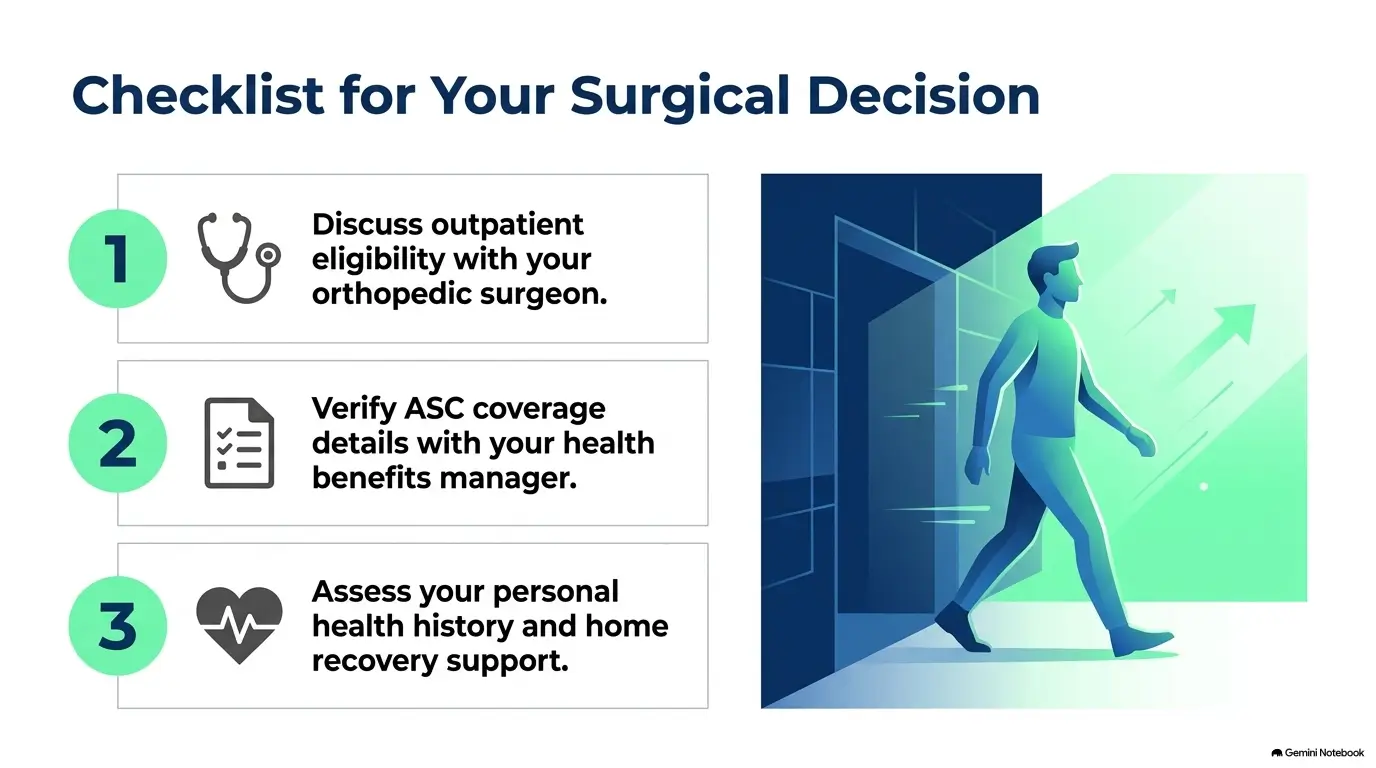
- Write down the exact procedure and proposed facility. Do not settle for “knee surgery at the hospital.”
- Ask the surgeon which other settings are medically appropriate. If there is no alternative, you have your answer.
- Call the insurer. Confirm coverage, authorization, facility network status, surgeon network status, deductible remaining, and expected cost sharing.
- Call the facility. Ask for your estimated responsibility and a list of major charges excluded from the estimate.
- Ask about separate providers. Anesthesia is the obvious one, but not necessarily the only one.
- Write the numbers side by side. Compare patient responsibility, not published charges or isolated professional fees.
The decision in one sentence
Choose among the settings your medical team considers appropriate, then compare the full financial picture: facility, providers, coverage, authorization, deductible, cost sharing, and the care you may need after you leave.
Last reviewed: 2026-09
Targeted editorial update: October 21, 2026. Added a topic-specific follow-up record and recheck triggers, revised the title and search description, and removed unverified first-person claims or clarified selected wording where found. The existing body was retained. This update is not a complete legal, coverage or clinical review; confirm current rules and individual decisions with the relevant official source or service.