

Walker Safety Guide
Why Turning Around Is Risky With a Walker and How to Make Each Turn Safer
Walking straight can feel manageable. Then a corner, chair, bathroom doorway, or ringing phone asks the body to change direction, and several quiet tasks suddenly arrive together: redirect the walker, shift weight, place both feet, scan the room, and stay upright.
That is why turning is often the moment when a seemingly steady walker user begins to shuffle, twist, cross the feet, or let the device drift away. The walker has not stopped helping. The movement has simply become more demanding than forward walking.
This guide breaks a safer turn into visible, repeatable pieces. It also explains when equipment adjustment, home changes, caregiver training, or professional assessment may be more useful than practicing harder.
See the hidden risk
Understand why a turn asks more of balance than a straight path.
Use a staged sequence
Replace spinning and twisting with smaller, controlled changes of direction.
Know when to stop
Recognize equipment problems, new symptoms, and situations needing professional help.
The central idea: a safer turn is not a spin. It is a short series of calm, aligned steps. 🧭
Snapshot
Who this is for: older adults, rehabilitation patients, family caregivers, and home-health aides using a standard walker, front-wheeled walker, or rollator. What it solves: unstable pivots, tangled feet, walker drift, and risky chair or bathroom turns. What comes next: you will be able to identify the weak point in a turn, improve the surrounding space, and decide whether supervised training is needed.
Table of Contents
Before You Practice: Know When General Advice Is Not Enough
Before You Act
This article offers general fall-prevention education. It cannot determine the correct technique for a particular surgery, neurological condition, amputation, weight-bearing restriction, medication effect, or walker design. Confirm important movement changes with a physical therapist, occupational therapist, surgeon, rehabilitation clinician, or other qualified professional who can observe the person and fit the device.
Who can use this guide as a starting point
This guidance is most useful for adults who already use a walker and want to understand why corners, chair transfers, and turnarounds feel less steady than walking down a clear hallway.
It can also help caregivers notice specific movement patterns. “She looks nervous when she turns” is difficult to act on. “Her shoulders turn before her feet, and the walker ends up beside her” gives a clinician something concrete to assess.
- Adults using a standard, two-wheeled, or four-wheeled walker
- People rebuilding mobility after hospitalization or orthopedic treatment
- Caregivers preparing a safer route between the bed, bathroom, kitchen, and chair
- Walker users who feel steady going forward but hesitate when changing direction
Situations that need personal instruction
Do not experiment with a new turning method alone when the person has been told to keep weight off a leg, limit hip rotation, protect a healing joint, or follow a procedure-specific sequence. Instructions that are sensible for one patient can be unsafe for another.
- New dizziness, fainting, confusion, weakness, numbness, or visual disturbance
- Recent hip, knee, foot, ankle, spine, or lower-limb surgery
- Partial, toe-touch, or non-weight-bearing restrictions
- Parkinson’s disease, stroke, neuropathy, amputation, severe arthritis, or significant cognitive changes
- A walker that tips, catches, rolls away, or does not fit through the intended space
- A need for hands-on assistance every time the person turns
A 60-second turning risk screen
Observe one ordinary turn without coaching first. Stand close enough to help only if you have been trained to guard the person safely.
- Does the walker move far ahead or to one side?
- Do the feet cross, collide, or become trapped near the rear legs or wheels?
- Does one foot stay planted while the torso rotates?
- Does the person grab furniture instead of using the planned support?
- Does the walker continue rolling after the person slows down?
- Does the person hold their breath, rush, freeze, or show new pain?
One “yes” does not diagnose a problem. It identifies the part of the turn worth discussing at the next rehabilitation or medical appointment. The site’s walker appointment checklist can help organize those observations before the visit.
Key Takeaway
The safest general advice is not “turn exactly this way.” It is “use a clinician-taught method, keep the turn small and staged, and stop when symptoms or equipment behavior change.”
Why Turning Around With a Walker Feels So Different
Straight walking keeps the movement predictable
During forward walking, the walker, feet, head, and body generally travel toward the same destination. The user can repeat a familiar rhythm: place or roll the walker, step into its support area, regain balance, and continue.
The path may still be demanding, but the direction is clear. The body is not being asked to rotate while also deciding where each foot should land.
Turning creates several moving targets at once
A turn changes the job. The walker must point toward a new path. The feet must reposition. The trunk and head rotate. Vision shifts from the floor immediately ahead to the new destination. Weight moves from one side to the other, often while the available floor space becomes smaller.
That combination is why a person may appear stable in a hallway yet lose control near a chair or bathroom door. The problem is not necessarily overall walking ability. It may be the timing and coordination required to change direction.
Sideways balance can become the weak link
Research examining real-world falls among older walker users found that sideways falls during turning and backward falls during weight transfer were prominent patterns. The researchers also identified maneuverability, lateral stability, and wheel-speed control as contributing design concerns. :contentReference[oaicite:0]{index=0}
This does not mean walkers cause every fall. It means the device must remain correctly positioned while the body changes direction. When the walker angles away, rolls too quickly, or cannot move smoothly through the available arc, the user may not have enough time or space for a recovery step.
The walker supports only where it is positioned
A walker is not a movable safety wall. Its support is most useful when the frame is stable, the user remains appropriately positioned relative to it, and the hands are available for the intended grip.
Support drops when the walker is lifted awkwardly, pushed beyond comfortable reach, dragged sideways, or allowed to roll faster than the person can follow. Confidence may remain high for another second, but the useful base of support has already wandered away.
Show me the nerdy details
A turn combines rotational movement with side-to-side weight transfer. The body’s center of mass must remain controllable while the base of support changes shape and direction beneath it.
A fast pivot may leave one foot fixed while the trunk rotates. A crossover step briefly narrows the usable base between the feet. An overextended walker places the hands and support farther from the body, increasing the need to lean or reach.
Small steps do not remove all risk, but they divide one complex movement into several smaller balance problems. Each brief stop offers a chance to realign the walker, feet, and body before continuing.
The Safer Small-Step Turning Sequence
Many clinical instructions use a staged turn: slow down, move the walker a small distance toward the new direction, move the feet without twisting or crossing, and repeat until the walker and body face the destination.
The exact sequence may change according to walker type, surgery restrictions, and which leg is stronger. Treat the steps below as a framework to discuss and practice with a qualified clinician, not as a substitute for personal training.
The small-step turn in four parts
01 · SLOW
Reduce speed while still moving straight. Do not wait until balance is already changing.
02 · POINT
Reposition the walker a small amount toward the destination without overreaching.
03 · STEP
Let both feet follow through short steps. Avoid planting, spinning, or crossing.
04 · SETTLE
Pause when the walker, feet, and body face the same direction.
1. Slow down before the corner
Reduce speed while the path is still straight. Braking halfway through a turn can create a mismatch between the walker’s motion and the user’s momentum, especially with a rollator.
A useful cue is, “Finish the straight walk first.” This creates a small moment to look toward the destination, check the available space, and prepare the feet.
2. Move the walker only a small amount
The walker should begin pointing toward the new direction without being pushed far beyond comfortable reach. A large sweeping movement may tempt the user to lean after it or twist inside the frame.
Hospital guidance for walking frames commonly recommends turning in stages, placing the frame a small way around, and avoiding overreaching. :contentReference[oaicite:1]{index=1}
3. Let the feet follow the new direction
Use enough short steps for both feet to change direction. The goal is not to complete the turn in the fewest steps. The goal is to avoid twisting, crossing, rushing, and standing with the upper body facing somewhere the feet do not.
A caregiver may say, “Walker a little, feet a little.” That brief cue is often easier to process than several instructions delivered while the person is already moving.
4. Pause when everything is aligned
Do not immediately begin another task. Stop when the walker, toes, knees, hips, and chest are generally facing the destination. Check that the device is stable and that neither foot is caught near a tip, wheel, or rear leg.
This pause matters before approaching a chair, reaching for a door, or entering a narrow bathroom. The turn is complete only when the person is stable enough to begin the next movement.
Key Takeaway
Think of a turn as a short staircase laid flat on the floor. Each small step creates a new stable position before the next one begins.
Walker-Turning Mistakes That Quietly Shrink Stability
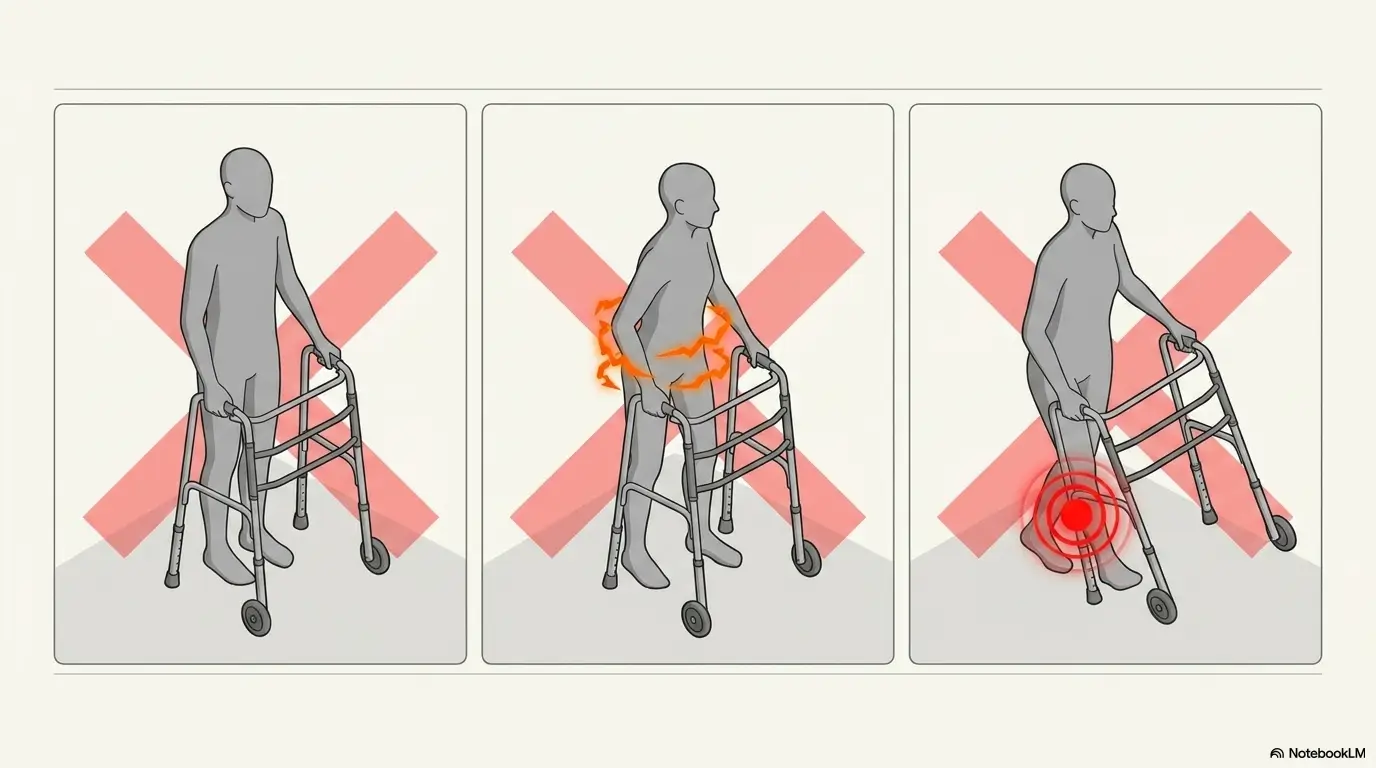
Pivoting on one planted foot
A quick pivot looks efficient, but it can leave one foot fixed while the rest of the body rotates. That reduces the opportunity to make a sideways recovery step and may conflict with instructions after certain orthopedic procedures.
The safer general pattern is to move the feet around the turn rather than winding the torso over a planted leg. Anyone with surgical precautions should use the method taught by their rehabilitation team.
Turning the shoulders before the feet
The eyes and shoulders often hurry toward the destination. The feet, less enthusiastic members of the committee, may remain pointed forward. The result is a twisted position with the walker in one direction and the base of support in another.
Use a simple checkpoint: after every small repositioning step, ask whether the toes are beginning to face the same way as the walker.
Crossing or tangling the feet
Crossover steps briefly narrow the space between the feet and make rapid correction harder. Shuffling can also place a shoe against a walker tip, rear leg, or wheel.
Watch for heel-to-toe contact, one foot wrapping behind the other, or a shoe repeatedly clipping the same part of the frame. These are useful observations to record, not merely habits to scold away.
Turning while carrying, talking, or rushing
Bathroom urgency, a barking dog, a phone, a caregiver’s rapid instructions, or a plate balanced in one hand can divide attention at exactly the wrong moment. A walker cannot provide its intended support when one or both hands are busy with another task.
Plan carrying separately. A walker tray, secured basket, caregiver assistance, or staged delivery may be appropriate depending on the device and clinician’s advice. Never add an accessory that changes stability or blocks safe use without checking compatibility.
| Common mistake | What it changes | Safer alternative to discuss or practice |
|---|---|---|
| Fast pivot | Leaves little time to reposition the feet | Use several short steps |
| Walker pushed far ahead | Encourages leaning and reaching | Move the device a small distance |
| Shoulders turn first | Twists the body over feet facing elsewhere | Let both feet follow the walker |
| Feet cross | Narrows the usable base of support | Use uncrossed, compact steps |
| Looking only at the floor | Hides the destination and nearby obstacles | Alternate foot-placement checks with forward scanning |
| Carrying an object | Removes a hand from the walker | Use a clinician-approved carrying setup or ask for help |
Caregiver Cue Card
Before: “Slow and look.” During: “Walker a little, feet a little.” After: “Pause. Are everything and everyone facing the same way?”
The Walker Type Changes the Turn
A technique learned with one device should not automatically be transferred to another. A standard walker must be lifted. A two-wheeled walker rolls forward but may not correct sideways easily. A rollator turns smoothly but can continue moving after the user slows.
Standard walkers require lift-and-place control
A standard walker has four non-wheeled contact points. Turning commonly requires repeated lifting and placing of the frame. This can be difficult for someone with limited arm strength, shoulder pain, poor coordination, fatigue, or a restriction on how much weight can be placed through a leg.
Lifting too high can disturb balance. Barely clearing the floor can cause a tip to catch. The frame should not be swung in a large arc or used as a handle for pulling the body around.
Two-wheeled walkers may resist sideways correction
Front wheels support forward rolling, while rear tips add friction. That combination can make straight walking easier, but a hurried sideways drag may catch the rear tips or angle the device unpredictably.
Small staged changes of direction are often more controllable than trying to force the frame sideways. Worn rear tips, mismatched wheel behavior, or an uneven floor can make the problem more noticeable.
Rollators add wheel speed and brake decisions
A four-wheeled rollator may maneuver more freely, but free movement creates another task: controlling speed. The device can begin turning before the feet are ready or continue rolling while the user is trying to settle.
Brake use varies by activity, device, and individual instruction. Do not invent a mid-turn brake routine. Ask a therapist or supplier to demonstrate normal slowing, parking brakes, cable adjustment, and what to do on slopes or uneven flooring.
A practical walker-turning comparison
| Walker type | Turning challenge | What to verify | Who should assess problems |
|---|---|---|---|
| Standard walker | Repeated lifting and precise placement | Height, tip condition, arm strength, floor clearance | Physical therapist or occupational therapist |
| Two-wheeled walker | Forward rolling with limited sideways movement | Rear-tip wear, wheel alignment, frame width | Therapist or durable medical equipment provider |
| Rollator | Wheel speed, turning radius, and brake control | Brake response, wheel condition, seat-lock instructions | Therapist and qualified equipment provider |
The least expensive device is not automatically the best value, and the most feature-heavy model is not automatically safer. The correct walker should match the user’s strength, balance, cognition, walking pattern, body dimensions, and home environment.
Chairs, Bathrooms, and Tight Spaces Need Their Own Plan
The final two steps before sitting
A chair creates a false sense of arrival. Once the back of the legs touches the seat, the person may reach backward, release the walker too early, or begin sitting before the feet and body are stable.
Clinical walking-frame guidance commonly describes approaching the chair closely, turning in stages, feeling the chair behind the legs, then moving the hands one at a time to stable chair arms before lowering under control. The individual’s own transfer instructions take priority. :contentReference[oaicite:2]{index=2}
Key Takeaway
Feeling the chair behind the legs is a position check, not permission to collapse backward. The feet, hands, chair, and walker still need a controlled plan.
Bathroom turns combine several hazards
Bathrooms add urgency, wet flooring, narrow doorways, clothing management, low seating, and tempting fixtures that may not be designed to support body weight. A person may leave the walker outside because it does not fit, then reach from the door to the sink or toilet.
Measure the route rather than assuming it works. Check whether the walker can enter, turn, and position near the toilet or shower without striking the door, vanity, waste bin, or bath mat. The guide to bathroom doorway fall risks offers a room-specific inspection list.
Bedroom and kitchen turns hide ordinary obstacles
In a bedroom, the turning arc may be interrupted by a bed corner, nightstand, loose blanket, oxygen tubing, charging cable, pet bed, or pair of slippers. A walker user who cannot complete the turn may begin “furniture walking,” moving hand to hand across unstable surfaces.
That pattern deserves attention. Read the guide to furniture walking and fall risk if the walker is routinely abandoned near beds, counters, or doorframes.
In a kitchen, carrying, opening an appliance, and reaching across a counter can remove one or both hands from the device. A walker-friendly kitchen setup should reduce the number of turns and keep frequently used items between comfortable waist and shoulder height.
Create a dedicated turning pocket
A turning pocket is an uncluttered patch of floor large enough for the walker and both feet to change direction without clipping furniture. It does not need a special product. It needs honest measurements and the removal of objects that have quietly occupied the floor.
- Move baskets, decorative stools, floor lamps, and small tables out of the arc
- Secure or remove loose rugs and curling mat edges
- Route cords and tubing away from the walker path
- Improve lighting at corners and between the bed and bathroom
- Keep pets outside the practice area
- Park the walker where it can be reached without twisting or furniture walking
Use the walker path safety checklist for the full route, then choose a reliable walker parking spot at home so the device does not become an obstacle when it is not in use.
Short Story: The Chair That Arrived Too Soon
Martin could cross his living room with his front-wheeled walker without difficulty. The trouble appeared at his armchair. As soon as he felt the cushion behind his knees, he released one handle, twisted his shoulders, and dropped the final few inches.
His daughter thought the chair was too low. A therapist noticed something else: the side table blocked the walker’s turning arc. Martin was trying to fit his body into a turn the room would not allow.
They moved the table, marked a wider approach, and practiced stopping after the turn before reaching for the chair arms. Nothing expensive was purchased. The improvement came from separating “turn” from “sit.”
The lesson was quiet but useful: when a movement repeatedly fails in the same location, inspect the location as carefully as the person.
Fit, Maintenance, and Home Setup: What Is Worth Paying For
Start with fit and basic mechanical condition
A poorly fitted walker can encourage bent posture, overreaching, shoulder strain, or standing too far inside or outside the frame. Loose hardware, worn tips, dragging brakes, damaged wheels, or a frame that no longer sits evenly can make turns inconsistent.
Do not rely on a generic height chart alone. Shoe height, arm length, posture, hand function, diagnosis, and weight-bearing instructions can all affect fitting. A therapist can assess the device while the person performs actual tasks rather than merely standing beside it.
Free fixes versus paid professional help
Many hazards can be reduced without buying anything: move a table, remove a loose rug, improve the route, stop carrying objects, slow the cueing, or practice at a quieter time of day.
Paid help becomes more reasonable when the cause is unclear, the person has fallen, the device behaves unpredictably, surgery restrictions apply, or the home has several difficult transfers. A physical therapist may focus on gait and turning. An occupational therapist may examine bathroom access, furniture placement, daily tasks, and equipment use in the home.
| Setup level | What it includes | Best suited to | Important limit |
|---|---|---|---|
| Good: no-cost reset | Clear the route, improve lighting, remove rugs, reduce distractions | A stable user with an already fitted walker and no new symptoms | Does not correct poor technique or unsuitable equipment |
| Better: equipment review | Height check, tip and wheel inspection, brake testing, accessory review | A walker that catches, rolls unevenly, or no longer feels predictable | A supplier may not assess the person’s full movement pattern |
| Best: in-person mobility assessment | Turning, transfers, gait, strength, home tasks, symptoms, and device selection | Falls, near-falls, recent surgery, neurological conditions, or caregiver assistance needs | Coverage, referral, and visit availability vary |
Questions to ask before paying for equipment or services
- Will the person be observed turning, sitting, and entering the bathroom?
- Does the assessment include the current walker rather than assuming a replacement is needed?
- Who will adjust the device, and what training do they have?
- Will the clinician review weight-bearing or surgical precautions?
- Can a caregiver receive safe cueing or guarding instruction?
- Is a home visit needed, or can measurements, photographs, and videos support an office visit?
- What repairs or replacement parts are available for the current device?
- What portion may be covered by insurance, and what requires prior authorization or a prescription?
Avoid spending money on trays, bags, glides, larger wheels, or replacement walkers until compatibility and stability are confirmed. An accessory that solves carrying may also widen the device, shift weight, interfere with folding, or block brake cables.
Key Takeaway
Spend first on understanding the problem. A new walker cannot fix a blocked turning space, rushed cueing, sudden dizziness, or a technique that has never been taught.
When Turning Trouble Signals a Bigger Mobility Problem
New difficulty matters more than familiar slowness
A person who has always turned slowly may simply be using a careful strategy. A person who suddenly begins veering, freezing, buckling, dragging a foot, becoming confused, or needing furniture support deserves prompt attention.
Possible contributors include pain, weakness, infection, dehydration, low blood pressure, medication effects, vision changes, neurological symptoms, fear after a near-fall, or a mechanical problem with the walker. General practice should not be used to test whether a sudden symptom disappears.
Separate an equipment problem from a skill or symptom problem
Repeated hesitation at the same doorway may point to insufficient clearance. Difficulty everywhere may suggest fitting, balance, strength, pain, or coordination issues. A rollator pulling ahead on every turn may need brake or wheel inspection. A standard walker catching on one side may have worn or uneven tips.
Record where the problem occurs, what the walker does, which foot moves first, whether pain or dizziness appears, and whether time of day matters. That information helps a clinician distinguish a room problem from a broader mobility change.
Contact a clinician or therapist promptly when
- Turning has become noticeably harder or less coordinated
- The walker repeatedly tips, slides, catches, or rolls away
- The person has fallen or nearly fallen more than once
- Pain, numbness, weakness, dizziness, or a medication change affects walking
- The person cannot turn without grabbing furniture
- A recent procedure or injury changed weight-bearing instructions
- A caregiver must pull, steer, or physically rotate the walker
- Fear of turning is causing the person to avoid essential movement
The CDC recommends discussing fall risk with healthcare professionals and addressing factors such as home hazards, footwear, vision, medications, strength, and balance. Its patient and caregiver materials also emphasize clearer floors and improved lighting. :contentReference[oaicite:3]{index=3}
After a fall, do not automatically pull the person up
First check for immediate danger, severe pain, deformity, bleeding, head impact, confusion, weakness, breathing difficulty, or inability to move normally. Call emergency services for life-threatening symptoms, loss of consciousness, breathing difficulty, signs of stroke, serious bleeding, or suspected major injury.
A head impact deserves particular caution in someone taking an anticoagulant or other blood-thinning medicine. MedlinePlus advises contacting a clinician after a fall or injury, especially after hitting the head, for medicines such as apixaban or warfarin. :contentReference[oaicite:4]{index=4}
Do not use the walker as a lifting handle. Keep the person comfortable, avoid unnecessary movement when a serious injury is possible, and obtain appropriate assistance. Caregivers should learn a post-fall plan before an incident, not improvise one from the floor.
For a wider review of symptoms, medications, home conditions, and mobility changes, see the guide to fall risk in older adults.
Key Takeaway
A sudden change in turning is not a practice problem until medical, medication, vision, pain, and equipment causes have been considered.

FAQ About Turning Around With a Walker
Should you pivot when using a walker?
A fast pivot is generally less controlled than turning through several small steps. It can leave one foot planted while the body rotates. Individual instructions may differ after surgery, amputation, or with a neurological condition, so use the technique taught for the person and device.
Should the walker move first during a turn?
Many staged-turn methods involve moving the walker a small distance toward the destination and then moving the feet to follow while remaining appropriately positioned. The exact order may change according to the walker, stronger leg, weight-bearing status, and therapist’s instructions.
Can you turn a walker sideways?
Do not drag a walker sideways as a shortcut unless a qualified clinician has taught that movement for the specific device. Wheels and tips may not move or stabilize effectively in that direction, and the frame may catch or angle away.
How many steps should a walker turn take?
There is no universal number. Use enough short steps to avoid twisting, crossing the feet, overreaching, or allowing the walker to drift away. A larger person, narrower room, painful joint, or different walker may change the number required.
Is a rollator safer for turning than a regular walker?
Not automatically. A rollator may turn smoothly, but the wheels can continue moving and require reliable speed and brake control. A standard walker does not roll away as easily, but it demands lifting and placement. Device selection should match the user rather than a general ranking.
Why do I lose balance when turning but not walking straight?
Turning requires rotational movement, side-to-side weight shifting, visual redirection, foot repositioning, and walker control at the same time. A clinician can assess whether the difficulty comes from technique, balance, pain, weakness, vision, medication effects, or the device.
Should I look down at my feet while turning?
A brief check of foot placement may help, but staring downward throughout the turn can hide the destination, furniture, pets, and doorway edges. Many people need a balanced strategy that combines short foot checks with forward scanning.
Can a caregiver pull the walker around for the user?
Pulling or steering the walker without coordination can destabilize the user. When hands-on assistance is needed, the caregiver should receive instruction on positioning, cueing, guarding, transfers, and when not to attempt the movement alone.
Practice One Supervised Quarter-Turn Today
Prepare the area in five minutes
Choose a clear, dry, level, well-lit area with enough room for a 90-degree turn. Remove rugs, cords, pets, movable furniture, and carried objects. Use the person’s usual secure footwear and correctly fitted walker.
- Confirm that no new pain, dizziness, weakness, or medical symptoms are present
- Inspect wheels, tips, brakes, handgrips, and folding joints
- Place a stable destination in view without creating a reaching task
- Use supervision appropriate to the person’s assessed needs
- Stop if the walker catches, accelerates, tips, or moves unpredictably
Practice 90 degrees, not a full circle
- Walk straight toward the turning point and slow down before reaching it.
- Pause long enough to identify the destination and available space.
- Reposition the walker a small amount using the clinician-taught method.
- Move both feet through short, uncrossed steps so they follow the new direction.
- Repeat only as needed until the walker, feet, and body face the same way.
- Pause in a stable position before walking, reaching, or sitting.
Ask one diagnostic question
After the turn, ask: “Did the walker, my feet, and my body finish facing the same direction?”
If the answer is no, do not chase perfection through repeated unsupervised attempts. Record what moved first, where the walker ended, and whether a foot crossed or caught. Bring those notes, and a photograph of the turning space if appropriate, to a therapist or clinician.
Stop immediately if control fades, pain rises, a knee buckles, a foot freezes, breathing becomes difficult, the walker accelerates, or dizziness appears. The goal is not to conquer a full turn today. It is to make one quarter-turn understandable.
Your 15-minute next step
Inspect one frequently used turn, such as the approach to a favorite chair or bathroom doorway. Clear the turning pocket, watch one supervised quarter-turn, and write down the first moment when the walker, feet, and body stop moving together. That single observation is more useful than repeating “be careful” all week.
Last reviewed: 2026-08