

A pain clinic vs orthopedist comparison is useful when it compares the actual clinician, assessment, services and follow-up. Both fields diagnose and treat. A clinic name does not tell you whether a particular clinician addresses your question, which services are included or who will coordinate the next step. This guide helps you collect actual answers without assigning a “best specialty” score.
Use the six essential service checks, the actual-service comparison table, two fictional writing examples, or the service comparison, real-answer and care-handoff record. Its distinct purpose is to connect what a service says it offers with what was booked, actually received and handed back to the care team.
Needed assessment must not wait for clinic comparisons, records or insurance replies. With back pain, new difficulty urinating or loss of bladder/bowel control, loss of feeling around the genitals or anus, symptoms such as weakness or numbness in both legs, chest pain or pain after a serious accident need emergency assessment. Use appropriate local emergency services, including 911 for U.S. emergencies. These are selected examples, not a complete triage list. NHS back-pain warnings.
Sudden severe joint pain with swelling, heat, colour change or difficulty moving needs urgent assessment; fever may be absent. Do not wait for a routine specialist booking. New or worsening weakness also needs appropriate prompt assessment rather than an automatic switch between clinics. NHS joint-infection guidance. This tool cannot diagnose a cause or decide urgency.
This is U.S.-focused, caregiver-written education, not individual medical, insurance or financial advice. The operator is not a medical professional. Relevant clinicians assess clinical needs; offices and plans explain their actual access and payment conditions. The NHS sources support selected symptom education, not U.S. referral rules. You can ask for care and help with incomplete notes.
Table of Contents
Pain clinic vs orthopedist: six essential service checks
| Check | Actual fact to record | Question to ask |
|---|---|---|
| 1. Question and current care | Remaining question, actual referral reason and instructions already received. | What assessment or decision is the next service meant to help with? |
| 2. Named clinician and expertise | The clinician, relevant training and actual areas of practice. | Does this clinician evaluate this type of concern? |
| 3. Assessment and service scope | What the visit includes; direct services versus outside referrals. | Is this an assessment, treatment review, procedure visit or another defined service? |
| 4. Access and records | Actual referral, existing records, receiving access and booking conditions. | Which requirements apply to this exact clinician, site and service? |
| 5. Actual answer and visit | Who answered, source, scope, booking and assessment actually received. | What is confirmed, and what remains unknown? |
| 6. Follow-up and handoff | Actual owners for results, medicines, reassessment and coordination. | Who will explain the plan and respond when it needs review? |
These are comparison categories, not six mandatory clinical steps or an eligibility checklist. An unanswered question is not a reason to postpone assessment. No particular specialty, scan, injection, waiting period or payment route follows from completing the checks. Actual care may involve more than one professional working together.
What overlaps, and what a clinic label cannot tell you
AAOS describes orthopaedic care as including diagnosis, medication, injections, bracing, surgery, rehabilitation and prevention. Orthopedists may focus on particular body regions or conditions. Seeing one does not by itself mean surgery is planned. Their roles cannot be reduced to finding a structure while leaving all symptom management to someone else.
ABMS describes pain medicine within PM&R as diagnosing and treating acute or chronic pain and coordinating care with other specialists. That is one professional scope description, not a guarantee about every pain clinic or every clinician’s training. Ask about the actual clinician and service rather than assuming that persistent pain no longer needs assessment or that pain medicine requires an orthopedic visit first.
AAPM&R describes rehabilitation medicine as addressing function and quality of life across a range of conditions. Primary care, sports medicine, rehabilitation medicine, neurology, rheumatology or other services may also be relevant according to the clinical question. This page does not add them to a universal referral ladder or choose among them from symptoms alone.
| Label or assumption | More useful distinction | Actual-service question |
|---|---|---|
| “Orthopedist means diagnosis or surgery” | Assessment, nonsurgical treatment, rehabilitation and surgery can overlap within orthopedic care. | What does this clinician evaluate and offer for the question already identified? |
| “Pain clinic means symptom control after diagnosis” | Pain medicine also evaluates painful conditions and may work with other clinicians. | Does the proposed service include assessment and ongoing review, or a narrower visit? |
| “A multidisciplinary clinic provides everything in one place” | Team composition, direct provision and outside referrals vary. | Which professionals and services are actually available, and who coordinates them? |
| “Known diagnosis means no further reassessment” | An earlier explanation does not answer every new or changing concern. | What does the treating team advise about this unresolved or changing question? |
| “The fastest or cheapest visit is automatically the best fit” | Availability, actual scope, clinical needs and cost conditions answer different questions. | What can be confirmed about the service without delaying needed care? |
Do not classify your own pain as structural, nerve-related or “only chronic” to select a clinic. Describe existing experiences and questions, then ask the appropriate clinician about assessment. A burning sensation, movement trigger, injury date or pain duration alone does not identify a diagnosis or the correct specialty.
Actual-service comparison table: ask both services the same questions
Use service A and service B as matching labels. Write an actual reply, its source and any uncertainty in each column. A clinic website can describe advertised services; an office can explain its booking arrangements; individual clinical advice requires the relevant professional. Keep those sources distinct. Neither a blank field nor a detailed advertisement ranks the service.
| Comparison item | Service A: record actual answer | Service B: record actual answer |
|---|---|---|
| Clinician and relevant practice | Name/role, relevant expertise and confirming source; otherwise unknown. | Use the same fields; do not infer expertise from the clinic name. |
| Assessment scope | What this specific visit includes and which question it can address. | Assessment, review or procedure scope actually explained. |
| Treatment configuration | Medicines, rehabilitation, psychological support or procedures actually offered. | Record direct provision, external referral or unavailable; not a recommendation. |
| Records and referral | Actual requirements; reports/images sent and receipt confirmed. | Record what this service needs, not what the other office required. |
| Booking and cost conditions | Exact clinician, site, service and quote/coverage source. | Same scope where possible; keep differing conditions visible. |
| Results and medicine owner | Who explains tests and manages the actual medicine plan, if applicable. | Actual agreement or unresolved; no assumption of transfer. |
| Reassessment and coordination | Who reviews benefit, burdens, new concerns and onward referrals. | Follow-up and handoff owner actually identified. |
This table compares confirmed information, not treatment effectiveness, safety or professional quality. Do not add points for more procedures, more staff, an MRI requirement or a shorter wait. A focused service may be appropriate for a defined question; a broad service description does not guarantee access to every treatment or coordination with your existing team.
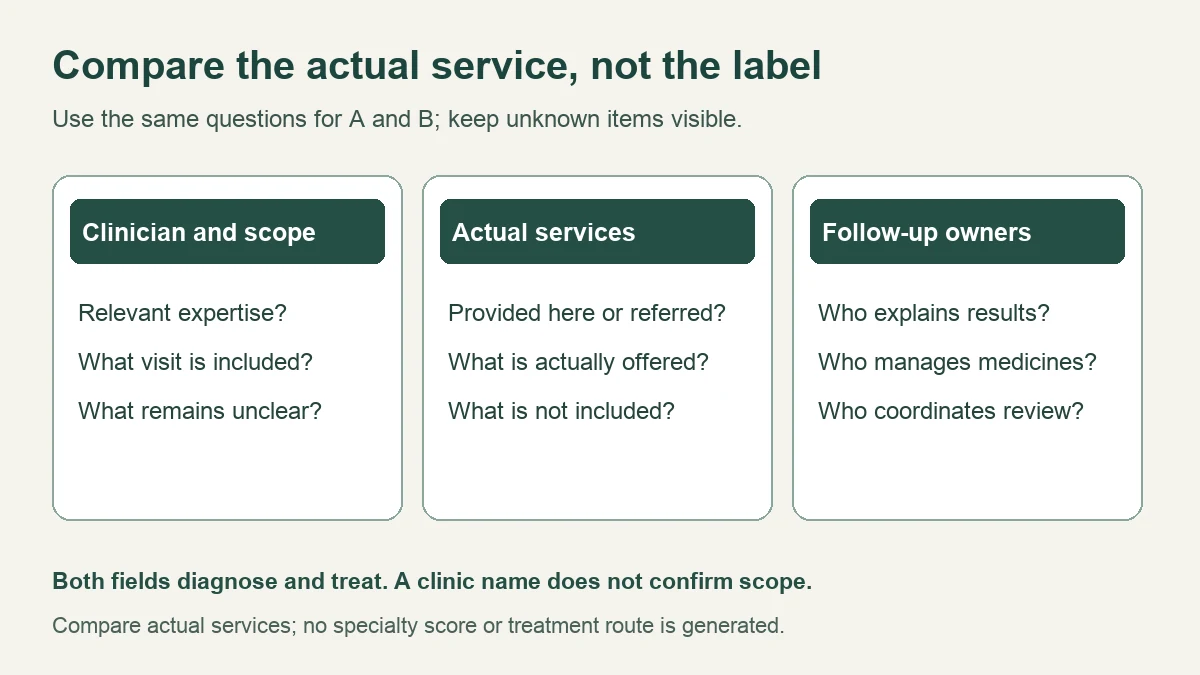
If an office says it does not handle the question, preserve the actual answer and ask the referring team about appropriate alternatives. Do not treat an administrative booking answer as a diagnosis. If a referral was made for a specific purpose, ask for that purpose to be clarified rather than replacing it with a different appointment from a comparison score.
Prepare existing facts without proving pain or treatment failure
Bring what is already known: symptom location, onset if remembered, changes, relevant prior assessment, current medicines and instructions, and what was actually tried. Mark approximate dates and missing details honestly. Records may help the discussion, but incomplete recall does not make pain less important or make you ineligible for assessment.
Pain intensity matters. Sleep, mobility, ordinary activities, emotional burden and treatment effects can add context alongside it. Preserved function does not invalidate severe pain; difficulty describing a timeline does not make a person’s account less credible. Do not perform painful tasks, stop medication or repeat an unsuccessful treatment to create a clearer record.
Separate your observations from a clinician’s explanation and from the referral question. Treatment proposed, treatment accessible, treatment actually received and treatment response are different facts. A barrier or partial course is not automatically “failed conservative care.” Tell the relevant team about access, side effects, practical difficulties or unclear instructions without inventing a completed trial.
Keep existing imaging reports and images distinguishable. Ask what relevant material is required and how the receiving service can access it. Do not obtain a new scan just to make the comparison complete. The clinician assesses imaging need; ACR/RSNA low-back imaging information addresses specific low-back situations, not every body part or which specialty should always be visited first.
Our MRI referral preparation guide focuses on a proposed imaging question. This page instead asks what the actual consultation includes and who will own its follow-up. A scan referral and a clinic booking are not interchangeable answers.
Keep booking, records and financial conditions separate from clinical fit
An actual referral order, an office accepting a patient, a confirmed booking and insurance coverage are different statuses. Ask which requirement applies to the exact clinician, service and site. Record the source and scope rather than transferring one office’s rules to another. A plan answer does not decide medical urgency or replace the treating team’s advice.
| Question type | Actual information to preserve | Avoid assuming |
|---|---|---|
| Office intake | Referral requirement, material required, accepted transfer route and actual receipt. | That sending a report means the clinician can open the images or has reviewed the record. |
| Booking | Named service, clinician/site and appointment actually confirmed. | That an appointment includes a scan, procedure or continuing treatment. |
| Cost or coverage | Exact service, quote conditions and actual office/plan explanation. | That a visit quote includes later tests or that another visit will necessarily be wasted. |
| Care during an access gap | Actual clinical advice and support questions. | That stable symptoms, an available later booking or a low quote makes waiting safe. |
There is no repeat-referral cost calculator here. The number of future visits, their clinical value and the final out-of-pocket amount cannot be inferred from a specialty label. If cost or access blocks recommended care, explain the barrier to the relevant clinical/support team. The separate care-access and support guide organizes such questions without choosing a treatment or payment strategy.
Keep the actual question sent, recipient role, response date if known, answer and unresolved point. A prepared question is not a completed call. A receipt confirmation is not a clinical opinion or coverage approval. The tool does not book a service, contact a plan, request a referral or transmit records.
After the visit: confirm the explanation and care handoff
Record what service actually happened and what was explained. A booked assessment may be narrower or different from what you expected; ask about the remaining question rather than labeling the visit a failure. A request for another assessment can be clinically useful and is not automatically wasted care. No referral-count target or promise of fewer visits is made.
| Follow-up responsibility | What to confirm | Actual status to record |
|---|---|---|
| Clinical explanation | What was assessed, what remains uncertain and which plan was actually discussed. | Explanation received, unclear or pending; not a self-diagnosis. |
| Tests and results | Who orders, receives and explains a result, if a test is actually recommended. | Order, performance, report availability and explanation are distinct. |
| Medicine plan | Which clinician manages each applicable medicine and answers problems. | Actual advice and owner; no assumption that another clinic took over. |
| Response and reassessment | Who reviews benefit, unwanted effects and unresolved concerns. | Actual agreed review and contact instructions; not a universal waiting period. |
| Clinical handoff | Permitted material sent to the existing team, receipt and actual discussion. | Report prepared, delivered, received and explained are different. |
If instructions differ, keep both sources and ask the relevant professionals to clarify them. Do not choose a medication change, stop therapy or transfer care based on this worksheet. If symptoms change, seek the assessment appropriate to the situation rather than automatically moving from pain medicine back to orthopedics or the reverse.
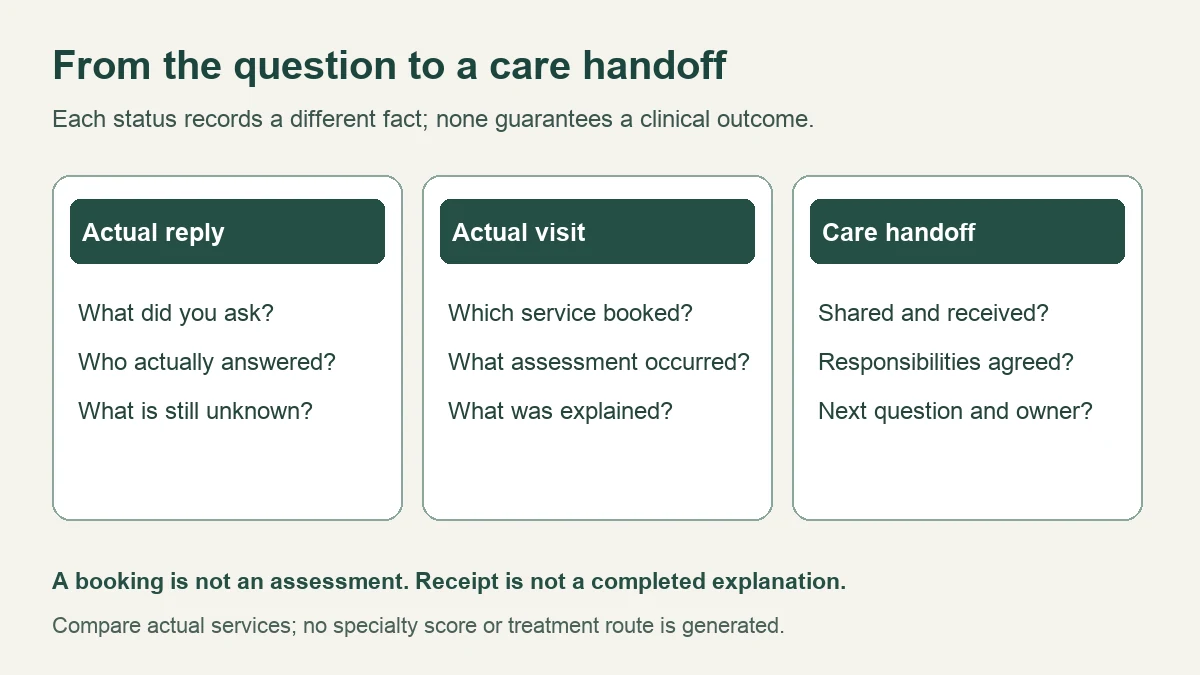
This comparison guide is about actual service scope and shared responsibilities. Our second-opinion guide separately addresses a request for another clinical opinion, a real denial event and its handoff. Neither a service comparison nor a second opinion automatically approves a procedure or determines the next treatment.
Two fictional service comparison writing examples
These invented examples show how to write notes, not how to select treatment. They involve no real patient or clinic and supply no diagnosis, waiting advice, insurance decision or measured outcome. Matching A/B labels let you compare actual services without assigning a winner. Example buttons replace entries and mark the output fictional.
Example A: persistent pain and an unresolved assessment question
| Record area | Fictional entry |
|---|---|
| Question / existing facts | Pain persists; questions about assessment and care remain. No cause or mandatory specialty inferred. |
| A/B service scope | A and B are placeholders. Ask which actual clinicians assess the question, what the visit includes and who follows up. |
| Question / real answer | Questions prepared, not sent. No actual office or clinician reply supplied. |
| Visit / next owner | No confirmed booking or assessment received. Record real replies and appropriate clinical guidance; no waiting permission generated. |
The example does not make chronic pain a reason to exclude orthopedic assessment or make an unresolved diagnosis a reason to exclude pain medicine. Its useful output is a precise question and a record of what is still unknown.
Example B: proposed pain-care referral with unclear responsibilities
| Record area | Fictional entry |
|---|---|
| Purpose / current care | A pain-care referral is proposed after an orthopedic visit. Exact referral scope needs clarification; this example supplies no changed instructions. |
| Actual services | Which assessment, medicine management, rehabilitation or procedures the proposed service provides remains unconfirmed. |
| Question / actual answer | Questions about scope and follow-up sent in this fictional example; receipt unconfirmed. No actual reply received. |
| Handoff / next action | Results, medicines and reassessment owners unresolved. Record actual replies, material delivery and owners agreed; no automatic transfer or treatment change. |
A proposed referral is not a booked consultation, and a consultation is not proof that every ongoing responsibility has transferred. Keep the actual agreed roles with the current plan and ask for clarification. Needed assessment must not wait for the worksheet to be complete.
Private service comparison, actual-answer and handoff tool
Download the offline tool before entering real health or personal information. Use fictional entries here because the surrounding page may contain ads and analytics. The tool uses no network requests, browser storage or automatic saving. The offline copy contains no external assets or automatic network requests. Keep completed files private.
Use one comparison question per record. Label services A/B consistently; mark unknown, pending or not applicable according to an actual answer. Avoid names, account numbers, full records and identifying details. A paper note with the same headings works. Neither the article nor the tool establishes the quality of an individual clinician or recommends a specialty.
Actual-service comparison, real-answer and care-handoff record
Use matching A/B labels to compare actual services, then keep booking, assessment received and handoff separate. The record does not choose a specialty or treatment.
Download the offline tool before entering actual health or personal details. Use fictional entries here; this page may contain ads and analytics.
Offline copy. No ads, analytics, external assets or automatic network requests.
No network requests, browser storage or automatic saving are used by the tool. Closing or refreshing can lose entries. Omit names, identifiers and complete records; keep exports private. Needed assessment must not wait for comparisons or routine replies.
Start with the fictional example or download a blank offline copy.
Paper alternative: clinical question; current care; A/B clinician and expertise; assessment scope; actual services; records; access/cost conditions; questions sent; real replies; actual visit; handoff owners; next action. Unknown and pending are valid.
My actual-service comparison, real-answer and care-handoff record
Unverified personal record for discussion. Entries verify no clinical fact, service, cost or handoff and recommend no specialty or treatment.
Guide: living.kioptrix.com/pain-clinic-vs-orthopedist/
After edits, rebuild the summary, then copy, download text or print it. Offline downloads include current entries. Blank fields generate optional clarification questions rather than an urgency or referral score. An export does not contact an office, obtain permission to disclose records, book care or change instructions. Refreshing or closing may lose unsaved entries.
Common pain clinic vs orthopedist questions
Does a pain clinic diagnose, or only manage symptoms?
Pain medicine includes diagnosis and treatment. Ask what the named clinician and specific service actually assess. No universal orthopedic-first rule follows from an unresolved diagnosis.
Does visiting an orthopedist mean I need surgery?
No. Orthopedic care includes nonsurgical options and rehabilitation as well as surgery. The actual clinical assessment and discussion determine what is proposed.
Is a multidisciplinary pain clinic always better?
The label alone cannot establish available services, coordination or suitability. Ask which professionals participate, what is provided directly and who manages follow-up. This guide does not rank institutions.
Do I need an MRI before either appointment?
No scan is required by this guide. Ask about relevant existing material and the actual service requirements; the clinical team assesses any imaging need. Imaging guidance is specific to the clinical situation.
Should I choose the lowest price or fastest booking?
Neither alone establishes clinical fit or safe timing. Confirm the actual scope and financial conditions, explain access barriers and obtain appropriate clinical advice without postponing needed assessment.
What if pain remains after an orthopedic appointment?
Record the assessment, actual explanation, remaining question and agreed follow-up. Continued pain does not automatically select pain medicine, repeat imaging or another procedure. Ask the relevant team to clarify the next clinical step.
What makes this different from a general visit checklist?
It compares the actual scope of two services and follows the gap between an advertised service, a reply, a booking, an assessment received and a completed care handoff. It generates questions rather than a specialty recommendation.
Sources, corrections and review limits
- AAOS: What is an orthopaedic surgeon? — overlapping assessment, nonsurgical care, surgery and rehabilitation; not a guarantee about a named clinician.
- ABMS: PM&R and subspecialties — scope of pain medicine within this board description; not credentials for every clinic.
- AAPM&R: About physical medicine and rehabilitation — function, care teams and rehabilitation practice.
- ACR/RSNA: Low-back imaging — situation-specific imaging education, not a referral order or a rule for all body parts.
- NHS: Back pain; NHS: Septic arthritis — selected warning symptoms, not U.S. access or insurance rules.
Source check and editorial update: October 29, 2026. Replaced the diagnosis-versus-management split in text, tables and images; removed unverified personal/reader stories, dismissive pain language, eligibility-style routing and the speculative repeat-referral cost calculator. Added actual-service comparison, actual replies, visit scope and care-handoff ownership. Original URL, publication date, author and category are retained.
This caregiver-created organizer is not an independently clinically reviewed or validated referral instrument. No real-reader study, verified clinic comparison, cost saving, faster recovery or clinical outcome is claimed. The featured image is AI-generated fictional artwork; diagrams illustrate questions and roles, not a clinical route. Our background and editorial approach.