

Workers comp settlement documentation should help you identify the original records, the actual proposal and the questions that still need an answer. A tidy file cannot value a claim, establish eligibility or tell you whether to accept a settlement. This guide helps you prepare for a review without rewriting facts into a more persuasive story.
Start with six essential record checks, compare sources, facts and questions, read two fictional writing examples, or use the settlement review materials and actual-answer tool. It produces a private discussion record, not a legal filing, agreement or recommended outcome.
Care, injury reporting and actual notice requirements must not wait for a complete file. Start with what you have and ask for missing material in parallel. A record request, phone inquiry or proposed follow-up does not automatically extend a legal deadline. If the applicable program, real notice or a time-sensitive requirement is unclear, seek appropriate agency or qualified-representative help promptly rather than applying a timetable from this page.
This is U.S.-focused education from a family-caregiver-run site. The operator is not a medical, legal, insurance or financial adviser. Your own qualified representative can explain legal terms; the relevant treating team assesses care needs. A helper can organize permitted material without assuming authority to disclose records, negotiate or sign for someone else. No complete file is required before asking for help.
Table of Contents
Workers comp settlement: six essential record checks
| Check | Keep the actual source | Question to resolve |
|---|---|---|
| 1. Applicable program | State or federal program and the source confirming it. | Which agency and rules apply to this claim? |
| 2. Document and time requirement | Real notice or proposal, version, relevant page and deadline wording. | What requirement actually applies, and who can clarify it? |
| 3. Records and differences | Original treatment/work records, existing observations and missing material. | What fact is known, what changed, and what needs explanation? |
| 4. Proposed scope and future care | Actual wording about resolved/continuing items and real care explanation. | What would be resolved, what continues, and who has explained future-care responsibility? |
| 5. Requests and actual answers | Prepared, sent, receipt confirmed; actual reply and its scope. | Has an answer really arrived, and is it written, oral or still pending? |
| 6. Review and next owner | Permitted delivery, receipt, review actually completed and remaining questions. | Who has reviewed what, and what next action was actually agreed? |
These are categories to check, not a required sequence or a settlement-readiness score. Some facts may remain unknown. Clinical care, required reporting, records requests and professional review can occur together. Filling every field does not establish that a proposal is fair, complete or suitable.
Identify the applicable program before using a rule
USAGov distinguishes state programs from federal programs. Its overview routes most private-sector and state/local-government workers toward state workers’ compensation offices, while federal employees and certain specific groups use federal programs. Work across states or an uncertain employment situation needs appropriate clarification; this article cannot determine jurisdiction from a job title or injury location.
Keep the actual agency or program name, how it was confirmed and which question remains unresolved. Do not assume that a federal FECA rule applies to a state claim, or that a California or New York example below describes another jurisdiction. A general agency webpage is a starting resource, not a ruling about your own claim.
| Role or source | Question it can help address | Boundary to preserve |
|---|---|---|
| Your own qualified representative | Applicable law, disclosure duties, proposal terms and individual options. | This organizer cannot supply legal advice or replace review of the actual document. |
| Relevant workers’ compensation agency / assistance service | Program resources, actual forms and the applicable process. | A general information response is not necessarily advice on what terms to accept. |
| Treating team | Current restrictions, actual findings, care plan and anticipated care explanation. | A personal symptom note is not a clinical opinion or a valuation. |
| Claims administrator / proposal issuer | Which document/version is current and the scope of its actual response. | An opposing party’s explanation is not your independent legal advice; keep oral and written sources separate. |
| Worker / permitted helper | Originals, dates, questions, real replies and permitted handoff. | No alteration, concealment, invented history or authority to sign is created. |
Preserve the actual notice and its exact time requirement privately. If a date, service route or triggering event is uncertain, record that uncertainty and ask the appropriate role. The tool copies your words without calculating a deadline. Do not assume that waiting for a record, an ordinary appointment or an email answer suspends a requirement.
Compare original records, observations and unanswered questions
Use a short index to locate originals rather than pasting complete medical or employment records into a public webpage. An index can identify a document label, date, issuer, version and private location. Keep originals available; a summary is not a substitute for a report or notice when the relevant process requires it.
| Material | What it can show | What it does not establish by itself | Useful clarification |
|---|---|---|---|
| Injury report / received notice | What was reported or notified, by whom and when. | Legal eligibility, accepted causation or settlement value. | Is the original available, and what action does the actual notice require? |
| Treatment note / imaging report | Documented findings, explanation and plan at that time. | Every present limitation or a complete future-care forecast. | What does the treating team explain, and is a relevant report missing? |
| Work restriction / employer form | Actual wording, source and dates. | That a restriction ended just because another form says full duty. | Is there a clinical change, different purpose or error requiring clarification? |
| Personal observation / later recollection | What you experienced and when you recorded or recalled it. | A diagnosis, medical causation or a contemporaneous professional record. | Which details are known, approximate or recalled later? |
| Wage / missed-work / benefit record | Recorded dates and amounts from that source. | That all amounts are owed or determine a final recovery. | Which relevant role can explain discrepancies or missing records? |
| Proposal / actual response | The real version, wording and answer received. | That every issue is resolved or an oral promise is a binding term. | What is written, what is uncertain and who reviewed it? |
OSHA expressly separates injury recordkeeping from workers’ compensation entitlement. An OSHA-recordable injury is not automatically compensable, and a compensable case is not necessarily OSHA-recordable. A workplace safety log may be relevant background, but it is not a settlement entitlement test. This article uses no OSHA rule to rank the strength of a claim.
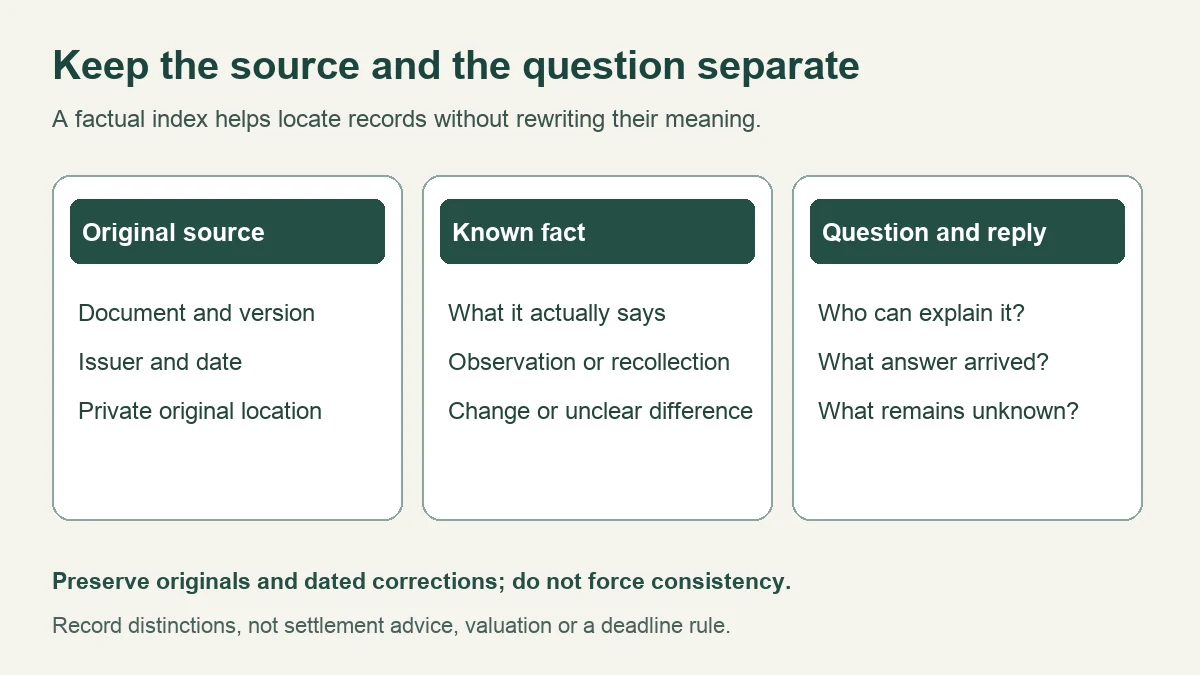
Describe existing symptoms and ordinary activity honestly, including severe days, better days and uncertainty. Do not test an aggravating task, repeat a procedure or seek extra treatment to complete the record. Personal observations help formulate questions; the clinician explains clinical findings and restrictions. Relevant prior history should not be hidden. Ask your own qualified representative about the scope and method of any disclosure.
Keep changes, errors and treatment gaps factual
Symptoms, findings and restrictions may legitimately change. Different documents may also serve different purposes or contain an error. Keep both versions and ask the relevant issuer to explain the difference. Do not edit a downloaded medical note or make separate accounts artificially consistent. Keep any dated correction or addendum with the original and identify who issued it.
For a treatment gap, distinguish what you know from what you infer. A scheduling message, authorization response, transport difficulty or personal recollection may explain different parts of the timeline. Do not assign a credibility penalty, count “exposed days,” or assume that a gap means recovery or noncooperation. Record a reason only when actually known; “reason not confirmed” is an acceptable entry.
A short timeline can be started from existing material while missing reports are requested. Suggested columns are event date if known, source/date recorded, actual event, question and actual reply. Clearly mark approximate dates and later recollections. There is no requirement to reconstruct every day, meet an arbitrary number of entries or finish the timeline before reporting an injury or obtaining care.
Keep a personal journal privately and preserve original entries. Before sending a journal, selecting documents for another party or removing duplicates from a disclosure set, ask your lawyer or other authorized adviser about actual requirements. You can organize an index without deleting source material or assuming every private note should automatically be sent.
Read the actual settlement scope and future-care questions
A records guide earns its place by helping you locate the proposal language you need explained. Keep the exact version and relevant page privately. Separate the question “what medical care is recommended?” from “what does this proposal say about who pays?” Neither the clinician’s care recommendation nor an organized binder answers the legal effect of a release.
| Review topic | Record from the actual document or explanation | Question for the appropriate role |
|---|---|---|
| Claim / injury / items included | Which claim, injury or disputed item the wording identifies. | What exactly is included, excluded or unresolved in this proposal? |
| Wage benefits and medical benefits | Each item’s stated treatment, not a single “everything settled” label. | Which benefits would continue and which would be resolved? |
| Current and anticipated care | Actual clinical explanation and relevant proposal wording. | What care has been discussed, and how would its payment responsibility be addressed? |
| Oral explanation versus written terms | Who said what, when, and where the written wording differs or is unclear. | Can my own qualified representative explain the actual written effect? |
| Deductions / payment and other unresolved obligations | Actual document references and questions, without guessing a net amount. | Who can explain the applicable fees, obligations and timing in this case? |
| Review / approval / status | What has actually been submitted, reviewed or decided and by whom. | What remains pending under the applicable process? |
California example only: the DWC explains that Stipulations with Request for Award usually retain insurer-paid medical care if needed, while a Compromise and Release that includes estimated future medical costs makes that care payment the worker’s responsibility. California requires judicial review of settlements. These distinctions illustrate why the actual terms matter; they are not instructions to select a type or rules for every state. California DWC: how a case is resolved.
New York example only: the WCB explains that a Section 32 agreement may settle wage benefits while continuing medical benefits, or settle both. It warns that future treatment is not automatically covered by private insurance or Medicare. The Board reviews the agreement but does not negotiate its terms for the worker. Do not transfer New York procedures or time limits to another program. New York WCB: Section 32 questions.
Medicare-related question: if relevant, ask the appropriate qualified role about Medicare’s interests and future work-injury care rather than assuming Medicare will take over payment. CMS describes a Workers’ Compensation Medicare Set-Aside as a future-medical allocation and explains that submission for CMS review is a recommended process, not a statutory or regulatory submission requirement. Its review thresholds are not universal exemption rules. This guide does not calculate an allocation or decide whether a particular arrangement is needed. CMS WCMSA overview.
Record requests, real answers and review handoff
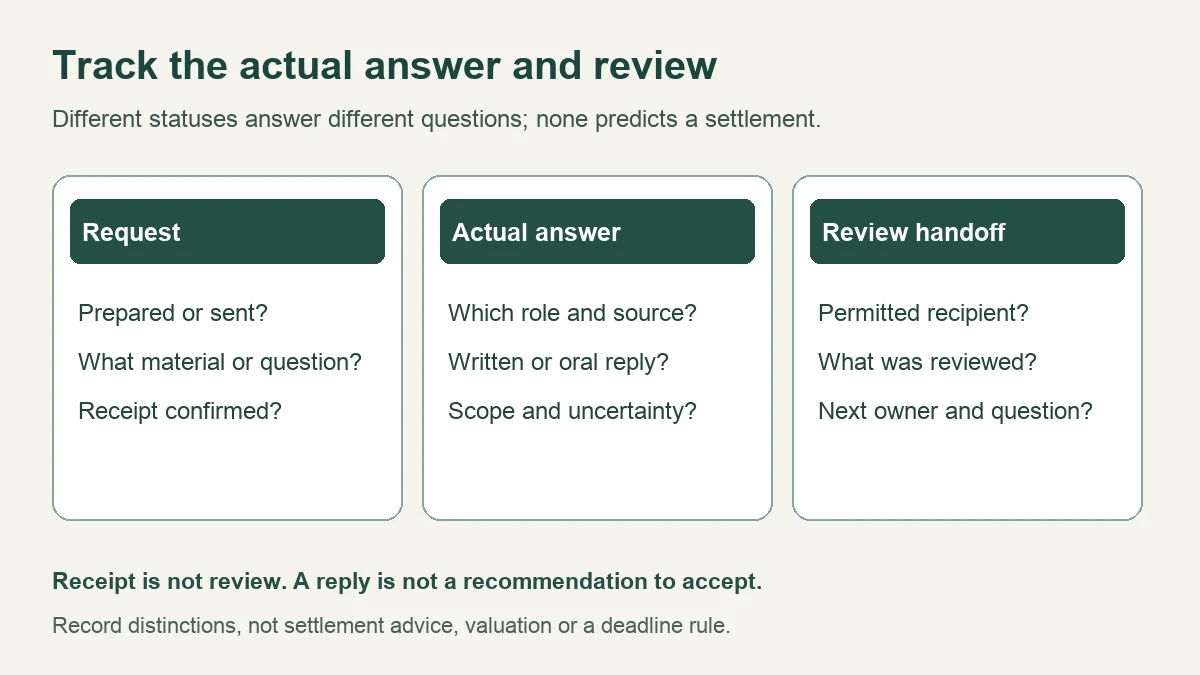
A question written in a notebook is prepared, not sent. A sent request is not confirmed receipt. Receipt is not a substantive answer, and receipt of documents is not proof that a professional reviewed them. These distinctions make follow-up useful without suggesting that an administrative milestone improves the settlement outcome.
| Actual status | Useful note | Avoid inferring |
|---|---|---|
| Prepared | Question, intended role and permitted channel. | A filing, disclosure, agreement or completed contact. |
| Sent | Actual date/channel if known and what was sent. | Receipt, completeness or compliance with a legal requirement. |
| Receipt confirmed | Who confirmed which material and when. | Review, acceptance, correct terms or extended time. |
| Actual answer received | Role, date, source, exact scope and remaining question. | That a general answer settles a different issue. |
| Review completed / next action agreed | What was actually explained and who owns the next action. | A recommended acceptance decision or suspension of a real deadline. |
Keep an oral response labeled oral. If someone refers to a clause or document you do not have, record that source request rather than filling in the missing content yourself. If replies conflict, keep both and ask the appropriate qualified role to explain them. Do not convert “we received it” into “we approved it.”
Share material only with an authorized recipient through an appropriate channel. Keep a private copy of the relevant source and actual response. This page neither contacts an agency nor transfers a medical record. A caregiver’s completed worksheet does not establish authority to negotiate or sign. Follow-up arrangements should name an actual owner and distinguish an agreed check-in from an enforceable deadline.
This is the distinct job of this settlement review guide. Our workers comp provider and service-request guide addresses program, provider and treatment-request questions. The second-opinion guide tracks an additional clinical consultation and care handoff. Neither process answers the legal effect of a settlement proposal.
Two fictional settlement review writing examples
These are invented documentation examples. They contain no real case, clinical instruction, deadline, legal advice or settlement outcome. Their purpose is to show how to preserve uncertainty and distinguish actual answers from pending questions. The tool’s example buttons replace entries and label the output fictional.
Example A: clinic restriction note and employer form differ
| Area | Fictional entry |
|---|---|
| Original material | Clinic restriction note and later employer return-to-work form kept separately, with dates and versions in the private originals. |
| Difference / question | Wording differs. No assumption that restrictions ended. Ask the relevant clinician and workplace contact to explain the difference. |
| Request / actual answer | Clarification question prepared, not sent. No actual answer or dated correction supplied. |
| Handoff / next owner | No delivery or professional review confirmed. Record real replies and any actual next action; no return-to-work clearance generated. |
The useful outcome is a precise question with both sources preserved. It is not a stronger claim score. If the question later receives a reply, add its real source and scope, including any unresolved point. Do not overwrite the earlier record or treat the example as permission to perform a task.
Example B: future-care phone explanation and proposal are unclear
| Area | Fictional entry |
|---|---|
| Actual document | Proposal version B; relevant future-medical clause location still needs checking against the private original. |
| Scope / question | Whether wage benefits, medical benefits or both would be resolved is unconfirmed. A phone explanation suggests continuing care, but written effect has not been explained. |
| Request / actual answer | Question about the clause and future-care responsibility sent; receipt unconfirmed. No actual clarification received. Oral account kept separate. |
| Review / remaining point | Material intended for own qualified representative; delivery and review not confirmed. Record the actual answer and what remains unresolved; no accept/reject or wait advice. |
The example does not assume the written term is wrong or the phone account is reliable. It identifies what needs qualified explanation. No future payer, Medicare payment, extra compensation or outcome is promised.
Private settlement review materials and actual-answer tool
Download a blank offline copy before entering actual health, employment or claim details. Use fictional entries on this page because the surrounding site may contain advertising and analytics. The tool makes no network requests, uses no browser storage and does not automatically save. Its offline file contains no external assets or automatic network requests. Keep completed copies private.
Use one proposal/version per record or matching short labels for related documents. Unknown, not asked, pending and not applicable according to an actual answer are valid entries. Avoid names, claim numbers, signatures, full notices and complete medical records. An ordinary paper note using the same headings works if you prefer.
Settlement review materials and actual-answer record
Keep originals, facts, unclear proposal wording, actual replies and review handoff distinct. No settlement value, acceptance recommendation or legal conclusion is generated.
Download the offline tool before entering actual health, employment, claim or personal details. Use fictional entries here; the surrounding page may contain ads and analytics.
Offline copy. No ads, analytics, external assets or automatic network requests.
The tool makes no network requests and uses no browser storage or automatic saving. Closing or refreshing may lose entries. Omit names, identifiers and complete records. Keep exports private. Needed care, reporting and real notice requirements must not wait for this worksheet.
Start with the fictional example or download a blank offline copy.
Paper alternative: program/source; actual document/version; actual deadline wording; original records; differences; proposed scope; future-care question; requests; actual answers; review handoff; unanswered points; next owner. Unknown and pending are valid.
My settlement review materials and actual-answer record
Unverified personal record for discussion. Entries verify no legal fact, term, deadline or outcome and recommend no settlement decision.
Guide: living.kioptrix.com/workers-comp-settlement-documentation/
Build again after changing an entry, then copy, download text or print the summary. An offline download includes current entries, so treat it as a private file. Blank fields add optional clarification questions, not a risk score. Completing every field verifies nothing about jurisdiction, evidence, deadlines, proposed terms or review. No request is submitted and no agreement is signed.
Common questions about settlement records
Can this record tell me whether the settlement amount is fair?
No. It identifies sources, unanswered questions and actual replies. It does not value a claim, compare offers or recommend acceptance or rejection. The actual terms and applicable law need qualified individual review.
Should I finish the timeline before asking for missing records or help?
No. Start with existing material and seek missing records or help in parallel. Needed care, reporting and real notice requirements must not wait for a complete timeline.
Does a treatment gap automatically weaken my claim?
No automatic conclusion or day-count rule is provided. Preserve what is known about the gap, its actual source and remaining uncertainty. Do not fabricate a reason or obtain unnecessary care for documentation.
Should I send every personal journal entry to the insurer?
This page cannot determine disclosure requirements. Preserve originals privately and ask your own lawyer or authorized adviser about the actual required scope, recipient and channel. Do not delete or alter material to make a story persuasive.
Does settlement mean Medicare or private insurance will pay future treatment?
Do not assume that. Actual terms, applicable coverage and Medicare responsibilities need clarification. The examples and tool do not create payment rights or determine an allocation.
What if I have new symptoms while organizing the file?
Seek appropriate assessment rather than waiting for paperwork or a routine reply. The record is not a symptom checker and does not decide urgency.
For back pain, new bladder or bowel control changes, loss of feeling around the genitals or anus, or symptoms such as weakness or numbness in both legs need emergency assessment. Use appropriate local emergency services, including 911 for U.S. emergencies. Other concerning new or worsening symptoms need appropriate clinical advice; these examples are not a complete triage list. NHS back-pain warning guidance.
Sources, corrections and review limits
- USAGov: Workers’ compensation — state/federal program routing, not an individual jurisdiction ruling.
- OSHA FAQ 0-2 — safety recordkeeping differs from workers’ compensation entitlement.
- California DWC: How a case is resolved — California-specific settlement examples and review.
- New York WCB: Section 32 FAQ — New York-specific scope and future-care questions.
- CMS: Workers’ Compensation Medicare Set-Aside Arrangements — Medicare responsibilities and the scope of CMS review; no individualized allocation.
- NHS: Back pain — selected symptom warnings, not U.S. compensation rules.
Source check and editorial update: October 29, 2026. Replaced persuasion and credibility framing, exposed-day counting, eligibility-style prompts and timeline-first commands. Separated recordkeeping from compensation, removed broad FECA/pain-page support for settlement claims, and added actual proposal scope, source records, real answers and permitted review handoff. Original URL, publication date, author and category are retained.
This caregiver-created organizer has not been independently legally or clinically reviewed or validated with a reader study. It claims no settlement success, savings or improved clinical outcome. The featured image is AI-generated fictional artwork. Diagrams illustrate record distinctions, not a legal strategy or mandatory process. Our background and editorial approach.