
This site is written from a family-caregiver perspective. The operator is not a medical professional. This article provides general education and preparation prompts rather than an individual assessment.
Separate medical quotes and household support
Use these prompts to prepare questions and arrangements. They do not diagnose a condition, determine coverage or clear an activity.
- What to record
- Provider estimates, separate billers, current benefit information, home assistance and essential household expenses.
- What to ask
- What is excluded from each quote and which recovery costs are still unpriced?
- Next action and owner
- Assign a contact for each gap; an estimate is not a coverage guarantee or final bill. Write down who will act and when to follow up.
Keep personal records private. You can use the visit preparation organizer to arrange questions; do not post identifying health information in comments.

The cost of shoulder surgery recovery is rarely just the surgeon’s bill. For a U.S. patient, the more useful number is the total recovery budget: your expected share of the surgery, anesthesia and facility charges, plus physical therapy, prescriptions, equipment, transportation, help at home, and income lost while you cannot work normally.
The biggest variable is your specific procedure and insurance arrangement. A rotator cuff repair, labral procedure, arthroscopy, and shoulder replacement can create very different rehabilitation needs and restrictions. Before buying recovery equipment or accepting a surgical estimate, ask for the procedure details, participating providers, expected rehabilitation plan, and your insurer’s estimate of patient responsibility. If you are self-pay, request written estimates from each provider or facility that may bill you.
Table of Contents
What Should Be Included in a Shoulder Surgery Recovery Budget?
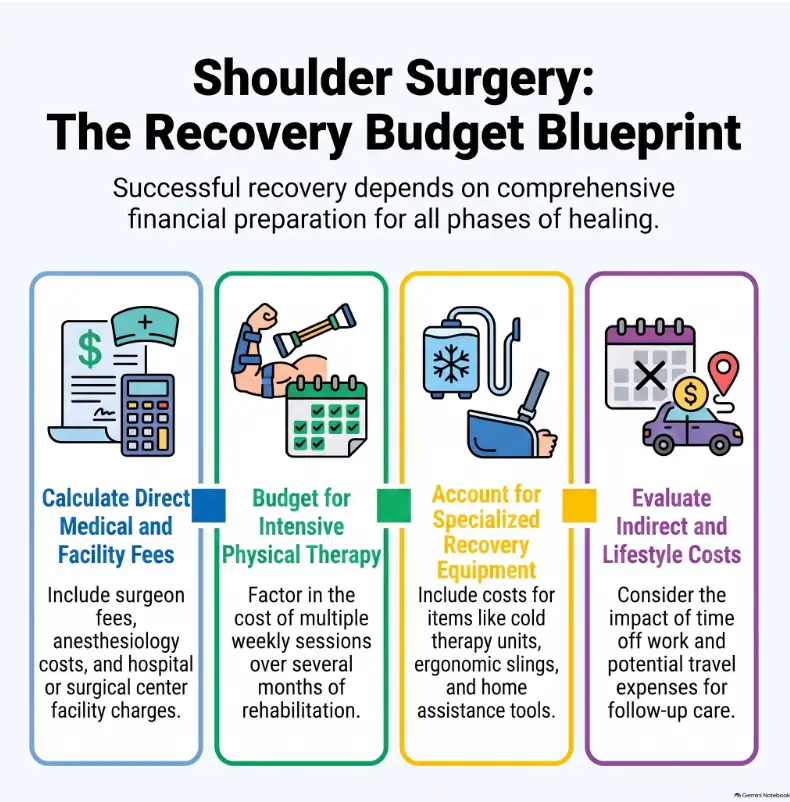
A useful budget starts with the medical episode but does not stop there. Think of recovery costs as several separate envelopes. Missing even one can make an apparently manageable estimate surprisingly incomplete.
| Cost bucket | What to verify | Why it gets missed |
|---|---|---|
| Surgeon | Procedure, surgeon participation, expected patient responsibility | The surgeon’s quote may not include the facility or anesthesia |
| Facility | Hospital outpatient department or ambulatory surgery center, network status, facility charge | Facility charges can be billed separately |
| Anesthesia | Expected anesthesia service and billing entity | Anesthesia may generate a separate claim or bill |
| Imaging and testing | Preoperative labs, imaging, medical clearance, postoperative imaging if expected | These may occur on different dates and generate separate claims |
| Physical or occupational therapy | Visit frequency, copay or coinsurance, deductible status, authorization requirements | Repeated visits can turn a modest per-visit amount into a meaningful recovery expense |
| Medication | Prescription pain medicines and other postoperative prescriptions | Pharmacy benefits are often separate from the surgical estimate |
| Equipment | Sling or immobilizer, cold therapy, bathing aids, pillows or other surgeon-approved items | Not every recovery item is covered or medically necessary |
| Home assistance | Meals, dressing, bathing, transportation, household tasks, pet care | Unpaid family help can hide the true labor required |
| Work interruption | Paid leave, disability benefits, remote-work options, reduced hours | Lost income may exceed the cost of recovery supplies |
If you have not yet obtained a detailed medical estimate, start with an orthopedic surgery estimate checklist before trying to calculate the rest of the recovery budget.
Why the Surgeon’s Estimate May Not Be Your Final Surgery Cost
A single quote can look complete while representing only one part of the episode. Shoulder surgery may involve a surgeon, facility, anesthesiology service, laboratory, imaging provider, pharmacy, rehabilitation provider, and durable medical equipment supplier.
Ask the surgical office whether its estimate represents only the surgeon’s professional fee or a broader bundled estimate. Then ask for the facility name and the anticipated anesthesia arrangement. If anesthesia billing is unfamiliar, review how a separate anesthesia bill can fit into an orthopedic procedure.
For hospital-based care, CMS requires hospitals to make pricing information publicly available, including consumer-facing information for shoppable services. The hospital’s estimator can be a useful cross-check, although your insurer’s benefit rules and the final services actually provided still matter. CMS explains the current requirements on its hospital price transparency page for consumers.
How to Estimate Your Insurance Share Without Using the Sticker Price
If you are insured, the hospital’s retail charge is usually not the number you should plug into your budget. The useful starting point is the plan’s allowed amount or negotiated amount, combined with your remaining deductible, coinsurance or copay rules, and current out-of-pocket spending.
Illustrative example
Assume, purely for illustration, that the combined allowed amount for covered services is $10,000, you still have $1,500 of deductible remaining, and your plan then applies 20% coinsurance.
A simplified calculation would be:
$1,500 deductible + 20% × $8,500 remaining allowed amount = $3,200 estimated patient responsibility.
That is not a quote. Actual plan rules may apply different cost sharing to the surgeon, facility, therapy, medications, equipment, or other services. Your out-of-pocket maximum also does not necessarily protect you from premiums, non-covered services, or every out-of-network expense. HealthCare.gov explains what does and does not count toward an out-of-pocket maximum.
The practical question for your insurer is not simply, “Is shoulder surgery covered?” Ask: “Using the procedure and facility information I have, what deductible, copay, coinsurance, network, authorization, and out-of-pocket rules are expected to apply?”
Physical Therapy Can Be a Separate Recovery Cost Center
Rehabilitation is one of the easiest costs to underestimate because the final number depends on both the clinical plan and the insurance benefit. The important variables are when therapy begins, how many visits are anticipated, whether authorization is required, whether the therapist is in network, and whether you pay a fixed copay or coinsurance.
Do not assume every shoulder procedure follows the same schedule. AAOS guidance for rotator cuff repair notes that the surgeon determines when physical therapy begins and how long a sling is needed based on factors such as the repair itself. In other words, a generic internet recovery calendar should not be used to buy therapy packages or equipment in advance.
If your plan language is confusing, the distinction between a physical therapy copay and coinsurance can materially change the amount you should reserve.
Which Recovery Purchases Are Worth Paying For?
Buy for a known restriction, not for the idea of “being prepared.” Shoulder-surgery shopping lists often accumulate specialty pillows, recliners, cold-therapy machines, adaptive clothing, shower equipment, one-handed kitchen tools, and other products before the patient knows what will actually be needed.
A cheaper setup is often sufficient when an item is optional, used only briefly, can be borrowed safely, or solves a problem you do not actually have. Ordinary loose clothing, strategically placed household items, help from another person, and surgeon-approved low-cost adaptations can sometimes replace specialty products.
Paying more becomes easier to justify when the equipment addresses a specific postoperative restriction, improves safe independence, will be needed repeatedly, or substitutes for substantially more expensive paid assistance. The relevant question is not whether an item is marketed for shoulder surgery. It is whether your surgical team expects it to solve a real functional problem.
- Ask which equipment is medically necessary rather than merely convenient.
- Ask whether the facility supplies the sling or immobilizer.
- Check insurance coverage before buying durable medical equipment from a retail seller.
- Wait until you know your bathing, sleeping, dressing, and movement restrictions before buying specialty products.
- Keep receipts for items you may be able to return if the postoperative plan changes.
Budget for Help at Home Before Assuming You Can Recover Alone
The financial question is not simply whether you can physically remain at home alone. It is which tasks require the operated arm, whether those tasks can safely wait, and whether another person will need to provide transportation or hands-on assistance.
Before surgery, walk through one ordinary day: getting dressed, bathing, preparing food, opening containers, managing medication, carrying laundry, caring for children or pets, driving, and handling household tasks. Then identify which activities would be difficult if one arm were restricted.
A family member helping at specific times may reduce paid-care costs once the clinical team says it is safe to be alone between visits. First budget for any required in-person supervision: many general-anesthesia instructions require a responsible adult to stay for the first 24 hours, and your written discharge instructions govern. Phone check-ins or a few short visits do not replace that requirement. Targeted help remains useful later for tasks you cannot safely manage independently.
Insurance-funded home health is not the same as a recovery helper. For Medicare, home health coverage has eligibility and skilled-care requirements; it is not a promise of continuous supervision. Medicare lists round-the-clock home care, meal delivery, homemaking unrelated to the care plan, and personal care alone among services it does not pay for under this benefit. Confirm what your actual plan and agency will provide. Do not assume a scheduled nursing or therapy visit covers the responsible-adult requirement in your discharge instructions.
Quote check: ask a paid-helper service about minimum booking time, tasks it can perform, cancellation and extra charges. If a hypothetical quote requires a four-hour minimum at $25 per hour, that booking is $100 before any separately stated charges, even if you expect only two hours of tasks. The rate and minimum are invented for this example. Match each task and supervision period to an actual person before treating the home-help budget as complete.
Do Not Leave Lost Income Out of the Cost Checklist
Time away from work can be a larger financial consequence than medication or recovery equipment. The relevant timeline depends on what was repaired, which arm was operated on, pain control, sling restrictions, transportation, and the physical requirements of the job.
Separate “returning to work” from “returning to normal duties.” Someone who can work remotely with temporary accommodations may have a very different income interruption from someone whose job requires lifting, overhead work, driving, or repetitive use of the operated arm.
Before surgery, review paid sick leave, PTO, short-term disability benefits if available, employer documentation requirements, and possible temporary work modifications. The practical planning questions are covered in more detail in this guide to returning to work after shoulder surgery.
If You Are Self-Pay, Get Written Estimates From the Actual Billers
For uninsured patients and people choosing not to use insurance, a verbal price from one office is not enough. Ask which separate providers or facilities are expected to bill you and request written estimates where applicable.
Under federal rules, patients who are uninsured or not using insurance generally have rights to a good faith estimate when qualifying care is scheduled in advance or when an estimate is requested. CMS explains the current requirements and timing on its good faith estimate guidance.
Keep every written estimate. CMS currently provides a patient-provider dispute process in qualifying self-pay situations when a provider or facility bills at least $400 more than its good faith estimate. Eligibility and deadlines matter, so check the current federal rules rather than assuming every unexpected bill qualifies.
Check Network Status Before the Procedure, Not After the Bill Arrives
For insured patients, confirm the surgeon and facility directly with the health plan. Also ask how anesthesia and other professionals involved in the procedure are handled. A provider office saying it “accepts” your insurance is not the same thing as your insurer confirming that the provider participates in your specific network.
Federal No Surprises Act protections can restrict certain unexpected out-of-network bills for non-emergency services received at an in-network hospital, hospital outpatient department, or ambulatory surgical center, including certain ancillary services such as anesthesiology. Those protections are important, but they are not a substitute for checking your plan before scheduled surgery. CMS provides a current explanation of federal surprise-billing protections.
Your Before-Surgery Cost Checklist
Use this once you know the procedure and proposed facility. You should be able to answer most of it without predicting your exact recovery timeline.
- Procedure: What operation is planned, and are additional procedures reasonably anticipated?
- Surgeon: Is the surgeon in my specific insurance network?
- Facility: Where will surgery occur, and is that location in network?
- Authorization: Has any required prior authorization been completed, and what exactly was authorized?
- Anesthesia: Who is expected to provide and bill for anesthesia?
- Insurance: How much deductible remains, what cost sharing applies, and how much has already accumulated toward my out-of-pocket limit?
- Therapy: Will PT or OT be expected, and what are my visit-level benefits and authorization rules?
- Equipment: What will be supplied, prescribed, optional, or worth waiting to buy?
- Medication: Which postoperative prescriptions are likely enough to check against the pharmacy benefit?
- Home help: Which daily tasks will require another person?
- Transportation: Who will handle surgery-day transportation and follow-up visits if driving is restricted?
- Work: How will leave, reduced duties, or remote work affect household income?
- Documentation: Have I saved estimates, authorization information, benefit details, and contact names?
When Cost Cutting Becomes the Wrong Priority
There is a difference between avoiding unnecessary recovery purchases and trying to economize on medically necessary care. Do not alter sling use, rehabilitation, medication, wound care, activity restrictions, or follow-up appointments simply because another patient recovered differently or an internet checklist suggests a cheaper path.
Your surgeon and rehabilitation team determine what is appropriate for the procedure actually performed. If symptoms after surgery raise concern for a complication, use the postoperative instructions you were given and seek the recommended medical evaluation rather than delaying care to compare prices.

Shoulder Surgery Recovery Cost FAQ
Does an insurance-covered shoulder surgery mean recovery will be inexpensive?
No. Coverage and low out-of-pocket cost are different questions. Your deductible, copays, coinsurance, network rules, therapy benefits, pharmacy coverage, non-covered equipment, and lost income can all affect the amount the household ultimately absorbs.
Should I buy a recliner or cold-therapy machine before shoulder surgery?
Not automatically. Ask whether your surgeon expects you to need the item and whether a lower-cost substitute is acceptable. Waiting for procedure-specific instructions can prevent an expensive purchase that solves the wrong recovery problem.
Can the final bill be higher even if I received a pre-surgery estimate?
Yes. Estimates may not include every provider, and the services actually required can differ from those expected beforehand. Insured patients should compare estimates with their Explanation of Benefits and bills. Qualifying uninsured or self-pay patients may have additional federal good faith estimate protections.
What if I cannot pay my portion of the surgery bill at once?
Contact the billing department before putting a large medical balance on high-interest credit. Ask about financial assistance eligibility, discounts that may apply, and payment-plan terms. Compare the total cost and conditions rather than looking only at the monthly payment.
Run This 10-Minute Cost Check Before Surgery
Put one sheet of paper beside your insurance card and write down four numbers or estimates: your expected surgical patient responsibility, anticipated rehabilitation cost, non-medical recovery spending, and income you expect to lose.
Total recovery budget = patient-paid medical costs, including surgery, rehabilitation, medicines, and covered equipment + additional transportation, household assistance, and other noncovered expenses + lost income. Count each charge once; do not add therapy, prescriptions, or equipment again if they are already included in the surgical estimate or medical cost-sharing total.
Then call the insurer or billing office and investigate whichever line is still blank. That missing number is usually more valuable than another page of generic shoulder-surgery shopping advice.
Last updated: October 15, 2026
Targeted update: 17 October 2026. Clarified Medicare home health versus household help and discharge supervision, and added an illustrative minimum-booking calculation. Other sections retain their existing review scope.
Targeted editorial update: October 21, 2026. Added a topic-specific record, question and follow-up guide and revised the title and search description. Existing useful material was retained; this update is not a complete medical, legal or insurance review. Confirm individual instructions, current prices and benefits with the relevant service.