

When conservative care is not helping, a pain management review should compare the goal actually explained, what treatment was actually carried out, and the benefits and burdens already noticed. “Not helping” may mean partial benefit, no perceived change, unwanted effects, unclear instructions or a plan that was never fully accessible. None of those entries automatically selects an injection, scan or operation.
Use the six essential review checks, the goal / actual-performance / response table, two fictional writing examples or the private treatment-review record. The aim is a clearer clinical conversation, not a treatment-failure score or a test you must pass before asking for help.
Some changes need care before a routine review. With back pain, new bladder or bowel changes, loss of feeling around the genitals or anus, or pain, tingling, weakness or numbness in both legs require emergency assessment. Sudden severe joint pain with swelling, heat, colour change or difficulty moving needs urgent assessment; joint infection can occur without fever. These are selected examples, not a complete triage list. Use appropriate local urgent or emergency services, including 911 for emergencies in the U.S.; do not wait for a record or routine reply. NHS back-pain guidance; NHS joint-infection guidance.
This is caregiver-written education for preparing a review of nonoperative care. It does not diagnose, judge treatment adequacy, tell you to maintain or stop a plan, or recommend a stronger treatment. Keep actual clinical instructions with your notes and ask the relevant professionals to reconcile conflicts. Do not change medicines or independently progress exercises to complete a worksheet.
Table of Contents
Six essential checks for a pain management review
| Check | Actual information to record | Question to clarify |
|---|---|---|
| 1. Explained goal | The goal really discussed, your priority and any uncertainty about what is being monitored. | “What was this plan intended to help, and how were we going to review it?” |
| 2. Actual instruction | Treatment items, source/date, wording and any unclear or conflicting advice. | “Which instructions currently apply, and who can clarify the difference?” |
| 3. Actual performance and access | What happened, what did not happen and what made the plan difficult to use. | “How do the actual delivery and barriers affect this review?” |
| 4. Benefit and burden | Reported benefit, no change, worsening, unwanted effects and treatment effort already known. | “How should we interpret this mixed response without assuming cause?” |
| 5. Pain and ordinary life | Existing pain, sleep, usual task, wellbeing or function observations together. | “Which concerns remain important even where another area improved?” |
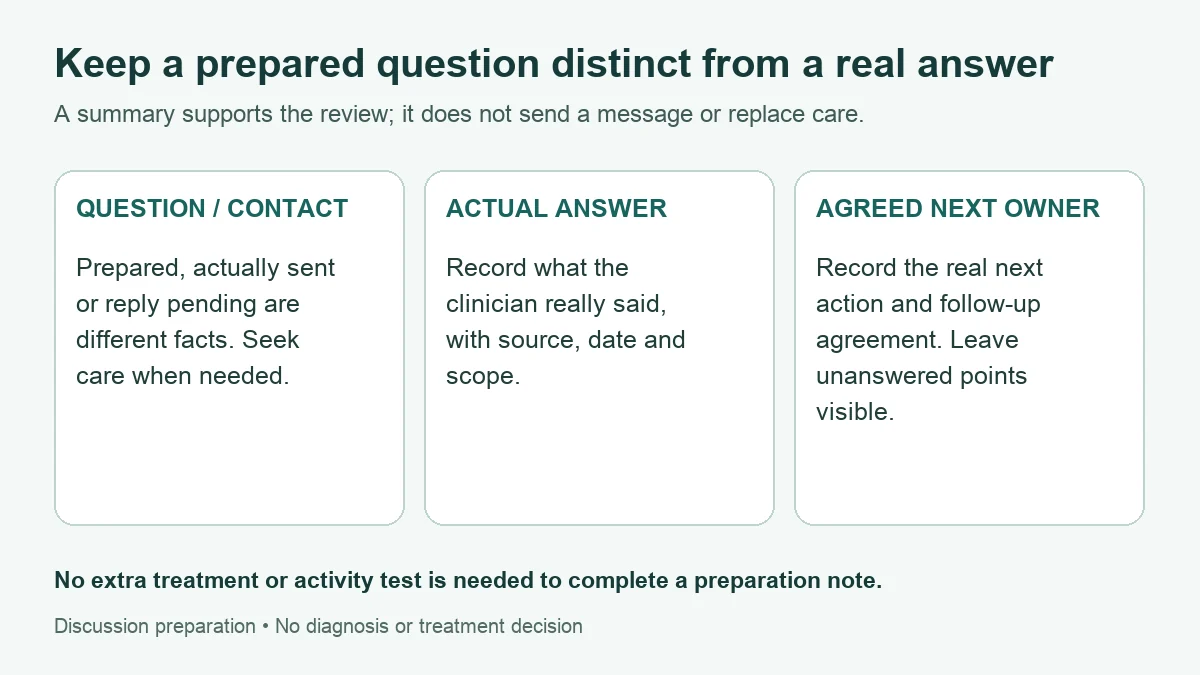
| 6. Actual answer and next owner | Question prepared/sent, reply received, scope and next action actually agreed. | “What has been answered, who will act, and what remains unresolved?” |
These are preparation prompts, not criteria for imaging, procedures or review eligibility. A person can ask for help with an incomplete note. Record “not explained”, “not performed”, “not remembered” or “reply pending” rather than guessing. The clinician’s assessment and the actual condition determine the care discussion.
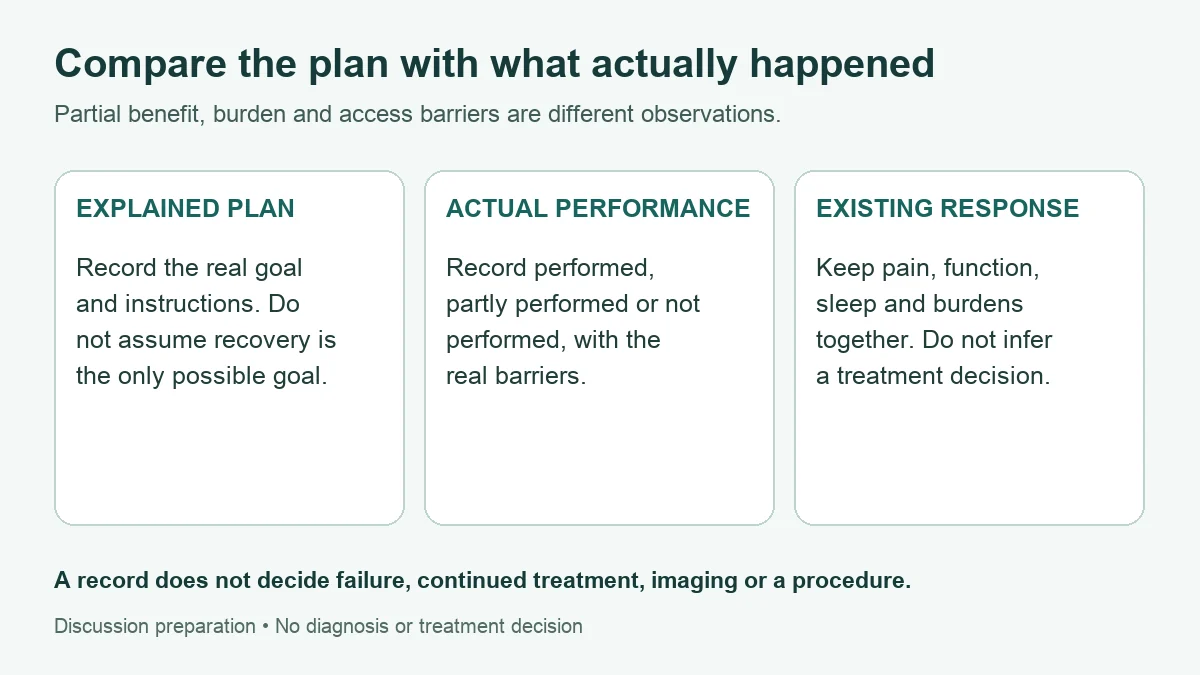
Separate partial benefit, burden and incomplete access
| What the reader reports | What to preserve in the note | Conclusion not established |
|---|---|---|
| Some ordinary tasks became easier but pain remains | Keep the task observation and the unresolved pain side by side. | The pain is unimportant, the cause is fixed or the plan should automatically continue. |
| No perceived change | Record what was actually carried out, the explained goal and the review question. | The diagnosis was wrong, effort was inadequate or a procedure is now required. |
| Unwanted effect or new deterioration | Describe the existing change and actual contact or advice, without assigning a cause. | The change is expected, harmless or suitable for waiting until a routine visit. |
| Only part of the plan was accessible | Record cost, travel, assistance, equipment or other delivery barriers. | A fully delivered treatment has failed or the person did not try hard enough. |
| Instructions or review goals were unclear | Keep the real wording and the unanswered question. | The reader must invent a progression, duration or stopping rule. |
Several rows may apply at the same time. These descriptions do not rank urgency or prescribe a next treatment. A record of actual experience is useful even when the explanation remains uncertain. You do not have to demonstrate worsening or complete a specified duration before raising a concern.
Goals can differ. Ask whether the actual plan was intended to improve a symptom, support an ordinary task, maintain function or address another agreed priority. Do not assume that every plan promises recovery, or that maintaining an ability is automatically adequate for this person. The explained goal, current burden and the reader’s priorities all belong in the review.
For chronic pain in people aged 16 and over, NICE NG193, recommendations 1.1.15–1.1.23 discusses symptom fluctuation, the possibility of improved quality of life despite unchanged pain, individual priorities, and reassessment when symptoms change. A cause for a flare-up may not be found. That supports a balanced conversation; it does not determine the cause of any reader’s symptoms or create a waiting rule. Its assessment recommendations must be distinguished from the separate treatment recommendations for chronic primary pain.
Compare the explained plan with actual performance and response
| Treatment-review area | Plan or instruction actually explained | Actual performance / observation / remaining question |
|---|---|---|
| Item and goal | Name the treatment item and real goal, with source/date if known. | What question remains? A hoped-for benefit is not an instruction. |
| Instruction | Keep the actual wording, including any stated limits or review arrangement. | What was actually followed? Which wording is unclear or conflicting? |
| Delivery and access | Record what was proposed or arranged. | Performed, partly performed, not performed, unavailable or not remembered, with actual barriers. |
| Benefit and unwanted effects | What outcome was to be discussed, if actually explained. | What benefit, no change, worsening or burden was already noticed? Avoid causal conclusions. |
| Ordinary life | The person’s actual priorities, without a new performance target. | Existing pain, sleep, daily-task and wellbeing observations; no extra task test. |
| Follow-through | An actual follow-up instruction or agreement. | Question prepared or sent; actual answer, next owner and unresolved point. |
For several treatments, use matching labels such as A and B across the fields: A is the same treatment item in the goal, instruction, actual-performance and response entries. This helps avoid attaching a response to the wrong intervention. Use ordinary names privately rather than posting a medical record. Dates can be approximate if clearly marked; do not invent precision.
Keep changes made during the same period visible. Several circumstances may have changed, so a diary cannot prove which treatment caused an observation. If the sequence is uncertain, say so. A brief report of existing experience is sufficient; do not repeat treatment, withhold care or provoke symptoms to create cleaner data.
Access and understanding are part of the story. Explain a barrier concretely: an appointment could not be reached, a cost was unaffordable, assistance was unavailable or an instruction was not understood. Ask what help or clarification is available. A request is not an offer of assistance, and an offer is not actual delivery; record each fact as it occurs.
If instructions conflict, quote both versions with their sources and ask the relevant professionals to reconcile them. This article supplies no medicine dose, exercise progression, treatment duration or continue/stop decision. A guideline, a previous patient’s experience or this form cannot replace individual instructions.
Keep investigation and procedure evidence within its scope
A review can include questions about the diagnosis, goals, delivery, benefit, burden or alternatives. It does not require an automatic sequence of therapy, MRI, injection and surgery. Ask what a proposed investigation or treatment is intended to answer for the actual condition, what uncertainty remains and what alternatives deserve discussion. A discussion or referral is not a commitment to a procedure.
| Actual source | Relevant scope | Limit to preserve |
|---|---|---|
| ACR Appropriateness Criteria: Low Back Pain, 2021 | Variant 3 concerns persistent or progressive low-back symptoms during or after six weeks of optimal management in a surgery/intervention candidate. | Not a six-week waiting period or imaging rule for every joint, every pain condition or suspected emergency. |
| NICE NG59, recommendations 1.1.4–1.1.6 | Low back pain and sciatica in over 16s: imaging is not routinely offered in nonspecialist settings; specialist imaging is considered when likely to change management. | Not a requirement to obtain imaging before any treatment or specialist visit. |
| AAOS: Electrodiagnostic Testing | EMG/NCS help clinicians investigate selected nerve and muscle questions. | Not a general pain-severity test or proof that pain is absent when results are normal. |
These sources illustrate why the specific question and population matter; they do not establish that a reader needs any test. Evidence for one body region, diagnosis or procedure cannot be carried across by changing the label to “orthopedic pain management”. Record the clinician’s actual explanation rather than using the table as authorization or an insurance-approval checklist.
If an injection or surgical opinion is proposed, ask about that actual proposal and its benefits, risks, alternatives and practical arrangements. There is no general rule that all conservative care must be exhausted before every possible intervention. Equally, continued symptoms do not establish that an invasive option is appropriate. Those are individual clinical discussions, not outcomes generated by this record.
For an already proposed injection, our cortisone preparation guide focuses on comparing the booking explanation with actual instructions. For a referral between services, the referral progress record distinguishes sent, received, booked and actual replies. Neither link selects an intervention.
Prepare contact without delaying appropriate care
Concerning new changes may need care before a planned review. In the back-pain context, NHS guidance separates emergency symptoms from urgent advice for severe pain that starts suddenly or worsens quickly, or feeling hot, cold, shivery or generally unwell. In a joint-pain context, NHS septic-arthritis information warns about sudden severe pain, swelling, heat or colour change and difficulty moving; not everyone has a fever. These examples do not diagnose a cause or cover all conditions. Use appropriate local clinical services.
For other persistent symptoms, a mixed response, treatment burden, uncertainty or difficulty accessing the plan, prepare a specific review question for the relevant team. You do not need a failure score, multiple positive checklist items or a complete timeline to ask. If unsure which clinical route applies, seek appropriate clinical advice rather than waiting for an equipment, scheduling or insurance reply.
Separate the facts: question drafted, actually sent, contact attempted, reply pending, actual answer and next action agreed. Keep the answer with its source, date and scope. A booked visit does not itself answer a medicine question or reconcile an instruction. The record sends nothing and assigns no professional responsibility.
Two fictional examples with unresolved questions
These are writing demonstrations, not patient cases, clinical advice or evidence of treatment outcomes. Both examples deliberately leave questions open. The tool’s example buttons replace entries and label the output fictional. A sample answer is never a real professional reply.
Example A: partial practical benefit with pain and burden remaining
| Record area | Fictional entry |
|---|---|
| Explained goal / actual performance | Clinical goal and exact instructions are not supplied by the example. Some of an existing plan was followed; no extra treatment or activity test. |
| Response / ordinary life | An ordinary task was described as somewhat easier, while pain remained. No measured effect, cause or recovery finding. |
| Burden / question | Ongoing burden and any unwanted effects need discussion. Ask how the mixed response relates to the actual goal and alternatives. |
| Actual contact / answer | Question prepared, not sent. No clinician answer or continue/stop instruction supplied. Record the real agreement when received. |
The note preserves the useful task change without dismissing pain. It does not tell the person to continue the plan merely because something improved. The treatment goal, remaining concerns and actual clinical answer are still needed for an individual review.
Example B: incomplete access and unclear instructions
| Record area | Fictional entry |
|---|---|
| Actual performance | Only part of the proposed plan was performed. This does not establish failure of a fully delivered treatment. |
| Barriers / instructions | Cost and transport difficulties, plus unclear wording, limited participation. No lack-of-effort conclusion or substitute instruction. |
| Review question | Ask what access help is available and request clarification of the actual instruction. |
| Contact / actual reply | Questions sent in this fictional example; response pending. No professional answer or automatic treatment change supplied. |
This note describes what prevented delivery without labelling the person noncompliant. Record assistance only when really offered or arranged, and actual advice only when received. No entitlement, coverage result, funding or treatment outcome is guaranteed by the example.
Private treatment goal, performance and real-reply record
Download a blank offline copy before entering actual health or personal notes. Use fictional entries on this page because the surrounding site may contain ads and analytics. The tool itself uses no network requests, browser storage or automatic saving; the offline copy contains no external assets. Completed exports may contain sensitive notes, so keep them private.
Use one review question or period per record. For several treatments, keep matching A/B item labels in the relevant fields. A paper note works too: goal, instruction, actual performance, barriers, response, burden, daily observations, contact, real answer and next owner. Leave missing information clearly marked instead of recreating treatment or testing a task.
Treatment goal, actual-performance, response and real-reply record
Keep the explained plan, what actually happened, benefit, burden and the real answer distinct. For several treatments, use matching A/B labels across fields. This organizer determines no treatment failure or next treatment.
Download the offline tool before entering actual health or personal notes. Use fictional entries here; the surrounding site may contain ads and analytics.
Offline copy. This file has no ads, analytics, external assets or automatic network requests.
The tool uses no network requests, browser storage or automatic saving. Refreshing or closing may lose entries. Keep exports private; omit names, identifying contact details and full medical records. Do not delay care for a record or routine reply.
Start with the fictional example or download a blank offline copy.
Paper alternative: question/period; explained goal; actual instructions; actual performance; barriers; existing response; burden; pain/sleep/daily observations; actual contact; actual answer; next owner. Unknown and pending are valid.
My treatment goal, actual-performance and real-reply record
Unverified personal record for discussion. Entries verify no clinical fact and do not establish treatment failure or recommend a treatment.
Guide: living.kioptrix.com/orthopedic-pain-management-2/
The brief adds optional questions from blank items. It does not assess urgency, verify instructions, score failure or recommend continuing, stopping, imaging, injection or surgery. If you change an entry, rebuild the brief before using it. Copying or downloading does not send it to a clinician. Care and support should not depend on completing the form.
Common review questions
Does no improvement mean conservative care has failed?
The record cannot determine that. Clarify the actual goal, instructions, delivery, response, burdens and condition-specific clinical assessment. No perceived change and incomplete access are different observations.
Should I continue because function improved even though pain remains?
This guide gives no continue/stop decision. Keep the practical change and remaining pain or burden together and discuss the actual plan with the relevant clinician.
Must I wait six weeks before asking for review or imaging?
No universal waiting rule is provided here. The ACR scenario described above concerns selected low-back patients being considered for surgery or intervention. New concerning changes can need earlier care, and other conditions have different assessment questions.
Does a filled record prove I need a scan or procedure?
No. All entries remain unverified. The tool provides discussion notes and blank-item questions only; it verifies no diagnosis, need for a test, procedure eligibility or professional reply.
Sources and review limits
- NICE NG193, 2021, recommendations 1.1.15–1.1.23 — assessment and review discussions for chronic pain in people aged 16 and over; distinguish chronic-primary-pain treatment recommendations.
- ACR Appropriateness Criteria: Low Back Pain, 2021, Variant 3 — a specific imaging scenario, not general orthopedic treatment escalation.
- NICE NG59, 1.1.4–1.1.6 — low-back-pain/sciatica imaging scope.
- AAOS: Electrodiagnostic Testing — selected nerve/muscle investigations and limits.
- NHS: Back pain, reviewed March 2026 — condition-specific urgent/emergency examples; use local services.
- NHS: Septic arthritis, reviewed September 2026 — joint-infection warning context; absence of fever does not exclude it.
Source check and editorial update: October 29, 2026. Replaced the previous escalation-oriented article with a focused review organizer, removed unvalidated eligibility/calculator labels and universal treatment decisions, and corrected source scope. This is selected education, not a systematic evidence review or validated clinical instrument. Original URL, publication date, author, category and tags are retained.
Written from a family-caregiver editorial perspective. No independent clinical review, real-reader usability study or improved clinical outcome is claimed. Functional checks establish tool behavior only. The hero is AI-generated fictional artwork; diagrams show record distinctions, not a treatment pathway. Our background and editorial approach.