

Before a cortisone injection, compare what the booking said with the procedure and instructions the treating team actually explains. “Cortisone shot” alone does not identify the site, side, medicine, purpose or preparation. This guide helps expose unanswered questions and conflicting wording without deciding whether an injection is right for you.
Use the six essential checks, the earlier explanation versus actual proposal table, two fictional writing examples or the private offline preparation record. Unknown, not yet discussed and reply pending are valid entries. A complete form is not consent, a safety assessment or permission to proceed.
Concerning symptoms take priority over paperwork. Breathing difficulty or sudden swelling of the mouth, tongue or throat after an injection needs emergency help. For an emergency use local emergency services, including 911 in the U.S.; do not copy UK service numbers into a personal plan. Severe or worsening symptoms need appropriate clinical assessment rather than an assumption that they are an expected flare. See the contact guidance and procedure-specific limits below.
This is caregiver-written general education. It provides no personal diagnosis, drug dose, medicine-stopping interval, fasting instruction, driving clearance or activity plan. For a broader consent-question discussion, see our cortisone consultation guide. This page’s distinct task is to compare the earlier proposal, actual instructions and actual reply.
Table of Contents
Six essential checks before a cortisone injection
| Check | What to record | Question to clarify |
|---|---|---|
| 1. Exact proposal | Earlier wording and the actual site, side, procedure and medicine explained. | “Is this the same procedure the booking described? What is different?” |
| 2. Purpose and evidence | Diagnosis actually explained, intended benefit, uncertainty and alternatives. | “What outcome is realistic for this condition, and how will we review it?” |
| 3. Individual review | Medicines, allergies, relevant health changes and prior injections actually discussed. | “Has the relevant information been reviewed for this specific proposal?” |
| 4. Preparation instruction | Actual wording, source/date and any conflict with an earlier leaflet or message. | “Which instruction applies to me, and who will reconcile the difference?” |
| 5. Return-home and aftercare plan | Actual guidance about activity, transport, contacts and follow-up. | “What written advice and contact route apply to this procedure?” |
| 6. Actual event and answer | Discussed or performed; existing observations; question prepared/sent; real reply and next owner. | “What has actually been answered, and what remains unresolved?” |
Start with the unresolved point that matters to the next conversation. These checks are an editorial organizer, not a clinical screening sequence. You do not have to assemble every document before asking the service for help. A practice’s actual process and the treating professional’s explanation matter more than completing boxes.
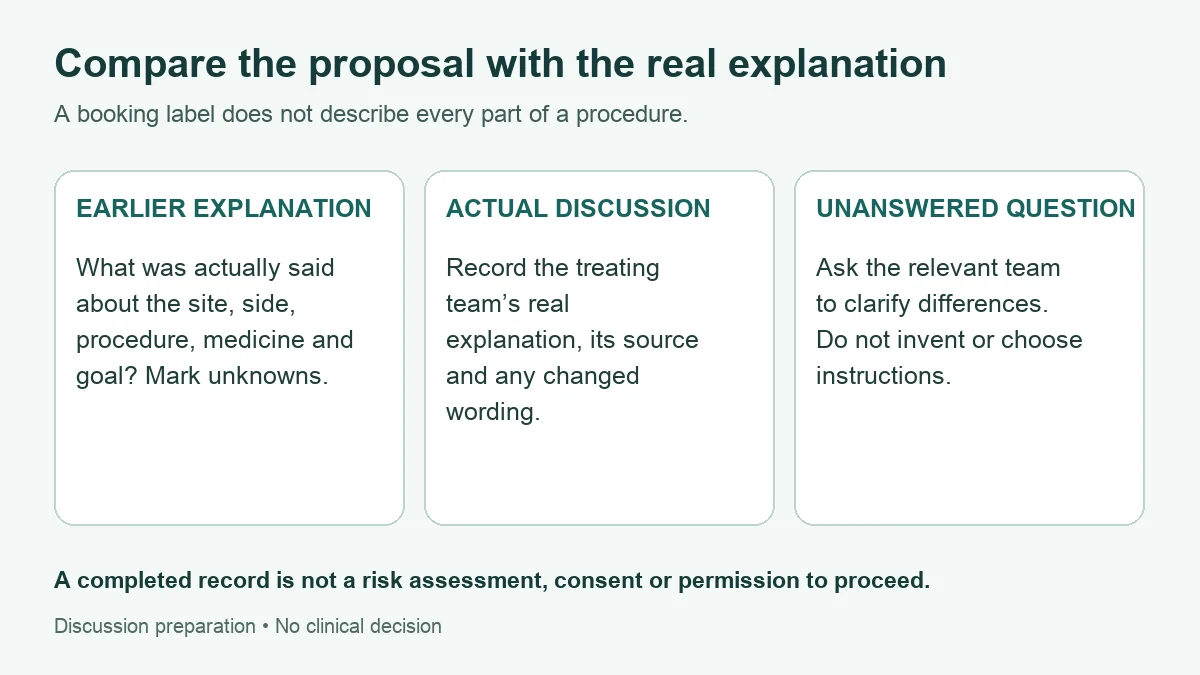
Compare the earlier explanation with the actual proposal
| Area | Earlier explanation | Actual discussion / remaining question |
|---|---|---|
| Site, side and procedure | Quote the appointment letter or booking message. Mark absent details. | Record what the treating team actually proposes; ask about any difference. |
| Medicine and purpose | Record what was said, including uncertainty. | What medicine is proposed, for what explained diagnosis and goal? Do not infer a dose. |
| Review and preparation | What information or instruction was requested, and by whom? | What has actually been reviewed? Which instruction applies if wording differs? |
| Return-home and activity | Record the arrangement you have prepared as a plan. | Does it match the actual procedure-specific advice? A plan is not clearance. |
| Aftercare and follow-up | Keep earlier contact details and promises with their source. | Record the actual contact route, expected follow-up arrangement and unanswered questions. |
If the target, medicine or procedure changes, ask the clinician to explain the updated purpose, expected benefit, alternatives, risks and practical instructions. Do not treat a general article or an earlier discussion as consent to an unexplained new proposal. The record cannot establish that a consent process is complete.
An apparent conflict may reflect different procedures, outdated paperwork or incomplete explanation; this guide cannot determine which. Quote both versions and identify their sources. Ask the relevant professionals to reconcile the wording rather than following whichever version is easier. Do not stop, restart or change a prescribed medicine, food or drink on the basis of this page.
Benefit, evidence and individual risk are separate questions
For joint injections, AAOS explains that corticosteroids can reduce inflammation and pain but do not cure the underlying cause of the inflammation. Some injections also involve local anesthetic, so immediate and later responses need explanation. Ask what outcome and review plan apply to the actual diagnosis; do not use brief relief as proof of tissue repair, a new diagnosis or permission for activity.
This is not a complete efficacy review of every condition treated with an injection. If a clinician names a diagnosis, ask which evidence supports the proposed benefit for that condition and what uncertainty remains. Ask how a non-injection option or not proceeding would fit the plan. A general description of pain relief does not tell you the probability or duration of benefit for an individual.
For a repeat proposal, bring the date and response to previous injections if known: what was done, any benefit or adverse experience, and what remains uncertain. Ask what makes this proposal different and how the earlier response affects the discussion. This article supplies no universal annual limit, minimum interval or threshold for deciding that another injection is appropriate.
NHS hydrocortisone guidance identifies information to disclose such as allergies, infection, unhealed wounds, pregnancy and diabetes. Hydrocortisone can affect blood-sugar control. This is information about that medicine, not proof that every corticosteroid or procedure has identical restrictions. Tell the treating team about relevant changes and ask for an individual plan rather than following a generic monitoring schedule from this page.
NHS medicine guidance also asks patients to disclose prescriptions, over-the-counter medicines, herbal remedies, vitamins and supplements. Having written a list does not mean it has been clinically reviewed. Record the actual review or unanswered question. Any change to treatment needs the relevant professional’s real instruction; the tool generates none.
Keep joint, soft-tissue and spinal procedures distinct
| Source / scope | What it can support here | What it does not establish |
|---|---|---|
| AAOS cortisone-shot information | General joint-injection explanation and selected risks. | Evidence for every soft-tissue condition or a personal treatment recommendation. |
| NHS hydrocortisone pages | Medicine-specific information to discuss about review, interactions and side effects. | Identical rules for all injectable drugs, sites, doses and procedures. |
| FDA epidural steroid safety project | A separate discussion of spinal epidural administration and rare serious neurologic risks. | The risk profile of a knee-joint injection or a conclusion about personal suitability. |
| A hospital’s aftercare leaflet | The instructions and contact arrangements used by that service. | Universal preparation, follow-up timing or activity instructions for all readers. |
The FDA’s Safe Use Initiative page on epidural steroid injections describes rare serious neurologic events associated with this route and the work to address them. This is a distinct route-specific warning, not a statement that every injection called a cortisone shot has the same risks. A spinal proposal requires its own explanation by the treating team; this guide provides no technique, drug-selection or eligibility advice.
If you do not know whether the proposal concerns a joint, tissue around a structure, or the spine, record that uncertainty and ask. Do not select a category from where you feel pain. The exact procedure determines which educational material and instructions are relevant.
Prepare aftercare and the actual contact route
Ask for written guidance specific to the actual procedure, including the return-home arrangement, activity advice, follow-up and which service to contact for concerns. Transport arranged in advance may still need checking against the actual advice. This page gives no fixed period for driving, resting or returning to work, and no instruction to try an activity to see whether it is safe.
For hydrocortisone, NHS side-effect guidance describes serious allergic reactions including sudden mouth, tongue or throat swelling and difficulty breathing, which require emergency help. It also identifies signs of infection and other serious changes requiring medical contact. These are selected examples, not a complete symptom checklist or a way to diagnose the cause. Use appropriate local services and the actual clinical instructions.
A Gloucestershire Hospitals pain-clinic aftercare leaflet calls for urgent advice for fever, chills or redness around the injection site, and urgent emergency assessment for worsening limb weakness or new loss of bladder or bowel control. The latter are especially relevant to discussions of spinal or nerve-related procedures. Do not generalize that service’s follow-up schedule, dressing instruction or exercise advice to every injection.
Do not assume severe or worsening pain, a hot swollen area or changing neurologic symptoms are an expected flare simply because the appointment involved a steroid. Seek appropriate clinical advice; the record cannot distinguish an expected response from a complication. An absence of the examples above is not a guarantee of safety. Do not wait to build a summary or receive a routine booking reply if care is needed.
Keep contact facts separate: a number supplied, a question prepared, an actual call or message, and an answer received. Ask which route applies outside normal hours if it has not been explained. A routine scheduling message is not an emergency contact. When help is needed, the actual procedure details and discharge information can support the clinical conversation; a perfectly completed form is unnecessary.
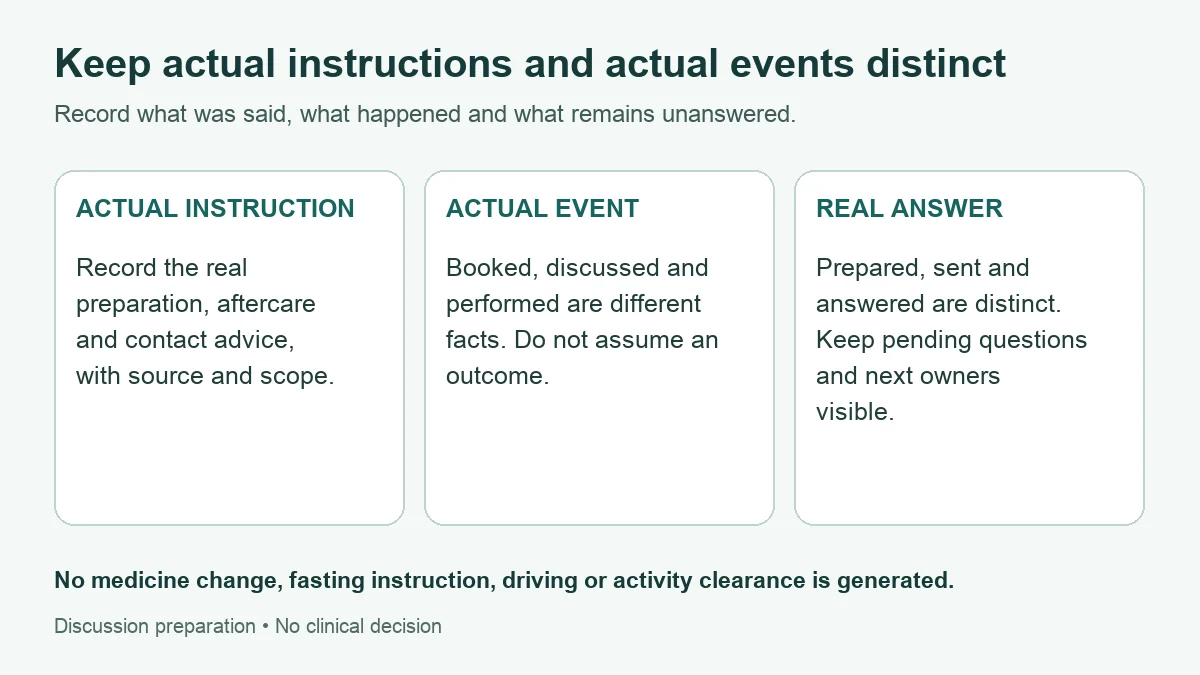
Two fictional examples with unanswered questions
These are writing demonstrations, not patient cases, instructions or evidence of outcomes. They leave important fields unresolved. The tool’s example buttons replace entries and label the output fictional; an example must never be copied as personal medical advice.
Example A: the booking says only “cortisone shot”
| Record area | Fictional entry |
|---|---|
| Earlier explanation | Appointment message says cortisone shot. No exact site, side, procedure or medicine recorded. |
| Actual proposal | No treating-team explanation supplied yet. No performed procedure recorded. |
| Question prepared | “What exact procedure, site, side and medicine are proposed, for what goal?” |
| Actual reply / next action | No reply supplied. Discuss the actual proposal and record the answer; no consent or clearance inferred. |
The note identifies missing information without inventing a diagnosis or deciding that an injection should or should not occur. It also does not treat the booking label as a complete explanation. Any new details belong with the real source, date and scope of the answer.
Example B: preparation wording and the return-home plan are unresolved
| Record area | Fictional entry |
|---|---|
| Earlier and later wording | A leaflet and later message appear different. Exact wording needs clarification with the relevant professionals. |
| Review / practical plan | Medicine review and return-home, activity and contact instructions are not confirmed. |
| Actual contact | Questions submitted in this fictional example; reply pending. No procedure or outcome supplied. |
| Actual reply / next action | No professional answer supplied. Record the real response and agreed next step; no medicine, food, drink, driving or activity change is instructed. |
This example does not choose between the instructions. It shows how to preserve the conflict as a question and distinguish a request from an answer. A completed record cannot resolve the clinical issue or verify a safe preparation plan.
Private preparation, actual-event and real-reply record
Download a blank offline copy before entering real notes. Use fictional entries on this page because the surrounding website may contain ads and analytics. The tool itself uses no network requests, browser storage or automatic saving. The downloaded copy contains no external assets; exports may contain sensitive notes and should be kept private.
The output organizes entries and optional questions from blank fields. It does not send a message, check a medical record, measure risk or establish informed consent. For a paper alternative, note the earlier proposal, actual explanation, difference, real instruction, actual event, contact, actual reply and next owner. You do not need every field to ask for help.
Cortisone proposal, actual instructions and real-reply record
Compare the earlier explanation with the actual proposal. Keep instructions, events and professional answers distinct. This organizer verifies no clinical fact and gives no permission to proceed.
Download the offline tool before entering actual health or personal notes. Use fictional entries here; the surrounding site may contain ads and analytics.
Offline copy. This file has no ads, analytics, external assets or automatic network requests.
The tool uses no network requests, browser storage or automatic saving. Refreshing or closing can lose entries. Keep downloaded notes private; avoid names, identifiers and full records. Do not delay appropriate care for a form or routine reply.
Start with the fictional example or download a blank offline copy.
Paper alternative: earlier explanation; actual proposal; goal/evidence/alternatives; difference; review; actual instructions; aftercare and contacts; actual visit; contact; actual answer; next owner. Unknown and pending are valid.
My cortisone proposal, instructions and actual-reply record
Unverified personal record for discussion. Entries verify no risk assessment or instruction and do not establish consent or permission to proceed.
Guide: living.kioptrix.com/pain-management-before-cortisone-injection/
After an actual answer arrives, keep its source, date and scope with the question and record only the next action really agreed. If you change an entry, rebuild the summary before using it. Copying or downloading does not send anything to a clinician. Do not undertake a procedure, change treatment or provoke symptoms to make the record more complete.
Common preparation questions
Does completing the record mean I am ready for the injection?
No. Entries remain unverified notes. The tool checks no medical history, determines no suitability and cannot complete a consent process.
Which instruction should I follow if the leaflet and message differ?
Quote both to the relevant professionals and ask them to reconcile the instructions for the actual procedure. This page supplies no substitute medicine, food or drink instruction.
Does early relief tell me the cause is fixed?
Do not infer healing, a new diagnosis or activity permission from relief. Ask the clinician how immediate and later observations will be interpreted for the actual procedure and diagnosis.
Can I leave the actual-answer field blank?
Yes. Not discussed, not recorded and reply pending are valid. Seek appropriate care for concerning changes without waiting for a form or routine reply.
Sources, scope and review limits
- AAOS: Cortisone Shot — joint-injection explanation, benefit limits and selected risks.
- NHS: Who can and cannot have hydrocortisone injections — medicine-specific review information; reviewed January 2024.
- NHS: Hydrocortisone with other medicines — medicine and supplement disclosure; reviewed January 2024.
- NHS: Hydrocortisone side effects — selected warning symptoms and contact guidance; reviewed January 2024.
- FDA: Safe Use Initiative, epidural steroid injections — route-specific safety context; distinct from joint injection.
- Gloucestershire Hospitals: Pain Clinic aftercare, GHPI1096_02_24 — local aftercare; review due February 2027.
Source check and editorial update: October 29, 2026. Rebuilt to compare the earlier proposal with actual instructions, events and answers. This is selected patient information, not a systematic evidence review or a validated decision aid. The original URL, publication date, author, category and tags are retained.
Written from a family-caregiver editorial perspective. No independent clinical review, real-reader usability study or improved clinical outcome is claimed. Tool checks establish behavior only. The hero is AI-generated fictional artwork; diagrams show record distinctions and no injection technique. Our background and editorial approach.