

Orthopedic pain management referrals can leave a practical gap: a letter has been sent, but nobody has explained what happens next or which team answers questions while you wait. Start with the actual referral purpose, confirmed progress and care contacts. A clinic name or booked appointment does not tell you whether all records arrived or who will explain an existing test result.
This guide focuses on the handover between services. Use the six referral checks, compare sent, received, booked and completed, read two fictional writing examples or download the private offline record. You do not need every answer before asking for help.
Care comes before paperwork. New severe or rapidly worsening symptoms may need prompt clinical assessment rather than a routine booking message. For an emergency, use local emergency services. AAOS lists examples including severe bleeding, loss of consciousness, and intense pain with concerning symptoms such as fever or inability to bear weight or move a limb. These examples are not a complete triage list. Follow actual clinical advice and use the appropriate local urgent route; a referral worksheet cannot decide urgency. AAOS patient guidance.
This is caregiver-written general education, not a diagnosis, clinic-selection test or personal treatment plan. The record below supplements communication between practices. It does not make the patient responsible for carrying the entire medical record, chasing every clinician or assigning professional duties. Ask the referring practice what coordination help is available.
Table of Contents
Six essential orthopedic pain management referral checks
| Check | What to establish | Useful wording |
|---|---|---|
| 1. Purpose | The question actually put to the receiving service, including what remains uncertain. | “What are you asking this service to assess or advise on?” |
| 2. Destination and progress | The intended service and only the status actually confirmed. | “Has that service confirmed receipt, and what does the current status mean?” |
| 3. Relevant records | Requested information, actual transfer and any missing item. | “Which records are needed, and will the practices exchange them directly?” |
| 4. Care contacts while waiting | Actual answers about medicines, existing results, changing symptoms and follow-up. | “Which team should I contact about each of these questions until the visit?” |
| 5. Access and changes | The specific scheduling, language, transport, cost or redirection issue. | “What help is available, and who will follow up if the referral cannot proceed?” |
| 6. Actual reply and next owner | What was really answered, its scope and the next action actually agreed. | “What happens next, who will do it, and what follow-up arrangement have we agreed?” |
These are prompts for an unfinished conversation, not eligibility criteria or mandatory stages. A short note saying “receipt unconfirmed; referring practice checking” can be more useful than a full page of assumptions. Keep the source and date with a confirmation when available; leave “not recorded” rather than guessing.
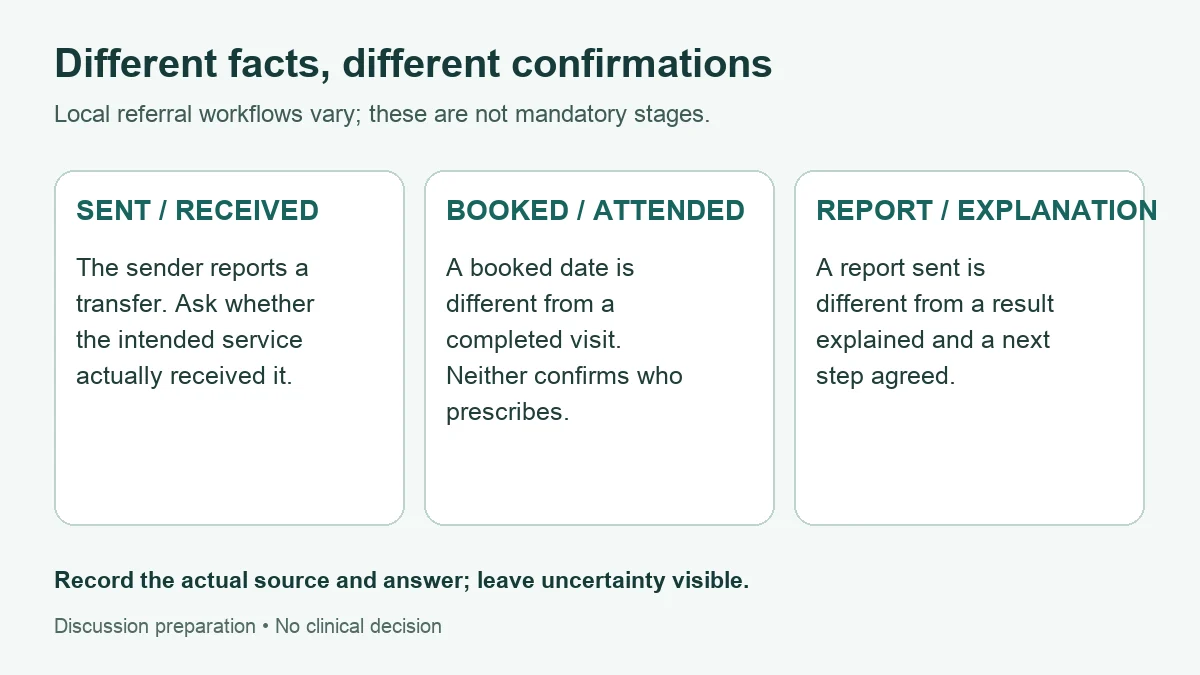
Pain clinic or orthopedist: ask about the actual service
Avoid the shortcut that orthopedists only diagnose or operate while pain clinics only relieve symptoms. AAOS describes orthopaedic care as including diagnosis, nonsurgical and surgical treatment, rehabilitation and prevention. Seeing an orthopaedic surgeon does not necessarily mean having surgery. ASA pain-management information also includes causes and diagnosis, medicines and nondrug approaches. A label alone does not describe a particular clinic’s staff, remit or available care.
Ask what the intended service is being asked to do: assess an unresolved question, offer advice about options, provide an intervention if appropriate, or help coordinate ongoing care. Those are possible referral purposes, not categories that determine which specialty the reader should choose. If the explanation conflicts with the booking description, ask the referring practice to clarify with the destination.
A useful preparation note separates the clinician’s actual explanation from the reader’s hope. “I hope to understand why ordinary tasks remain difficult” is a goal; “the referral requests assessment of X” is a statement only if it has actually been explained or documented. The tool does not turn the first into the second.
If you do not know the cause of the pain, say that. Do not select a diagnosis from a body location or seek a particular scan just to make a referral look complete. The appropriate professional can explain what assessment or existing information is needed for the question being asked.
Distinguish referral progress from clinical responsibility
| Recorded fact | What it confirms | What remains a separate question |
|---|---|---|
| Sent | The sending practice reports a transfer to a stated destination. | Did the intended service receive the referral and relevant attachments? |
| Received | Receipt was actually confirmed by the intended service. | Has it been reviewed, accepted or redirected under that service’s process? |
| Reviewed / accepted / redirected | The service gave that actual status and explanation. | What action follows, who arranges it, and what remains unanswered? |
| Booked | A visit date or booking arrangement was actually provided. | Has the visit occurred? Who answers current care questions in the meantime? |
| Attended | The consultation actually took place. | Was a report sent, received and explained? What was actually agreed? |
| Report returned / explanation / next step | Each confirmed fact can be recorded separately. | Which open question still needs an answer, and who has agreed to follow up? |
Local workflows and terminology differ. This table is an editorial way to distinguish facts, not a universal sequence or proof that a service must use each label. A portal status can be quoted with its source without interpreting it as clinical acceptance. If a message is unclear, ask the practice what it means in that system.
Separate administrative and clinical questions. Reception may confirm a date or delivery status; that confirmation is not a professional answer about treatment or who will manage a result. Ask for the relevant clinical route when the question concerns care. Do not send sensitive details to an unverified address found in a general search result.
For a referral that is redirected or cannot proceed, record the explanation actually received and ask who will arrange the next step. Do not assume that a declined booking means no care is needed, or that another service has automatically received the information. New concerning changes require appropriate care even while a routine referral is unresolved.
Compare roles and unanswered care-contact questions
| Question area | Record the actual answer | Avoid assuming |
|---|---|---|
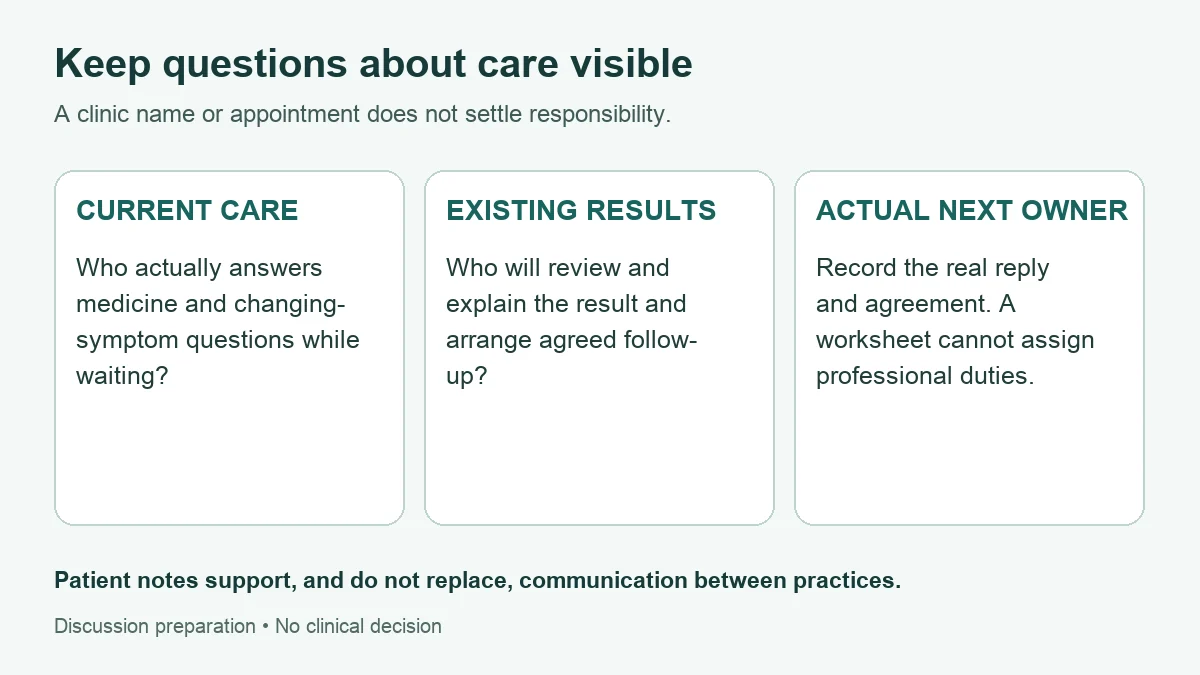
| Medicines / prescriptions | Which team currently answers the medicine question, and any actual handover explanation. | The booked specialist has accepted prescribing; or a worksheet instructs a change, interruption or refill. |
| Existing test results | Who will review the result, explain it and arrange any agreed follow-up. | A result visible online has been explained, or silence means normal. |
| Symptoms while waiting | The actual clinical contact route and advice received, including out-of-hours instructions if supplied. | A routine scheduling inbox can assess urgent clinical changes. |
| Referral and record transfer | Which practice has agreed to check receipt or missing requested information. | The patient must act as the sole messenger between teams. |
| Visit report and follow-up | Who will send or review the report and what next action has actually been agreed. | Attendance alone completes every part of the handover. |
A question such as “Who is responsible?” can be too broad for a useful reply. Name the unresolved task: explaining an already-performed test, answering a medicine question, checking referral receipt or arranging follow-up. Record the actual answer and its limits. This guide cannot determine professional or legal responsibility from a clinic name or completed form.
If instructions from two services appear to conflict, quote the conflicting wording and ask the relevant teams to reconcile it. Do not choose whichever wording is more convenient or use this record to create a new treatment plan. The examples here provide no medicine dose, stopping instruction, new test requirement or personal care recommendation.
Records and access: ask for help with the handover
AHRQ’s Make Referrals Easy, Tool 21 is guidance for practices. It recommends explicit referral arrangements, relevant information exchange, assistance with barriers and follow-up. It specifically says not to rely on patients to relay information. Patient notes should support that work, not replace direct clinical communication or turn coordination failure into the patient’s fault.
For this reader worksheet, record only the item being discussed and whether transfer or receipt was confirmed. Ask the practices which relevant referral information, reports or current medicine information they need and how they will exchange it securely. Follow their consent and transfer process. Do not collect an entire chart, buy new imaging or repeat a test merely to fill a box.
If you hold a copy of an existing report, ask whether it is useful and which agreed channel to use. Keep a note of the request rather than pasting the report into this page. A receipt for an attachment says nothing about its clinical interpretation. Record a report as “received” only when confirmed and “explained” only when an explanation was actually given.
Name an access barrier in concrete terms: difficulty arranging the date, needing language assistance, inability to reach the location, or uncertainty about a quoted cost or coverage condition. Ask what help the practice or service can actually offer. Record an offer as an offer until it has been arranged; no interpreter, transport, funding or appointment is guaranteed by this article.
A practical request is: “I cannot complete this booking because of this barrier. Who can help, and what is the next agreed step?” You do not have to solve every administrative issue before raising the problem. If cost or insurance information is unclear, ask the service and payer for the relevant details; this guide gives no price or coverage estimate.
Two fictional examples: incomplete answers stay visible
These are writing demonstrations, not patient cases, clinical advice or evidence of improved outcomes. They deliberately leave gaps. The actual reply field must contain a real answer when received, not the answer someone hopes to hear. The tool buttons load these fictional situations and replace existing entries.
Example A: the sender says sent, receipt is unconfirmed
| Record area | Fictional entry |
|---|---|
| Actual information | The referring practice says the referral was sent. The intended service’s receipt and review are not confirmed. |
| Question prepared | “Could the practices check whether the intended service received the referral and requested attachments, and tell me who will follow up?” |
| Contact / actual reply | Question prepared; no actual contact or receiving-service reply recorded. |
| Next owner | Unconfirmed. Record the practice’s real agreement when received; do not mark accepted or booked in advance. |
This note identifies a transfer question without claiming the referral was lost. It does not ask the patient to resend private records through an unverified route. The blank clinical-contact fields remain optional questions rather than conditions for asking the practice to help.
Example B: appointment booked, care contacts are unresolved
| Record area | Fictional entry |
|---|---|
| Actual information | A specialist visit is booked. No explanation of current prescribing or existing-result review has been recorded. |
| Question sent | “Which team should answer my current medicine question, and who will explain the existing test result while I wait?” |
| Contact / actual reply | Question submitted in this fictional example; response pending. No professional advice or treatment change supplied. |
| Next owner | Record the actual answer, its scope and agreed follow-up. A booked visit does not answer these questions by itself. |
The reader does not stop, change or delay a medicine on the basis of this example. The distinction is between a confirmed booking and an unanswered care-contact question. If symptoms change in a concerning way, use the appropriate clinical route instead of waiting for a routine scheduling response.
Private referral progress and actual-reply record
Start with the smallest useful note. Download a blank offline copy before entering real information; use only fictional entries on this site page because the surrounding site can contain ads and analytics. The downloaded tool itself contains no external assets, network requests, storage or automatic saving. Exports may contain sensitive notes: keep them private.
The tool produces a plain-language brief and optional questions from blank fields. It does not check a referral system, contact a practice, confirm acceptance, assign duties or calculate how long it is safe to wait. Complete fields remain unverified. Copying or downloading a note does not send it to a clinician.
Referral progress, responsibility questions and actual-reply record
Keep the referral question, actual progress, care-contact questions and real replies distinct. This organizer does not select a clinic, assign responsibility or replace communication between practices.
Download the offline tool before entering actual health or personal notes. Try fictional examples here. The offline copy has no site ads, analytics or external assets.
Offline copy. This file has no ads, analytics, external assets or automatic network requests.
No network requests, browser storage or automatic saving are used by this tool. Refreshing or closing may lose entries. Keep exports private. Avoid names, contact details, identifiers and full records. Seek appropriate care without waiting for a worksheet or routine booking reply.
Start with the fictional example or download a blank offline copy.
Paper alternative: purpose; destination; confirmed progress; record transfer; prescribing contact; result review; interim care contact; access barrier; actual contact; real reply; next owner. Unknown and pending are valid. Do not delay care for a record.
My referral progress, contact and actual-reply record
Unverified personal record for discussion. Entries do not verify referral progress, assign professional responsibility or supply clinical advice.
Guide: living.kioptrix.com/orthopedic-pain-management/
To use the brief, choose the unresolved question relevant to the next contact. Ask the practice how it wants information supplied, then record the actual reply and agreed next owner privately. A short paper note works equally well if a downloaded tool is inconvenient. The record is optional; care and communication should not depend on completing it.
Common referral questions
Does a booked appointment mean the specialist now manages all care?
No such handover should be inferred from a date alone. Ask about the specific unresolved task, such as the current medicine question or explanation of an existing result, and record the actual answer.
Do I need an MRI before a pain-management appointment?
This guide establishes no imaging requirement. Ask the relevant professional what information is needed for the actual referral question. Do not arrange or repeat a test just to complete the worksheet.
What if neither practice has answered?
Record who was actually contacted, the question and the pending status. Ask the referring practice for coordination help and the appropriate clinical contact while waiting. Concerning changes may need care before a routine reply; this tool sets no waiting deadline.
Is a completed record proof of referral acceptance or a care agreement?
No. It is an unverified discussion note. Quote real confirmations with their source and scope; the worksheet cannot verify systems, allocate professional responsibility or provide a treatment plan.
Sources and review limits
- AHRQ: Make Referrals Easy, Tool 21, toolkit 3rd edition; page reviewed April 2024 — practice-level referral communication and assistance, not validation of this worksheet.
- AAOS OrthoInfo: What Is an Orthopaedic Surgeon? — orthopaedic scope, nonsurgical care and selected emergency examples; not a personal referral instruction.
- American Society of Anesthesiologists: Pain Management — general diagnosis and treatment context; not a list of services available in every pain clinic.
Source check and editorial update: October 29, 2026. Rebuilt around referral progress, care-contact questions, actual replies and agreed next actions. The status labels and record tool are editorial adaptations, not a validated AHRQ instrument or universal workflow. The original URL, publication date, author and category are retained.
Written from a family-caregiver perspective. No independent clinical review, legal responsibility assessment, real-reader usability study or improved clinical outcome is claimed. Functional checks establish tool behavior only. The hero is AI-generated fictional artwork; the diagrams organize questions rather than prescribe care. Our background and editorial approach.