

Hip pain at night that disrupts sleep, recurs or worsens deserves a clinical discussion. A useful sleep review separates current individual instructions, a proposed change and what actually happened overnight. A pillow response, preferred side or quieter morning cannot diagnose the cause or establish that a new position is appropriate.
This guide provides seven preparation checks, a setup comparison, two fictional writing examples and a free offline sleep, observation and real-reply record. See the comparison, read the examples or jump to the record tool. Use what is already known; no three-night experiment, extra walking or repeated painful position is required.
Get emergency help before making a sleep record. Severe hip pain after a fall or injury, inability to walk or bear weight, or tingling/loss of feeling in the hip or leg after injury needs emergency assessment. Do not force walking to prove capacity or drive yourself. Use local emergency services, including 911 in the U.S. where emergency assistance is needed. NHS hip-pain guidance describes these warning signs; its UK contact numbers are not U.S. instructions.
With back/leg symptoms, new difficulty starting urination, inability to urinate, new bladder/bowel control changes, saddle-area numbness, or severe/worsening weakness or numbness in both legs needs emergency assessment. See NHS sciatica emergency guidance. Do not wait for morning, a pillow trial or a routine reply.
Sudden severe hip pain without injury, or a hot swollen hip, needs urgent medical advice; do not wait for fever. Other concerning changes, such as new weakness, worsening numbness, unexplained weight loss or a marked change in ordinary function, also need timely clinical advice. Emergency signs override routine follow-up. After an operation, follow the discharge contact instructions for new symptoms and unclear restrictions; a generic sleep article cannot replace that plan.
Arrange clinical review when hip pain affects sleep or ordinary activity, worsens or keeps returning. You do not need to fail a home experiment or complete three nights of notes first. This is caregiver-written general education, not an examination, diagnosis, sleep treatment or positioning prescription. Your care team can assess the cause and give advice suited to the person.
Table of Contents
Seven essential checks for a hip pain at night review
| Check | What to keep distinct | Question to prepare |
|---|---|---|
| 1. Current instructions | Actual advice, source/date and scope versus a generic internet suggestion. | What applies to this person, including any operation or other positioning restriction? |
| 2. Proposed change | A new pillow, position, surface or help suggestion versus advice received. | What remains unconfirmed before changing the arrangement? |
| 3. Actual night | What is remembered versus the intended setup. | What happened, and which parts are unknown? |
| 4. Sleep observations | Existing wake-ups, discomfort and timing versus a calculated sleep-loss estimate. | What was already noticed without extra monitoring or alarms? |
| 5. Daily-life changes | Existing morning or daytime task changes versus a new function test. | What else needs to be described to the clinician? |
| 6. Contact and answer | A prepared question, actual contact and answer received. | Who has actually replied, and what did the reply cover? |
| 7. Follow-through | A real agreement, responsible role and unresolved question. | What is the next agreed step, and what remains unclear? |
These checks organize a conversation. They do not score severity, identify a painful structure, determine urgency or approve a sleep setup. Complete only the useful parts. An incomplete record can still explain a concern; unknown is better than an invented time, position or instruction. Warning symptoms need appropriate help rather than a completed checklist.
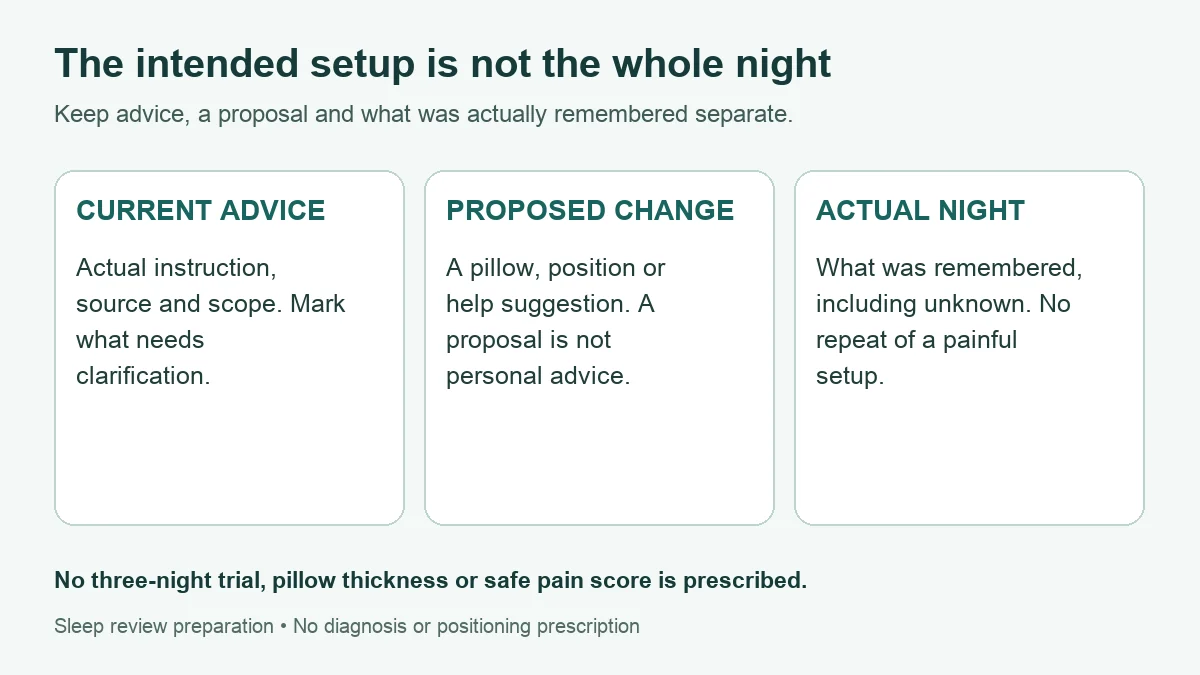
Compare current instructions, proposed changes and the actual night
A setup can differ between the moment someone gets into bed and the moment they wake. A support may move, help may be unavailable, or a person may not remember the position. That difference is useful to describe. It does not prove that a pillow failed, the mattress caused pain or the reader used the setup incorrectly.
| Topic | Current instruction / proposed change | Actual situation and unresolved point |
|---|---|---|
| Sleep position | Keep the actual advice and its source separate from a suggestion to switch sides or lie differently. | Record a position only if remembered. Do not recreate a painful position to compare sides. |
| Pillow or other support | Record the arrangement actually advised, if any, and a proposed change separately. | Describe a support shift already noticed. Do not infer the whole night from where a pillow was found. |
| Mattress or topper | A purchase suggestion is not a diagnosis or a treatment recommendation for the person. | Record actual surface changes already made, uncertainty and practical questions before another purchase. |
| Turning / getting out of bed | Keep individual movement instructions and help arrangements, including postoperative advice. | Describe actual help, missing help or difficulty already experienced. Do not practise a difficult transfer for the record. |
| Other treatment / activity | Record relevant existing instructions and actual use or activity without changing them for a test. | Several circumstances may change together; timing does not identify a cause. |
| Contact / reply | A planned question, actual contact and professional answer are different entries. | A booked visit is not an answer. Preserve the wording, date, scope and remaining question. |
If two instructions seem to conflict, preserve both sources, dates and wording and ask the relevant team to clarify. Do not turn a vague remembered suggestion into a precise restriction. If a position cannot be maintained or an arrangement becomes impractical, explain the barrier rather than forcing it or substituting a blog’s alternative.
After hip surgery, a change involving side-lying, rotation, pillows or getting out of bed may depend on the operation and personal instructions. Ask the surgical or rehabilitation team about the actual difficulty. General condition-specific advice elsewhere on this page is background for discussion, not an alternative discharge plan.
What the hip-pain and sleep-position sources support
Cambridge University Hospitals: Gluteal tendinopathy discusses side-lying support and other positioning options for that condition. This is the source for the former pillow and semi-prone suggestions. It does not establish that every person with nighttime hip pain has gluteal tendinopathy or should use those positions. Its advice does not override a person’s postoperative or other individual instructions. The tool below records advice actually received instead of selecting a position.
AAOS: Hip Bursitis explains that trochanteric bursitis pain may worsen at night when lying on the affected hip. That supports a condition-specific symptom description, not a diagnosis from side preference. The actual source title is Hip Bursitis; calling it an official guideline for all hip pain at night would overstate its scope.
Mayo Clinic: Hip pain — causes and when to see a doctor includes self-care suggestions for minor hip pain and medical contact guidance. It recognizes several possible causes. It does not validate this article’s former three-night eligibility checklist, thin-versus-thick pillow rule or walking dose. Individual care needs depend on more information than an overnight observation.
NHS: Hip pain in adults lists sleep disruption, recurring pain and effects on normal activity as reasons for clinical review, alongside urgent and emergency signs. Its separate mention of a home-treatment interval is not a requirement to wait when another reason for care already applies. Its UK service routes must be adapted to the reader’s location.
None of these sources validates this editorial worksheet as a diagnostic or treatment decision aid. They do not establish a universal pillow thickness, best mattress, safe pain score or three-night waiting rule. A useful note preserves facts and uncertainty; a clinician may need history, examination and other information beyond the note.
Record sleep and observations without a home diagnostic test
Use ordinary observations already available: waking with discomfort, a position remembered, a shifted support, difficulty turning, or an existing morning task change. Describe the location and feeling in the person’s own words without mapping outer-hip, groin or back discomfort to a diagnosis. There is no need to press the hip, repeat a movement, count steps or compare stairs to obtain clues.
| Observation | Useful wording | What it cannot establish |
|---|---|---|
| Remembered waking | “I remember waking with discomfort; the time is uncertain.” | A complete waking count, exact sleep duration or cause. |
| Support position | “The pillow was elsewhere when I woke; the rest of the night is unknown.” | Which position was held all night or why symptoms occurred. |
| Fewer wake-ups | “I remember fewer wake-ups on this night.” | A treatment effect, recovery or permission to change instructions. |
| Morning function | “There was an existing change in ordinary walking or turning.” | A diagnosis or a passed/failed function test. |
| Daytime context | “This activity and this later symptom were both noticed.” | That activity caused the night pain or that reducing it will resolve symptoms. |
| Real reply | “This was the actual answer, from this role, on this date.” | Advice about a different activity or a broader permission than the reply contains. |
A count of remembered wake-ups multiplied by guessed settling minutes is not a reliable measurement of total sleep loss. Record approximate timing only if already known and useful. Do not stay awake to monitor position or set alarms for the worksheet. If sleep problems need assessment in their own right, raise that question with the relevant clinician.
Avoid changing several treatments or withholding a prescribed treatment merely to make a cleaner experiment. Pain relief is a legitimate care goal. Follow actual instructions and ask the clinician or pharmacist about uncertainty. Relief after medicine, heat, cooling or a position change cannot by itself identify the cause. This guide supplies no medicine, heat, stretching or walking schedule.
No particular side, pillow height or softer surface is guaranteed to help. Before spending money, distinguish a comfort preference from a clinical recommendation and ask whether the proposed change fits existing instructions and practical needs. The record can capture a product or setup already used; it does not rank products or imply that a purchase is needed.
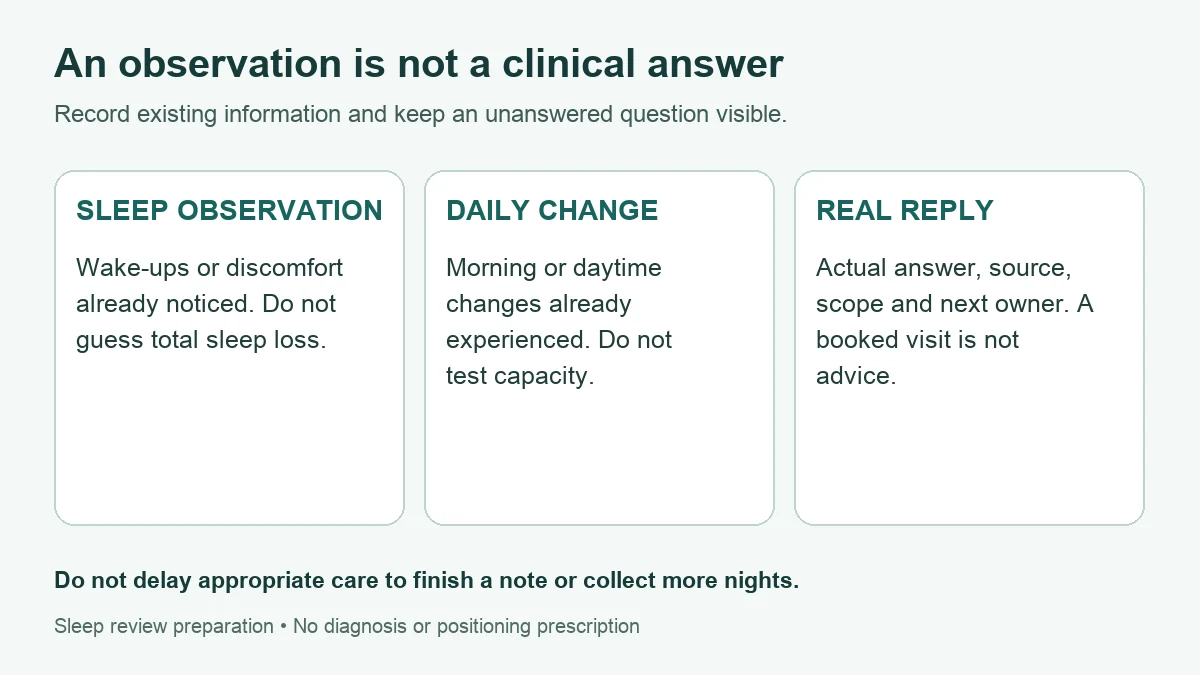
Who can clarify the sleep plan and actual difficulty?
| Role | Useful contribution | Keep this boundary |
|---|---|---|
| Person experiencing pain | Preferences, existing observations and actual difficulties. | No need to demonstrate pain or finish a diary before asking for help. |
| Treating clinician / appropriate health professional | Assessment, relevant instructions and follow-up. | The worksheet does not diagnose a condition or prescribe a position. |
| Surgical / rehabilitation team when relevant | Operation-specific restrictions, movement education and practical clarification. | A general pillow article cannot replace personal discharge instructions. |
| Caregiver or helper, with consent | Help actually available and observations genuinely witnessed. | Do not invent overnight observations or record private information unnecessarily. |
| Urgent / emergency care team | Timely help when symptoms warrant it. | Do not wait for a routine sleep review or a returned worksheet. |
Record whom the question actually reached and whether an answer has been received. If advice was given, keep its exact scope: what it addresses, what remains unanswered and any agreed follow-up. A reply about one practical issue may not answer a new symptom. The tool does not send a message, request an appointment or monitor the record.
Our side-sleeping assessment and questions guide provides brief background about the limits of a sleeping preference. This page adds a night-to-clinician record focused on instructions, actual setup, observations and answers. For medication questions in an older adult, the pain medicine review guide separately records actual use and replies. Each organizer has a limited purpose.
Two fictional hip pain at night writing examples
These examples are invented records, not patient stories, medical instructions or evidence that a change works. Neither supplies a real professional answer or successful recovery. Loading an example replaces entries in the tool. Use your actual care instructions for real concerns, and seek appropriate help without waiting for a record.
Example A: the support shifted overnight
| Record | Fictional entry |
|---|---|
| Current instruction | An instruction to use a leg-support pillow is recalled. Exact wording, source and applicability still need checking; no position is prescribed here. |
| Intended / actual | The reader intended to use that existing arrangement. On waking, the pillow was elsewhere; the position through the rest of the night is unknown. |
| Observation | A wake-up with discomfort is remembered. Exact time and total sleep lost are unknown. |
| Question / answer | A question about the practical difficulty was submitted to the care team. Reply pending; no clinical answer supplied. |
Writing example: “I intended to follow the arrangement I recall being advised. When I woke, the pillow was no longer where I expected. I do not know my position through the night or whether the support shift explains the pain. Could you clarify the instruction and what to do if the setup cannot be maintained? I have not repeated a painful position to demonstrate it.”
Example B: fewer remembered wake-ups, daily difficulty remains
| Record | Fictional entry |
|---|---|
| Sleep observation | Fewer wake-ups were remembered than on another night; no measured sleep total or treatment effect inferred. |
| Daily observation | An existing change in ordinary morning walking remained. No extra walk, stair or movement test performed. |
| Context | Individual positioning instructions are not supplied; circumstances may differ between nights. |
| Question / answer | A question about both observations was prepared. Contact not yet recorded; no actual professional answer supplied. |
Writing example: “I remember fewer wake-ups, but the existing difficulty with ordinary morning walking remained. I have recorded both without treating better sleep as recovery or repeating a task to test it. What assessment and individual advice fit this change? I have not yet recorded a reply.” Real urgency depends on the situation; emergency warning signs need emergency care.
Free sleep, observation, contact and real-reply record
The tool has 11 optional fields: current instructions, proposal, actual help, remembered night, differences, sleep observations, daily changes, other context, contact, real reply and agreed follow-through. Blank items produce optional clarification questions. Completed fields remain unverified notes. No diagnosis, urgency score, pillow thickness or three-night trial is generated.
Try fictional examples on this page. Download the offline HTML copy before entering actual health or personal notes. The live site may use site services. The downloaded file has no ads, analytics, external assets, automatic network requests or browser storage. It needs no account or email. Exports contain entries; keep them private and share through an agreed channel with consent.
Build a record, copy it, download text or use browser print/save PDF. Editing hides the old output until rebuilt. Nothing is submitted and there is no automatic saving. Avoid names, addresses, identifying contact details and full medical records. If the tool is unavailable, use paper and leave unknown items visible; do not delay care.
Hip pain at night: sleep, observation and real-reply record
Keep current instructions, a proposed change, the night actually remembered, existing observations and the actual professional answer separate. This is an organizer, not a sleep test, diagnosis or positioning prescription.
Download the offline tool before entering actual health or personal notes. Try fictional examples here. The offline copy has no site ads, analytics or external assets.
Offline copy. This file has no ads, analytics, external assets or automatic network requests.
The tool uses no network requests or browser storage and does not save automatically. Refreshing or closing may lose entries. Exports contain your notes; keep them private. Avoid names, addresses, identifying contact details and full medical records. Do not delay urgent or emergency care for a record.
Start with the fictional example or download a blank offline copy.
If the tool does not load, use paper: current instructions; proposal; actual help; actual night; differences; existing sleep observations; daily changes; context; contact; real answer; agreed next owner. Unknown is a useful entry. Do not delay care for a form.
My sleep, observation, contact and real-reply record
Unverified personal record for discussion. Entries are unverified notes, not medical advice, proof of cause or permission to change instructions.
Guide: living.kioptrix.com/hip-pain-at-night/
Common questions about hip pain at night records
Must I complete three nights before contacting a clinician?
No. Sleep disruption, worsening or recurring pain and effects on daily activity can already be reasons to seek review. Urgent and emergency signs need appropriate help without a diary. There is no required observation period.
Can a pillow response tell me the diagnosis?
No. A response describes an experience. It cannot identify the source, prove healing or determine which position is appropriate. Keep the observation separate from the clinical question.
Which side, mattress or pillow thickness is best?
This guide cannot choose for the person. General positioning suggestions may concern a particular condition; personal restrictions and other needs also matter. Ask about the actual difficulty and existing instructions rather than treating a purchase or a position as a diagnostic test.
What if I do not remember my position or waking times?
Write unknown or approximate if appropriate. Do not reconstruct a full night from a pillow location, set alarms or provoke discomfort to get better data.
What if sleep improves but morning function changes?
Record both existing observations and seek appropriate assessment. Fewer remembered wake-ups do not establish recovery. Do not repeat walking, stairs or turning to prove the change.
Can I use the general advice after hip surgery?
Use the surgical team’s actual instructions and contact route. Ask about unclear or conflicting advice and an arrangement you cannot maintain. This organizer supplies no postoperative position or transfer technique.
Sources, corrections and review limits
- NHS: Hip pain in adults — contact guidance, symptoms and general context; UK service routes have local scope.
- NHS: Sciatica — neurological emergency warnings; not a diagnosis of night pain.
- CUH: Gluteal tendinopathy — condition-specific positioning background, not advice for every hip symptom.
- AAOS: Hip Bursitis — condition-specific symptoms, not a general nighttime-pain guideline.
- Mayo Clinic: Hip pain — causes, minor-pain self-care and medical contact guidance.
Editorial correction and source check: October 29, 2026. Removed the three-night eligibility checklist, symptom-to-diagnosis shortcuts, thin/thick pillow decision rule, walking dose, sleep-loss calculator and unverified reader-improvement anecdote. Replaced repeated experiment instructions with an optional record of existing information. Corrected source labels and applicability. The original URL and publication date are retained.
Written from a family-caregiver editorial perspective. No independent clinical or sleep-specialist review, validated decision aid, real-reader usability study or improved outcome is claimed. Functional checks verify tool behavior only. The hero is AI-generated fictional artwork; body diagrams explain records, not sleeping positions or transfer technique. Our background and editorial approach.