

Hip pain noticed while lying on your side is an observation, not a diagnosis. This guide helps you check what an evaluation actually explained: what you noticed, what you suspect, what the clinician said, what remains uncertain and what the next plan really is. It does not choose a sleep position, pillow, test or treatment.
Go to the six explanation checks, the observation–hypothesis–explanation table, two fictional writing examples, or the private explanation and next-plan tool. You can start with an incomplete account. No painful position test, required diary or proof that a product failed is needed before asking for care.
Warnings come before paperwork. Seek emergency assessment for severe hip pain following a fall or injury, inability to walk or bear weight, or tingling/loss of feeling after an injury. Do not test walking to complete this record. Sudden severe pain without an injury, a hot/swollen hip, skin colour change, or hip pain with fever/shivering or feeling generally unwell needs urgent assessment. Use local urgent or emergency services; for a U.S. emergency call 911. These selected warnings are adapted from NHS adult hip-pain guidance; its UK service numbers do not apply everywhere. A routine message or a previously reassuring explanation must not delay needed care.
Hip pain affecting sleep or normal activities, worsening or repeatedly returning deserves clinical discussion. This page supplies no safe waiting interval. After surgery, bring the actual postoperative instructions and contact route; a general side-lying article cannot replace them. New concerns may require reassessment even when a prior explanation exists.
This educational guide is published by a family-caregiver-run site. The operator is not a medical professional, and no independent medical review is claimed. It is a communication aid, not a validated diagnostic instrument. Pain, disrupted sleep, worry and practical difficulty all matter; the record does not rank one as more legitimate than another.
Table of Contents
Hip pain: six essential explanation checks
| Check | Keep this fact | Clarify this gap |
|---|---|---|
| 1. Observation | The patient’s own description and changes already noticed. | What information is missing without provoking pain? |
| 2. Personal hypothesis | A possible explanation you are wondering about. | Has it actually been assessed, or is it still a guess? |
| 3. Evaluation question | What you want the assessment to explain. | Was the question only prepared, or actually asked? |
| 4. Actual explanation | The clinician’s explanation, attributed to its source. | What supports it, and is it provisional? |
| 5. Remaining uncertainty | Symptoms or wording not explained or understood. | What needs clarification rather than reassurance inferred from silence? |
| 6. Next plan | Actual instructions, owner and review arrangement. | What really happened next, and what remains blocked? |
The checks are not points toward a diagnosis, scan, referral or reassurance. They make a conversation easier to review. A completely filled record can still contain a mistaken recollection. A short record can still raise an important concern. “Unknown,” “not asked” and “not yet answered” are useful entries.
Compare observation, personal hypothesis, clinical explanation and remaining question
| Observation | Personal hypothesis | Actual clinical explanation | Remaining question |
|---|---|---|---|
| Pain noticed while lying on the side. | “I wonder whether pressure caused it.” | Not yet supplied, unless actually discussed. | What did the assessment suggest, and what remains uncertain? |
| Patient’s own description of location. | A specific structure may be suspected by the patient. | Keep only the clinician’s actual explanation and attribution. | What does location contribute, and what can it not establish? |
| Waking or difficulty settling already noticed. | Pillow or sleeping side may be blamed. | Distinguish a comfort suggestion from an explanation of the pain. | Did the evaluation address the concern or only the setup? |
| An existing report contains a finding. | The patient thinks the finding explains all symptoms. | Record how the clinician actually interpreted its relevance. | Which symptoms were explained, and which were not? |
| A previous diagnosis was communicated. | The current concern may be assumed to have the same cause. | Keep the prior explanation in its actual context. | Does it cover the current change or need reassessment? |
Keep the patient’s account separate from a helper’s observation, with consent. A helper may notice difficulty turning; that does not replace the patient’s description or establish a cause. Avoid converting “perhaps” into “confirmed,” a product recommendation into a diagnosis, or a report label into an explanation of every symptom.
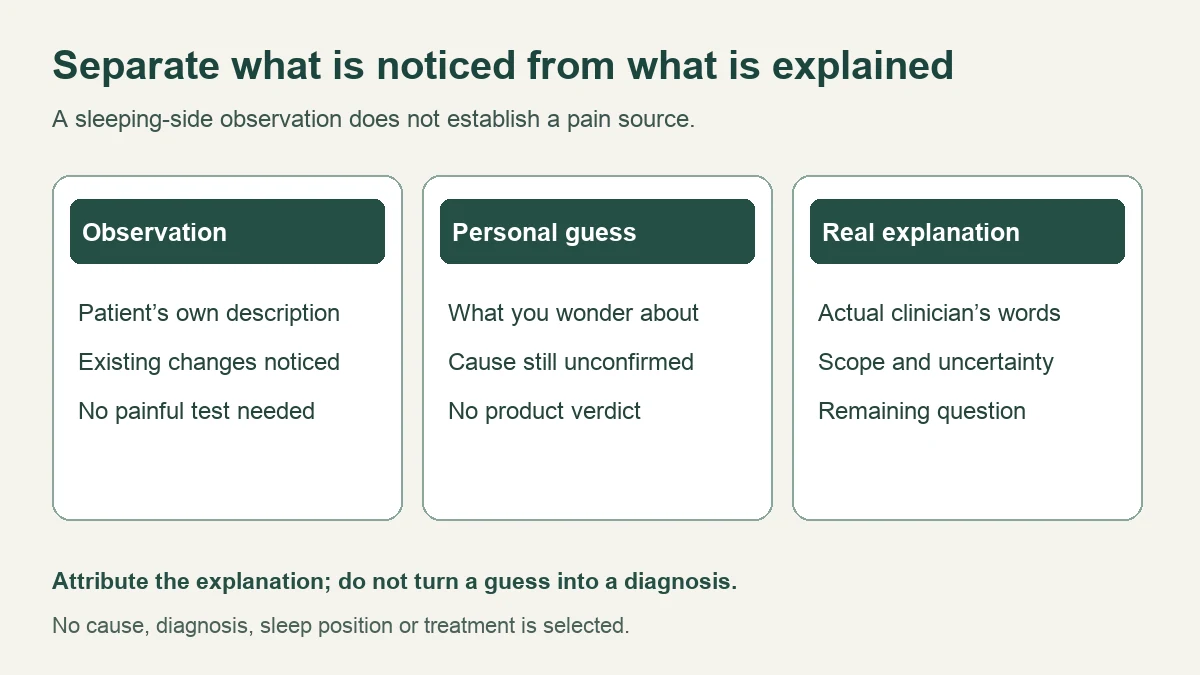
Bring a useful account without diagnosing from sleeping side
Use existing information: where the discomfort is felt, the context in which it appeared, changes already noticed, associated concerns and any actual assessment or instructions. Approximate timing is acceptable. Do not repeat an aggravating position, press a painful area or perform a movement test just to make the record more precise.
A question such as “Could this be related to pressure?” is reasonable to bring. Record it as your question. It should not become “pressure is the cause” simply because the pain appeared on that side. The NHS describes several possible causes of hip pain and advises against self-diagnosis; the brief context here is not a replacement for an assessment.
The IASP pain definition and notes support respecting a person’s pain experience, including when communication is difficult. They do not identify the source of side-lying hip pain or validate a pillow, exercise or sleep position. The patient does not need a detailed chart or a visible abnormality before the concern can be discussed.
Bring existing reports and relevant instructions if available, but do not postpone necessary care to obtain a perfect packet. If there was an operation, injury or an important change, say so as actually known. This article does not decide whether imaging is indicated or supply a list of findings to seek.
Ask what the evaluation actually explains
Start with the concern you want answered: “I notice this pain while lying on my side. What does today’s evaluation suggest, what information supports that explanation and what remains uncertain?” This invites an explanation of the assessment rather than asking the clinician to confirm a diagnosis selected by a website.
- Was this a working explanation, a diagnosis communicated after assessment, or one possibility still being considered?
- Which symptoms or concerns does the explanation address? Which remain unexplained?
- What did the actual examination or existing information contribute? Were there limits to what could be assessed?
- Is a report finding thought relevant to this concern, or is its relevance uncertain?
- What next step was actually recommended, and who is responsible for arranging it?
- What changes should prompt contact or assessment, and which contact route applies?
These are optional questions, not a mandatory script. No reader has to request every test or challenge every explanation. Choose what is unclear. A clinician may appropriately explain uncertainty; that is different from no answer being received. Record the uncertainty accurately rather than treating it as failure or inventing certainty.
A useful explanation can remain provisional. The record should preserve that status and the real review plan. It cannot establish whether the examination was sufficient, verify a diagnosis or determine urgency from the written account. New or worsening concerns still need appropriate clinical attention.
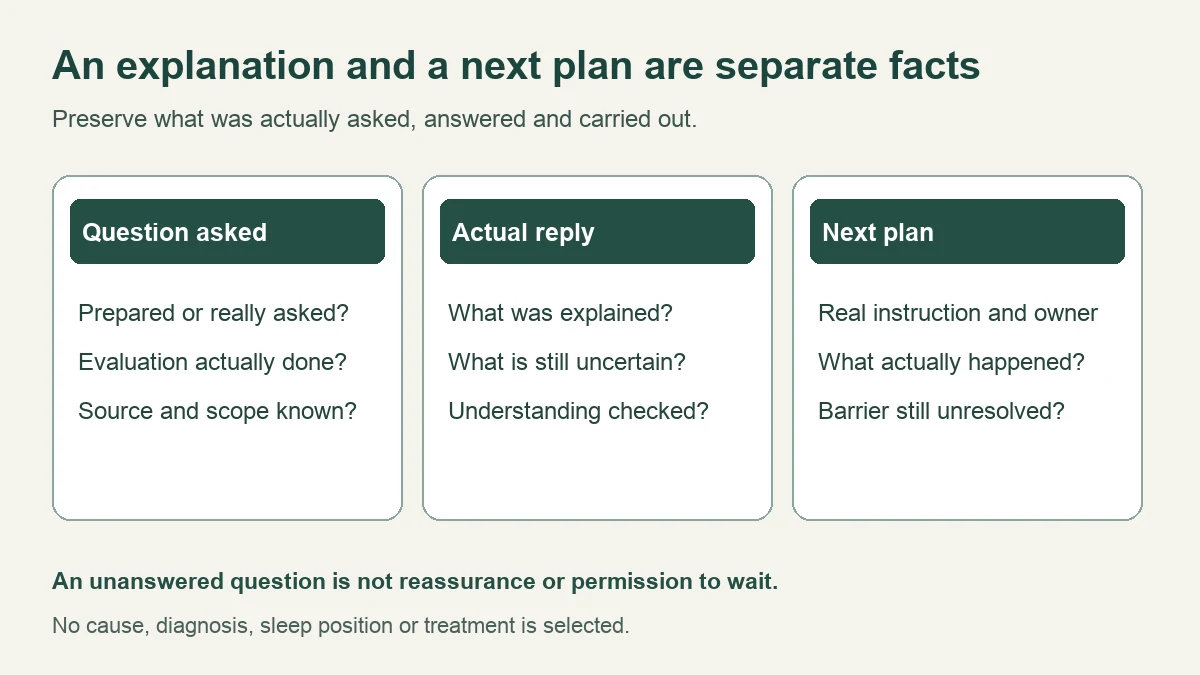
Check the actual explanation, then the actual next plan
| Event | Useful record | Do not infer |
|---|---|---|
| Question prepared | The concern and intended recipient. | That a clinician received or reviewed it. |
| Evaluation received | What visit/discussion actually occurred and any known limits. | That a booking or administrative reply was a clinical assessment. |
| Explanation received | Actual words or a clearly labelled personal summary, source and scope. | That a recalled term explains every symptom. |
| Understanding checked | Your summary and clarification actually received. | That your interpretation has been confirmed when no reply exists. |
| Next plan agreed | Actual instructions, responsible person and review/contact arrangement. | A new treatment, scan or waiting period from this worksheet. |
| Follow-through | What really happened, any barrier and the current unanswered point. | That a referral, message or planned appointment was completed care. |
Try a plain-language summary: “My understanding is that you are considering this explanation, this part remains uncertain, and the next step is this. Is that accurate?” Preserve the actual response. If you cannot recall the wording, write that rather than attributing a precise diagnosis or instruction to the clinician.
When instructions appear to conflict, retain both sources and ask the responsible team which applies. Do not combine fragments into a new rule about sleeping side, movement or medicines. This page neither starts nor stops treatment. A missing answer is not permission to wait, and a routine callback is not a substitute for urgent care.
This is an explanation-verification guide. The Hip Pain at Night: 7 Essential Sleep Review Checks article focuses on the actual night, existing instructions and practical sleep-plan concerns. Use this page when you need to separate observation from assumption and clarify what the assessment did and did not explain. It is not another sleep-position or product-comparison guide.
Two fictional explanation-check writing examples
These invented examples demonstrate documentation only. They describe no real patient, diagnosis, clinical finding or treatment outcome. The example buttons replace entries and explicitly label output fictional. Neither example establishes that waiting is safe.
Example A: pain noticed, pressure explanation unconfirmed
| Record category | Fictional entry |
|---|---|
| Observation | Discomfort noticed while lying on the side. No new painful trial performed. |
| Personal hypothesis | Patient wonders about pillow or pressure. Cause unconfirmed. |
| Evaluation question | “What does the assessment suggest, and what remains uncertain?” Prepared, not yet asked. |
| Actual explanation / next plan | No evaluation or clinical explanation supplied in the example. No new plan invented. |
The useful change is in wording: “I wonder whether pressure matters” remains a hypothesis. The record does not turn it into a diagnosis, make purchasing a pillow the next required step, or require another painful night before clinical discussion.
Example B: discussion occurred, explanation scope remains unclear
| Record category | Fictional entry |
|---|---|
| Actual discussion | A visit occurred; examination findings are not supplied here. |
| Actual explanation | Patient recalls a possible explanation but cannot reproduce the wording. No diagnosis inserted. |
| Remaining question | Was it provisional, and did it cover all reported concerns? |
| Next plan / follow-through | A next step was discussed but owner/instructions are unclear. Clarification prepared; no confirmation, completion or improvement claimed. |
A clarification request can read: “I do not want to misquote the explanation. What was the working explanation, what remained uncertain, and what was the next plan?” This preserves a genuine gap without implying the clinician said nothing or requiring the patient to reconstruct an examination.
Private evaluation-question, explanation and next-plan record tool
Download the offline copy before entering actual health details. Use fictional text on this page because surrounding ads and analytics may be present. The tool itself makes no network requests, uses no browser storage and does not automatically save. Its offline file has no external assets or automatic network requests. Keep completed exports private.
Use one concern and omit names, contact details, identifiers and full reports. Blank entries produce optional clarification questions, not a diagnosis, risk score or treatment plan. Paper with the same headings is equally acceptable. No one needs to finish this tool before seeking care.
Evaluation question, actual explanation and next-plan record
Separate what you noticed, what you suspect, what a clinician actually explained and what remains unanswered.
Download the offline tool before entering actual health details. Use fictional entries here; surrounding ads and analytics may be present.
Offline copy. No ads, analytics, external assets or automatic network requests.
The tool makes no network requests, uses no browser storage and does not automatically save. Refreshing may lose entries. Omit identifying details and keep exports private. Needed assessment must not wait for this record.
Start with the fictional example or download a blank offline copy.
Paper alternative: observation; hypothesis; existing record; concern; assessment question; actual evaluation; actual explanation; scope; remaining question; real plan; clarification; follow-through.
My evaluation, explanation and next-plan record
Unverified personal record for discussion. Entries verify no diagnosis, clinical explanation or next plan.
Guide: living.kioptrix.com/side-sleeper-hip-pain-relief/
Build the record, then copy, download text or print/save PDF. Editing hides the old result until rebuilt. Offline exports include current entries; closing or refreshing may lose unsaved notes. Filled fields remain unverified personal records. Nothing is sent to a clinician, and no explanation or plan is clinically confirmed by the tool.
Common questions about side-lying hip pain explanations
Does pain on one side identify the cause?
No. Context is useful to report, but this page cannot diagnose from sleeping side or location.
Should I try a painful position to show the clinician?
No test is requested for this record. Use what was already noticed and ask about the actual assessment.
Does an imaging finding automatically explain the pain?
Do not assume that connection. Ask how the clinician interprets the finding in relation to the concern and what remains uncertain.
What if I remember only a possible diagnosis?
Label it as your recollection and request clarification. Do not convert it into a confirmed diagnosis.
Can I use the tool before an appointment?
Yes. Mark questions prepared and explanation not yet received. The tool does not imply a visit has occurred.
What if the next plan cannot be carried out?
Record the actual barrier and ask for a real response from the responsible team. A written plan is not completed care; needed assessment should not wait for paperwork.
Sources, corrections and editorial limits
Sources checked: October 30, 2026. The article now concentrates on checking clinical explanations rather than repeating a general sleep-preparation block. The representative image shows a fictional consultation, with no position demonstration, pain glow or promised improvement. The record and examples are editorial communication aids, not clinically validated tools.
- NHS: Hip pain in adults — multiple possible causes, avoiding self-diagnosis, reasons for clinical discussion and selected urgent/emergency warnings. The page is UK guidance; local access and numbers differ. Its general self-care suggestions are not reproduced as individual instructions here.
- IASP: Terminology, revised pain definition and notes — respect for the personal pain experience and communication limitations. This is a conceptual source, not a hip assessment, position, product or treatment guideline.
The four-column distinctions, six checks and record workflow are editorial structure, not a guideline-derived diagnostic pathway. No independent medical review, direct clinical testing, verified patient story or reader-outcome study is claimed. The illustrative photo depicts fictional people. An appropriate assessment and actual professional instructions remain necessary.