
Showering after hip surgery involves separate wound and movement questions. What does the surgical team permit for the wound and dressing, and what individual plan covers getting in, washing, drying and leaving? Water permission does not establish that an unassessed tub transfer, different equipment or unavailable helper fits that plan.
Use the instruction and actual-preparation comparison, two fictional writing examples and free offline showering handover record. The six checks below organize actual instructions, preparation, performance, observations and replies. They do not give a ready-to-shower decision, a universal date, a transfer technique or a medicine schedule.
Emergency symptoms come before a showering record. New chest pain, serious difficulty breathing, collapse or inability to awaken needs emergency help. Sudden severe hip pain with a changed leg position or new inability to bear weight after a fall or transfer also needs emergency assessment. Do not force the hip into position, lift the person yourself or test walking. Use local emergency services, including 911 in the U.S. where needed.
After a recent hip replacement, new calf/leg pain or swelling, fever or feeling shivery, wound oozing/pus, or redness, tenderness, swelling or pain that worsens or does not improve needs urgent clinical advice. Follow your discharge contact route and use an appropriate urgent service if the team is unavailable; do not wait for a routine portal reply. Leg/hip pain and swelling with chest pain or breathing difficulty needs emergency help. NHS complication guidance distinguishes urgent from emergency contact; its UK service numbers are not U.S. instructions.
This is caregiver-written general education, not an individual assessment. Some cited sources concern hip replacement, not every arthroscopy, fracture-fixation procedure or other hip operation. Follow your own surgical, wound and rehabilitation instructions. Ask about missing or conflicting advice and which alternative washing arrangement to use while practical questions are resolved. The article selects no alternative technique.
Table of Contents
Six essential checks for a showering handover
| Check | Record the actual information | Do not confuse it with |
|---|---|---|
| 1. Wound and dressing | Water exposure, dressing care, conditions, source and date actually given. | A waterproof label, an online number of days or a healed-looking surface. |
| 2. Movement education | The individual entry-to-exit plan and conditions taught by the appropriate team. | A general video, a leg-swing script or water permission. |
| 3. Equipment and room | Actual model, fitting, layout and differences from the assessed setting. | Equipment ordered, a chair type name or a product photograph. |
| 4. Help and backup | Required assistance, trained person actually available and team-advised alternative. | A relative nearby or an improvised substitute. |
| 5. Performance and observation | What already happened, including not attempted or stopped; existing observations. | A requirement to attempt a shower or repeat a movement for the form. |
| 6. Contact and real answer | Question submitted, answer received, exact scope, next owner and unresolved issue. | A booked appointment, pending question or completed worksheet as approval. |
These are preparation checks, not a pass/fail sequence. Unknown information stays unknown. A fully completed record does not clear someone to shower. A partial record can still explain the problem, and symptoms needing care should not wait for additional detail. The practical aim is to make the next professional conversation specific.
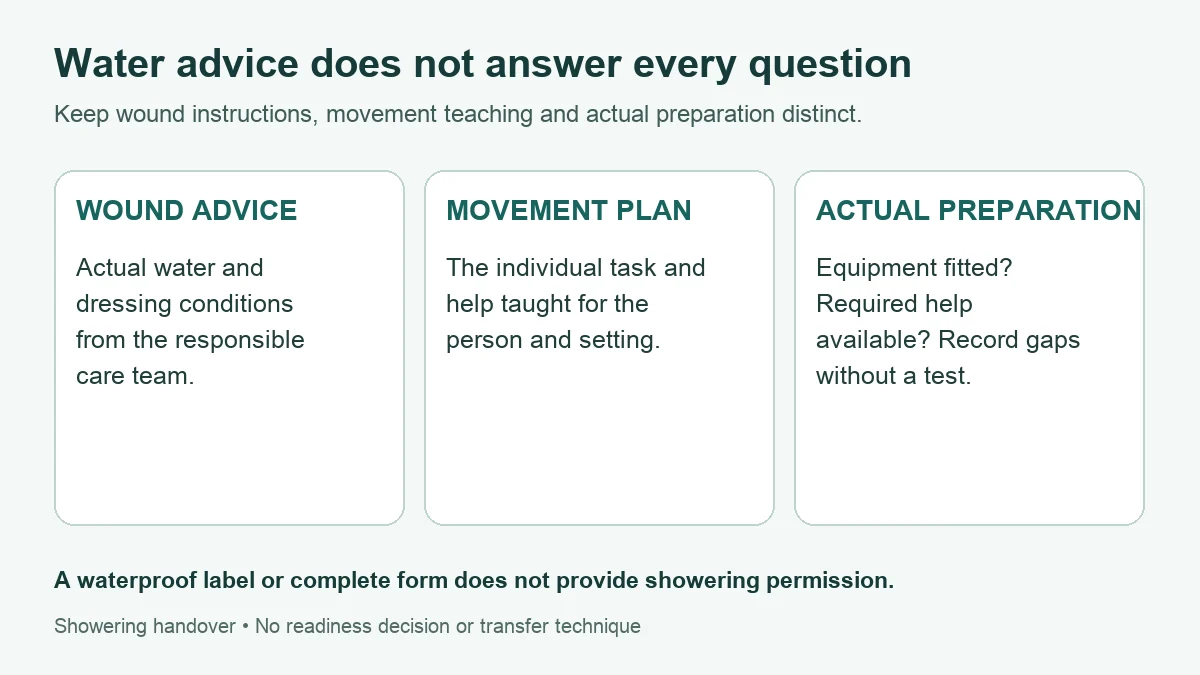
Compare wound instructions, movement plans and actual preparation
Ask the surgical or wound team for the actual showering instructions for the procedure and dressing: when permitted, whether the dressing stays on, allowed water exposure, drying and products, and the action/contact route if it becomes wet, loose or leaking. Do not remove or replace a dressing, scrub the incision, apply products or soak it unless instructed. Showering and soaking in a bath, pool or hot tub are different questions.
| Topic | Individual instruction or plan | Actual preparation / unresolved issue |
|---|---|---|
| Wound / dressing | The actual conditions and source, not just “shower allowed.” | Is the wording available? What exactly was answered and what still needs clarification? |
| Entry, washing, drying and exit | Teaching for this person, their restrictions and required help. | Does the real tub, threshold or shower differ from the teaching environment? |
| Equipment and support | Assessed model, height, placement, manufacturer conditions and load limits. | Delivered, fitted and checked are separate facts; a different model may need review. |
| Helper and privacy | Required help, who was taught, actual availability and assistance-call arrangement. | Is the required person available? Is the backup actually advised, rather than assumed? |
| Actual event and reply | Performance already completed or not attempted, observation and answer received. | What differed, who was contacted, what did they answer and what remains open? |
If wording conflicts, keep each instruction with its date and source and ask the responsible team to resolve it. Do not choose whichever advice permits an earlier shower or interpret silence as agreement. Water advice may answer only wound exposure; it does not necessarily address balance, fatigue, a home tub or the availability of help.
A helper can describe the empty bathroom: walk-in shower or tub, threshold or wall height, door opening, usable floor space, existing supports, controls and supplies. Record useful measurements or photographs only if appropriate and shared with consent through an agreed channel. The recovering person does not need to cross the tub or stand on a wet surface to provide this information.
Ask the therapist to assess the actual equipment and complete task. A shower chair, tub transfer bench and bath board are not interchangeable simply because each is sold for bathing. Follow the selected product’s instructions. Do not substitute a household stool, towel rail, movable shower door or unassessed suction handle for prescribed support. Discuss traction without creating a loose mat or trip obstacle.
The plan should address approach, entry, washing, drying, exit and dressing, including where any walking aid belongs and how it is retrieved. This article supplies no weight-bearing rule, hip angle, leg order, one-leg balance, lifting method or transfer demonstration. Request clarification or reassessment if the room, equipment, help or function differs from the situation taught.
Keep wound advice, therapy teaching and practical replies separate
| Relevant role | Question to take to that role | Scope to preserve |
|---|---|---|
| Surgical / wound team | What are the actual water, dressing and wound-problem instructions? | A wound answer may not assess the home transfer or equipment. |
| OT / PT / relevant rehabilitation team | What complete movement plan, equipment and assistance fit the person and room? | A practical plan does not replace wound instructions or new symptom assessment. |
| Prescriber / pharmacist | How does the prescribed schedule relate to washing, dizziness, drowsiness or inadequate relief? | Do not take an extra dose, bring a dose forward or change treatment to finish showering. |
| Helper / equipment provider | What was taught, delivered or fitted, and what help is actually available? | An order, delivery or relative nearby is not clinical clearance. |
| Urgent / emergency service | Which new symptom needs timely assessment now? | Do not wait for a routine equipment enquiry or completed handover. |
Pain relief is a legitimate care goal, but relief does not establish balance or transfer ability. Follow prescribed medicine instructions and discuss questions with the relevant professional. This guide sets no shower duration or mandatory morning/evening window. Fatigue and help availability belong in the actual individual plan.
If pain, weakness or dizziness begins during the task, stop and call for help rather than rushing or improvising an unsupported exit. Use the team’s instructions and appropriate clinical contact for the situation; emergency signs need emergency help. Describe an event already experienced without recreating it to obtain a clearer observation.
A routine question about a chair delivery belongs in a different contact stream from a new symptom. Record actual contact attempts and unanswered questions, but do not use the record as a reason to wait when urgent help is needed. The organizer below sends nothing, books nothing and monitors nothing.
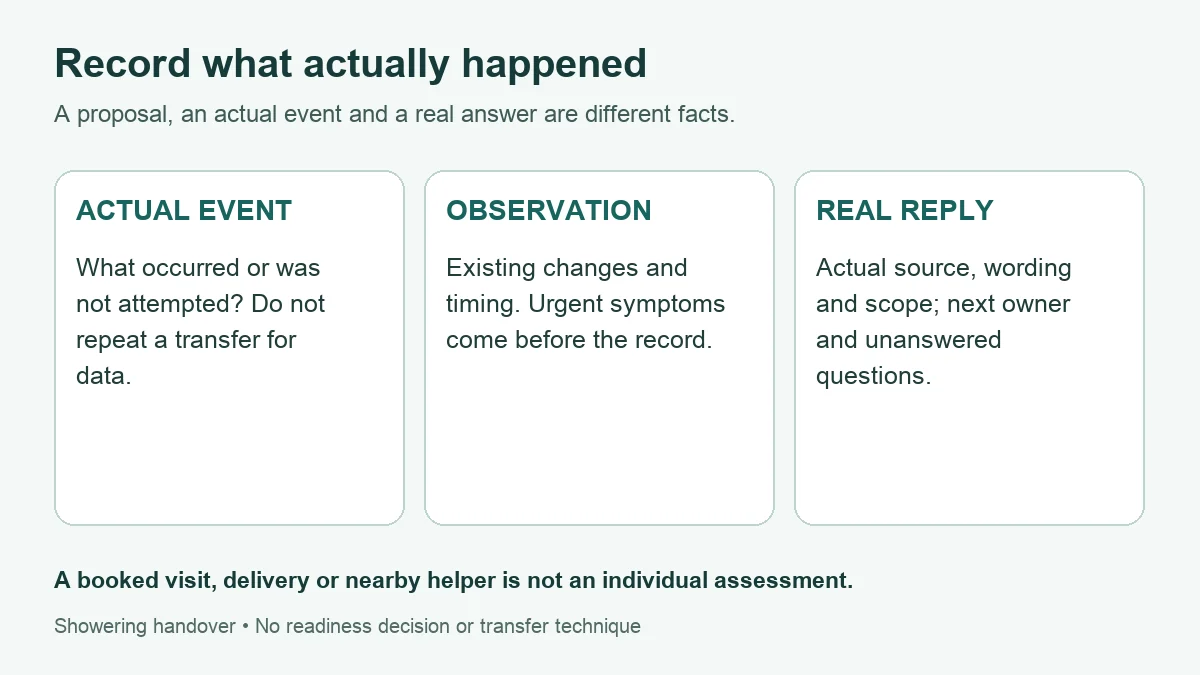
Two fictional showering record examples
These examples show how to preserve missing information. They are not real patient stories, transfer instructions or successful outcomes. No medical permission or professional answer is supplied. Loading either example replaces tool entries; use fictional information on the live page and an offline copy for private notes.
Example A: water advice received, tub transfer unanswered
| Record | Fictional entry |
|---|---|
| Wound answer | An answer about water exposure is recalled. Actual wording, conditions and dressing instructions still need recording. |
| Movement question | No personal teaching for the home tub is supplied. The transfer question remains unanswered. |
| Actual performance | Shower not attempted; no movement demonstration requested. |
| Contact / reply | A question about the home layout and movement/help plan was submitted to the therapy team. Reply pending. |
Writing example: “The answer I recall concerns wound water exposure. I have not treated it as advice about entering our tub. What individual movement, equipment and help plan applies to the actual room, and what washing alternative should we use while that is unresolved? The therapy reply is still pending.” This example gives no date or technique.
Example B: planned equipment or help is unavailable
| Record | Fictional entry |
|---|---|
| Plan | A taught individual plan is referred to; its actual instructions and conditions are not supplied here. |
| Actual preparation | The proposed equipment has not been fitted or confirmed in the room, and the required helper is unavailable. |
| Actual performance | Shower not attempted. An untrained relative or household stool is not treated as a substitute. |
| Question / answer | A practical question about the equipment, help and alternative washing plan was prepared. Actual contact and professional reply are not recorded. |
Writing example: “The equipment and trained help expected by the plan are not actually available. We have recorded that gap rather than calling the plan implemented. Who can clarify the arrangement and an appropriate alternative while it is unresolved? We have not recorded an answer.” Do not infer that any substitute washing or transfer method has been approved.
Free showering preparation, performance and real-reply record
Use 11 optional fields to keep wound advice, movement teaching, equipment, help, alternative arrangements, actual performance, differences, observations, contact, real answers and next ownership distinct. Blank fields produce optional questions; filled fields remain unverified notes. The tool does not diagnose symptoms, rank urgency, select equipment or decide readiness.
Download the offline HTML tool before entering actual health or personal information. Try fictional examples on this page. The live website may use site services. The offline copy has no ads, analytics, external assets, automatic network requests or browser storage and needs no account or email. It does not save automatically; exports contain entries, so keep them private and share through an agreed channel with consent.
Build, copy, download text or use browser print/save PDF. Editing hides the previous output until rebuilt. Avoid names, addresses, identifying contact details and complete medical records. If the tool is unavailable, use paper. Neither a form nor a pending reply should delay appropriate care.
Showering preparation, performance, observation and real-reply record
Keep wound instructions, the individual movement plan, actual preparation, performance and the answer received separate. This organizer gives no ready-to-shower decision or transfer technique.
Download the offline tool before entering actual health or personal notes. Try fictional examples here. The offline copy has no site ads, analytics or external assets.
Offline copy. This file has no ads, analytics, external assets or automatic network requests.
The tool uses no network requests or browser storage and does not save automatically. Refreshing or closing may lose entries. Exports contain notes; keep them private. Avoid names, addresses, identifying contact details and full medical records. Do not delay urgent or emergency help for a record.
Start with the fictional example or download a blank offline copy.
If the tool does not load, use paper: wound advice; movement teaching; actual equipment; help; advised alternative; actual performance or not attempted; difference; existing observation; contact; real reply; next owner. Do not delay care for a form.
My showering preparation, performance, observation and real-reply record
Unverified personal record for discussion. Entries are unverified notes, not medical advice, proof of preparation or permission to shower.
Guide: living.kioptrix.com/showering-after-hip-surgery/
Showering sources: what applies and what does not
The title covers a preparation task after hip surgery, but the main medical sources below are replacement-focused. They do not set the plan for every hip operation. The record organizes actual professional instructions; it has not been validated as a clinical decision aid.
- MedlinePlus: Hip replacement — discharge describes replacement-related home and wound care. Its example timing is not a universal shower date, and general dressing or medicine advice does not replace personal instructions.
- Guy’s and St Thomas’: Precautions after hip surgery explains the importance of an individual care plan and therapy support for daily tasks. This article does not copy its specific movement restrictions to every reader or teach a transfer.
- NHS: Complications of a hip replacement explains replacement complications and urgent/emergency contact. It is not a diagnosis of a symptom or a substitute for the reader’s discharge contact route; UK service numbers have local scope.
For related background, our shower seating and transfer-planning guide discusses why a product name alone is insufficient. This page adds the postoperative handover linking wound instructions, individual movement education, actual preparation and replies. For medicine questions, the older-adult pain medicine review guide separates actual use, observation and advice. Neither guide provides showering permission.
Common questions about the showering handover
How many days after surgery can I shower?
Use the surgical team’s actual instructions for the procedure, wound and dressing. No universal date is supplied here. Confirm the separate movement, equipment and assistance plan; an online day count answers neither question for the person.
Does a waterproof dressing mean the whole shower is permitted?
No. Its label does not establish individual wound permission or answer entry, exit and help questions. Keep the exact team instruction and any unresolved conditions visible.
What if the home bathroom differs from teaching?
Describe the difference without testing a difficult movement and ask the appropriate rehabilitation team to clarify or reassess the plan. Do not improvise a transfer from a blog or substitute unassessed equipment.
Does a completed record mean I am ready?
No. Entries remain unverified and the organizer supplies no approval. Record an actual answer only when received, including its scope and any remaining question.
Should I wait for a routine message if new symptoms appear?
Not when symptoms need urgent or emergency help. Follow the discharge route and appropriate local care; a routine equipment question and a new symptom are different issues. The warning signs at the start override record completion.
Editorial changes and review limits
Source check and editorial update: October 29, 2026. Preserved the distinction between wound-water advice and the complete individual bathing plan. Added source scope, actual-preparation comparisons, role-specific contact questions, two fictional examples and an offline handover record. The original URL, author, category and publication date are retained.
Written from a family-caregiver editorial perspective. No independent surgical, nursing or occupational-therapy review, real-reader usability study, clinical validation or improved outcome is claimed. Functional checks establish tool behavior only. The hero is AI-generated fictional artwork; body diagrams organize information and show no transfer technique. Our background and editorial approach.