

Older adults deserve pain relief and a careful review of unwanted effects. A useful medication-review note separates the written directions from what was actually used, and reported relief from changes in alertness, thinking or balance. It preserves uncertainty instead of deciding that a medicine caused a problem or that exercise should replace treatment.
This guide is for older adults with ongoing musculoskeletal pain and people helping them prepare for a prescriber or pharmacist conversation. It offers seven review checks, a directions/use/observation comparison, two fictional writing examples and a free offline record. Jump to the tool or see the examples. It supplies no personal medicine choice, dose, taper or interaction score. Cancer pain, palliative care, end-of-life care and acute clinical situations require their own treatment context.
Emergency signs come before a medication list. If someone cannot be awakened, has slow, shallow or difficult breathing, or blue/gray lips, call 911 in the U.S. now. If opioid overdose is suspected, give naloxone if available according to its instructions, follow the dispatcher’s guidance and stay with the person until help arrives. Do not assume they should sleep it off or wait for a routine callback. CDC: What to Do If You Think Someone Is Overdosing describes emergency response; naloxone reverses opioid overdose, not every cause of unconsciousness.
Severe new confusion, stroke-like symptoms, collapse or major injury also need immediate assessment. New grogginess, dizziness, a near-fall or a change in daily function deserves prompt advice from the prescriber or pharmacist; severe or rapidly worsening symptoms may need urgent or emergency care. Do not assume an observation is caused by age or by a medicine. If you cannot obtain timely advice and the situation is urgent, seek local urgent care; use emergency services for emergencies. The tool does not select urgency.
Do not change dose, timing, combinations or a prescribed treatment because of this article. Do not abruptly stop a long-used opioid, benzodiazepine or other medicine on your own; changes require an individual plan, and emergency clinicians may give immediate instructions. A form, diary or scheduled review must not delay appropriate help. Follow your actual care team’s advice, and ask promptly about unclear instructions.
Table of Contents
Seven essential medicine-review checks for older adults
| Check | Record separately | Question to prepare |
|---|---|---|
| 1. Actual product | Name, active ingredients, strength and formulation, with label or record source. | Which details are verified and which need checking? |
| 2. Directions and actual use | Written instructions versus doses/times actually used, including as-needed use. | Does the list reflect real use rather than only the prescription? |
| 3. Other products and changes | OTC sleep/cold/allergy products, supplements, alcohol and actual instruction changes. | What should be reviewed together and what is still missing? |
| 4. Benefit and priorities | Relief, no relief or uncertainty, plus the person’s own daily goal. | What benefit does the person report, and what matters to them? |
| 5. Observations and context | Patient account, helper observations, timing, falls/near-falls and other changes. | Could medicines or another problem contribute? Timing alone cannot answer. |
| 6. Contact and actual reply | Question, relevant professional, date-time, pending status and reply actually received. | What was answered, and within what scope? |
| 7. Agreed follow-through | Actual next step, responsible person, review time and unresolved wording. | Who clarifies the remaining issue, including after hours? |
These checks organize existing information; they do not pass or fail a treatment. One concern is enough to start a conversation. A complete list does not establish safe prescribing or permission to continue an activity. There is no requirement to collect seven days of notes, take a comparison dose or walk a route to demonstrate a problem.
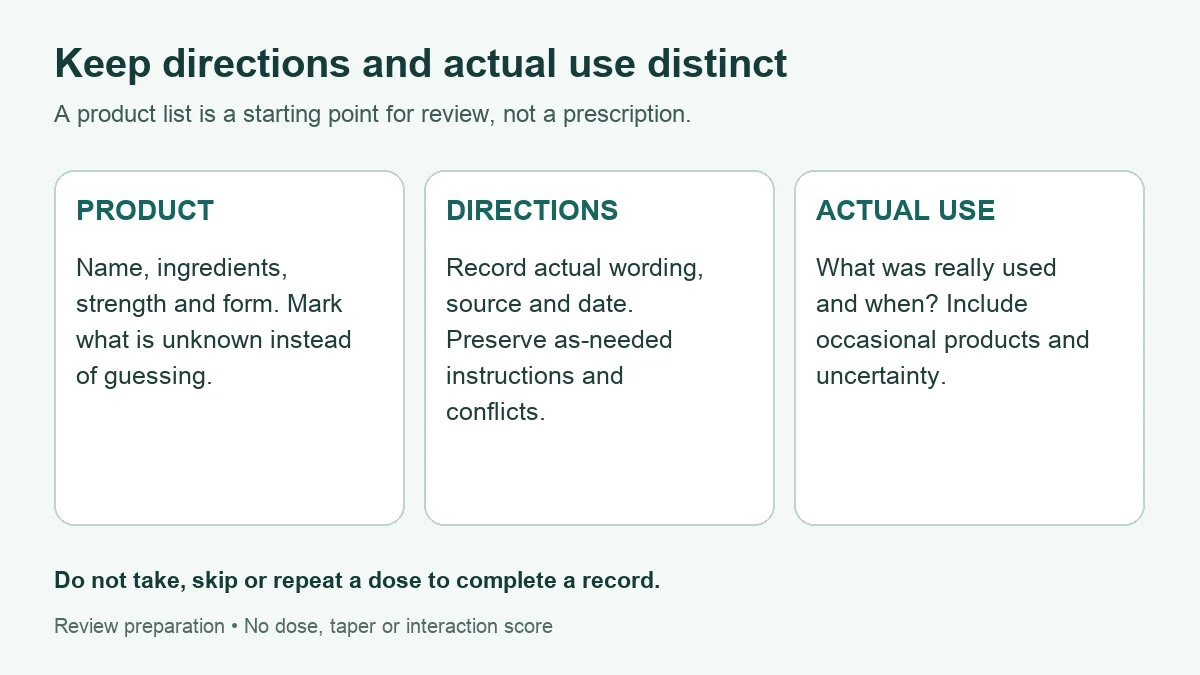
Older adults: compare directions, actual use and observations
Write down what the label or clinician actually says, then describe real use separately. An old list may omit an occasional nighttime product or may not reflect a later instruction. If the wording conflicts, keep the sources and dates and ask the prescriber or pharmacist to clarify; this page cannot choose between them. Use non-identifying summaries on paper or in the downloaded offline tool.
| Record | Useful detail | Do not infer |
|---|---|---|
| Product and source | Product name, active ingredient(s), strength, tablet/liquid/patch or other form, label/verified record. | A familiar brand, similar package or pill appearance proves ingredients or strength. |
| Existing direction | Actual regular/as-needed instruction, source/date and reason if already known. | This article creates a new schedule or supplies a dose. |
| Actual use | What was used, when and how much if already known; missed/extra use or uncertainty. | A prescription list proves every dose was taken as written. |
| Reported benefit | The person’s account of pain relief, sleep or an ordinary activity, including no benefit or uncertainty. | Relief proves safety, or fewer pain points erase an unwanted effect. |
| Observation | What the person felt or a helper saw, onset/time, effect on daily life and falls already known. | A change after medicine proves that medicine caused it. |
| Context and reply | Other actual changes, real question/contact, answer, scope and agreed next step. | A portal submission is a clinical answer, or an appointment booking is a completed review. |
For multiple products, use one line or clearly marked entry per product. Include prescriptions used for reasons other than pain, and relevant OTC sleep, cold and allergy preparations, supplements and alcohol use. Keep unknown details unknown. Ask the pharmacist to help identify ingredients, duplicate products or unclear directions rather than guessing. No dose totals or interaction calculations are produced here.
Regular use and as-needed use are different records. A bottle on a shelf does not show whether it was used, and an occasional product may still matter to a review. Record existing information as accurately as possible without searching for a perfect memory. If you cannot recall an amount or time, mark it uncertain and discuss it; do not take or skip a dose to make the notes more complete.
Record a clinician-directed change and its actual implementation separately. A new instruction may have been received but not understood, or a previous list may still be in circulation. Preserve the real wording and source/date. If a next dose is due and you are unsure what to do, contact the prescriber, pharmacist or appropriate after-hours service for individual advice rather than using this tool to decide.
What the sources support about sedation and medication risk
CDC: Assess Risks and Potential Harms of Opioid Use calls for additional caution and monitoring in adults 65 and older, including falls and cognitive impairment considerations. It also discusses risk factors such as reduced kidney/liver function, sleep-disordered breathing and opioid/benzodiazepine use. This is opioid-risk guidance, not a general instruction to avoid every sedating medicine or a source proving that home adjustments outperform prescriptions.
FDA’s gabapentin/pregabalin breathing warning identifies older adults and people with respiratory risk factors, including use with opioids or other central nervous system depressants. “Nonopioid” does not automatically mean nonsedating or free of breathing risk. This warning supports a complete review and prompt response to serious symptoms; it does not tell a reader to stop, replace or taper these medicines independently.
FDA’s benzodiazepine boxed-warning communication addresses dependence and withdrawal, including the danger of abrupt stopping or overly rapid reduction. Any planned reduction needs an individual clinician-led approach. The warning is not a taper schedule, and this article provides none. Ask for a clear plan for uncertainty, unwanted effects and after-hours contact rather than improvising a hold or change.
AGS Health in Aging Foundation: Ten Medications Older Adults Should Avoid or Use with Caution discusses certain muscle relaxants, anxiety/sleep medicines, anticholinergic products and OTC antihistamines, among other medicines. It tells readers to speak with a provider or pharmacist rather than stop medicines independently. The examples identify review topics; they are not an exhaustive interaction checker or a declaration that all drugs in a broad category are interchangeable.
For older adults, risks beyond sleepiness also matter. For example, the same AGS resource discusses bleeding, kidney and heart-related concerns with NSAIDs in relevant patients. A person may feel alert and still need a medicine review. Avoid replacing the whole discussion with a single “least sleepy” choice. The product, reason for use, other conditions, actual use and patient priorities all belong in the professional assessment.
NIAMS osteoarthritis treatment information includes pain relief, function, exercise, fitted supports and medicines in its treatment context. It concerns osteoarthritis, not every cause of back, shoulder or post-injury pain. It does not establish that exercise or a cushion should replace a particular prescription. Existing clinical care and appropriate practical support can be considered together; there is no five-tier treatment ladder to complete before medication review or reassessment.
Describe benefits and unwanted changes without a causal test
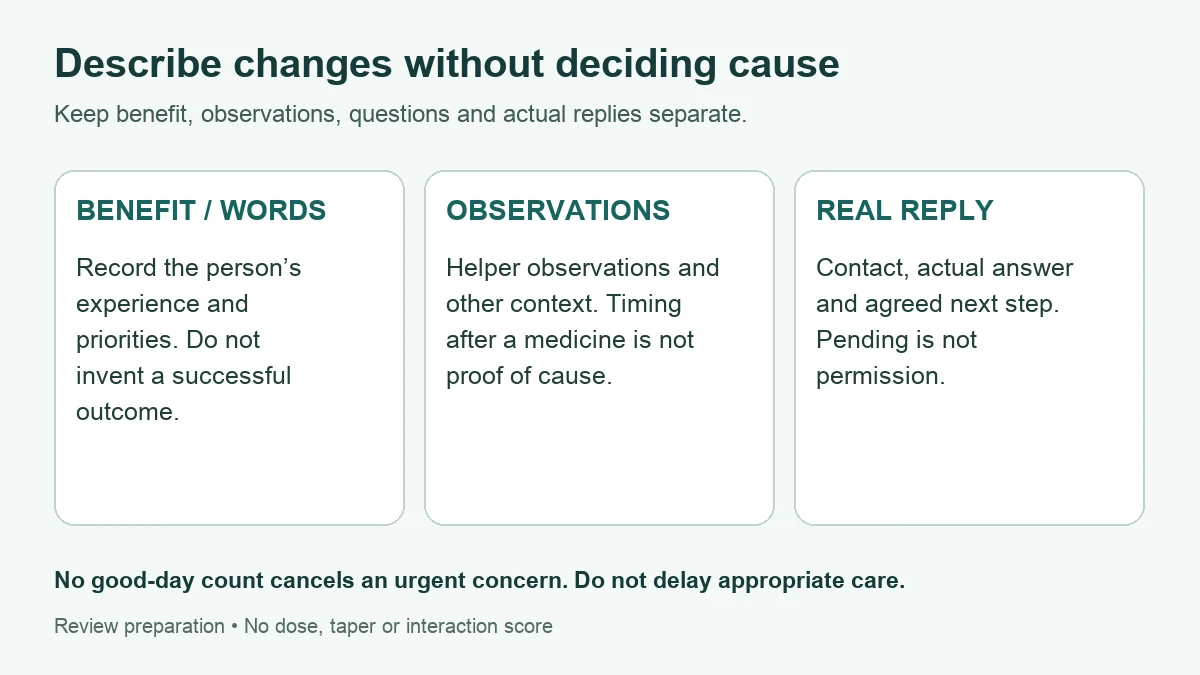
Pain relief matters. Older adults should not have to demonstrate more walking or tolerate undertreated pain to prove that their concern is legitimate. Ask what they want help with and what benefit they actually notice. Separately describe unwanted changes such as daytime sleepiness, feeling unsteady, difficulty concentrating or changes in an ordinary task. The record does not decide whether benefit outweighs risk.
Keep the patient’s own account separate from another person’s observations. “I felt less pain” and “the helper saw me fall asleep during breakfast” describe different information. If a quotation is not remembered accurately, use a paraphrase and say so. Include uncertainty and consent where possible. Avoid labels such as “uncooperative,” “just old” or “overmedicated” when the observed fact can be described directly.
Timing helps describe a concern but does not prove cause. Sleep disruption, another illness, several treatment changes or ordinary activity may coincide. Do not deliberately take another dose, omit treatment, repeat an unsafe transfer or compare walking distances to identify the culprit. New or concerning symptoms need appropriate assessment without waiting for a pattern to become obvious.
Avoid counting “good days” against days with dizziness as if the totals establish safety. A serious event does not become acceptable because other days felt better. A later improvement also does not identify the mechanism of pain or rule out a medical problem. The former mini calculator has been replaced with a narrative record that preserves events, questions and real answers.
For older adults waiting for surgery, household help and medication review may overlap but have different purposes. Our joint-replacement daily support guide compares planned and actual help. This page focuses on product directions, real use, benefit, observations and the professional reply. Neither record certifies a transfer or selects a medicine.
Who helps older adults review products and symptoms?
| Role | Useful contribution | Keep the boundary clear |
|---|---|---|
| Patient | Priorities, actual use, experience of benefit/unwanted changes and consent. | A helper’s description should not erase the person’s account or pain. |
| Family helper | Existing observations, product-list assistance and support with contact as agreed. | Observation is not diagnosis or authority to change prescriptions. |
| Pharmacist | Product/ingredient identification, actual-use review, duplicate/interaction questions and clarification within scope. | A request is not an answer; preserve the scope and any need to contact a prescriber. |
| Prescriber / treating clinician | Assessment of symptoms, treatment purpose, individualized changes and monitoring/contact instructions. | A generic article or completed worksheet is not a new prescription. |
| Emergency team | Immediate assessment and treatment of emergency symptoms. | Do not wait for a routine medication-review appointment or portal reply. |
At review, ask how the plan addresses both comfort and the concern you observed, what to monitor, whom to contact and when. Request clear wording if a medicine is to be changed, held under specified circumstances or reviewed again. Record only the instruction actually given, with its source and date; this tool does not generate that instruction or determine whether it is suitable.
Older adults may receive care from several clinicians, so the review may need coordination. Keep unresolved or conflicting instructions visible and ask the relevant professionals to coordinate them. Do not silently rewrite the medication list to make it look consistent. A reply about one OTC ingredient does not automatically resolve an unrelated new symptom or another prescription. An agreed follow-up time does not override emergency symptoms.
Two fictional medicine-review writing examples
These are invented writing examples, not real family stories, patient outcomes or professional recommendations. They supply no product-specific dose, successful treatment, diagnosis or real reply. Their purpose is to preserve missing information and a useful question. Loading either example replaces existing tool entries. Real emergency symptoms require emergency response regardless of an example.
Example A: an OTC nighttime product was missing
| Record | Fictional entry |
|---|---|
| Product / direction | An occasional nighttime product was not on the earlier list. Exact product, ingredients, strength, form and directions are unconfirmed. |
| Actual use | Occasional use was mentioned; dates, timing and amount remain uncertain. No dose invented. |
| Review question | Which product details and actual use need clarification, including possible duplicate ingredients or unwanted effects? |
| Contact / reply | A pharmacist-review question was submitted in the example. Reply pending; no product-change advice supplied. |
| Next step | Record the actual reply and agreed follow-up when received. No stop or replacement instruction generated. |
Writing example: “The list may be incomplete because an occasional nighttime product was not included. I have not guessed its ingredients or assumed it is harmless. Product details and actual use need checking. Our pharmacist question is pending; which information is needed to review this alongside the other actual products?” No cause or safe combination is established.
Example B: an instruction change and several observations
| Record | Fictional entry |
|---|---|
| Directions / actual use | A change was reported, but exact source/date and wording still need verification. What was actually used is a separate entry. |
| Benefit / observation | Record the patient’s reported benefit separately. A helper noticed changed daytime alertness; no cause inferred. |
| Other context | Sleep was also disrupted and ordinary conditions changed. No comparison dose or activity test performed. |
| Question / reply | Could medicines or another issue contribute, and what monitoring/contact plan applies? No clinician answer supplied. |
| Follow-through | Seek appropriate advice without waiting for a diary period; record a real agreed next step only when received. |
Writing example: “An instruction change and actual use are separate facts we need to clarify. The helper noticed a change in alertness while sleep and other conditions also changed. We are recording benefit and observations without concluding which product caused them. What assessment and individual monitoring/contact advice applies?” This example does not decide urgency; use the emergency guidance for real emergency signs.
Free medicine-review record for older adults
The tool has 13 optional fields: product, directions, actual use, other products, instruction changes, reported benefit, patient account, helper observation, context, question, contact, actual reply and next arrangement. Blank items generate optional clarification prompts. Full fields remain unverified notes. It is not medication reconciliation by a professional and provides no dose, interaction score, causal conclusion, taper or permission to continue a task.
Try fictional examples here. Download the offline HTML copy before entering actual medication or health information. The live site may use site services. The downloaded file contains no ads, analytics, external assets, automatic network requests or browser storage. It requires no account or email. Exports contain entries; keep them private and share through an agreed channel with consent.
Build a record, copy it, download text or use browser print/save PDF. Editing hides the previous output until rebuilt. Nothing is sent to a pharmacist, clinician or emergency service, and entries are not saved automatically. Avoid names, addresses, prescription numbers, identifying contact details and full medical records. No photo upload is required. If the tool is unavailable, use paper without delaying care.
Medicine use, observation and real-reply record
Keep product directions, actual use, reported benefit, patient words, helper observations and real replies separate. The tool diagnoses no condition and does not rank, stop, taper or approve any medicine.
Download the offline tool before entering actual medication or health notes. Try the fictional examples here. The offline copy has no site ads, analytics or external assets.
Offline copy. This file has no ads, analytics, external assets or automatic network requests.
The tool uses no network requests or browser storage and does not save automatically. Refreshing or closing may lose entries. Exports contain your notes; keep them private. Avoid names, addresses, prescription numbers, identifying contact details or full medical records. No product photo is required or uploaded. Do not delay urgent or emergency care to complete a form.
Start with the fictional example or download a blank offline copy.
If the tool does not load, use paper: products; directions; actual use; other products; changes; benefit; patient words; helper observations; context; question; contact; real reply; next owner and review. Do not wait for a form to seek care.
My medicine use, observation and real-reply record
Unverified personal record for discussion. Entries are unverified notes, not medical advice, a medication reconciliation, a prescription or proof that a medicine is safe.
Guide: living.kioptrix.com/orthopedic-pain-management-for-older-adults/
Common review questions from older adults and helpers
Does the goal have to be avoiding all sedating medicines?
No. The goal is an individualized review of relief, unwanted effects, other risks and priorities. This guide neither chooses treatment nor assumes that non-drug care or a nonsedating product is automatically better.
Does a change after a dose prove the medicine caused it?
No. Record timing and the actual event, then seek appropriate review. Do not take a comparison dose, stop treatment or reproduce a difficult activity to test a cause.
What if an OTC or as-needed product was left off the list?
Include it with actual product details, directions and use if known. Mark unknowns and ask the pharmacist to help clarify. Do not guess ingredients or declare a combination safe.
Should we wait until there are seven days of notes?
No. A concern can be raised with the information already available. Emergency symptoms need emergency response, and new or worrying changes should not wait for a diary to finish.
Can the tool advise which medicine to stop or when to take it?
No. It transcribes unverified entries and questions. Dose, timing, hold instructions and tapering require individual professional advice; a full form is not a prescription.
What if instructions conflict or a reply is pending?
Preserve source/date and exact wording where possible and ask the relevant professional to clarify. A submission, booking or pending callback is not a clinical answer; urgent concerns need a timely care route.
How can a helper contribute without taking over?
Ask consent where possible, record the patient’s priorities and words separately from observations, and help gather actual product/use details. Avoid blame or diagnoses and do not change medicines on the person’s behalf based on a blog.
Sources, editorial corrections and review limits
- CDC: Assess Risks and Potential Harms of Opioid Use — older-adult opioid monitoring context; not a general orthopedic treatment ranking.
- CDC: What to Do If You Think Someone Is Overdosing — opioid-overdose signs and response; not a tool for ruling out other emergencies.
- FDA: Gabapentin/pregabalin serious breathing problems — respiratory risk context; no independent stop/taper instruction.
- FDA: Benzodiazepine boxed-warning update — dependence, withdrawal and individualized change planning; not a taper schedule.
- AGS Health in Aging Foundation: Ten Medications Older Adults Should Avoid or Use with Caution — selected review topics; not an exhaustive interaction list.
- NIAMS: Osteoarthritis diagnosis, treatment and steps to take — condition-specific options; no evidence here that environment changes outperform prescriptions.
Editorial correction and source check: October 29, 2026. Removed the unverified family/mailbox success story, non-drug superiority claims, sedation-as-pain-mechanism framing, response-based cause inference, treatment-tier map and diary calculator. Replaced broad “official guidance” link labels with actual document names. Added product/use distinctions, two fictional examples and a record that preserves actual professional replies. The original URL is retained.
This is caregiver-written education; the operator is not a medical professional. No independent clinical or pharmacist review, validated medication decision aid, real-user usability study or improved health outcome is claimed. Tool checks establish functional behavior only. The hero is AI-generated fictional editorial artwork; the body diagrams illustrate records, not treatment. Our background and editorial approach.