
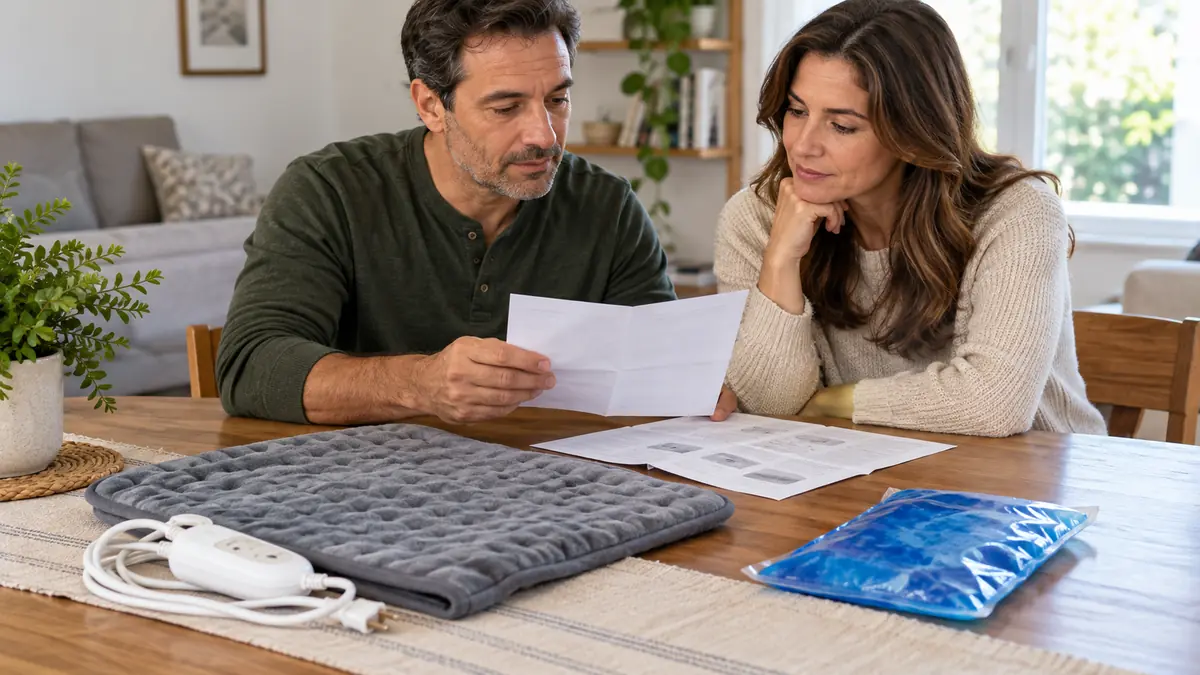
Heat or ice for orthopedic pain is a question about the condition, actual instructions and actual product—not a choice made from one symptom word. Compare the proposed option with clinical advice and product warnings, then retain the actual reply, use or non-use, observations and changes completed. This guide selects no treatment, temperature or schedule.
Start with the heat, cold and neither comparison, follow seven essential checks, read two fictional writing examples, or download the free offline instruction-and-answer record. One unanswered point is enough. No new application, skin-sensation test, stairs or walking trial is needed.
The focus is clarifying a treatment recommendation and its product scope. The separate heating-pad before-sleep guide addresses device warnings and ending ordinary-pad use before sleep. The ice-pack storage guide addresses handling and access. Neither storage nor shutdown arrangements establish which treatment is appropriate.
This is family-caregiver education, not individual medical advice or independent clinical review. No product, patient or treatment outcome has been tested here. The tables and record are editorial communication aids, not validated treatment-selection instruments. A completed record does not approve use or overrule a manufacturer prohibition.
Table of Contents
Care and skin concerns come before a heat or ice comparison
Do not explain a new severe symptom or significant injury as just a need for heat or cold. Seek appropriate direct assessment for severe or rapidly worsening symptoms, significant injury or sudden loss of function. For an emergency use local emergency services, including 911 in the U.S.; do not wait for a product, routine message reply or full diary. This guide is not a triage assessment.
For water-circulating hot/cold devices, FDA guidance says to stop use and contact the health care provider for serious reactions such as numbness, unexpected or increased pain, burning, itching, blisters, swelling or skin-colour changes. Do not reapply the device to prove the reaction or compensate with a different temperature. This device-specific warning is not a complete emergency checklist.
Sherwood Forest Hospitals heat-and-ice guidance warns about poor sensation or circulation, open wounds and use while asleep. A known concern needs its own clinical and product clarification; do not test sensation or remove a dressing to complete the form. Individual instructions and matching product restrictions remain essential. Do not alter medicines to tolerate an unassessed application.
Compare heat, cold and neither without a symptom chooser
This is a comparison of questions and limits, not a recommendation to try each option. Record the actual condition or operation only as known. Stiffness, swelling, redness or a comfortable sensation does not identify its own cause or decide the treatment. An uncertain field should remain uncertain until an actual answer is received.
| Option to discuss | What must be clarified | What cannot be assumed |
|---|---|---|
| Heat | Actual purpose, product type, relevant clinical instruction, warnings and personal concerns. | Stiffness alone does not choose heat; warmth does not prove healing or individual suitability. |
| Cold | Actual purpose, pack or circulating device, protection and monitoring instructions and relevant concerns. | Swelling alone does not choose cold; stronger or longer cooling is not automatically better. |
| Neither / no new application | Actual advice or unresolved reason, care needed and practical next step. | This row is not permission to delay assessment or discontinue prescribed care without clarification. |
| Alternating or combined use | Only the actual plan if one was supplied, with its source and product scope. | No alternating sequence or trial of both treatments is generated here. |
Keep a proposed option separate from a recommendation actually received. Likewise, a recommendation is not proof that the product is available, its instructions match or required help has been arranged. These are different questions, and a useful record does not hide them inside a single ready-to-use tick box.
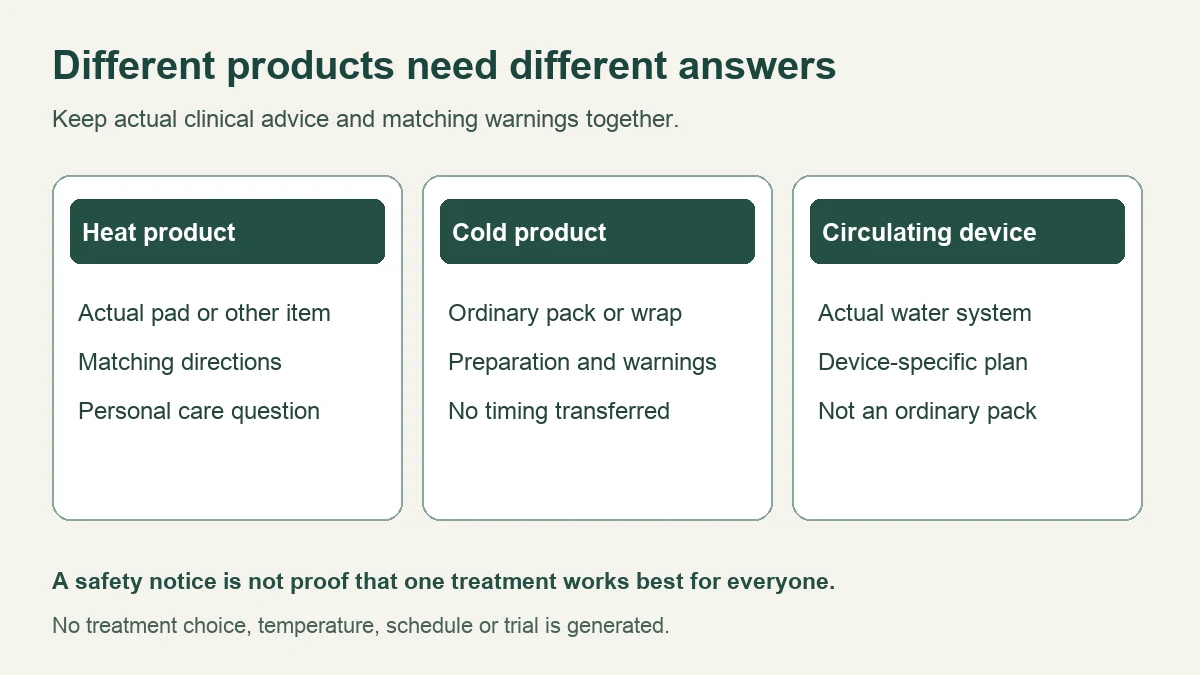
An ordinary pack and a water-circulating device are different
| Actual product category | Information to retain | Boundary |
|---|---|---|
| Ordinary electric heating pad | Matching model/manual, user restrictions, placement, sleep, skin and shutdown warnings. | Auto-off or a low setting does not cancel a warning. No sleeping-use permission is supplied. |
| Other heat product | Actual type and its own preparation, covering and application instructions. | A hot-water bottle, microwave pack and electric pad do not share one universal manual. |
| Ordinary cold pack or wrap | Actual product and its own preparation, protection, application and inspection instructions. | A generic pack leaflet is not a circulating-device prescription. |
| Water-circulating hot/cold device | Actual device, clinical plan, settings, wrap and any compression instructions actually supplied. | FDA notes these can remain colder longer than ordinary ice packs. Do not transfer pack timing to the device. |
The FDA article describes equipment that circulates heated or cooled water through a wrap; some models also provide compression. Its risk information concerns that category. It is not a head-to-head study of an ordinary heating pad and an ice pack, or a universal postoperative protocol. Product identity matters before interpreting a general instruction.
Retain relevant wording from both the actual clinical instruction and matching product directions. If the model, manual or instruction scope is unclear, keep the precise question for the appropriate source. Do not borrow a similar-looking model’s limits, add pressure, fold equipment or invent a protective layer to reconcile a mismatch. No installation method is generated by this page.
Seven essential heat or ice instruction checks
Keep the clinical question and goal explicit
Record what condition or procedure is known, what symptom or concern is being discussed and what goal was actually stated. Temporary comfort, a change in swelling, improved activity and faster healing are different outcomes. Do not replace the person’s concern with a guessed treatment goal.
Keep the proposed option separate from real advice
Describe whether heat, cold, neither or another plan was proposed and by whom. A shop label, family preference or symptom word is not an individual clinical recommendation. An unanswered question is useful information; no self-classification is required.
Identify the actual product and manual
Retain the real category/model and matching directions if available. Ordinary packs, electric pads and water-circulating systems need distinct questions. A photograph or delivery does not establish clinical suitability, correct setup or treatment benefit.
Retain personal and instruction concerns
Keep known skin, sensation, circulation, dressing or assistance concerns with the actual wording needing clarification. No sensation test, wound inspection procedure or new treatment trial is requested. Do not change a dressing or waive a product restriction to make a plan fit.
Confirm actual teaching and practical help
Record application, protection, limits, monitoring and stop/contact advice only as actually supplied. This guide sets no minutes, temperature, frequency or alternating regimen. A leaflet, promised demonstration and education received are different facts; needed assistance also requires actual acceptance.
Record existing use and observations
Retain actual use, non-use or stopping and what was already noticed. An approximate or missing time is acceptable. Keep reported benefit and concern separate from a diagnosis or proof of effect. Do not repeat an exposure, bend, walk or climb stairs to score a response.
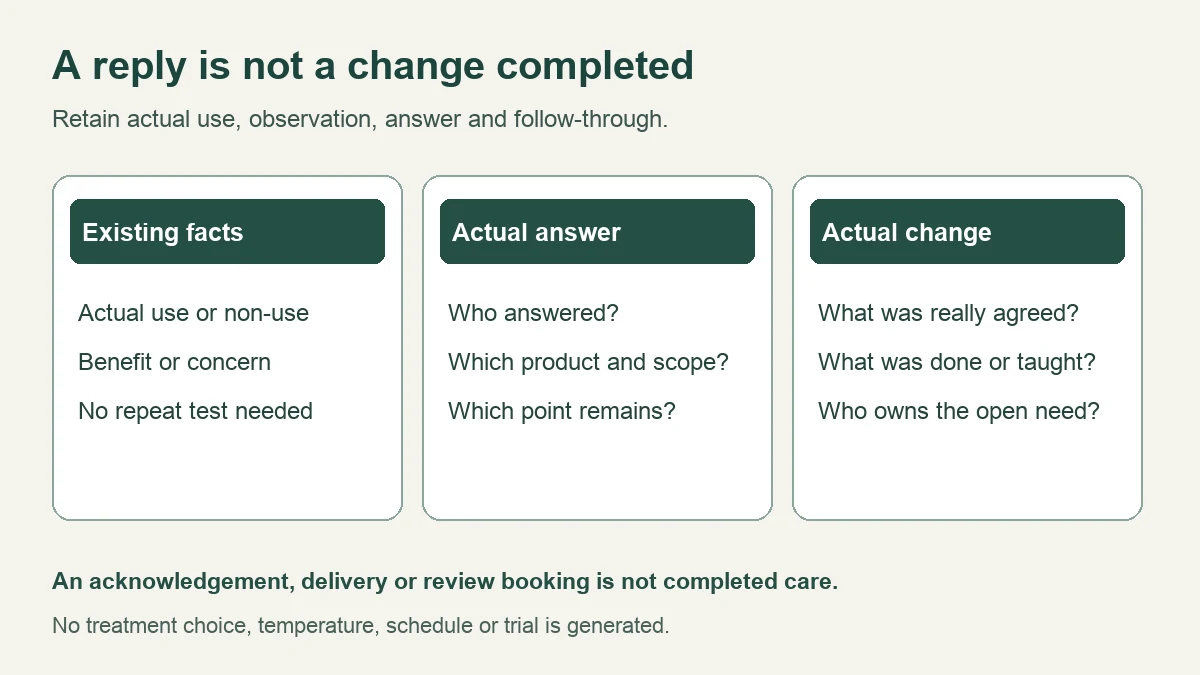
Follow the answer through to actual change
Keep contact status, substantive clinical reply, product explanation, agreed correction and action completed distinct. Acknowledgement, an appointment or replacement order is not a resolved concern. Preserve the remaining question and accepted next owner when known.
Read the evidence by condition, outcome and product
The 2006 Cochrane low-back-pain review, based on searches through 2005, found a small short-term benefit from heat wraps in some acute/subacute low-back-pain trials. Cold evidence was insufficient and heat-versus-cold results conflicted. This is dated, condition-specific evidence, not a current universal ranking or a postoperative knee protocol. It does not validate the reader’s actual device or prescribe its duration.
A general hospital leaflet and a device-safety notice answer different questions from comparative efficacy research. The Sherwood Forest Hospitals page offers general application and caution information, while the FDA page addresses circulating-device injury prevention. Neither proves that every case of orthopedic pain has the same best treatment. This guide does not adopt general leaflet timings as an individual schedule.
Reported relief is a valid experience to communicate, but it does not establish the cause of pain, repair of tissue or faster recovery. A symptom returning does not by itself select a stronger application. Retain lack of benefit and coexisting concerns without turning the record into a treatment contest. No minimum improvement score determines whether the concern deserves review.
| Information | Useful role | Limit |
|---|---|---|
| Condition-specific research | What happened in a defined population, intervention and outcome. | Do not extrapolate across operations, conditions or products. |
| Device safety source | Risks and precautions for the specified equipment category. | Not comparative effectiveness or personal clearance. |
| Matching product directions | Actual restrictions and support route for the item. | Not an individualized clinical assessment. |
| Actual clinical answer | The individual question actually addressed and conditions stated. | Do not extend its scope to a different product or new concern. |
| Personal observation | Experience already reported during actual use or non-use. | Not a diagnosis, causal finding or verified treatment outcome. |
Keep actual answers and changes separate
A useful question is: “This is the actual instruction, this is the product, and this is the concern or mismatch. Does your answer address this condition and device, what should be taught or changed, and who has accepted the action?” Preserve the exact question rather than asking for a generic hot-or-cold winner.
Manufacturer support may explain the model and manual. A clinical role addresses individual treatment and symptom questions within its remit. A helper can confirm availability without supplying clinical advice. Retain each answer’s scope instead of combining incomplete replies into a claim that the whole plan was approved.
Record the actual agreed change and then what really happened. A scheduled review, supply delivery and education completed are distinct. If an instructed arrangement cannot be implemented, keep the barrier and actual response visible. Do not invent an interim temperature, duration, replacement product or safe waiting interval.
Two fictional heat or cold clarification examples
These are invented writing examples, not patient histories, actual clinical replies or successful outcomes. Neither supplies a new application, a treatment choice or a functional test. They retain unresolved questions rather than modelling a reassuring result.
Example A: ordinary pack advice and circulating-device scope differ
| Record | Fictional entry |
|---|---|
| Question / product | An ordinary cold pack and a water-circulating wrap were discussed as different products after an operation; exact procedure omitted. |
| Mismatch | A general pack leaflet does not establish the actual device instruction. |
| Actual reply | A product source explained its equipment only. No individual clinical answer supplied. |
| Teaching / completion | No applicable limits, corrected arrangement or completed education claimed. |
| Next question | Which actual device-specific instruction applies and what needs clarification? No treatment trial performed. |
A note could say: “The document I have describes an ordinary pack, while the proposed item circulates water. Please clarify which instructions apply to this actual device and condition. I have not treated the leaflet or product explanation as a personal prescription.”
Example B: an existing concern, actual answer still absent
| Record | Fictional entry |
|---|---|
| Existing concern | A discomfort, skin or sensation change was already noticed. No cause diagnosed. |
| Actual use | Use, non-use or stopping is recorded as it occurred. No repeat application requested. |
| Contact / answer | A service acknowledged a message. No substantive clinical reply or resolved concern supplied. |
| Change / completion | Review or education is proposed, not confirmed delivered. |
| Remaining need | Needed care comes first. Retain actual advice, action completed and remaining gap when known. |
A note could say: “This is what was already noticed and what actually happened next. My message was acknowledged, but I have no substantive answer or completed change yet.” Acknowledgement is not a reason to wait when direct assessment is needed. No renewed exposure or alternate treatment is invented.
Private heat or cold instruction, use and answer record
Download the offline tool before entering actual health or care details. Use fictional entries on this webpage because surrounding ads and analytics may be present. The tool itself makes no network requests, uses no browser storage and does not automatically save. Its offline export contains no external assets or automatic network requests.
Every field is optional. Blank entries generate questions, not a treatment recommendation, urgency score or clearance. Omit names, identifiers, private contacts and full reports. Paper with the same headings works; needed care never depends on a complete record. Share relevant information with consent through an agreed private route.
Heat or cold: instruction, actual use and answer record
Start with one unanswered point. Blank fields create questions, not diagnosis, treatment selection or clearance.
Download the offline tool before entering actual health or care details. Use fictional entries here; surrounding ads and analytics may be present.
Offline copy. No ads, analytics, external assets or automatic network requests.
The tool makes no network requests, uses no browser storage and does not save automatically. Refreshing may lose entries. Omit names, identifiers, private contacts, full reports and other private details. Needed care comes before this record.
Start with the fictional example or download a blank offline copy.
Paper alternative: clinical question; option; product and warnings; personal concern; teaching; actual use or non-use; observation; contact; actual reply; agreed change; completion and remaining need.
My heat or cold instructions, use, answer and change record
Unverified personal record for discussion. Entries verify no diagnosis, advice, completed change or treatment outcome.
Guide: living.kioptrix.com/heating-pad-vs-ice-wrap/
Build, copy, download text or print/save PDF. Editing hides old output until rebuilt. Examples replace entries and mark output fictional. Offline copies include current entries; keep them private. Refreshing or closing may lose unsaved notes. The tool contacts no service and verifies neither a reply nor treatment completion.
Common heat or ice comparison questions
Does swelling automatically mean cold and stiffness mean heat?
No. Those words do not establish the cause or individual treatment choice. Retain actual advice and the unresolved concern.
Can I use pack timing with a circulating device?
Do not transfer it by assumption. Identify the actual product and retain its applicable clinical and manufacturer instructions.
Should I alternate both to find the winner?
No alternating sequence or trial is supplied here. Record a plan only if it was actually provided for the person and product.
Does less pain establish faster recovery?
No. Keep the person’s report without expanding it into tissue healing, diagnosis or a verified outcome.
Does a filled record approve use?
No. It verifies neither suitability nor correct application and cannot cancel a product prohibition.
What if instructions conflict?
Preserve both sources and the exact mismatch for clarification. Do not invent new settings or a replacement arrangement.
Sources, corrections and review limits
Editorial revision and source check: October 31, 2026. Original URL and publication date retained. The former generic card is replaced by product-type comparisons and actual-answer records. FDA scope is corrected to circulating-device safety. The old application illustration is replaced; no universal timing, symptom chooser, unverified experience or recovery claim is supplied.
- FDA: Water-circulating hot/cold therapy devices — specified-device safety, not universal efficacy.
- Sherwood Forest Hospitals: Heat and ice — general physiotherapy information and cautions, not personal instructions for every device.
- Cochrane: Superficial heat or cold for low back pain (2006) — dated, condition-specific evidence, not a universal comparison.
The representative image is AI-generated and shows unused products during a fictional instruction discussion, not an application demonstration. Diagrams distinguish products, sources and follow-through. No actual patient, device setup, clinical reply or outcome has been independently assessed. Independent qualified review and reader usability testing would strengthen this guide.