

A wrist splint for typing pain raises two separate questions: what care instruction applies, and what the actual work requires. Typing discomfort does not establish a diagnosis or select a device. An instruction to wear a splint at night is not automatically permission to type in it, and a supportive feeling does not establish work readiness.
Use the splint-instruction and work-demand comparison, follow seven essential checks, read two fictional writing examples, or download the free offline work-and-answer record. Start with one unanswered point. No typing endurance test, symptom provocation or extra work session is needed.
This guide focuses on reconciling the actual splint instruction with keyboard, mouse and other task demands, then recording real replies and changes implemented. It is not a product ranking, diagnosis chart or permission to work through symptoms. A delivery, fitting appointment, clinical message and workplace adjustment are different events; keep each visible.
This is education from a family-caregiver-run website. See our background and editorial approach. The operator is not a medical professional. No independent clinical review, product testing, personal fitting or successful return-to-work outcome is claimed. The comparisons and record are editorial communication aids, not validated diagnostic or work-clearance instruments.
Table of Contents
Wrist symptoms needing care come before a splint or work record
Do not use a brace, a new mouse or a full diary to postpone needed assessment. NHS wrist-pain guidance lists severe pain, inability to move the wrist or hold things, a changed shape or colour, loss of sensation, and concerning injury or illness signs as reasons for urgent assessment. See the original wrist-pain warning guidance. These are selected examples, not a complete triage tool.
For a severe or rapidly developing emergency use local emergency services, including 911 in the U.S.; do not substitute a routine portal message. The NHS page uses UK services and contact routes, which are not U.S. instructions. New or worsening weakness, tingling, numbness, skin concerns or work difficulty deserves an appropriate clinical response rather than a tighter strap or another typing trial.
For persistent or worsening symptoms, use the actual clinical contact and review plan; seek appropriate direct care if the situation needs it or the team cannot be reached. No safe waiting interval is supplied. This page does not prescribe immobilization, exercises, medicine changes or an interim wearing schedule. Record actual use, non-use or stopping as it occurred without turning it into a new treatment rule.
Compare actual wrist splint instructions with work demands
Place what you were actually told beside what the job actually involves. Unknown is an acceptable entry. Preserve conflicting wording and its sources instead of choosing whichever seems easier to follow. You do not need a diagnostic label, full task log or completed form before asking for help.
| Area | Actual information to retain | Question or gap |
|---|---|---|
| Clinical purpose | Condition considered, diagnosis if actually supplied, uncertainty and intended splint purpose. | What question is being assessed, and does the instruction address it? |
| Actual wrist splint | Real item and product instructions; clinical source and actual wear/activity advice. | Was work use addressed, or only a different setting such as night use? |
| Keyboard and mouse tasks | Tasks already performed, input demands, reach or handling concern and existing barrier. | Which task needs clarification or a work assessment without a test? |
| Fit and education | Who checked the actual device, teaching received and what remains unclear. | Was instruction delivered to the actual user, rather than only offered? |
| Use and observations | Actual use/non-use, work performed and benefit or concern already noticed. | What needs reporting without assigning a cause or repeating the exposure? |
| Actual reply | Real clinical, therapy, occupational-health or product-source answer and its scope. | Which question remains unanswered? |
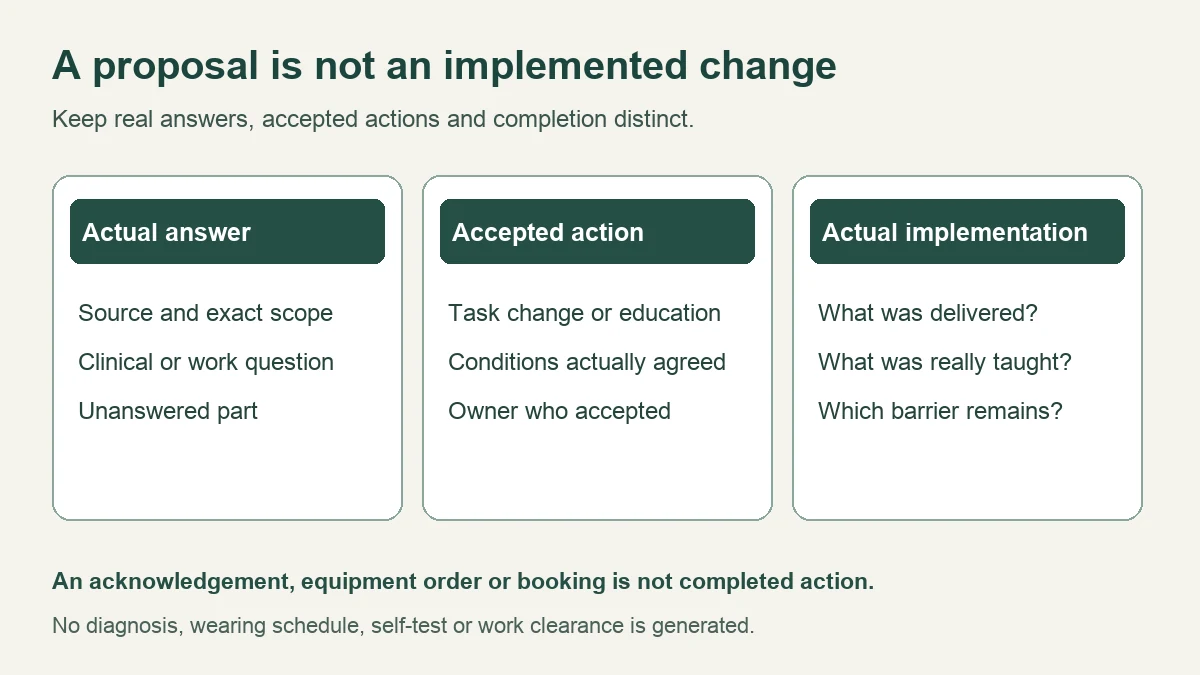
| Work change and completion | Change actually agreed, accepted owner, implementation and remaining barrier. | Was it delivered, or only proposed, ordered or acknowledged? |
Keep keyboard work, mouse work and other hand tasks distinct when they raise different concerns. A task description can be approximate and brief. Omit employer, client, patient, login and account details. Workload, equipment facts and personal care instructions belong in the same discussion, but they are not interchangeable evidence.
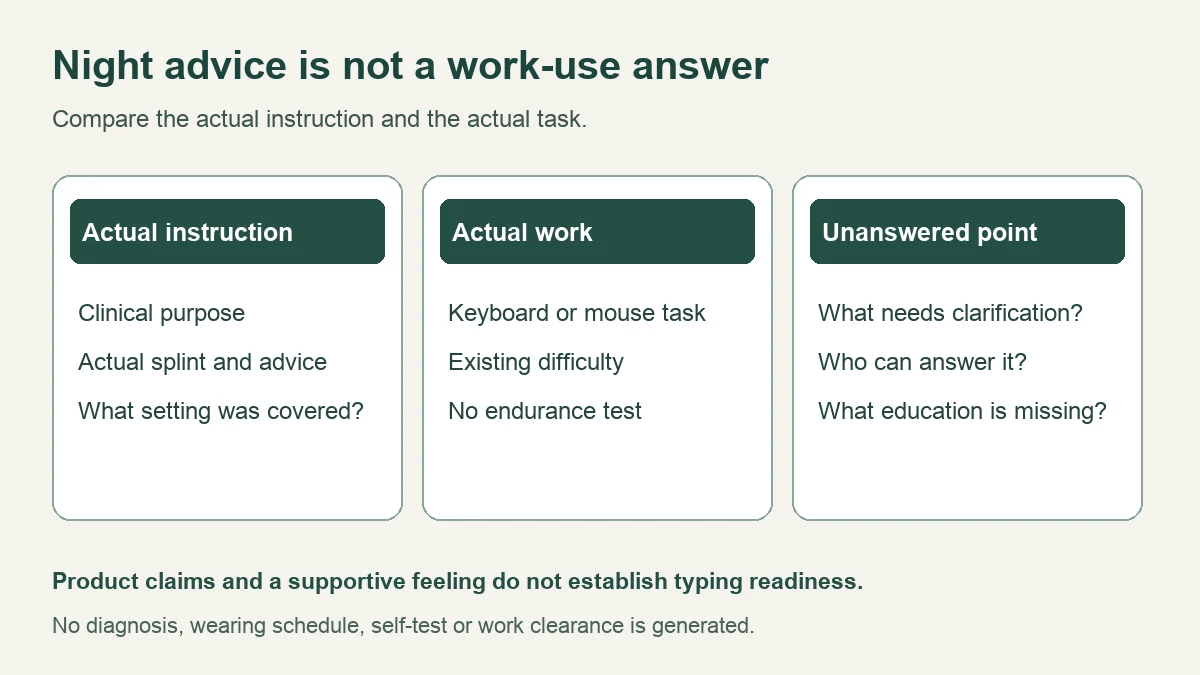
Seven essential wrist splint and work checks
Clarify the clinical question
Retain the actual diagnosis or uncertainty and why a splint is being considered. A symptom location or the fact that typing aggravates it does not determine the cause. Do not use a symptom map or provocative hand manoeuvre to select a brace from this guide.
Preserve the actual device and instruction
Record the real item, source and wear/activity wording. A product description or night recommendation does not automatically answer daytime work use. Ask about the specific gap rather than borrowing another person’s schedule, replacing an instruction or changing strap tension.
Describe the actual task barrier
Use existing facts about keyboard, mouse, handling or other work. Identify the task that is difficult without inventing a safe amount of typing. A person need not reproduce the difficulty, finish a shift or compare devices in a fixed-duration experiment to deserve review.
Confirm fit and use education actually received
Record who addressed the actual device and what was explained. Delivery, a leaflet, an offered appointment and education received are different facts. Ask what remains unclear; the worksheet supplies no fitting manoeuvre, tightness target or self-clearance test.
Retain experience without diagnosing its cause
Pain, sensation change, skin discomfort, perceived support and lack of benefit can coexist. Keep each as reported. Feeling supported does not cancel a concern or establish safe work capacity. Record actual use, non-use or stopping without prescribing more exposure.
Separate the roles and real replies
A supplier may explain its product. A clinical or therapy role addresses the individual question within its remit. Occupational health or the relevant work contact may address task arrangements. Do not turn receipt of a message or a manager’s acknowledgement into clinical advice or a completed adjustment.
Check what changed in practice
Retain the actual agreed action, conditions and accepted owner. Then record the education, equipment or task change actually delivered. Keep the remaining barrier visible when a proposal was not implemented; a purchase or booking does not establish a resolved concern.
What the wrist splint evidence does and does not establish
NHS carpal-tunnel guidance discusses night splints for that condition and clinical review when symptoms worsen or do not improve. This is relevant patient education, not a prescription for every typing-related complaint. It does not establish permission to type in a particular brace or a universal day/night schedule. Its example treatment period is not a requirement to wait before reporting a concern.
The 2023 Cochrane review assessed splinting for carpal tunnel syndrome, mostly in people with mild-to-moderate symptoms. Short-term symptom and hand-function benefits compared with no intervention were limited or uncertain, although some night-splint users reported overall improvement. Longer-term benefit was uncertain because studies were few and inconsistent. Those findings do not establish that every splint is ineffective or that all typing pain is carpal tunnel syndrome.
The review does not validate this reader’s device, fit, work schedule or ability to type safely. An individual report of benefit remains worth communicating, but it is not proof of a specific mechanism, a diagnosis or work clearance. Likewise, lack of benefit should become a real review question rather than a reason to invent a stronger brace or longer wearing period.
OSHA work-process guidance addresses repetition, task organization, variation and recognition of symptoms alongside workstation concerns. It supports examining actual work demands; it does not prove that a wrist splint treats an individual condition or creates a personal safe typing limit. Public ergonomic examples are not substitutes for actual clinical restrictions or agreed workplace arrangements.
| Source or information | Useful scope | Limit to retain |
|---|---|---|
| NHS carpal-tunnel advice | Condition-specific patient education and night-splint context. | Not a generic typing-pain diagnosis or work-use permission. |
| Cochrane review | Benefits, harms and uncertainty in studied carpal-tunnel populations. | Not an assessment of the actual user, product or job. |
| OSHA work-process guidance | Task organization, repetitive work and symptom reporting. | Not an individual prescription, fixed work timer or guarantee. |
| Product instructions and actual replies | The wording and question actually addressed by the source. | Do not extend the answer beyond its real scope. |
Separate clinical advice, work arrangements and actual implementation
A useful question is: “These are my actual splint instructions and these are the work tasks I cannot manage. Does the advice address this use, what education or assessment is needed, and what task change has actually been agreed?” A partial answer is still useful when its limits remain explicit.
Preserve actual replies from different roles separately. A product explanation is not a clinical diagnosis. A clinical recommendation does not prove that a work change is available or implemented. A work contact can confirm an arrangement without being qualified to decide that new symptoms are harmless. Ask who owns the unanswered part rather than assuming one response settles everything.
Possible task changes belong in the record as proposals until actually accepted. Keyboard shortcuts, alternative input or task variation should not be presented as automatically suitable for everyone or required self-tests. The appropriate arrangement depends on actual advice, task demands and availability. This guide selects no mouse, brace, exercise or universal break schedule.
If the work arrangement cannot be carried out, describe the barrier and retain the actual response. Equipment ordered, software requested, training booked and a task reassigned are not the same stage. Record what was really delivered and what remains open. No employment entitlement, approval sequence or guaranteed accommodation is asserted.
Share relevant information with consent through an agreed private route. A brief task description may be enough; do not distribute a full medical report or employer/client details unnecessarily. Keep the person’s own words separate from another observer’s account, and request accessible education or an interpreter where needed.
Two fictional wrist splint and typing-work examples
These are invented writing examples, not real clinical advice, fitting results or successful work outcomes. Neither supplies a typing test, wearing schedule, strap setting or diagnosis. Both retain missing answers rather than modelling approval.
Example A: night instruction, work-use answer absent
| Record | Fictional entry |
|---|---|
| Current advice | A night-splint instruction was reported; diagnosis and exact wording are omitted. |
| Work demand | Keyboard and mouse tasks are required. No extra work test was performed for this record. |
| Actual reply | A product source described its item only. No clinical or occupational-health work-use answer supplied. |
| Education / change | No task-specific teaching or newly approved wearing schedule is invented. |
| Completion / gap | Advice was received, but work-use clarification, education and adjustment implementation are not claimed complete. |
A note could say: “My instruction concerns night use. It does not answer this keyboard or mouse task. Please clarify the actual activity question and education needed. I have not treated the product description as permission to work in the device.”
Example B: a work barrier, proposed change not implemented
| Record | Fictional entry |
|---|---|
| Existing experience | A sensation or skin concern and a difficult task were already noticed. No cause diagnosed. |
| Actual use | Use, non-use or stopping would be recorded as it occurred; no repeat exposure requested. |
| Contact / reply | A service acknowledged a message and a work contact received a proposed change. No substantive clinical answer or accepted work arrangement supplied. |
| Action / education | Review, education or task adjustment is proposed, not confirmed delivered. |
| Remaining gap | No resolved concern, completed fitting or implemented change claimed. Needed care must not wait for a reply. |
A note could say: “This is what already happened and this is the task barrier. My message was acknowledged, but I have no actual clinical answer or implemented change yet. What applies now, who accepted the action, and what education or work change was actually completed?”
Private wrist splint, actual work and answer record
Download the offline tool before entering actual health or work details. Use fictional entries on this webpage because surrounding ads and analytics may be present. The tool itself makes no network requests, uses no browser storage and does not automatically save. Its offline export has no external assets or automatic network requests.
Start with one question; all fields are optional. Missing entries create optional questions, not a diagnosis or a readiness score. Omit names, private contacts, identifiers, employer/client information and full reports. Paper with the same headings works. Needed care and an actual work response never depend on completing a diary.
Wrist splint, actual work and answer record
Start with one unanswered point. Blank fields create questions, not diagnosis, fit or work clearance.
Download the offline tool before entering actual health or work details. Use fictional entries here; surrounding ads and analytics may be present.
Offline copy. No ads, analytics, external assets or automatic network requests.
The tool makes no network requests, uses no browser storage and does not save automatically. Refreshing may lose entries. Omit names, identifiers, private contacts, employer/client details and full reports. Needed care comes before this record.
Start with the fictional example or download a blank offline copy.
Paper alternative: clinical question; actual splint and instruction; work demand; mismatch; education; actual use or non-use; observation; contact; actual reply; agreed change; implementation and remaining gap.
My wrist splint, actual work, reply and change record
Unverified personal record for discussion. Entries verify no diagnosis, advice, completed change or treatment outcome.
Guide: living.kioptrix.com/wrist-splint-for-typing-pain/
Build a record, copy it, download text or print/save PDF. Editing hides previous output until rebuilt. Example buttons replace entries and mark output fictional. Offline exports include current entries; keep them private. Refreshing or closing may lose unsaved notes. The tool contacts no recipient and independently verifies no advice, fitting or implemented change.
Common wrist splint and work questions
Does night advice permit typing in the device?
Not automatically. Preserve the actual instruction and ask about the specific work task rather than extending its scope.
Does feeling supported establish work readiness?
No. It is an experience worth reporting, alongside concerns and actual task barriers. It is not diagnosis, fit verification or clearance.
Must I repeat a painful task to complete the form?
No. Existing observations are enough. Do not perform an endurance test, new brace trial or painful manoeuvre for this record.
Does an acknowledged message mean the plan changed?
No. Record the substantive answer, actual accepted action and implementation separately.
Does the research mean splints never help?
No. Findings and certainty vary by outcome and context. Do not turn population-level uncertainty into an individual treatment decision.
What if the product or job task changes?
Keep earlier advice with its original scope and ask whether it covers the changed situation. The tool transfers no approval by assumption.
Sources, corrections and review limits
Editorial revision and source check: October 31, 2026. The URL and original publication date are retained. The generic preparation card is replaced with actual instruction–work comparison and follow-through records. The old image implying supported typing is replaced by a fictional instruction discussion. The link to the mouse article’s pain-pattern selection and fixed test is omitted here; this page supplies neither.
- NHS: Carpal tunnel syndrome — condition-specific patient information, not generic work clearance.
- Cochrane: Splinting for carpal tunnel syndrome (2023) — evidence and uncertainty in studied populations, not a personal prescription.
- OSHA: Computer workstation work process — task organization and symptom awareness, not individual clinical advice.
- NHS: Wrist pain — symptom/contact context; UK routes must not be presented as U.S. services.
No actual patient, device fitting, clinical reply, task assessment or work outcome has been independently assessed. The representative image is AI-generated and shows an unused splint during a fictional discussion, not an approved typing technique. Diagrams distinguish instructions, demands, answers and implementation. Independent qualified review and reader usability testing would strengthen this guide.