

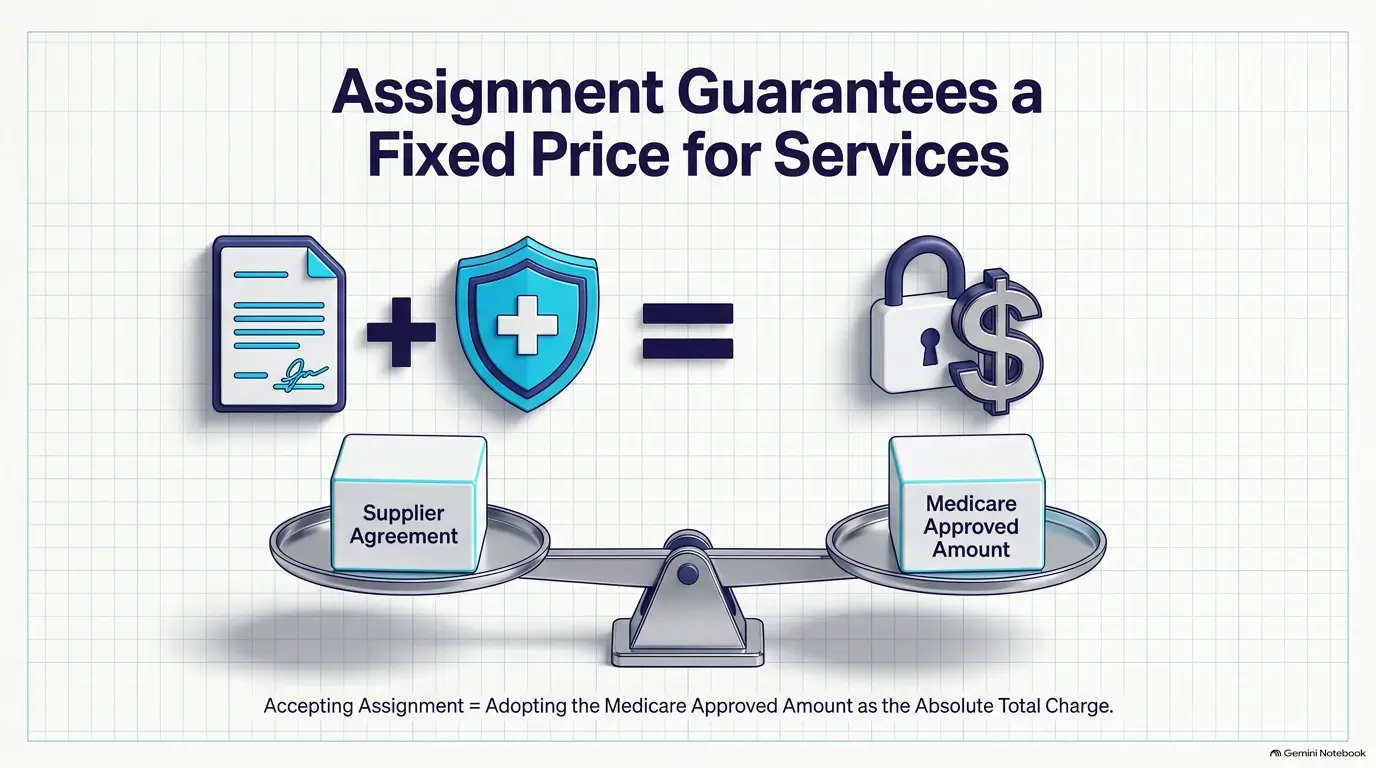
For people with Original Medicare, a DME supplier’s decision to accept assignment can directly affect how much you are asked to pay, when you have to pay it, and how predictable the final bill will be. When a supplier accepts Medicare assignment, it agrees to accept the Medicare-approved amount as full payment for the covered durable medical equipment. You are generally responsible for the applicable Part B deductible and coinsurance rather than whatever price the supplier might otherwise charge.
This matters for wheelchairs, walkers, hospital beds, oxygen equipment, continuous glucose monitors, braces, and many other items billed under Medicare’s durable medical equipment, prosthetics, orthotics, and supplies benefit, usually shortened to DMEPOS.
There is one important boundary to establish at the beginning: assignment is primarily an Original Medicare payment concept. If you have Medicare Advantage, the plan must cover the medically necessary DME categories Original Medicare covers, but your supplier network, authorization requirements, and cost sharing can depend on the individual plan. Medicare advises Medicare Advantage members to contact their plan about DME coverage and suppliers.
Table of Contents
What Does Medicare Assignment Mean for DME?
Medicare defines accepting assignment as accepting the Medicare-approved amount as full payment for a covered service or item. For a DME claim, that creates an important ceiling on what the supplier can collect for the Medicare-approved amount.
For most Part B-covered DME, after the Part B deductible has been satisfied, Medicare generally pays its share of the Medicare-approved amount and the beneficiary is responsible for 20% when the supplier accepts assignment. Other insurance, including applicable supplemental coverage, can change what you ultimately pay.
The phrase sounds technical, but the practical question is wonderfully plain: “Will you accept Medicare’s approved amount for this item as payment in full?”
Enrolled, Participating, and Accepting Assignment Are Not the Same Thing
One of the easiest ways to get tangled in DME billing is to treat several Medicare terms as interchangeable. They are not.
| Term | What it tells you | Why it matters |
|---|---|---|
| Medicare-enrolled supplier | The supplier is enrolled in Medicare and eligible to submit qualifying Medicare claims. | Enrollment is generally necessary for Medicare payment, but it does not by itself answer every assignment question. |
| Participating supplier | The supplier participates in Medicare. | Medicare says participating suppliers must accept assignment. |
| Non-participating supplier | The supplier is enrolled but has not agreed to participate on that basis. | It may choose to accept assignment for an individual claim, but generally is not required to do so. |
| Accepts assignment | The supplier accepts the Medicare-approved amount as full payment for the covered item. | This is the question that directly affects the payment arrangement for the claim. |
That is why asking only, “Do you take Medicare?” leaves too much fog on the table. A better sequence is: “Are you enrolled in Medicare? Are you a participating supplier? Will you accept assignment for this specific item?”
The same distinction comes up frequently with orthopedic equipment. If you are checking a brace rather than another type of DME, the site’s guide to checking orthopedic brace insurance coverage before accepting the device explains how the billing code, supplier identity, documentation, and coverage rules need to line up.
Why Assignment Can Change Your Out-of-Pocket Cost
Medicare’s current DME coverage guidance says that after the Part B deductible, you generally pay 20% of the Medicare-approved amount when the supplier accepts assignment.
If the supplier does not participate in Medicare and does not accept assignment for the claim, Medicare warns that you may be charged more. The Medicare-approved amount and the supplier’s own charge are not necessarily the same number.
A simple hypothetical example
Suppose a covered DME item has a Medicare-approved amount of $120, you have already satisfied the applicable Part B deductible, and no secondary insurance changes the calculation.
- If assignment is accepted, 20% of $120 would be $24.
- Medicare’s share would generally be based on the remaining 80%, or $96.
- If assignment is not accepted, the supplier’s billing and upfront-payment arrangement may be different, and you could be asked to pay more initially.
This example is only arithmetic, not a personalized Medicare quote. Actual responsibility can depend on your deductible status, secondary coverage, the item, Medicare payment rules, and whether all coverage requirements are satisfied.
Assignment Can Also Change When You Have to Pay
The difference is not only the eventual total. Cash flow can change too.
Medicare explains that if an applicable DME claim is not assigned, you may have to pay the full cost upfront. Medicare can then pay you the amount it covers after the claim has been submitted and processed.
That distinction can matter enormously for an inexpensive cane, but it becomes even more noticeable with a wheelchair, respiratory device, hospital bed, or other higher-cost equipment. A reimbursement later does not erase the problem of finding the money today.
It is also worth identifying who is actually billing you. A device handed to you in a physician’s office may be billed by a separate equipment company. The guide to understanding orthopedic bills from multiple providers and suppliers explains why the name on a later DME bill may not match the clinic where you received the equipment.
Rental Equipment Makes the Assignment Question Even More Important
Many Medicare-covered DME items are rented rather than purchased immediately. Medicare therefore specifically advises beneficiaries to make sure the supplier will accept assignment for all rental months.
This is easy to overlook. You may carefully verify the first month’s charge, receive the equipment, and mentally close the billing file. The claim, however, may continue month after month.
Before beginning a rental, ask the supplier to explain in writing:
- Whether the item will be rented or purchased.
- Whether the supplier accepts assignment.
- Whether assignment will apply to every expected rental month.
- Your estimated monthly responsibility.
- Whether ownership eventually transfers to you and, if so, under what Medicare rules.
- Who is responsible for repairs, replacements, accessories, and supplies during the rental period.
Do not assume the first month’s receipt tells you how the entire rental episode will work.
Five Questions to Ask Before Accepting DME
You do not need to become a Medicare billing specialist before taking home a walker. You do need a few precise answers.
- Are you enrolled in Medicare as a DMEPOS supplier?
Medicare generally requires covered DME to come from an appropriately enrolled supplier. - Are you a participating Medicare supplier?
If the supplier participates, Medicare says it must accept assignment. - Will you accept assignment for this exact item or claim?
This is especially important when dealing with a non-participating supplier. - What is my estimated out-of-pocket amount before delivery?
Ask for the Medicare-approved amount, expected deductible, coinsurance, and any anticipated noncovered charges to be identified separately when possible. - If this is rented, will you accept assignment for every rental month?
A yes for today’s delivery should not be casually interpreted as a yes for the entire rental period.
You can also use Medicare’s official medical equipment Supplier Directory to look for suppliers. Medicare notes that directory information can occasionally contain errors, so confirming the supplier’s status directly before delivery remains sensible.
Assignment Does Not Guarantee That Medicare Will Cover the Equipment
This is the other half of the puzzle. Assignment controls a payment relationship; it does not magically make an otherwise noncovered item payable.
Medicare Part B generally covers medically necessary DME for home use when the applicable coverage conditions are met. Depending on the equipment, that can involve a clinician’s order, medical-necessity documentation, qualifying clinical findings, or prior authorization.
For example, Medicare’s wheelchair and scooter coverage guidance explains that certain power mobility equipment requires specific documentation and may require prior authorization. A supplier’s willingness to accept assignment does not replace those medical and administrative requirements.
Think of assignment as one lock on the door, not the whole key ring.
What If the Supplier Does Not Accept Assignment?
A refusal to accept assignment does not automatically mean the equipment is medically inappropriate or that Medicare never covers that type of item. It means you should understand the financial consequences before agreeing to delivery.
For non-urgent equipment, consider these steps before proceeding:
- Ask for the supplier’s expected charge in writing.
- Ask how much must be paid before delivery.
- Ask what amount the supplier expects Medicare to approve.
- Ask who will submit the Medicare claim.
- Search Medicare’s Supplier Directory for another enrolled supplier.
- Ask an alternative supplier whether it participates in Medicare or will accept assignment.
- Confirm that changing suppliers will not disrupt a required order, authorization, fitting, or delivery schedule.
If the equipment is medically urgent, do not delay necessary care merely to chase a cleaner invoice. Ask the treating clinician and supplier how quickly an alternative Medicare-enrolled supplier can safely provide the required equipment.
Original Medicare and Medicare Advantage Need Different Questions
If you have Original Medicare, assignment is a central cost question. If you have Medicare Advantage, start instead with the specific plan’s supplier and coverage rules.
Medicare states that Medicare Advantage plans must cover the same medically necessary categories of DME as Original Medicare, but the suppliers available to you and your specific costs depend on your plan. The plan’s Evidence of Coverage and customer-service representatives can explain the applicable network, authorization, and cost-sharing rules.
If you are navigating equipment after an orthopedic problem, the site’s guide to Medicare Advantage orthopedic care and DME supplier rules goes further into network and prior-authorization questions.
The shortest useful version is this:
- Original Medicare: ask about Medicare enrollment, participation, and assignment.
- Medicare Advantage: ask whether the supplier and equipment are covered under your specific plan, whether the supplier must be in network, and whether authorization is required.
What to Do If a DME Claim Is Already Wrong
If equipment has already been delivered and the bill is larger than expected, begin with the claim rather than arguing from memory.
- Identify the legal name of the DME supplier.
- Compare the bill with your Medicare Summary Notice or plan Explanation of Benefits.
- Confirm whether the claim was assigned or unassigned.
- Check the billed HCPCS code and whether the item was processed as a purchase or rental.
- Ask the supplier to explain any amount beyond the Medicare-approved or plan-allowed amount.
- If coverage was denied, identify the exact denial reason before starting an appeal.
For brace-related claims, the site’s denied brace insurance appeal guide shows why supplier eligibility, documentation, coding, medical necessity, and authorization problems need different remedies rather than one generic appeal letter.
Frequently Asked Questions
Does accepting assignment mean my DME is free?
No. Assignment generally means the supplier accepts the Medicare-approved amount as full payment for the covered item. You may still owe the Part B deductible and applicable coinsurance unless another form of coverage pays those amounts.
Can a non-participating DME supplier accept assignment?
Yes. Medicare says a non-participating supplier does not necessarily have to accept assignment but may choose to do so for an individual claim. Ask about the specific item rather than assuming its policy is identical for every customer and claim.
If a supplier is enrolled in Medicare, does that mean it accepts assignment?
Not necessarily. Enrollment establishes the supplier’s Medicare billing status, while participation and assignment address different parts of the payment relationship. Ask all three questions separately.
Why does assignment matter more for rented equipment?
Because the billing relationship can continue for multiple months. Medicare specifically advises beneficiaries to make sure the supplier is willing to accept assignment for all rental months.
The Question to Ask Before the Equipment Arrives
A prescription tells you that a clinician wants you to have the equipment. Medicare coverage tells you whether the item can qualify for payment. Supplier enrollment tells you whether the company can participate in the Medicare billing system for the item.
Assignment tells you something different: whether the supplier will accept Medicare’s approved amount as full payment for the covered claim.
Before accepting non-emergency DME under Original Medicare, ask one sentence and write down the answer: “Will you accept Medicare assignment for this item, including every rental month if it is rented?”
That small question can turn a fuzzy promise that a supplier “takes Medicare” into information you can actually use when estimating the bill.