
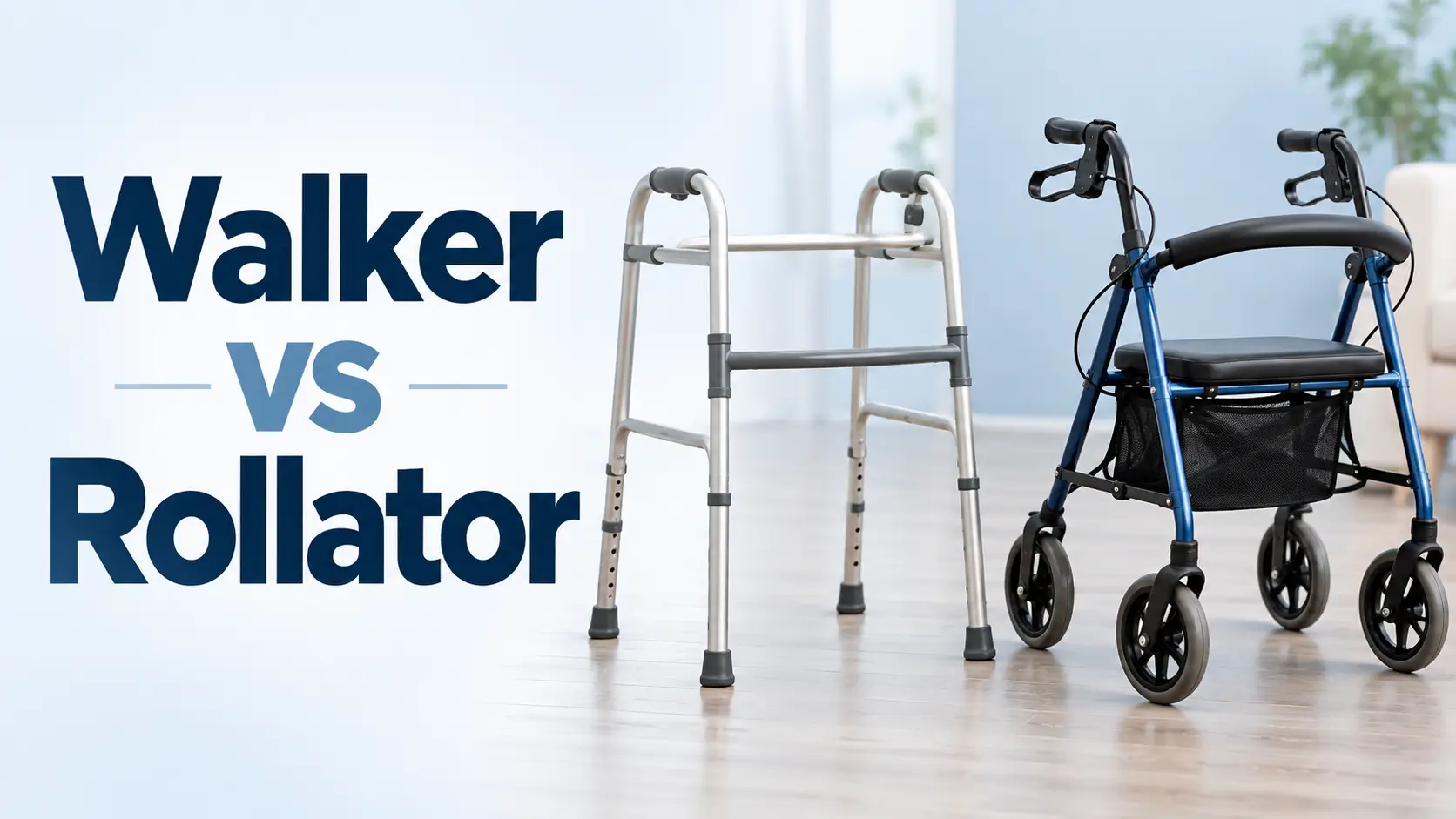
Medicare Part B can cover both walkers and rollators when the equipment is medically necessary and the coverage requirements are met. The important question is not simply whether a standard walker or rollator is “covered.” It is whether the particular device your clinician orders, the way the supplier bills it, and your documented mobility needs satisfy Medicare’s durable medical equipment rules.
That distinction matters because retail names and Medicare billing categories do not always line up neatly. A four-wheeled rollator with brakes and a seat may look very different from a basic pickup walker, yet Medicare may treat both within its walker benefit depending on the device and coding. Medicare’s own walker coverage guidance specifically says walkers, including rollators, may be covered for eligible beneficiaries.
This guide focuses on U.S. Medicare coverage rules reviewed on September 29, 2026. It explains the questions to ask before a walker is ordered or purchased. It does not determine which mobility device is medically safest for a particular person, and Medicare Advantage plans may apply plan-specific network, authorization, and cost-sharing rules.
Table of Contents
Standard Walker vs Rollator: Coverage Starts With Function, Not Features
Medicare coverage is built around medical necessity rather than the number of wheels, the color of the frame, or whether a product page describes something as “premium.” CMS states that a standard walker and related accessories can be covered when a beneficiary has a mobility limitation that significantly interferes with one or more mobility-related activities of daily living in the home, can safely use the walker, and can sufficiently resolve the mobility deficit with the walker. The CMS walker compliance guidance explains these criteria in detail.
Those home activities include practical tasks such as toileting, dressing, grooming, bathing, and eating. This home-use requirement is easy to overlook. Wanting a rollator mainly for long walks at a mall, airport, park, or cruise ship does not by itself establish the same Medicare medical-necessity case as needing a walker to complete essential activities inside the home.
The terminology can also be slippery. CMS walker policy recognizes wheeled walkers with two, three, or four wheels, and its coding guidance notes that devices sometimes called gait trainers or rollators may be billed using walker codes. That is why asking the supplier for the exact billing code is often more useful than relying on the product name printed on the box.
How a Standard Walker and Rollator Differ in Everyday Use
| Feature | Basic pickup walker | Typical rollator |
|---|---|---|
| Ground contact | Usually four non-wheeled legs | Usually three or four wheels |
| Movement | Lift or advance the frame between steps | Rolls continuously as the user walks |
| Brakes | Usually none | Commonly hand-operated |
| Seat | Usually none | Often included |
| Typical advantage | High stability and controlled advancement | Easier continuous movement and potential resting seat |
| Main coverage question | Is a walker medically necessary? | Is this specific wheeled walker and its features medically necessary and correctly billed? |
The American Academy of Orthopaedic Surgeons notes in its guidance on walkers, canes, and crutches that a four-legged pickup walker provides substantial stability. A rollator behaves differently because its wheels continue moving unless the user controls its speed and brakes appropriately. Neither description makes one device universally better. Balance, arm strength, endurance, walking pattern, cognition, home layout, weight-bearing restrictions, and the ability to operate brakes all matter.
If turning is already difficult, it is worth reviewing the practical differences in turning with a standard walker and a rollator. A device that feels wonderfully fluid in a showroom can become a tiny runaway shopping cart if the user’s braking and turning skills do not match it.
1. Which Device Does My Clinician Believe Is Medically Necessary?
Start with the clinical question before the insurance question. Ask the prescribing clinician whether you need a non-wheeled walker, a wheeled walker, a rollator, or another mobility aid, and why.
A rollator should not be chosen solely because it has a seat, basket, larger wheels, or a more convenient folding mechanism. Likewise, choosing the simplest walker solely because it costs less can be a false economy if the user cannot safely or efficiently use it.
- What mobility problem is the device intended to solve?
- Do I need substantial weight support, balance support, or primarily endurance assistance?
- Can I safely control wheels and hand brakes?
- Do I need to sit during ordinary walking activities?
- Should a physical or occupational therapist fit and train me on the device?

2. Does My Medical Record Describe the Mobility Problem Inside My Home?
For Original Medicare, the documentation should support more than a vague statement that walking is difficult. CMS’s current Walker Local Coverage Determination L33791 focuses on a mobility limitation that significantly interferes with mobility-related daily activities in the home.
In practical terms, ask whether the medical record explains what happens without the walker. For example, does the person have difficulty reaching the bathroom safely, completing dressing within a reasonable time, or moving through the home without an increased risk of harm? Coverage decisions live in those functional details, not in adjectives such as “weak,” “unsteady,” or “elderly” standing alone.
3. What HCPCS Code Will the Supplier Bill?
This is one of the most useful questions a beneficiary or caregiver can ask a durable medical equipment supplier.
HCPCS is the coding system suppliers use to describe equipment on Medicare claims. The retail label “rollator” does not automatically identify one Medicare billing category. CMS policy recognizes several kinds of wheeled walkers, and some devices marketed as rollators are billed under walker codes.
Ask the supplier:
- What exact HCPCS code will you submit?
- Does that code describe this exact model?
- Are any attachments billed separately?
- Is any part of the product considered an upgrade or noncovered enhancement?
- If Medicare pays only for a less expensive covered configuration, what would I owe for the upgrade?
This step is particularly useful when comparing a simple wheeled walker with a feature-heavy rollator. Insurance sees codes and medical necessity. The showroom sees cup holders.
4. Is the Seat or Other Accessory Actually Covered?
Do not assume that Medicare coverage of the walker means every feature attached to it is separately covered. CMS walker policy distinguishes medically relevant walker components from enhancement accessories. Its current policy states that certain walker attachments can have their own billing codes, while enhancement features that do not significantly contribute to the therapeutic function may be noncovered.
That distinction can matter with seats, baskets, specialty braking systems, storage components, styling upgrades, and hybrid devices. A basket may be wonderfully useful while still being an insurance wallflower.
Ask the supplier to separate the price into the covered base device, covered medically necessary components, and any optional noncovered upgrades before you agree to the order.
5. Is the Prescription and Required Documentation Complete Before Delivery?
Medicare Part B covers medically necessary durable medical equipment when an eligible provider orders it for use in the home. Documentation rules can depend on the item and code, so the supplier should confirm that it has the required order before billing Medicare.
Do not treat “my doctor told me to get a walker” and “the supplier has a Medicare-compliant order” as interchangeable statements. The clinical recommendation and the claim paperwork need to meet each other somewhere in the middle.
For patients preparing for surgery, the equipment question is easier to manage before discharge than after everyone is tired and looking for a walker at 9 p.m. The surgery recovery equipment checklist explains how to confirm which items are expected, who supplies them, and what should be fitted before going home.
6. Is the DME Supplier Enrolled in Medicare and Does It Accept Assignment?
This question can directly affect what you pay. Medicare says beneficiaries should make sure their clinicians and DME suppliers are enrolled in Medicare. It also advises asking whether the supplier accepts assignment.
With Original Medicare, after the Part B deductible is met, the beneficiary generally pays 20% of the Medicare-approved amount for a covered walker when the supplier accepts assignment. Medicare also warns that a supplier that does not accept assignment may create higher or more complicated upfront costs.
Ask before the walker leaves the store:
- Are you enrolled as a Medicare DME supplier?
- Do you accept assignment for this claim?
- If this is rented equipment, will you accept assignment for every rental month?
- What is the Medicare-approved amount?
- What amount do you expect me to pay today?
Orthopedic recovery can generate bills from surprisingly separate companies. If an equipment bill arrives from a name you do not recognize, the guide to orthopedic bills from multiple providers and DME suppliers explains why equipment charges may travel on a different billing path from the surgeon or hospital.
7. Is Medicare Renting the Walker, Buying It, or Giving Me a Choice?
Medicare does not handle every piece of durable medical equipment in exactly the same way. Medicare.gov explains that depending on the equipment, Medicare may require rental, purchase, or allow a choice between the two.
Before accepting a walker or rollator, ask the supplier whether the claim is being processed as a purchase or rental and what happens if you no longer need the device after surgery. Also ask who handles repairs and replacement parts if you own the walker.
This can be especially relevant after joint replacement, when the device may be essential for a limited stage of recovery rather than lifelong use.
8. Do I Have Original Medicare or Medicare Advantage?
This is where two patients with the same diagnosis and the same walker can encounter different administrative paths.
Medicare Advantage plans must cover medically necessary services that Original Medicare covers, but Medicare’s comparison of Original Medicare and Medicare Advantage explains that an Advantage plan may require prior authorization for certain services or supplies.
A Medicare Advantage member should therefore ask the plan:
- Is this specific walker or rollator covered under my DME benefit?
- Do I need prior authorization?
- Does the prescriber need to be in network?
- Must I use a particular DME supplier?
- Is this supplier in network for my exact plan?
- What copayment or coinsurance applies?
- Are upgraded models or accessories treated differently?
For a broader look at those plan-specific friction points, see the guide to Medicare Advantage orthopedic care, DME networks, and prior authorization.
9. What Happens If Medicare Is Expected to Deny the Device?
With Original Medicare, a supplier may sometimes expect Medicare to deny payment for an item that Medicare can cover in other circumstances. In situations where the rules require it, an Advance Beneficiary Notice of Noncoverage can warn the beneficiary about potential financial responsibility before the item is furnished.
CMS explains in its Advance Beneficiary Notice guidance that an ABN is used in certain Original Medicare situations when payment is expected to be denied and potential financial liability may transfer to the beneficiary.
If a supplier says, “Medicare probably won’t cover this one,” do not stop at that sentence. Ask:
- Why do you expect denial?
- Is the issue medical necessity, documentation, coding, supplier status, or an upgrade?
- Is there a covered alternative?
- Will you submit a claim if I want a formal Medicare determination?
- Will I receive an ABN when applicable?
- What is my estimated financial responsibility if Medicare denies the claim?

After Joint Replacement, Do Not Choose by Coverage Alone
A device can be covered and still be the wrong device for a particular stage of recovery. A person immediately after hip or knee replacement may have different stability, weight-bearing, endurance, and turning needs from the same person six weeks later.
A rollator’s seat can appear ideal for fatigue, but the user must also safely control a rolling frame and brakes. A pickup walker may offer greater stability but requires enough upper-body ability and coordination to advance it correctly. A two-wheeled walker sits somewhere between those patterns.
The correct sequence is usually clinical selection first, coverage verification second, and shopping third. Reversing that order can turn an attractive mobility aid into an expensive coat rack.
Once community walking resumes, remember that a store introduces curbs, crowds, turning, waiting, bags, and fatigue that do not exist during a short hallway test. The guide to grocery shopping after joint replacement while using a walker or cane covers those real-world transitions in more detail.
Four Coverage Assumptions Worth Avoiding
“Medicare does not cover rollators.”
Too broad. Medicare.gov expressly includes rollators within its walker coverage information for eligible beneficiaries. The individual device, medical necessity, documentation, supplier, and billing still matter.
“My doctor prescribed it, so Medicare has to pay.”
A prescription or order is important, but it does not erase Medicare’s other coverage criteria. The device still needs to fall within the benefit and satisfy applicable medical-necessity, documentation, and supplier requirements.
“If the rollator is covered, every accessory is covered.”
Not necessarily. CMS distinguishes covered components from enhancement accessories and other features that may not be separately payable.
“I can buy one online and ask Medicare to reimburse me afterward.”
Do not assume this. Medicare tells beneficiaries to obtain covered DME through Medicare-enrolled suppliers. Medicare Advantage plans may impose additional network requirements. Verify the supplier and billing route before paying retail price.
A Five-Minute Call Script Before You Accept the Walker
You do not need to speak fluent insurance dialect. Ask the supplier these questions in plain English:
“My clinician recommended a walker. Can you tell me the exact make and model you plan to provide, the HCPCS code you will bill, whether Medicare considers any part of it an upgrade or noncovered accessory, whether you accept Medicare assignment, and what you expect me to pay?”
“Do you already have the required order and documentation? If Medicare is expected to deny any part of the equipment, please explain why and tell me whether I will receive a written notice before delivery.”
If you have Medicare Advantage, add: “Are you in network for my exact plan, and has any required prior authorization been completed?”
Write down the supplier representative’s name, the date, the equipment model, the billing code, and the quoted patient responsibility. The goal is not bureaucracy for sport. It is to prevent the delightful experience of discovering three weeks later that everyone was discussing a different walker.
Bottom Line
Medicare Part B can cover standard walkers and rollators, but coverage is determined by more than the product label. The strongest questions are whether the device is medically necessary for mobility-related activities in the home, whether the user can safely use it, what HCPCS code the supplier will bill, whether optional features are covered, and whether the supplier meets Medicare or Medicare Advantage requirements.
Before buying or accepting delivery, confirm the clinical fit with the prescribing or rehabilitation team and confirm the coverage mechanics with the supplier and, when applicable, the Medicare Advantage plan. That small triangle of conversations can prevent both an unsafe equipment choice and an avoidable bill.