

A practical return-to-errands guide
Grocery Store Strategy After Joint Replacement:
Shop Safely Without Overdoing It
The first grocery trip after hip or knee replacement can look harmless on paper. A short list. A familiar store. Perhaps one carton of milk and a heroic little bunch of bananas. Yet the real trip includes a car transfer, uneven pavement, automatic doors, turning shoppers, checkout lines, bags, and the long walk back to the kitchen.
That is why your first visit should be treated as a controlled mobility test rather than a return to ordinary shopping. The goal is not to prove that you can complete the family’s weekly stock-up. It is to learn how your balance, pain, concentration, swelling, and walking pattern respond to a small dose of real life.
This guide helps patients and caregivers build a safer plan from driveway to refrigerator. You will learn how to check readiness, choose support, limit the route, manage checkout, arrange loading help, compare pickup and delivery options, and recognize the moment when leaving early is the wisest move in the store.
A successful first trip may end with three items instead of five. Safety, not shopping volume, is the scorecard. 🛒
Snapshot
This guide is for adults returning to community errands after hip or knee replacement and for caregivers helping them plan. It solves the hidden problems around walking aids, fatigue, checkout, bag weight, driving, and warning signs. By the end, you can design a five-item trial trip with a clear exit plan.
Table of Contents
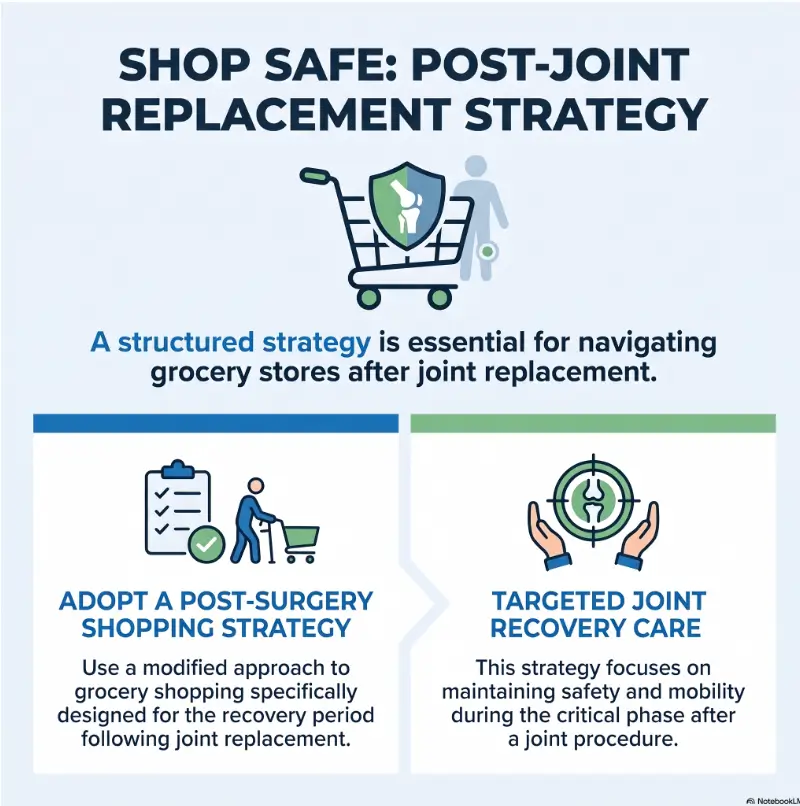
Before You Shop: What This Guide Can and Cannot Decide
Safety note before you make the list
This article offers general planning ideas, not individualized medical advice or clearance to walk, lift, drive, or shop. Your surgeon’s instructions, physical therapy plan, weight-bearing status, hip precautions, medication guidance, and wound-care directions take priority. Confirm uncertain activities with your surgical team, especially after a complication, fall, medication change, or sudden decline.
Function Matters More Than a Date on the Calendar
People naturally ask, “How many weeks after joint replacement can I go grocery shopping?” It is an understandable question, but the calendar cannot see you walk across a wet parking lot, turn around a display, or stand while a cashier scans fifteen items.
A safer answer depends on function. Your care team may consider the joint replaced, the surgical approach, which side was operated on, your weight-bearing restrictions, balance, strength, pain control, medications, reaction time, and whether you need a walker or cane.
Two people at the same postoperative week may need completely different plans. One may be ready for a ten-minute visit with a caregiver. The other may still need curbside pickup because standing, turning, or vehicle transfers remain difficult.
Hip and Knee Replacements Create Different Shopping Problems
After hip replacement, bending, pivoting, leg position, seat height, and approach-specific precautions may affect reaching shelves and entering a car. Do not assume that a movement is permitted because another hip-replacement patient was allowed to do it.
After knee replacement, the main obstacles may be stiffness, swelling, reduced confidence during turning, difficulty standing still, or fatigue from repeatedly starting and stopping. A person who walks well down a hallway may still struggle in a checkout line.
If car transfers are part of the challenge, review a careful post-surgery car seat setup before testing a store trip.
Who Should Wait and Use Another Shopping Option
- You have not been cleared for community walking or the planned amount of activity.
- You feel dizzy, sedated, confused, unusually weak, or unsteady.
- Your pain or swelling has suddenly worsened rather than following its usual pattern.
- You cannot use your prescribed walking aid correctly in a crowded space.
- You would need to drive despite movement limits or medication that affects coordination.
- Your incision has concerning redness, swelling, drainage, or another change your team has told you to report.
- You have no safe plan for getting groceries from the vehicle into the home.
Key takeaway: “I can walk around my house” and “I can complete a store trip” are not the same test. Community shopping adds traffic, turning, waiting, carrying, and divided attention.
Green Light Before Aisle One: The Five-Point Readiness Check
Before choosing a store, check whether your body can manage the building blocks of the trip. You do not need perfect movement. You do need controlled movement that matches the plan your clinician has approved.
Ask These Five Questions Before Leaving Home
- Can I enter and exit the vehicle safely? You should not need a sudden twist, deep bend, forceful pull, or improvised grab at the door.
- Can I walk on a level surface using my prescribed aid? The answer should include stopping, restarting, and navigating around another person.
- Can I stand briefly without my posture or balance deteriorating? Checkout may require more stillness than the aisles.
- Can I turn and change direction under control? Grocery stores are full of abrupt detours, low displays, and carts appearing from tributary aisles.
- Has my surgeon or physical therapist approved this level of activity? General clearance to walk is not always the same as clearance for a full errand.
Run a Home Rehearsal Without Groceries
Put on the shoes and clothing you plan to wear. Take your walking aid, phone, payment card, and keys. Walk from your usual chair to the vehicle, practice the transfer with supervision if needed, then return indoors.
Notice whether you become breathless, distracted, shaky, or rushed. Check whether your phone or wallet occupies the hand that should be controlling a walker or cane. Tiny logistical problems at home tend to grow teeth in a busy parking lot.
A walker outing checklist can help you prepare the mobility aid, footwear, medication information, transportation, and caregiver roles before any community trip.
A Simple Readiness Scorecard
| Area | Ready for a small trial | Reason to pause |
|---|---|---|
| Walking | Steady with the prescribed aid | Limp rapidly worsens or aid use is inconsistent |
| Turning | Slow, controlled changes of direction | Pivoting, crossing feet, or grabbing nearby objects |
| Standing | Can wait briefly without swaying | Needs to sit immediately or leans heavily |
| Attention | Alert enough to manage people and obstacles | Drowsy, foggy, dizzy, or easily confused |
| Symptoms | Usual, manageable recovery pattern | New weakness, escalating pain, or unusual swelling |
| Plan | Transport, help, route, and exit time arranged | No loading help or backup ride |
A single “pause” result does not automatically mean something is medically wrong. It means the shopping plan needs to change, perhaps to curbside pickup, delivery, a caregiver-only trip, or a discussion with your physical therapist.
Caregiver cue: Watch the person turn, stop, and divide attention. A cheerful “I’m fine” may arrive several minutes before the body reveals fatigue.
The 20-Minute Store Test Starts in the Parking Lot
The parking lot is not merely the hallway before the store. It is the first aisle, except the floor moves under weather, curbs, painted lines, car doors, traffic, drainage slopes, and impatient drivers.
Choose the Easiest Version of the Errand
- Use a familiar store with a predictable layout.
- Choose a quiet weekday or another low-traffic period.
- Avoid rain, snow, ice, extreme heat, and poorly lit evening hours.
- Use accessible parking when you are eligible, but still assess curb height and vehicle clearance.
- Choose an entrance close to seating, customer service, or a staffed checkout area.
- Skip warehouse-sized stores for the first trial, even when the price per ounce whispers sweetly.
Reviewing parking lot safety with a walker can help you think through surface changes, vehicle visibility, curbs, and the need to keep both hands available.
Count Every Part of the Trip
Your activity total begins when you stand up at home. It includes walking to the vehicle, getting in, getting out, crossing the lot, entering the store, shopping, waiting, returning to the vehicle, and unloading at home.
A “15-minute shopping trip” may create 35 or 45 minutes of total effort. This is why the first visit should have a firm exit point before pain and fatigue begin negotiating on your behalf.
Set a Turnaround Rule Before Fatigue Appears
Choose an early exit trigger. Examples include ten minutes inside the store, completion of one short loop, the first noticeable change in gait, or the moment discomfort begins rising instead of remaining steady.
The rule should be decided before leaving home. Once you are standing beside the cereal, the brain becomes an enthusiastic bargain lawyer: “We are already here, and the oatmeal is only two aisles away.”
The five-stage store test
Cart, Walker, or Cane? Avoid the Support Trap
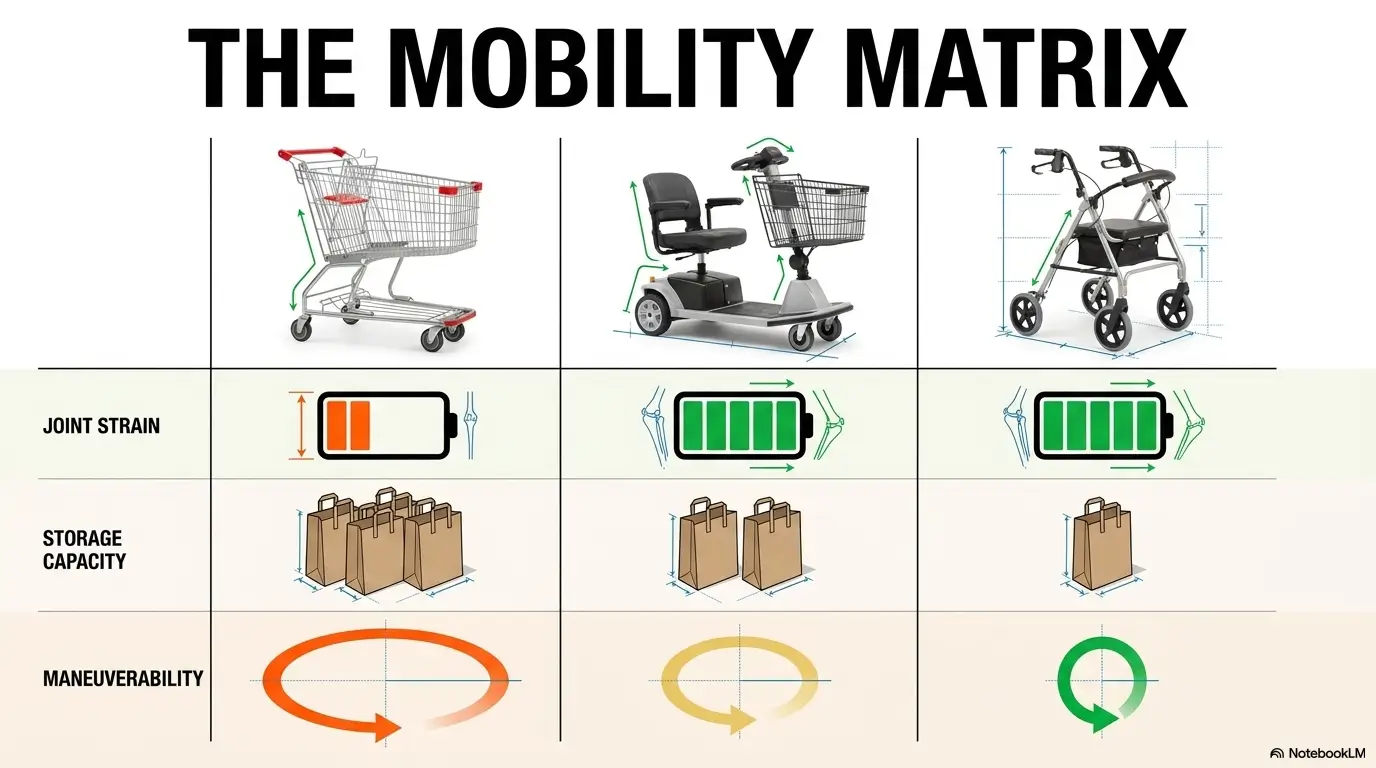
A shopping cart can feel stable because it is large and familiar. It is not automatically a safe replacement for a walker, cane, or crutches prescribed and fitted by your care team.
A Shopping Cart Is Shopping Equipment, Not a Prescribed Aid
Store carts may roll unexpectedly, pull to one side, have sticky wheels, or move when another shopper bumps them. Their handle height is not fitted to your body, and the base may not provide the support pattern your therapist taught you.
If you have been instructed to use a walker, cane, or crutches, continue using that device until the clinician managing your mobility says you can change. One good morning is not a formal graduation ceremony.
Keep the Support Hand Free
- Do not carry a hand basket if it occupies the hand needed for your cane or walker.
- Keep your phone in a secure pocket, belt pouch, or caregiver’s possession.
- Use a small walker bag only if your therapist approves it and it does not affect stability.
- Do not hang heavy grocery bags from the walker handles.
- Avoid reaching across your body while holding the mobility aid with one hand.
The same principle applies at home. A walker-friendly kitchen layout can reduce the temptation to carry items while moving between the counter, refrigerator, and table.
When a Motorized Cart May Be the Better Tool
A motorized grocery cart may reduce walking demands, but it creates different tasks: transferring onto the seat, positioning the operated leg, steering around displays, backing up, reaching products, and standing again at checkout.
Ask your physical or occupational therapist whether the transfer and seated position suit your precautions. A caregiver can retrieve items from low or high shelves while you remain seated.
| Shopping setup | When it may fit | Main concern to check |
|---|---|---|
| Prescribed walker or cane with caregiver | Short walking trial approved by the care team | Can the caregiver manage products and cart without blocking your path? |
| Motorized store cart | Walking endurance is limited but transfers are safe | Seat height, leg position, steering, and safe standing |
| Curbside pickup | The store itself adds unnecessary fatigue | Vehicle loading and unloading help |
| Home delivery | Driving, walking, weather, or bag handling is not yet safe | Doorstep placement and moving items into the kitchen |
Show me the nerdy details
Mobility safety is not determined only by leg strength. It also depends on sensory input, reaction speed, coordination, attention, device fit, weight-bearing rules, and the ability to recover from a small loss of balance.
A prescribed aid creates a particular support pattern. A walker provides a broad base and may allow controlled unloading of the operated side. A cane usually offers less support and must be used with the technique taught by the clinician. A grocery cart has wheels but no clinical fit, braking strategy, or predictable resistance.
That does not mean every cart is dangerous. It means replacing a prescribed device with a store cart is a clinical decision, not a cosmetic one.
Build a One-Loop Route That Protects Your Energy
The safest first list is not a miniature version of your usual weekly shop. It is a carefully edited mission in which every item earns its place.
Use the Five-Item Rule
Choose no more than five light, easy-to-reach items. Avoid beverages, large detergent bottles, bulk packages, pet food, awkward boxes, and anything stored near the floor or above shoulder height.
A suitable trial list might include bread, bananas, yogurt, a small package of sliced turkey, and one lightweight pantry item. The purpose is to test the trip, not to solve the entire household food supply.
Write the List in Store Order
- Place the first aisle’s item at the top.
- Keep the route to one continuous loop.
- Put refrigerated and frozen items near the end.
- Mark any item that requires another person to reach or lift.
- Remove optional items before leaving home.
- Identify a checkout lane and exit route in advance.
Backtracking quietly doubles work. It also increases the number of turns, stops, crowded crossings, and moments when you must read signs while moving.
Plan Rest Points Before You Need Them
Look for seating near the pharmacy, customer service area, café, or entrance. A rest point is useful only when you know where it is before your legs begin sending strongly worded correspondence.
Resting is not permission to extend the trip indefinitely. If you need an unplanned seated break during a five-item test, consider ending the visit after the rest rather than restarting the route.
Good, Better, Best: Match the Shopping Method to Today’s Capacity
| Plan | What it looks like | Best suited to | What to verify |
|---|---|---|---|
| Good | Caregiver shops while you remain home | Early recovery, high fatigue, medication effects, or unstable walking | Clear list, substitutions, and household priorities |
| Better | Curbside pickup with loading and unloading help | Safe vehicle travel but limited store endurance | Transfer safety, pickup process, bag weight, and kitchen help |
| Best for a first walking test | Five light items, one loop, caregiver present, 15 to 20 minutes maximum | Community walking approved and symptoms stable | Walking aid, weather, parking, rest point, and exit trigger |
Money-saving note: Delivery fees can feel wasteful, but one or two strategic orders for water, detergent, canned goods, and pet supplies may prevent an unsafe lifting attempt or an overlong trip. Compare the fee with the actual physical job being removed.
Real-world Example: The List That Changed at the Door
Marian planned her first post-knee-replacement trip around six familiar items. Her daughter drove, handled the cart, and agreed that the visit would end after 15 minutes.
The car transfer went smoothly, but the entrance walk was longer than Marian remembered. Inside, her steps became shorter while she waited for another shopper to clear the produce aisle.
They bought bread, yogurt, and bananas, then left. The other items stayed on the list for curbside pickup.
At home, Marian noticed more swelling than usual and wrote it down for her next therapy session. The trip was not a failure. It revealed that walking plus waiting, rather than walking alone, was her current limit. The next outing used a shorter entrance route and no checkout line.
Checkout and Grocery Bags: Where the Work Quietly Doubles
Many plans focus on reaching the items and forget the second half of the job. Checkout requires standing, payment, bagging decisions, another walk, vehicle loading, a second transfer, unloading, and carrying groceries into the kitchen.
Choose Checkout for Stability, Not Speed
- Use a staffed lane when scanning, bagging, or balancing at self-checkout would be difficult.
- Choose the shortest stable line, not necessarily the nearest line.
- Keep payment in an easy-to-reach pocket before entering the store.
- Tell the cashier before scanning that you need small, lightweight bags.
- Ask for help placing bags into the cart or vehicle.
- Skip impulse items if pain, swelling, or concentration is changing.
Standing still may feel harder than walking because the muscles are working without the rhythm of forward movement. Shift only as your clinician has taught you, keep the aid correctly positioned, and ask for a chair or assistance rather than leaning on unstable fixtures.
Make a Bag-Weight Plan Before Scanning Begins
Follow the lifting limit and movement restrictions given by your surgical team. Do not translate a formal restriction into “roughly that amount, provided the sale is excellent.”
Smaller bags are usually easier to control than one efficient but heavy bag. Still, even a light bag can create a balance problem when it occupies a hand, swings beside the operated leg, or requires bending into a deep cart.
| Item or task | Safer early-recovery alternative |
|---|---|
| Case of bottled water | Delivery, caregiver purchase, or smaller containers |
| Large detergent bottle | Small bottle, measured pods stored safely, or delivery |
| Bulk pet food | Scheduled delivery or caregiver transport |
| Heavy bag packed for efficiency | Several light bags handled by another person |
| Reaching into a deep cart | Ask the cashier, employee, or caregiver to retrieve items |
| Carrying groceries while using a walker | Caregiver transport, approved walker pouch for very light items, or staged unloading |
Plan the Last 30 Feet
The route from the vehicle to the kitchen often becomes the hardest part because fatigue has accumulated and the patient is eager to sit down. Arrange another person to unload, or have groceries placed at a safe indoor staging point.
Do not carry bags up steps while using a walker unless your rehabilitation team has specifically trained and approved the method. Review safer household carrying methods, such as alternatives to awkward loads, in this guide to carrying items with a walker.
Key takeaway: The checkout receipt is not the finish line. A grocery trip ends only after you are safely seated and someone has moved the bags where they need to go.
Common Grocery Mistakes After Joint Replacement
Most unsafe shopping decisions are not dramatic. They begin as reasonable-sounding shortcuts: leaving the cane in the car, adding three more items, carrying one “not very heavy” bag, or shopping alone because yesterday’s hallway walk felt easy.
Mistake Versus Safer Alternative
| Common mistake | Why it creates trouble | Safer alternative |
|---|---|---|
| Shopping alone on the first trip | No one can manage the cart, observe gait changes, or help you exit | Bring a caregiver or use pickup |
| Using the store cart instead of a prescribed aid | The cart may roll and is not fitted to your support needs | Use the device your therapist approved |
| Leaving the cane or walker behind to look recovered | Appearance replaces actual balance and endurance needs | Treat the aid as safety equipment, not a verdict |
| Reaching low or twisting for a product | May conflict with precautions or reduce balance | Ask another person to retrieve it |
| Adding items because the trip feels easy | Fatigue often arrives after the decision to continue | Follow the written list and exit time |
| Shopping directly after physical therapy | The same muscles may already be fatigued | Separate demanding activities and ask your therapist about timing |
| Driving while taking impairing medication | Coordination, alertness, and reaction time may be reduced | Use a driver until medically and functionally cleared |
Confidence Often Returns Before Endurance
Recovery can create a strange mismatch. You may feel emotionally ready to resume normal life while your strength, balance, and stamina are still rebuilding. That confidence is useful, but it needs guardrails.
Judge the trip by movement quality, not determination. A changing gait, growing forward lean, reduced attention, irritability, or repeated requests to “just get one more thing” may signal that capacity is thinning.
Caregivers who are uncertain about how much support is needed may find it helpful to compare home equipment with caregiver hours. Equipment can reduce effort, but it does not replace observation, transportation, lifting help, or judgment during an early outing.
Before Buying a Recovery Shopping Tool
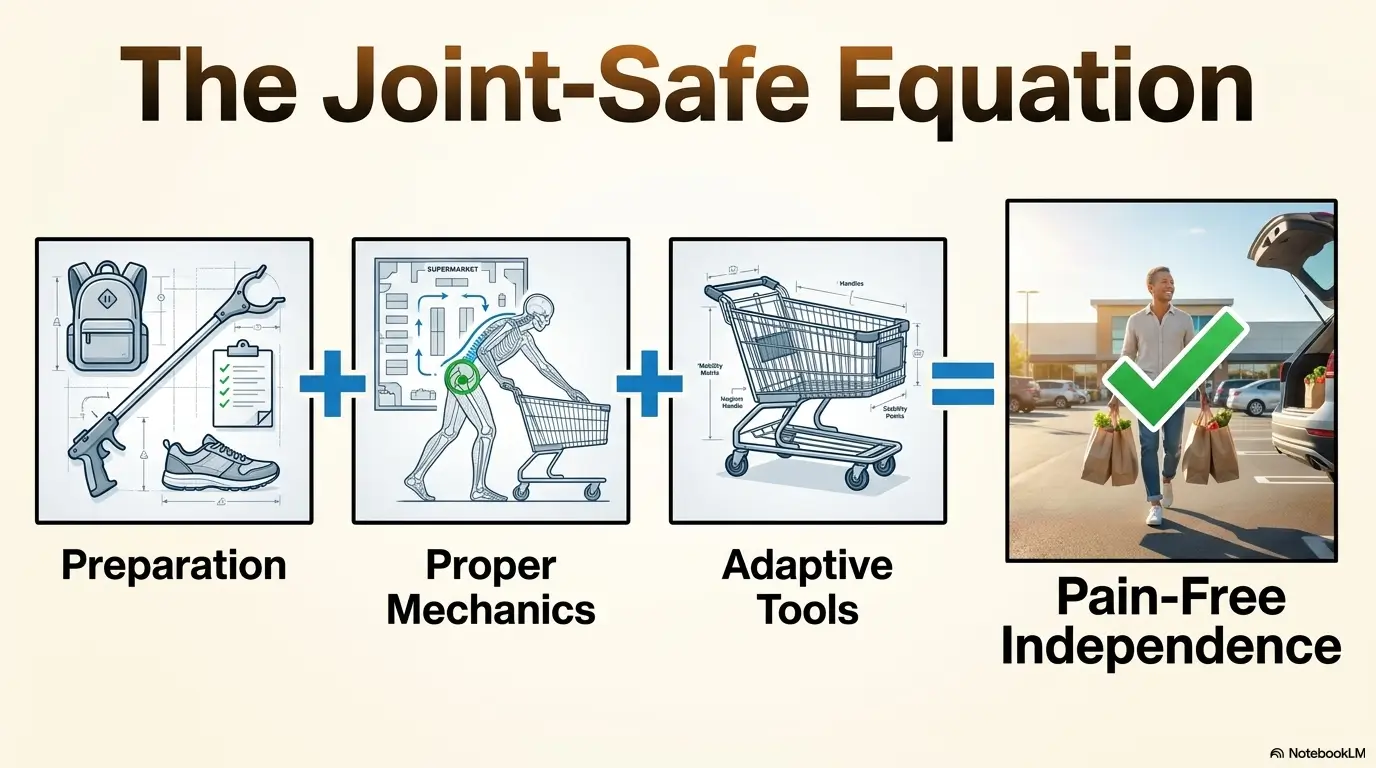
Special bags, walker accessories, folding seats, reachers, and delivery memberships may be useful, but buy them to solve a defined problem. A gadget that interferes with the prescribed aid or encourages unsafe carrying is not an upgrade.
- Ask whether your physical or occupational therapist approves the setup.
- Check weight limits, attachment method, and whether the accessory changes balance.
- Confirm that the product can be used without bending, twisting, or occupying a support hand.
- Compare the purchase price with temporary pickup or delivery fees.
- Choose easy returns in case the item does not fit your device or home layout.
- Avoid products that make medical promises or suggest they replace professional assessment.
Key takeaway: The cheapest solution may be a five-minute phone call to the store, a temporary delivery fee, or one hour of caregiver help rather than a collection of accessories that solve the wrong problem.
Your Backup Plan and the Warning Signs That End the Trip
A backup plan converts uncertainty into a series of simple choices. Decide in advance who can pick you up, where you can sit, how to contact the store, and which symptoms mean the visit ends immediately.
Build the Backup Plan Before Leaving Home
- Save the driver’s and caregiver’s numbers as favorites on your phone.
- Confirm who will load and unload the groceries.
- Know where the store’s customer service desk and seating are located.
- Save the store’s pickup or delivery page for a quick switch of plans.
- Carry necessary medication according to your prescribed schedule, not as a way to push through an unsafe trip.
- Keep your phone accessible without occupying the hand needed for support.
- Agree that abandoning the list counts as a successful safety decision.
For patients with a history of medication confusion, dizziness, or changing schedules, a caregiver may also need a simple system to monitor medication confusion during recovery.
Stop the Shopping Trip for These Changes
- New instability or a sudden feeling that the leg may give way
- Marked weakness, dizziness, faintness, or confusion
- A noticeable change in gait or inability to control turns
- Rapidly increasing pain rather than ordinary stable discomfort
- A fall, near fall, or sudden inability to bear weight
- New or increasing calf pain, tenderness, redness, or leg swelling
- Concerning incision redness, swelling, drainage, or worsening pain
Contact the surgical team promptly about concerning postoperative changes according to your discharge instructions. After a fall, do not assume that being able to stand means the joint and surrounding tissues are unharmed.
Emergency Symptoms Need Emergency Action
Call 911 or your local emergency number for sudden shortness of breath, chest pain, fainting, coughing blood, or another severe symptom that may indicate a medical emergency. Do not drive yourself to seek emergency care.
Blood clots and pulmonary embolism are recognized concerns after lower-extremity joint replacement. Your surgical team’s instructions should explain the warning signs, prevention plan, and whom to contact.
Do not finish the list first
When a serious warning sign appears, groceries become irrelevant. Stop, sit or secure yourself safely, ask for help, and follow the emergency or surgical-team instructions you were given.
Frequently Asked Questions
How soon after joint replacement can I go grocery shopping?
There is no universal postoperative week that makes grocery shopping safe for everyone. Readiness depends on clinician clearance, weight-bearing status, balance, walking-aid use, pain control, medication effects, car transfers, standing tolerance, and the planned length of the trip.
Ask your surgeon or physical therapist about a short community outing rather than asking only whether you may “walk.” The demands of a store are different from a level hallway at home.
Should I use my walker inside the grocery store?
Use the mobility aid prescribed or approved by your care team. Do not stop using a walker because the store cart appears more convenient or because you feel self-conscious. Ask your therapist how to manage a store cart when both hands are required for the walker.
Is pushing a shopping cart safe after hip replacement?
That depends on your hip precautions, balance, walking pattern, surgical approach, and whether you still need a prescribed aid. A shopping cart can roll or pull unexpectedly and should not automatically replace a walker. Confirm the movement with your therapist before testing it.
Can I ride a motorized grocery cart after knee replacement?
It may be an option when walking endurance is limited, but you still need to transfer safely, position the knee comfortably, steer, reach items, and stand again. Ask your clinician whether the seat height and transfer suit your current mobility.
How long should my first shopping trip last?
A short 15- to 20-minute store test may be reasonable after your care team approves the activity, but that is a planning limit rather than a medical prescription. Count the parking lot, vehicle transfers, checkout, and unloading as part of the total workload.
Can I carry grocery bags after joint replacement?
Follow the lifting limits and movement precautions in your discharge instructions. Even a bag below the stated weight limit can interfere with a cane, walker, balance, or safe body position. Arrange loading and unloading help during early trips.
When can I drive myself to the store?
Driving readiness depends on the operated side, reaction time, strength, movement, vehicle type, ability to enter and exit safely, and whether you take medication that impairs coordination or alertness. Wait for clearance from the appropriate member of your care team and do not drive while impaired.
Johns Hopkins provides additional general information about hip replacement recovery and driving considerations, but your own surgeon’s instructions remain the deciding guidance.
Is curbside pickup better during early recovery?
Curbside pickup can remove the parking-lot walk, aisle navigation, standing, and checkout demands. It may be the best-value option when vehicle travel is safe but store endurance is not. You still need a plan for loading, unloading, and moving groceries into the kitchen.
What should I do if my knee or hip swells during the trip?
End the trip and follow the symptom-management instructions provided by your care team. Contact the surgical team if the swelling is new, rapidly increasing, accompanied by calf pain or redness, linked to a fall, or otherwise outside the recovery pattern they told you to expect.
Run a Five-Item Trial in the Next 15 Minutes
You do not need to visit the store today to make progress. Spend 15 minutes building the plan on paper, then take it to your physical therapist, surgeon’s office, or caregiver for review.
Your 15-Minute Planning Task
- Choose one familiar store and a quiet shopping window.
- Write five lightweight items in the order you will encounter them.
- Circle anything that requires bending, reaching, or lifting.
- Name the person who will drive, manage the cart, load, and unload.
- Set a 15- to 20-minute maximum and one earlier exit trigger.
- Choose the backup option: caregiver shopping, curbside pickup, or delivery.
- Write down the clinician question you still need answered.
After an approved trial, record four things: pain, fatigue, swelling, and walking stability. Note how you felt immediately after the trip and later that day. This gives your rehabilitation team more useful information than “It went okay.”
The quiet victory
Your first grocery trip is not a test of toughness. It is a small field study in how your recovering body meets the world beyond the front door. Leave before the trip becomes a struggle, learn from what happened, and let the next outing grow only when your movement remains steady.
Last reviewed: 2026-08