

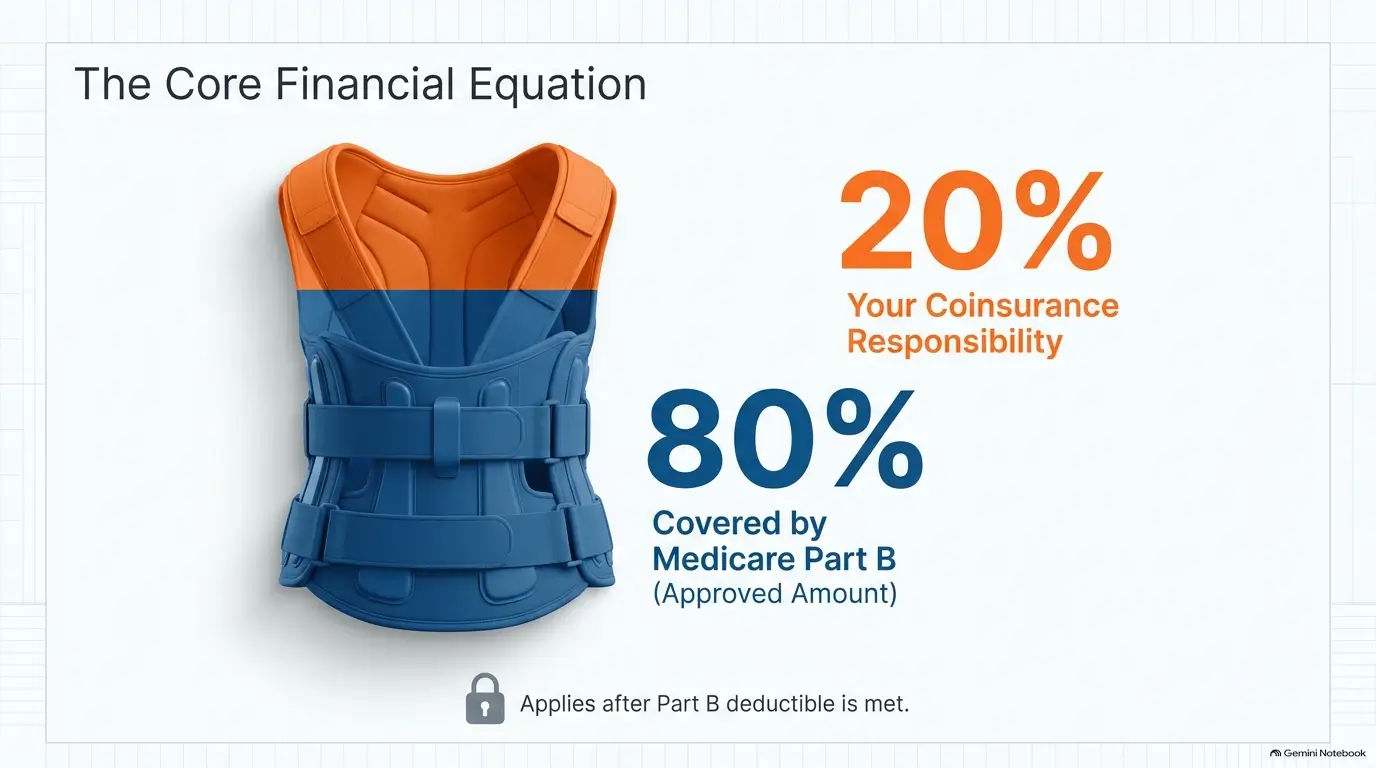
If Original Medicare covers your back brace, you will usually pay 20% of the Medicare-approved amount after meeting your Part B deductible. In 2026, the annual Medicare Part B deductible is $283.
That does not mean every Medicare-covered back brace has the same price. The approved amount depends on the type of spinal orthosis, its HCPCS billing code, where it is supplied, and other payment rules. A rigid lumbar brace can therefore have a very different Medicare-approved amount from a simpler support.
The practical question is not simply, “What is the retail price of this brace?” It is: What is the Medicare-approved amount for this exact brace, how much of my Part B deductible remains, and does the supplier accept Medicare assignment?
Table of Contents
How Medicare calculates your back brace cost
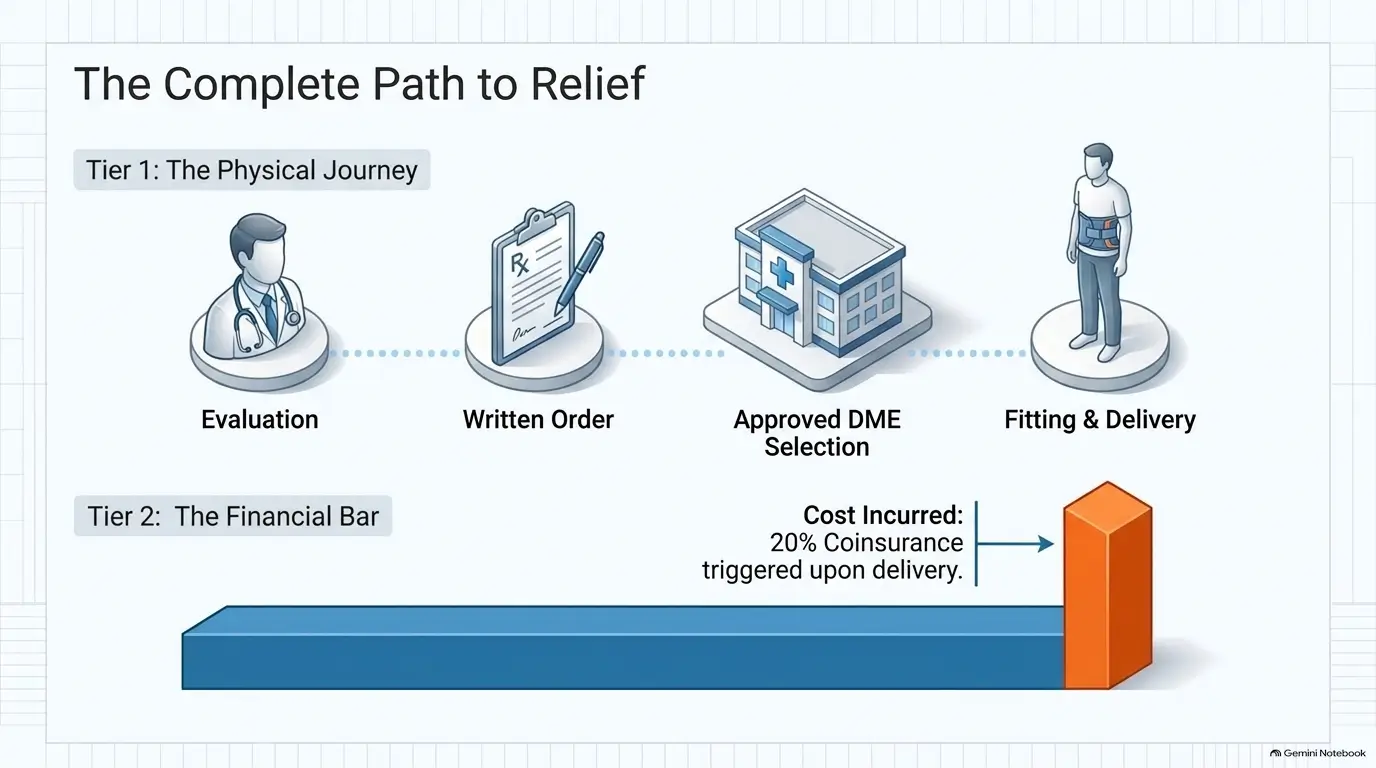
Medicare’s coverage guidance for arm, leg, back, and neck braces states that Part B covers braces when they are medically necessary and ordered by a doctor or other qualified health care provider. After the Part B deductible, the beneficiary generally pays 20% of the Medicare-approved amount.
For 2026, Medicare lists the annual Part B deductible as $283. This deductible applies across your Part B-covered care during the year. It is not a separate $283 deductible for every brace.
If you have already satisfied the deductible before receiving the brace, the math is relatively simple:
Your estimated cost = 20% × Medicare-approved amount
If you still have some or all of the deductible left, you generally pay the remaining deductible first and then 20% of the covered amount left after that deductible is applied.
Back brace cost examples for 2026
The figures below are hypothetical examples, not quoted prices for particular braces. They show why two Medicare beneficiaries receiving spinal braces can have different bills even when both items are covered.
| Medicare-approved amount | If Part B deductible is already met | If the full $283 deductible is still due |
|---|---|---|
| $400 | $80 | About $306.40 |
| $800 | $160 | About $386.40 |
| $1,200 | $240 | About $466.40 |
For example, suppose Medicare approves $800 for a covered brace and you have already met the Part B deductible. Your 20% coinsurance would ordinarily be $160.
If none of the $283 deductible has been met, you would first be responsible for $283. Medicare cost sharing would then generally apply to the remaining $517, adding $103.40 in 20% coinsurance. The combined amount would be approximately $386.40.
This is why an advertisement saying a brace “costs $800” or “costs $1,500” does not, by itself, tell you what you will owe under Medicare.
The Medicare-approved amount matters more than the sticker price
Medicare does not simply take a medical supplier’s retail price and pay 80% of it. Medicare uses payment rules and fee schedules for durable medical equipment, prosthetics, orthotics, and supplies, commonly called DMEPOS.
CMS publishes a DMEPOS fee schedule containing payment amounts for individual procedure codes and jurisdictions. Different spinal orthoses use different HCPCS codes, so there is no single nationwide dollar amount called the “Medicare back brace price.”
Imagine that a supplier’s listed charge is $1,300 but the relevant Medicare-approved amount is $800. If the supplier accepts assignment and your deductible has already been met, your ordinary 20% coinsurance would be based on the $800 approved amount, not simply 20% of the supplier’s $1,300 sticker price.
For a broader explanation of how braces interact with insurance billing, see our guide to orthopedic brace insurance coverage.
When does Medicare cover a back brace?
A prescription alone does not automatically make every back support Medicare-covered. The item and the medical record must satisfy the applicable coverage requirements.
CMS’s Spinal Orthoses: TLSO and LSO Local Coverage Determination describes circumstances in which spinal orthoses may qualify for coverage, including use to restrict trunk movement to reduce pain, facilitate healing after a spinal or related soft-tissue injury, facilitate healing following surgery, or support weak spinal muscles or a deformed spine.
If the documentation does not establish the applicable medical-necessity criteria, Medicare may deny payment. Coverage therefore depends on more than the fact that someone has back pain.
The type of brace changes the Medicare billing code
“Back brace” is a consumer-friendly phrase, but Medicare billing is more specific. Lumbar-sacral orthoses and thoracic-lumbar-sacral orthoses can differ in rigidity, control, construction, fitting requirements, and HCPCS code.
For example, CMS identifies L0648 as a prefabricated, off-the-shelf lumbar-sacral orthosis with rigid anterior and posterior panels. L0650 describes another off-the-shelf lumbar-sacral orthosis that provides additional sagittal-coronal control. Other codes apply to custom-fitted or differently constructed spinal orthoses.
That code matters because it affects the applicable fee schedule amount and may also determine whether additional documentation or prior authorization is required.
Some Medicare back braces require prior authorization
Some spinal orthosis codes are included in CMS’s required prior authorization program. CMS specifically identifies codes such as L0648 and L0650 among orthoses subject to prior authorization, along with other spinal orthosis codes.
The CMS DMEPOS prior authorization program explains the current requirements and which codes are affected.
Prior authorization is especially important because it can be a condition of Medicare payment for an affected code. The supplier should determine whether it applies before delivery. Our orthopedic prior authorization checklist explains the questions worth confirming before an item or procedure moves forward.
Why the supplier can change what you pay
Do not assume that every store, website, orthopedic office, or medical-equipment company handles Medicare the same way.
Medicare advises beneficiaries to verify that suppliers are enrolled in Medicare and to ask whether they participate in Medicare or accept assignment. A participating supplier must accept assignment.
Assignment means the supplier agrees to accept the Medicare-approved amount as the basis for payment. When assignment applies, the beneficiary’s covered cost is generally limited to the applicable deductible and coinsurance rather than being calculated from whatever retail price the supplier chooses to list.
If a nonparticipating supplier does not accept assignment, your payment arrangements and out-of-pocket exposure can be different and potentially higher. Ask before accepting the brace whenever circumstances allow.
Five questions to ask before the brace is delivered
- What HCPCS code will you bill? “Back brace” alone is not specific enough to estimate Medicare payment.
- What is the Medicare-approved amount for this code in my location? Ask for the amount that will actually form the basis of the Medicare claim.
- Do you accept Medicare assignment? Do not assume enrollment and assignment mean exactly the same thing.
- Does this code require prior authorization? If it does, ask whether authorization has been obtained before delivery.
- What do you expect me to owe after my remaining deductible and coinsurance? Ask for the calculation, not just a vague estimate.
If the supplier cannot tell you the billing code or explain how your expected Medicare cost was calculated, getting clarification before accepting a nonurgent item can prevent a surprisingly expensive envelope from arriving later.
What if you have Medicare Advantage?
Medicare Advantage changes the cost calculation. Medicare Advantage plans must cover medically necessary services covered by Original Medicare, but individual plans can use their own deductibles, copayments, coinsurance, networks, and prior authorization requirements.
Medicare’s comparison of Original Medicare and Medicare Advantage notes that Medicare Advantage members may need prior authorization for services or supplies that generally do not require prior approval under Original Medicare.
Therefore, you should not automatically use the Original Medicare “20% after the Part B deductible” formula to predict your bill under a Medicare Advantage plan.
Instead, call your plan or check its current Evidence of Coverage and ask about the exact HCPCS code, in-network supplier rules, prior authorization, and your cost sharing. Our guide to Medicare Advantage and orthopedic care covers some of these plan-specific issues in more detail.
Can Medigap reduce the cost?
A Medicare Supplement Insurance policy, commonly called Medigap, may reduce some of the out-of-pocket costs left by Original Medicare. Exactly how much it pays depends on the Medigap policy and your eligibility.
This means two people with the same Medicare-approved brace amount can still owe different amounts if one has supplemental coverage and the other relies on Original Medicare alone.
What if Medicare denies the back brace?
A denial does not necessarily mean that spinal braces are never covered. A claim can fail because the medical-necessity criteria were not established, documentation was incomplete, an affected code did not satisfy prior authorization requirements, or another billing requirement was not met.
Review the Medicare Summary Notice or plan explanation carefully and identify the stated reason before deciding what to do next. If the issue involves an insurance denial, our guide to appealing a denied brace insurance claim explains how to organize the coverage decision and supporting documents.
Is a Medicare back brace ever really “free”?
Under Original Medicare, a covered brace is not automatically free. Unless another form of coverage pays your share, the normal rule is that you remain responsible for the applicable Part B deductible and 20% coinsurance.
A Medicare Advantage plan or supplemental insurance may reduce your cost, but that depends on the particular coverage. Treat broad claims of a “free Medicare back brace” cautiously unless the supplier can explain exactly why your individual cost would be zero.
Can you buy a back brace online and have Medicare reimburse you?
Do not assume that buying a brace from an ordinary online retailer and submitting the receipt later will qualify for Medicare reimbursement. Medicare coverage depends on medical necessity, the applicable ordering and documentation requirements, the item supplied, and the Medicare status of the supplier.
If Medicare coverage matters to you, confirm those requirements before paying cash for a brace.
The simplest way to estimate your actual cost
Before delivery, obtain the exact HCPCS code from the supplier. Then ask for the Medicare-approved amount applicable to your location and confirm whether the supplier accepts assignment.
Next, check how much of your 2026 Part B deductible remains. If it has already been satisfied and you have Original Medicare without supplemental coverage, multiplying the approved amount by 20% gives you a useful starting estimate.
If part of the deductible remains, apply the smaller of the remaining deductible and this brace’s Medicare-approved amount first. Then add 20% of any approved amount left after that deductible is applied. If the approved amount is below your remaining deductible, you generally owe that approved amount, rather than the full unused annual deductible. Medicare Advantage members should instead use their plan’s current cost-sharing rules.
Bottom line: Medicare can cover a medically necessary back brace, but there is no universal $50, $100, or $200 patient price. Under Original Medicare in 2026, your cost generally starts with any remaining portion of the $283 Part B deductible and then 20% of the Medicare-approved amount. The brace’s billing code, your location, supplier assignment, prior authorization requirements, Medicare Advantage coverage, and supplemental insurance can all change the final bill.
Last updated: October 15, 2026