
If you need a replacement back brace before five years have passed, do not assume Medicare will automatically pay for a new one or automatically deny it. The reason the original brace can no longer be used matters, and so do the brace’s HCPCS billing code, the original delivery date, your current medical need, and the documentation available to the supplier.
Before accepting another brace, ask the supplier to identify exactly what Medicare was billed for the first brace and why the new one is being treated as a replacement rather than a repair, adjustment, or different medically necessary orthosis.
Table of Contents
Start with the original brace’s HCPCS code and delivery date
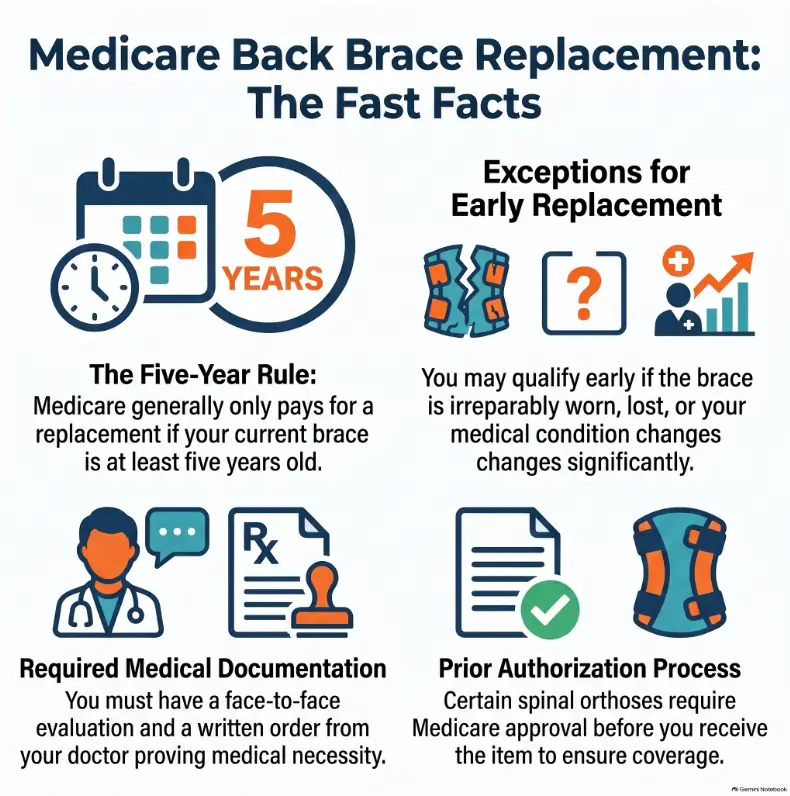
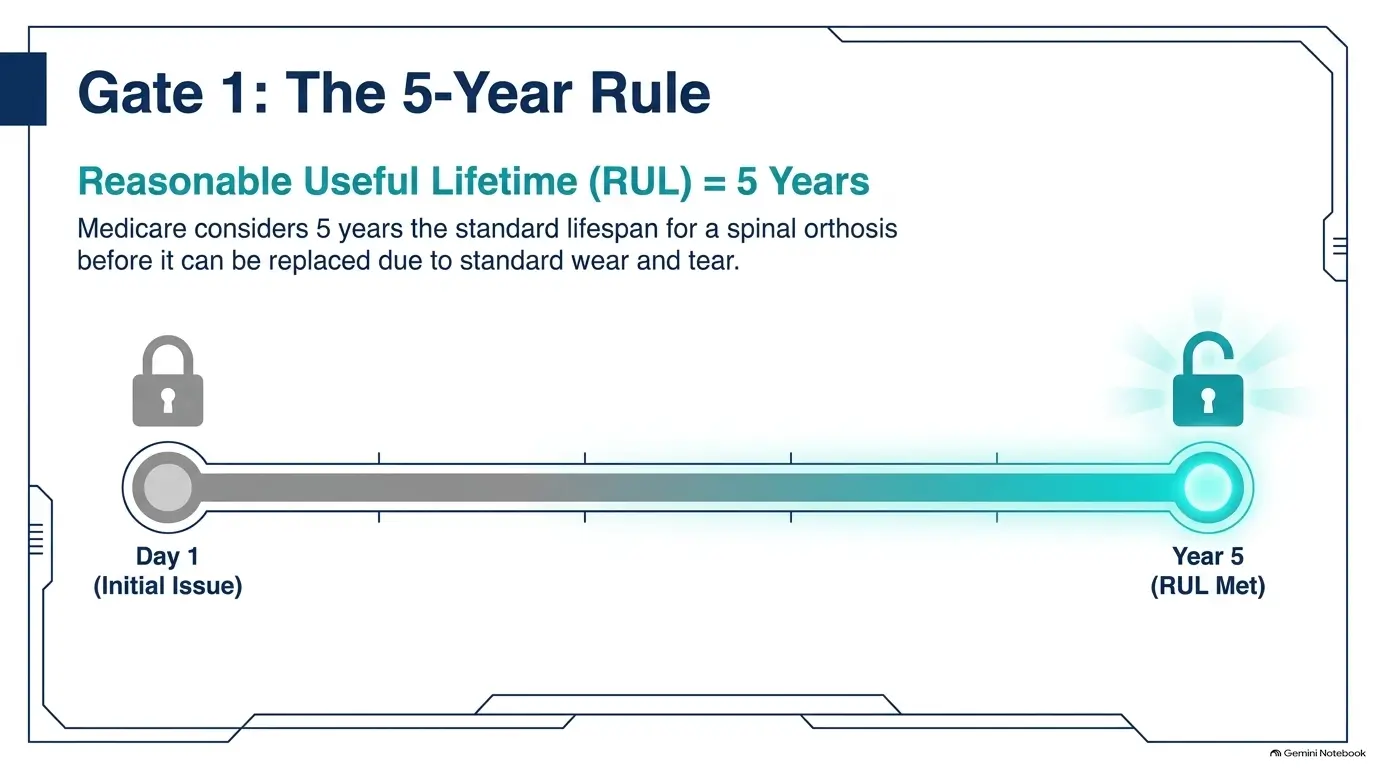
The phrase “five-year rule” can be misleading when it is treated as a universal countdown for every type of brace. Medicare replacement rules depend on the benefit category and, in some cases, code-specific policy.
Ask the supplier for the HCPCS code billed for your existing back brace. Medicare spinal orthosis codes include multiple lumbar-sacral orthosis and thoracic-lumbar-sacral orthosis codes, and the exact code can affect documentation, fitting, and authorization requirements.
Also ask for the date Medicare considers the brace furnished. Do not rely only on when you remember beginning to wear it. The supplier’s delivery records and prior claim information are more useful when determining whether the applicable reasonable useful lifetime has been reached.
If you are not sure how Medicare generally handles brace coverage, the related guide on orthopedic brace insurance coverage can help you separate medical necessity, billing, and insurance requirements before discussing a replacement.
Ask why the brace needs to be replaced early
For an early replacement request, “my brace is old” and “my brace cannot be used because of a specific accident” are not equivalent explanations.
Medicare documentation rules distinguish loss or irreparable damage from ordinary wear. Irreparable damage can involve a specific accident or a natural disaster. Depending on the circumstances, a Medicare contractor may request documentation describing what happened.
Useful questions for the supplier include:
- Is the brace being replaced because it was lost?
- Was it damaged in a specific accident, fire, flood, or another identifiable event?
- Is the brace simply worn from routine use?
- Could a component be repaired or replaced instead of replacing the entire brace?
- Has my medical condition changed enough that the old type of brace is no longer appropriate?
These distinctions matter because normal deterioration during a useful-lifetime period is not necessarily treated the same way as accidental, irreparable damage.
Find out whether repair is an option
A damaged strap, closure, panel, or other component does not always mean the entire orthosis must be discarded. Ask whether the existing brace can be restored to usable condition and whether the repair would meet Medicare requirements.
This is especially useful when the brace still provides the prescribed level of support and your underlying medical condition has not substantially changed.
Ask the supplier to explain in plain language why repair is or is not practical. If the answer is that replacement is cheaper or clinically more appropriate, ask how that conclusion will be documented on the claim.
Ask whether your medical need has changed
A replacement request can involve more than the physical condition of the old brace. Your treatment needs may have changed since it was originally prescribed.
Medicare’s spinal orthosis coverage policy recognizes braces prescribed to restrict trunk movement to reduce pain, support healing after spinal or related soft-tissue injury, support healing following spinal surgery, or support weak spinal muscles or a deformed spine.
If a clinician now believes you need a different type of spinal orthosis, make sure the medical record explains the current condition and why the newly ordered brace is reasonable and necessary. Simply writing “replacement brace” may not communicate the clinical change clearly enough.
When preparing for the appointment, you may also find the orthopedic appointment notes guide useful for organizing symptoms, functional problems, and questions before the visit.
Ask whether a new written order is required
Do not assume the prescription from the original brace automatically supports a replacement claim. Medicare’s standard documentation rules generally require a new order when an item is replaced, reaffirming current medical necessity. For a code subject to a written order before delivery, the supplier must receive that order before furnishing the replacement, rather than waiting until claim submission. Ask which requirements apply to your exact HCPCS code and service date.
A Standard Written Order generally identifies the beneficiary, the ordered item, the treating practitioner, the date of the order, and the practitioner’s signature. For spinal orthoses, Medicare policy requires the supplier to have the appropriate written order before submitting the claim.
Ask the supplier, “Do you already have everything you need from my doctor for this specific replacement claim?” That question is more useful than asking only whether you have a prescription.
Check whether your back brace requires prior authorization
Some Medicare spinal orthoses are subject to additional requirements such as a face-to-face encounter, a written order before delivery, or prior authorization.
This makes the HCPCS code particularly important. Two braces that look similar to a patient may not be billed under the same code or follow exactly the same administrative pathway.
Before the replacement is delivered, ask:
- What HCPCS code will you bill?
- Does this code require Medicare prior authorization?
- Has the authorization already been submitted?
- Has Medicare issued a decision?
- Do I need another face-to-face encounter?
- Is any additional documentation needed from the treating practitioner?
If prior authorization is involved, the orthopedic prior authorization checklist provides a useful framework for keeping the paperwork and questions organized.
Do not confuse prior authorization with guaranteed payment
Prior authorization and final claim payment are connected, but they are not identical concepts. A supplier still needs to submit a properly coded claim and meet applicable Medicare requirements.
Ask the supplier what you could owe if Medicare ultimately denies payment. If you are being asked to sign an Advance Beneficiary Notice of Noncoverage or another financial notice, read the reason carefully before choosing an option.
Do not treat a supplier’s statement that “Medicare probably won’t cover it” as a complete coverage determination. Ask what specific Medicare rule, documentation problem, coding issue, or replacement restriction is creating the concern.
If the old brace is damaged, document what happened
When an early replacement request involves irreparable damage, details can matter.
Write down when and how the damage occurred. Keep relevant photographs, repair evaluations, insurance reports, incident reports, or other records when they exist. Medicare contractors can request documentation supporting the circumstances surrounding loss or damage.
There is no benefit in exaggerating the event. A short, factual record of what happened, why the brace no longer functions, and what attempts were made to repair it is generally more useful.
Questions to ask before accepting the replacement brace
A short conversation with the supplier can prevent a surprisingly tangled billing problem later. Before delivery, try to obtain answers to these questions:
- What was the HCPCS code of my original back brace?
- What date does Medicare show for the original brace?
- What HCPCS code will be used for the new brace?
- Are you billing this as a replacement, repair, or different medically necessary orthosis?
- What is the documented reason the old brace cannot continue to be used?
- Can the existing brace reasonably be repaired?
- Does my doctor need to document a change in my condition?
- Do you have a current written order?
- Does this HCPCS code require prior authorization or another pre-delivery requirement?
- What happens financially if Medicare denies the claim?
If a claim is later denied, keep the order, supplier paperwork, Medicare Summary Notice, medical records supporting the brace, and any documentation showing why replacement was requested. The guide to a denied brace insurance appeal explains the next questions to consider when coverage does not go as expected.
Replacement request: supplier call record
Copy this table to a private document or print it. Record what the supplier actually confirms; leave unanswered items open. Do not put Medicare numbers or medical records in a public comment.
| Item to confirm | Answer or document reference | Person and date | Next action / due date |
|---|---|---|---|
| Original HCPCS code and delivery date | ________ | ________ | ________ |
| Replacement reason and repair assessment | ________ | ________ | ________ |
| Proposed code and current order | ________ | ________ | ________ |
| Authorization or other delivery requirements | ________ | ________ | ________ |
| Written estimate and possible noncoverage | ________ | ________ | ________ |
Example entry (illustrative, not a coverage decision): “Repair assessment not yet received. Supplier will send its written explanation by the agreed follow-up date; I will call if it has not arrived.” A completed record does not establish eligibility or guarantee payment.
This guide focuses on replacement before the applicable useful lifetime ends. For the broader replacement framework, read Medicare’s five-year rule and its limits.
What if you have Medicare Advantage?
Medicare Advantage plans must cover Medicare-covered benefits, but their network, authorization, supplier, and administrative rules can differ from Original Medicare procedures.
Before ordering a replacement through a Medicare Advantage plan, contact the plan or review its current coverage information. Ask whether the supplier is in network, whether prior authorization is required, and whether the plan needs documentation beyond what the supplier already has.
For a broader look at these plan-specific issues, see the guide to Medicare Advantage orthopedic care.
The five-year mark is only one part of the decision
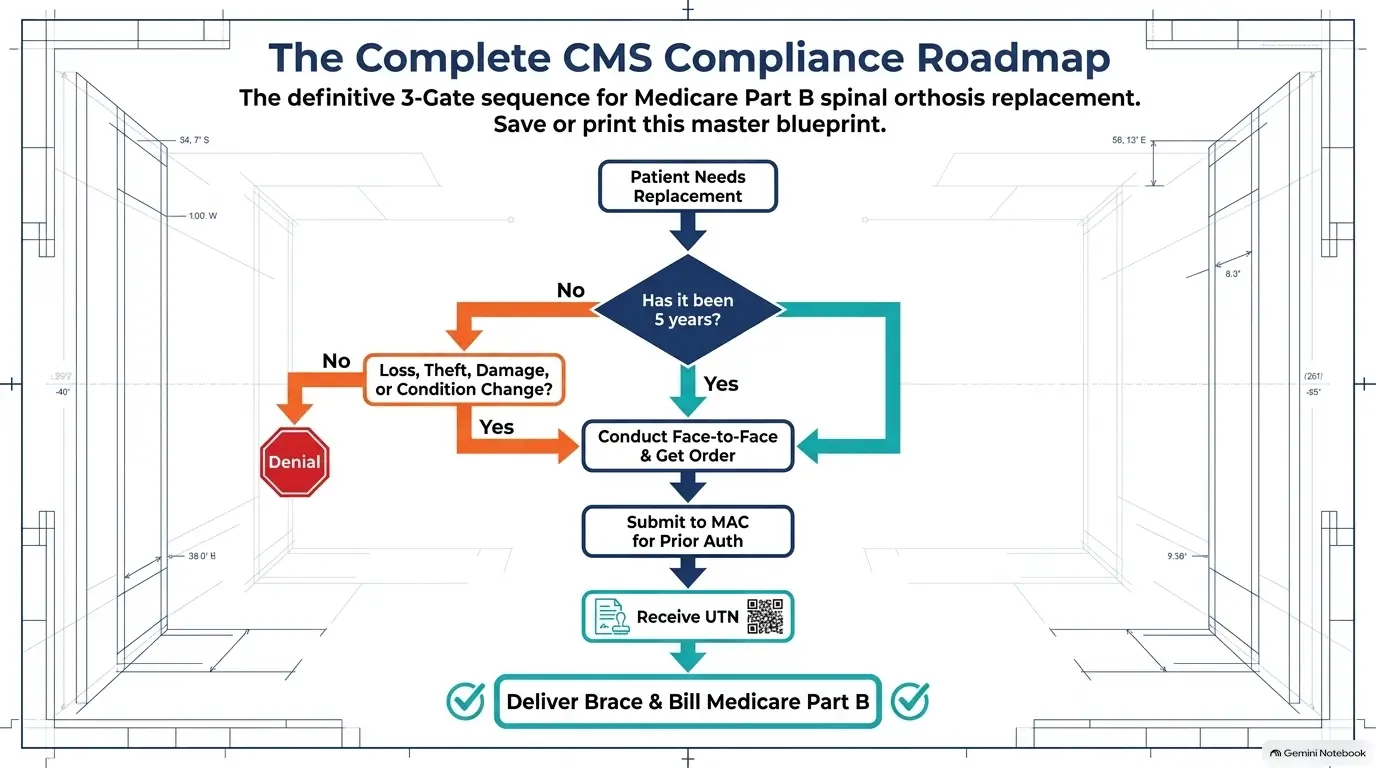
If your back brace needs replacement before five years, the most useful question is not simply, “Has five years passed?” Ask why replacement is necessary, what code Medicare will be billed, whether repair remains possible, what medical documentation supports the new brace, and whether authorization is required before delivery.
Those details turn a vague replacement request into something you, your clinician, and the supplier can evaluate against the applicable Medicare rules. Confirm the requirements for your specific brace and coverage before accepting a new device or agreeing to pay for it yourself.
- CMS Medicare Benefit Policy Manual, Chapter 15 – Official CMS guidance covering replacement of Medicare equipment, irreparable wear, reasonable useful lifetime, and the five-year rule.
- CMS Medicare Provider Compliance Tips: Spinal Orthoses – Official guidance on medical necessity, written orders, face-to-face requirements, and prior authorization for spinal orthoses.
- CMS Prior Authorization Process for Certain DMEPOS Items – Official CMS information on prior authorization requirements for selected durable medical equipment, prosthetics, orthotics, and supplies.
- Medicare.gov: Medicare Coverage of Durable Medical Equipment and Other Devices – Official Medicare guidance explaining Part B coverage for durable medical equipment and certain braces and orthotic devices.
- CMS Durable Medical Equipment, Prosthetics, Orthotics & Supplies – Official CMS resource hub for DMEPOS fee schedules, HCPCS coding, billing guidance, and related Medicare payment information.
Editorial update: October 27, 2026. Added a supplier call record and clarified the scope of this early-replacement guide. Original publication: October 26, 2026. This update is not an independent medical review or a new verification of every Medicare policy.