
This site is written from a family-caregiver perspective. The operator is not a medical professional or an insurance, legal or financial adviser. Use this guide to organize questions for the relevant service.
Keep fitting and coverage questions separate
Use this follow-up record alongside the guide below. It does not determine medical suitability, insurance eligibility or legal rights, and it does not guarantee a price.
- Keep together
- Device details, adjustment work proposed, order and each quoted code.
- Unanswered question
- Who performs the fitting and how will the actual adjustment work be documented?
- Next contact and owner
- Ask the supplier for clarification; ask the treating team about clinical fit rather than selecting by price alone.
- Recheck when
- A substitute brace or different fitter is proposed.
For each response, record its date, source, reference number and what remains uncertain. Agree the next follow-up date instead of treating silence as confirmation. Use official contact channels and keep identifying health, account and policy information out of public comments.
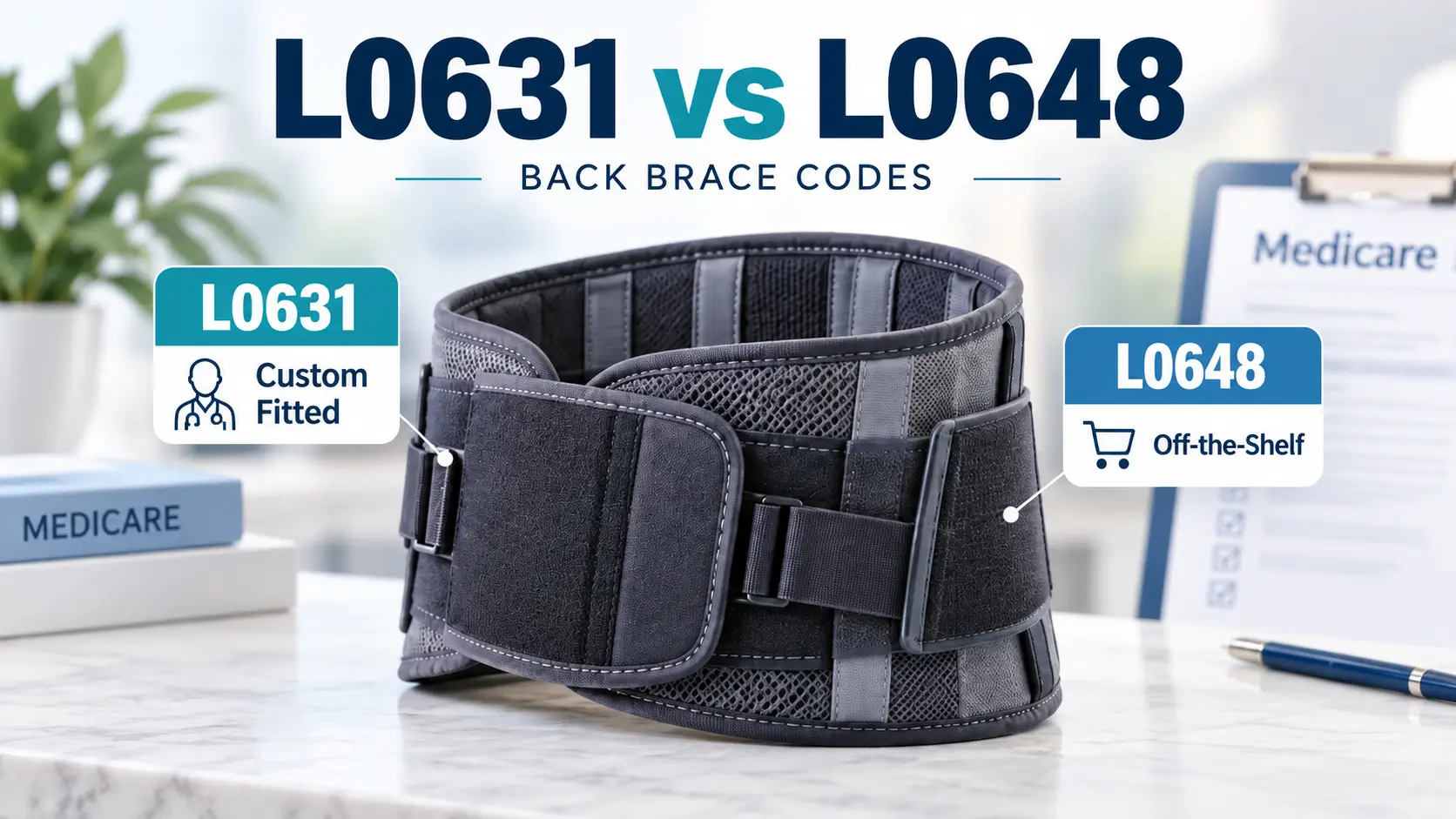
L0631 and L0648 describe very similar prefabricated lumbar-sacral orthoses, but they are not interchangeable billing codes. Both describe an LSO with rigid anterior and posterior panels designed for sagittal control. The key difference is the fitting performed when the brace is delivered: L0631 is a prefabricated brace that requires more than minimal adjustment by someone with fitting expertise, while L0648 is the off-the-shelf version that requires only minimal self-adjustment.
That distinction matters for Medicare billing. It does not mean L0631 is automatically stronger, medically better, or custom-made from scratch. For Original Medicare, CMS currently identifies both codes as requiring a face-to-face encounter, a written order before delivery, and prior authorization. Your best first move is to ask the supplier, before accepting the brace: “Which HCPCS code are you billing, and what fitting work makes that code appropriate?”
Table of Contents
L0631 vs L0648 at a Glance
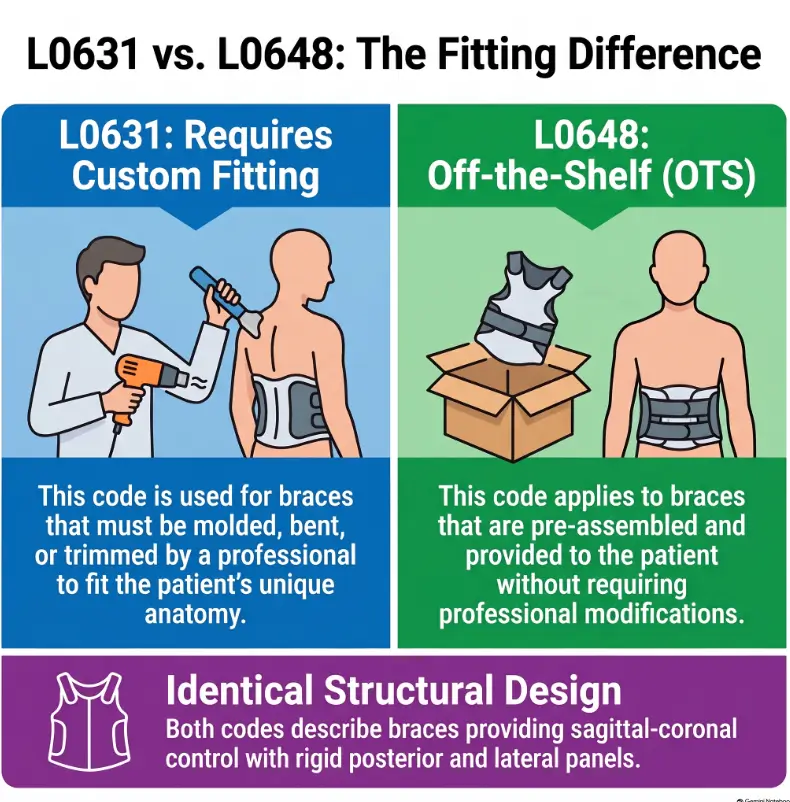
The shortest way to understand the two codes is this: the brace design is essentially the same category; the fitting requirement is different. CMS specifically distinguishes custom-fitted prefabricated orthoses from off-the-shelf orthoses according to what must happen during final fitting.
| Question | L0631 | L0648 |
|---|---|---|
| Type of brace | Prefabricated lumbar-sacral orthosis | Prefabricated lumbar-sacral orthosis |
| Main control | Sagittal control | Sagittal control |
| Rigid panels | Anterior and posterior | Anterior and posterior |
| Fitting category | Custom fitted | Off the shelf |
| Adjustment at delivery | More than minimal adjustment requiring fitting expertise | Minimal self-adjustment |
| Custom fabricated from scratch? | No | No |
| Original Medicare prior authorization | Required unless an applicable supplier exemption or exception applies | Required unless an applicable supplier exemption or exception applies |
| Face-to-face encounter and written order before delivery | Currently required | Currently required |
You can verify the current code status directly on the CMS pages for HCPCS L0631 and HCPCS L0648.
The Real Difference Is the Final Fitting, Not the Diagnosis
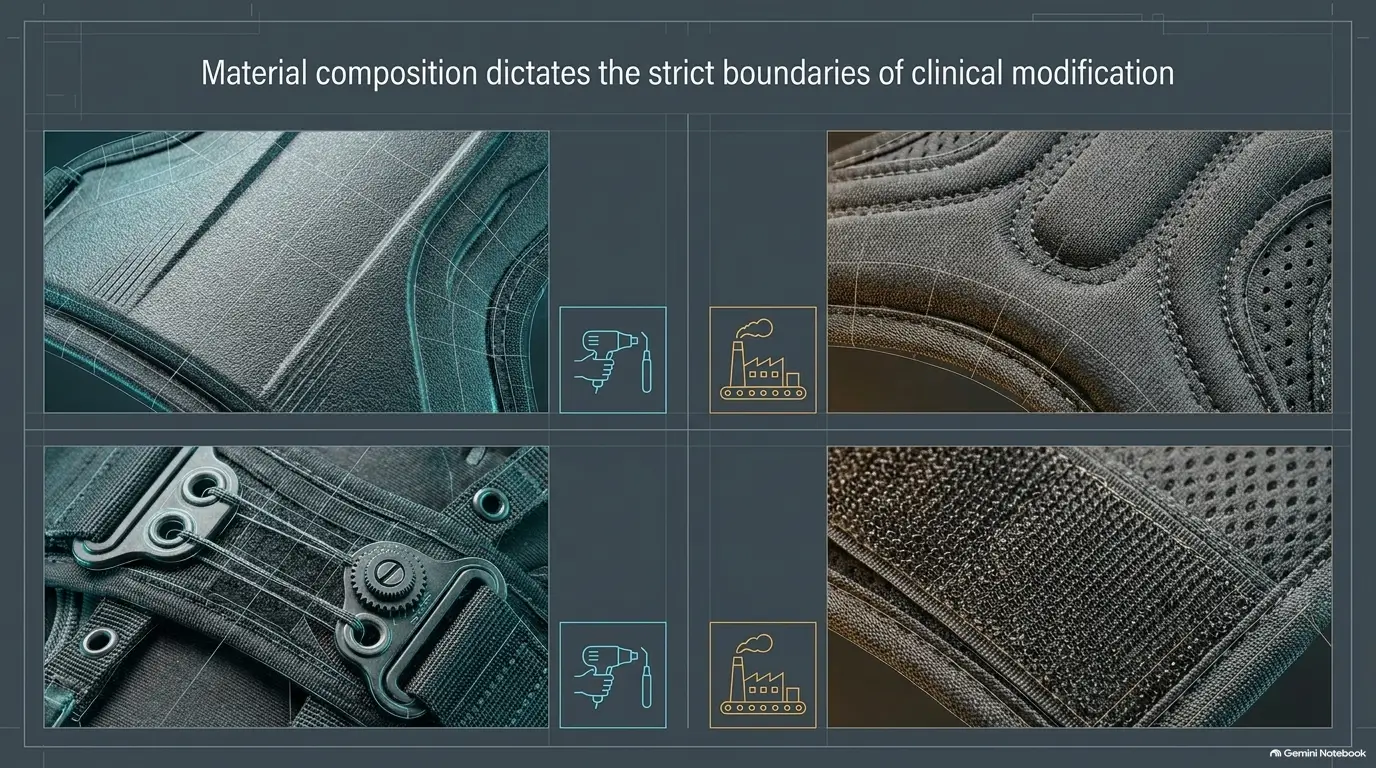
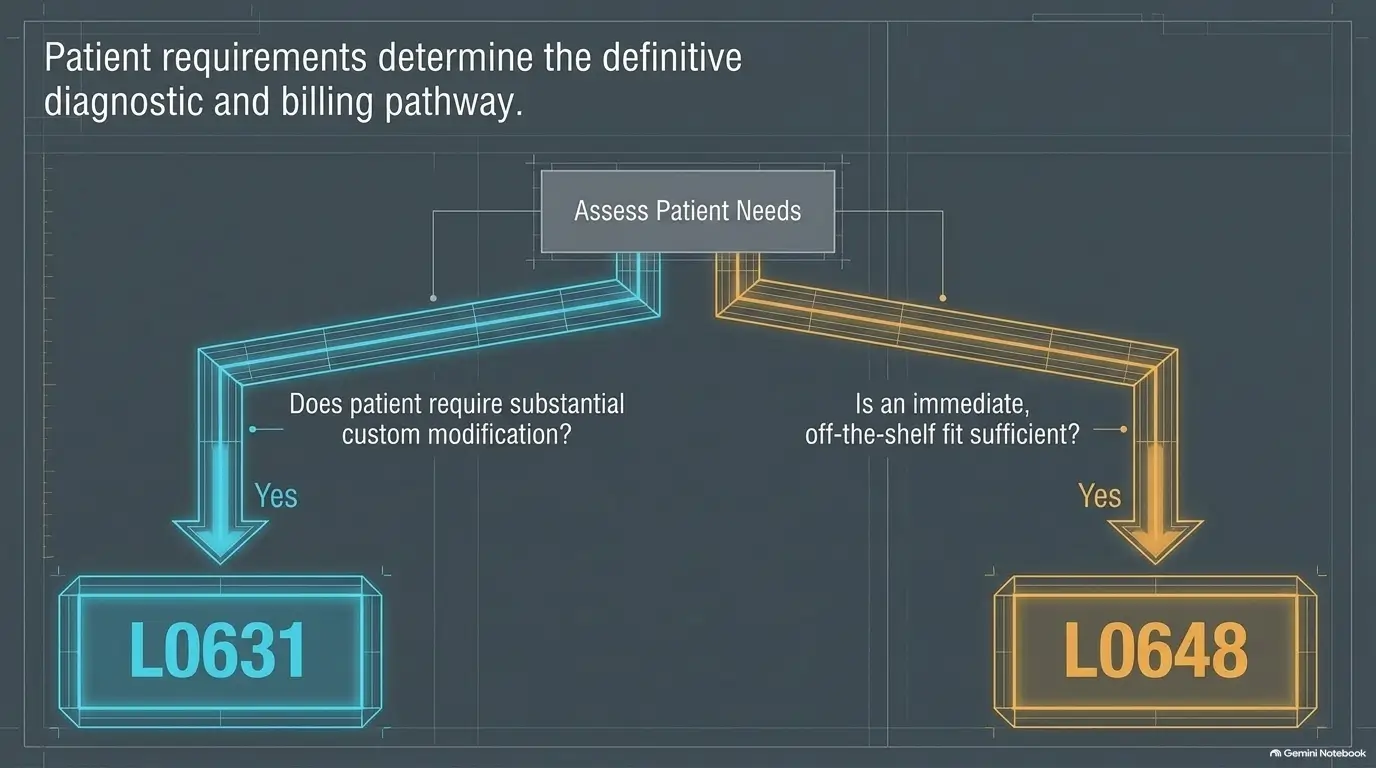
A diagnosis such as low back pain, spinal weakness, or recovery after spinal surgery does not by itself determine whether L0631 or L0648 should be billed. The billing distinction turns largely on how the prefabricated orthosis must be fitted to the individual patient at delivery.
When L0648 fits the coding definition
L0648 is the off-the-shelf category. It is appropriate when the brace can be fitted with only minimal self-adjustment rather than skilled, substantial modification. Ordinary final fitting does not magically transform an off-the-shelf brace into L0631 simply because someone tightened it around the patient.
This is an easy place for consumers to become confused because “off the shelf” can sound like “cheap” or “generic.” That is not what the code is judging. It is a Medicare coding distinction about fitting, not a quality grade.
When L0631 fits the coding definition
L0631 remains a prefabricated brace, but its final fit requires more than minimal adjustment by an individual with appropriate expertise. CMS policy expects documentation describing why those modifications were necessary and what was done during fitting.
That is the important phrase to remember: custom fitted is not the same thing as custom fabricated. L0631 does not describe a one-off brace manufactured from raw materials exclusively for your body. Calling it simply a “custom back brace” can therefore hide more than it explains.
Does Medicare Cover Both L0631 and L0648?
Potentially, yes. Medicare’s spinal-orthosis coverage policy includes both codes, but possessing the right HCPCS code does not itself establish coverage. The brace must still satisfy Medicare’s medical-necessity and documentation requirements.
CMS states that a qualifying spinal orthosis may be covered when ordered to reduce pain by restricting trunk mobility, help healing after a spinal or related soft-tissue injury, help healing after spinal surgery, or support weak spinal muscles or a deformed spine. The official CMS spinal orthoses guidance is the useful verification point if a supplier’s explanation sounds vague.
For a broader explanation of how braces interact with insurance, medical necessity, supplier rules, and patient costs, see our guide to orthopedic brace insurance coverage.
Both Codes Currently Require Prior Authorization Under Original Medicare
For Original Medicare fee-for-service, CMS lists both L0631 and L0648 on its Required Prior Authorization List and also requires a qualifying face-to-face encounter and written order before delivery. Since June 1, 2026, qualifying suppliers can be exempt from the usual prior authorization process in a specific jurisdiction. Limited urgent-furnishing exceptions also exist. Ask whether authorization is required for this claim and, if not, which documented supplier exemption or exception applies. An exemption does not remove medical-necessity, fitting, or order requirements.
That makes timing important. A supplier should not treat authorization as paperwork to clean up casually after handing over the brace. CMS maintains the current requirements through its DMEPOS prior authorization program.
If authorization terminology is new to you, use this orthopedic prior authorization checklist before delivery rather than trying to reconstruct the paperwork after a denial.
Medicare Advantage is different. A Medicare Advantage plan can have its own network, authorization, referral, and cost-sharing rules. If you have an Advantage plan rather than Original Medicare, verify the plan’s requirements directly; our Medicare Advantage orthopedic care guide explains the practical differences worth checking.
How Much Could You Pay for an L0631 or L0648 Brace?
Do not assume the code alone tells you your final price. Under Original Medicare, medically necessary back braces are covered under Part B. After the Part B deductible, Medicare says the beneficiary generally pays 20% of the Medicare-approved amount when the supplier accepts assignment.
The official Medicare back-brace coverage page also warns that what you owe can depend on other insurance, supplier participation, assignment, and where you receive the item.
That creates a useful spending rule: do not compare only the supplier’s retail price. First identify the HCPCS code, confirm coverage and authorization, ask whether the supplier accepts Medicare assignment, and then ask for your expected responsibility.
An L0631 code should not be treated as an automatic reason to pay more because it sounds more personalized. If the brace genuinely needs only minimal final adjustment, paying extra for a “custom fit” label does not create a different Medicare coding reality. Conversely, when substantial skilled fitting is actually required, selecting an off-the-shelf code solely because it looks cheaper can also be the wrong approach.
Your Five-Minute Back Brace Verification
Before the brace leaves the supplier’s hands, check these five items. This small pause can prevent a surprisingly large paperwork knot later.
- Ask for the exact HCPCS code. Do not settle for “Medicare back brace.” Ask whether the claim will use L0631, L0648, or another code.
- Ask what fitting will actually be performed. If L0631 is planned, ask what modifications require more than minimal adjustment and who will perform them.
- Confirm prior authorization status. For Original Medicare, ask whether authorization is required for this supplier and claim; confirm the decision before delivery or the documented applicable exemption or exception.
- Ask whether the supplier accepts assignment. This directly affects how Medicare-approved charges translate into your out-of-pocket responsibility.
- Ask for your expected patient amount before accepting the brace. Make sure the estimate separates Medicare coverage from anything the supplier expects you to pay privately.
The goal is not to interrogate the supplier like a courtroom drama. It is simply to make the code, fitting, authorization, and money all describe the same transaction.
Billing Explanations That Deserve a Second Question
Most coding problems are easier to resolve before delivery. These explanations do not automatically mean something is wrong, but each deserves clarification.
- “L0631 is just the stronger brace.” The principal coding distinction between L0631 and L0648 is fitting, not a simple stronger-versus-weaker hierarchy.
- “Custom fitted means custom made.” L0631 is still a prefabricated orthosis.
- “Medicare approved the brace because your doctor prescribed it.” An order is important, but coverage also depends on the applicable Medicare requirements.
- “We will sort out prior authorization afterward.” Both codes are on the Original Medicare required list, but applicable supplier exemptions and limited urgent exceptions must also be checked.
- “You don’t need to know the billing code.” Knowing the code is one of the simplest ways to verify what is actually being billed on your behalf.
What Should Be Documented for an L0631 Fitting?
If L0631 is used, the distinction should exist in the fitting record, not merely in the invoice. CMS policy expects enough detail to support the need for more than minimal adjustment and to describe the modifications performed at delivery.
You do not need to write the clinical record yourself. But you can ask a clean question: “What was changed during my fitting that makes this L0631 rather than L0648?” A supplier who performed a legitimate skilled fitting should be able to explain the answer in ordinary language.
The treating clinician’s record also matters because medical necessity is separate from coding accuracy. A perfectly fitted L0631 can still face coverage problems if the clinical documentation does not support Medicare’s coverage criteria. Conversely, a medically necessary brace can be billed incorrectly if the fitting and HCPCS code do not match.
If Medicare Denies the Brace, Identify the Type of Problem First
Do not treat every denial as proof that Medicare “doesn’t cover back braces.” The repair path depends on why the claim failed.
| Possible Problem | What to Check |
|---|---|
| Medical necessity | Whether the treating record supports a Medicare-covered reason for the spinal orthosis |
| Wrong fitting code | Whether the actual final fitting supports L0631 or L0648 |
| Prior authorization | Whether required authorization was obtained for the code and date of delivery |
| Order or encounter documentation | Whether applicable face-to-face and written-order requirements were satisfied |
| Supplier or claim issue | Whether the supplier was properly enrolled and the claim was submitted correctly |
Start with the denial reason rather than immediately buying another brace. If a brace claim has already been denied, this guide to a denied brace insurance appeal can help you organize the documents and questions before deciding what to do next.
FAQ About L0631 and L0648 Back Braces
Is L0631 a custom-made back brace?
No. L0631 describes a prefabricated, custom-fitted lumbar-sacral orthosis. That is different from a custom-fabricated orthosis made specifically for one patient from the fabrication stage onward.
Is L0631 better than L0648?
The codes do not create a better-versus-worse ranking. L0631 is appropriate when the final fitting legitimately requires more than minimal skilled adjustment. L0648 is appropriate when minimal self-adjustment is sufficient. Clinical suitability is a separate judgment for the treating professional.
Can two similar-looking braces have different codes?
Yes. Medicare’s policy states that prefabricated custom-fitted and off-the-shelf orthoses are not distinguished simply by physical appearance. The final fitting requirement is central to the coding distinction. The supplier must also ensure the product itself meets applicable Medicare coding-verification requirements.
Does Medicare prior authorization guarantee the brace will be paid?
No single administrative step should be treated as a blanket payment guarantee. Prior authorization addresses an important condition of payment, while the eventual claim must still satisfy other applicable coverage, documentation, eligibility, coding, and supplier requirements.
What if my Medicare Advantage plan uses L0631 or L0648?
The HCPCS codes can still appear in Medicare Advantage billing, but authorization procedures, network requirements, and cost sharing may be plan-specific. Confirm the brace code and then contact the plan using the member-services number on your card before delivery if coverage is uncertain.
Run This Check Before You Accept the Brace
Take the supplier’s paperwork and locate four things: the HCPCS code, the documented fitting plan, prior authorization status, and your estimated responsibility. If the code is L0631, ask what skilled modifications justify custom fitting. If it is L0648, confirm that the brace is being supplied as an off-the-shelf orthosis requiring only minimal adjustment.
“Before I receive the brace, can you confirm whether you are billing L0631 or L0648, explain what fitting will be performed, confirm the Medicare authorization status, and tell me my expected out-of-pocket amount?”
That single question separates four issues that are often blurred together: what the brace is, how it is fitted, whether Medicare requirements have been satisfied, and what you may actually owe. Once those four pieces agree, the difference between L0631 and L0648 becomes much less mysterious.
Last updated: October 15, 2026
Targeted editorial update: October 21, 2026. Added a topic-specific follow-up record and recheck triggers, revised the title and search description, and removed unverified first-person claims or clarified selected wording where found. The existing body was retained. This update is not a complete legal, coverage or clinical review; confirm current rules and individual decisions with the relevant official source or service.