
This site is written from a family-caregiver perspective. The operator is not a medical professional or an insurance, legal or financial adviser. Use this guide to organize questions for the relevant service.
Do not match prices by the dollar figure alone
Use this follow-up record alongside the guide below. It does not determine medical suitability, insurance eligibility or legal rights, and it does not guarantee a price.
- Keep together
- Hospital and campus, file date, code, payer and plan, setting and the charge category shown.
- Unanswered question
- Does this row describe the same service, setting and plan as the planned care?
- Next contact and owner
- Ask the hospital or insurer to explain an uncertain match before using it in a comparison.
- Recheck when
- The file, procedure, plan or location changes.
For each response, record its date, source, reference number and what remains uncertain. Agree the next follow-up date instead of treating silence as confirmation. Use official contact channels and keep identifying health, account and policy information out of public comments.
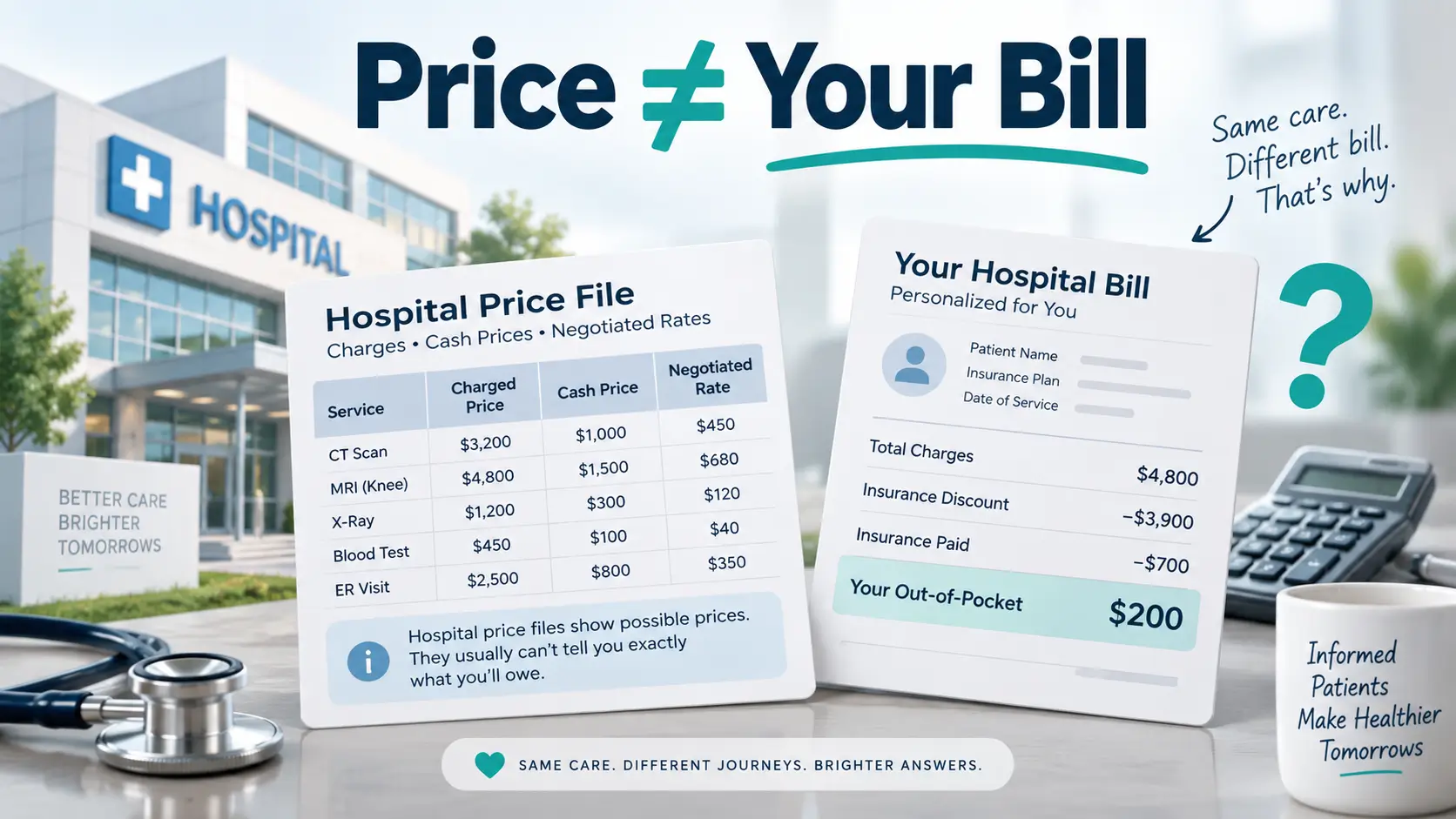
Hospital price files can tell you what a hospital charges for a service, including cash prices and many insurer-negotiated rates, but they usually cannot tell you exactly what you will owe. The distinction that matters most is simple: a posted hospital price is a pricing data point; your out-of-pocket cost is a patient-specific calculation.
If you are planning non-emergency care, use the hospital’s price data to identify the service, compare facilities, and spot large price differences. Then verify the price through the hospital’s estimator or billing office and, if you are insured, your health plan’s cost-comparison tool. Before scheduling, confirm the billing code, facility, network status, and whether separate professional bills are expected. That extra check is what turns a spreadsheet number into a useful decision.
Table of Contents
What a Hospital Price File Actually Shows
Under federal Hospital Price Transparency rules, most U.S. hospitals must publish pricing information online in two forms: a comprehensive machine-readable file and a consumer-friendly display for shoppable services. CMS explains the current requirements in its hospital price transparency guidance for consumers.
The machine-readable file is the larger, more technical dataset. Depending on the service and how the hospital contracts with a payer, it can contain information such as:
- the hospital’s gross charge;
- the discounted cash price;
- payer-specific negotiated charges;
- de-identified minimum and maximum negotiated charges;
- billing codes and descriptions used to identify items or services;
- information about whether a price applies to an inpatient or outpatient setting.
The consumer-friendly side is usually more useful if you are simply trying to price an upcoming MRI, procedure, lab test, outpatient visit, or other schedulable service. Hospitals generally must display at least 300 shoppable services, or as many as they provide if they provide fewer than 300. A qualifying online price estimator can also be used to meet this requirement.
A 2026 improvement still does not make the file a personal quote
Hospital price files became more detailed in 2026. When certain payer-specific negotiated charges are based on a percentage or algorithm rather than a simple dollar amount, hospitals are now required to report actual allowed-amount information using the median, 10th percentile, 90th percentile, and the number of allowed amounts used in the calculation. CMS describes these changes in its 2026 Hospital Price Transparency policy update.
That makes the data more informative, particularly for researchers and comparison tools. It still does not mean the median or another displayed amount is what your claim will cost. Your benefit design and the services actually delivered remain separate pieces of the puzzle.
The Distinction That Matters: Hospital Price vs. Your Price
A hospital file describes prices associated with the hospital. Your patient responsibility depends on additional information that the hospital file usually does not possess or cannot apply to you personally.
| Question | Hospital Price File Can Help | You Need Another Source |
|---|---|---|
| What is the hospital’s cash price? | Often yes | Confirm the exact service and what is included |
| What rate has my insurer negotiated? | Often yes, if the correct payer and plan are identified | Confirm network status and current plan details |
| How much deductible do I have left? | No | Your health plan |
| What will my coinsurance or copay be? | Not reliably by itself | Your health plan’s benefit and pricing tool |
| Will I get separate physician bills? | Not necessarily | Hospital and each expected provider |
| Is prior authorization required? | No | Your health plan |
| What will the final bill be? | No | Depends on services actually furnished and claim processing |
This is why two patients can receive the same hospital service at the same facility and still have different out-of-pocket costs.

Why the Final Bill Can Be Different From the Posted Rate
The most common mistake is finding one attractive number and treating it as the complete episode-of-care price. Several variables can move the final bill.
Your deductible and cost-sharing are personal
A negotiated hospital rate does not reveal how much of your deductible has already been satisfied, whether a copay applies, what coinsurance percentage your plan uses, or how close you are to your out-of-pocket limit.
For insured patients, your plan’s own comparison tool is usually the stronger second step. Federal Transparency in Coverage rules require most affected plans and issuers to provide a tool that can estimate a member’s cost-sharing for covered services. CMS explains how these tools work in its health plan price transparency guidance.
One hospital visit can produce several bills
A hospital price may cover the facility component while a radiologist, anesthesiologist, surgeon, pathologist, or another clinician bills separately. Hospital transparency rules include professional charges established by the hospital for employed practitioners, but services performed outside the scope of hospital employment are not necessarily part of the hospital’s posted charges.
For surgery or another complex procedure, ask explicitly which entities will bill you. This matters enough to treat a hospital bill involving multiple providers as a collection of possible charges rather than one neat receipt.
Facility fees can change the comparison
The physical location of care can matter. A service performed in a hospital outpatient department may carry a facility component that is different from charges associated with another care setting. If you are comparing locations, verify whether the quoted amount includes the facility charge rather than comparing procedure names alone.
If that part of the bill is unfamiliar, review how a facility fee can appear in orthopedic care before comparing two estimates.
The planned service and the performed service may diverge
Price shopping works best for care that can be specified in advance. Once additional imaging, laboratory work, supplies, medications, observation time, implants, or other services become necessary, the final combination of billing codes can differ from the original plan.
This does not make price transparency useless. It means the file is better at answering “What price is associated with this planned service?” than “What exact total will appear after everything happens?”
Use This Five-Minute Price Check Before Scheduling
You do not need to become a medical coder. You need enough specificity to make sure every person you ask is pricing the same thing.
- Get the service name and billing code. Ask the ordering office for the CPT, HCPCS, DRG, or other relevant code when one is available. A code is often more reliable than a broad label such as “knee MRI” or “outpatient surgery.”
- Identify the exact hospital location. Hospital systems can operate several campuses and outpatient departments with different pricing or billing arrangements.
- Find the correct price category. If insured, look for your specific payer and plan rather than the gross charge. If self-paying, look for the discounted cash price.
- Ask what is excluded. Specifically ask about professional fees, anesthesia, imaging interpretation, pathology, implants, laboratory work, medications, and facility fees when they could apply.
- Verify your patient responsibility separately. Insured patients should run the same provider and service through their plan’s price-comparison tool or call the insurer. Self-pay patients should request a written estimate when appropriate.
For a planned operation, a hospital’s posted rate is best treated as one input into an orthopedic surgery cost estimate, not as the finished estimate itself.
A Simple Calculation Shows Why the Posted Rate Is Not Your Bill
Illustrative example: suppose the relevant allowed amount for a covered hospital service is $5,000. Assume you have $1,000 of deductible remaining and then pay 20% coinsurance.
- $1,000 applies to the remaining deductible.
- $4,000 remains after that deductible amount.
- 20% of $4,000 is $800.
- Under these simplified assumptions, patient responsibility would be $1,800.
But the calculation changes if the plan applies different cost-sharing, the deductible has changed, the service is not covered as expected, another provider bills separately, or additional services are performed. The example also excludes premiums and unrelated charges.
Also check the remaining in-network out-of-pocket limit. In a hypothetical Marketplace plan, if only $600 remains toward the applicable limit and the entire service is covered in-network care that counts toward it, the $1,800 estimate above would be limited to $600 for that covered cost sharing. Premiums, non-covered services, and excluded charges do not become covered merely because the limit is reached. Do not apply this Marketplace explanation to Original Medicare, which has different rules.
Ask the insurer which individual or family deductible and limit apply, how much remains, and which plan year covers the service date. Pending claims can change these balances. Record the estimate date and the assumptions rather than treating an old account balance as a guaranteed bill.
That is the practical reason not to multiply a hospital price by your coinsurance percentage and stop there.
When the Cash Price Is Worth Checking
Having insurance does not automatically mean you should ignore the hospital’s discounted cash price. If you are considering paying without using insurance, compare the cash price with the estimated amount you would owe through your plan and ask what you give up by choosing self-pay.
For example, an insurance claim may contribute toward your deductible or out-of-pocket limit, while a transaction handled entirely as self-pay may not receive the same treatment. Coverage rules and plan terms matter, so do not compare only the two numbers displayed on the screen.
A low cash price deserves investigation, not automatic acceptance. Ask whether it includes the complete scheduled service, whether separate clinicians will bill you, whether the price requires payment before care, and what happens if the scope of care changes.
When a Written Estimate Matters More Than the Price File
If you are uninsured or are not using insurance to pay, a written good faith estimate can be substantially more useful than a generic price-file entry because it is tied to expected care from a particular provider or facility.
Under the No Surprises Act rules, uninsured or self-pay patients generally can receive a good faith estimate when scheduling qualifying care at least three business days in advance or when requesting an estimate. CMS explains the current requirements in its guidance for patients not using health insurance.
The estimate is also worth saving. Under the federal patient-provider dispute process, an uninsured or self-pay patient may qualify to dispute a bill from a provider or facility when the billed charge is at least $400 above that provider’s or facility’s good faith estimate, subject to the applicable requirements and deadlines.
If you are preparing for orthopedic care, the practical steps for obtaining and preserving an orthopedic good faith estimate are different from simply downloading the hospital’s machine-readable file.
What to Do After Care if the Numbers No Longer Match
Once care has occurred, stop using the hospital price file as your primary document. Your itemized bill, your insurer’s Explanation of Benefits if applicable, and any written pre-service estimate now matter more.
Compare the documents by provider, service date, billing code, allowed amount, insurer payment, adjustment, and patient responsibility. If the bill is too vague to make that comparison, request an itemized version. A structured review of an itemized orthopedic bill can help separate a pricing question from a coding, insurance, or duplicate-charge question.
A mismatch does not automatically prove that the hospital violated price transparency rules or that the bill is wrong. The actual service may have changed, another provider may be billing separately, or the claim may have been adjudicated under plan rules that the hospital file does not show.
What If the Hospital Price File Is Missing or Impossible to Use?
Start by searching the hospital’s website for terms such as “price transparency,” “standard charges,” “machine-readable file,” or “price estimator.” A hospital system may maintain separate files for different hospital locations, so confirm that you are looking at the facility where care will occur.
If required hospital pricing information appears to be unavailable, CMS provides a way to submit a Hospital Price Transparency complaint.
If the file exists but contains technical fields you cannot confidently interpret, you probably do not need to pay someone simply to decode it. For an ordinary planned service, first ask the hospital for its consumer estimator and your insurer for a personalized cost estimate. Those tools are closer to the decision you are actually trying to make.

FAQ About Hospital Price Files
Is the chargemaster price what insured patients pay?
Usually not. The gross charge is one type of hospital standard charge, but insured patients are generally affected by the rate applicable to their plan and the plan’s cost-sharing rules. Start with the correct payer-specific information rather than the gross charge.
Can I use hospital price files to compare two hospitals?
Yes, especially for planned services, but make sure you are comparing the same billing code, service package, setting, payer or cash category, and included ancillary services. A $3,000 bundled price and a $2,500 facility-only price are not a true $500 comparison if the second option generates additional bills.
Does a negotiated rate prove a hospital is in network for me?
No. A displayed rate associated with an insurer or plan is useful evidence for pricing research, but network participation should be confirmed with your health plan for the exact facility and, when relevant, the individual professionals involved in the care.
Can the hospital price file tell me whether insurance will approve the service?
No. Price transparency data does not replace a coverage determination or prior authorization. Coverage can depend on your benefits, medical-necessity criteria, network rules, referrals, authorization requirements, and the service actually billed.
Run This Check Before You Schedule
Take the service you are considering and write down five things: billing code, exact facility, your plan name or self-pay status, the displayed hospital price, and the services excluded from that price.
Then make one verification call or use your insurer’s online tool. Ask: “For this code at this exact facility, what is my estimated out-of-pocket cost, and should I expect any separately billed providers?”
That question closes the gap hospital price files cannot close on their own. Use the file to discover and compare prices. Use a patient-specific estimate to decide what the care is likely to cost you.
Targeted update: 17 October 2026. Added the remaining out-of-pocket-limit check and plan-year assumptions to the illustrative calculation, using HealthCare.gov guidance. This update is not an individual coverage determination.
Targeted editorial update: October 21, 2026. Added a topic-specific follow-up record and recheck triggers, revised the title and search description, and removed unverified first-person claims or clarified selected wording where found. The existing body was retained. This update is not a complete legal, coverage or clinical review; confirm current rules and individual decisions with the relevant official source or service.