
This site is written from a family-caregiver perspective. The operator is not a medical professional or an insurance, legal or financial adviser. Use this guide to organize questions for the relevant service.
Trace the rest of the expected care
Use this follow-up record alongside the guide below. It does not determine medical suitability, insurance eligibility or legal rights, and it does not guarantee a price.
- Keep together
- Surgeon quote, included services, separate billers, deposits and the issuer of each estimate.
- Unanswered question
- Which components are outside this quote, and who provides the missing estimates?
- Next contact and owner
- Keep a separate line for each biller and track where any deposit will be credited.
- Recheck when
- Operation, facility, professional group or deposit terms change.
For each response, record its date, source, reference number and what remains uncertain. Agree the next follow-up date instead of treating silence as confirmation. Use official contact channels and keep identifying health, account and policy information out of public comments.

Why Your Surgeon Quote Is Not Your Total Surgery Cost
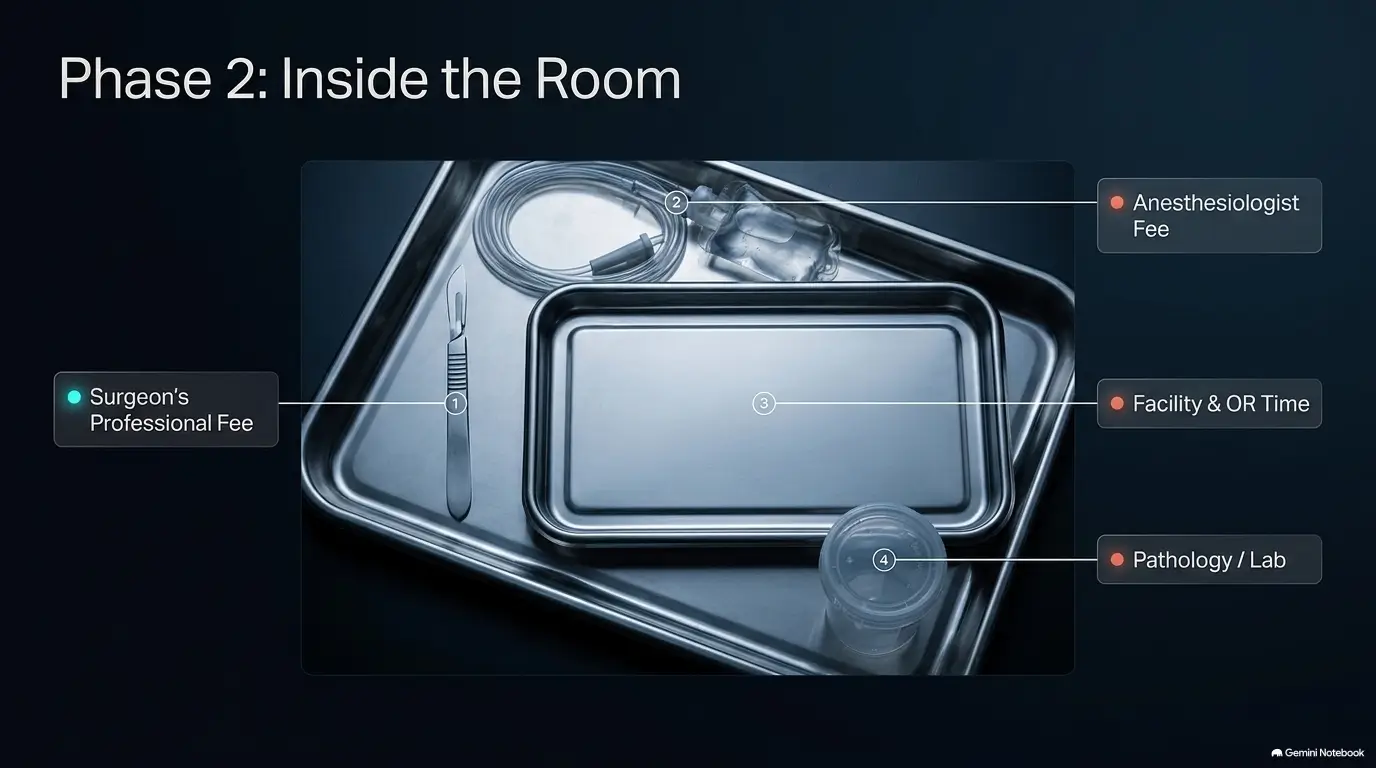
A surgeon’s quote can be an important number without being the complete number. Surgery may involve a facility, anesthesia professionals, assistant surgeons, laboratory or pathology services, imaging, implants, medications, and follow-up care that are billed separately.
For an insured patient, the amount that matters most is not simply what each provider charges. Network status, your health plan’s negotiated amounts, deductible, copayments or coinsurance, prior authorization requirements, and what you have already spent during the plan year can all change what eventually comes out of your pocket.
The practical goal is therefore not to chase one perfect surgery price. It is to identify the major billers, collect estimates from the right places, and ask your insurer questions precise enough to expose the expensive gaps before the procedure.
The useful question is not “What did the surgeon quote?” It is “Which expected surgery charges have I not accounted for yet?”
Snapshot
This US-focused guide is for patients preparing for scheduled surgery who have received a surgeon’s quote, estimate, or prepayment request. It explains why that number may not equal your total cost, which additional billers to identify, how insurance changes the calculation, and what to verify before committing financially.
Before you act
This article provides general billing and insurance guidance, not a personalized medical or insurance determination. Your procedure, facility, health plan, network, benefit year, medical necessity documentation, and unexpected clinical needs can change the final bill. Confirm important cost and coverage questions directly with the facility, each separately billing provider, and your health plan before relying on an estimate.
Table of Contents
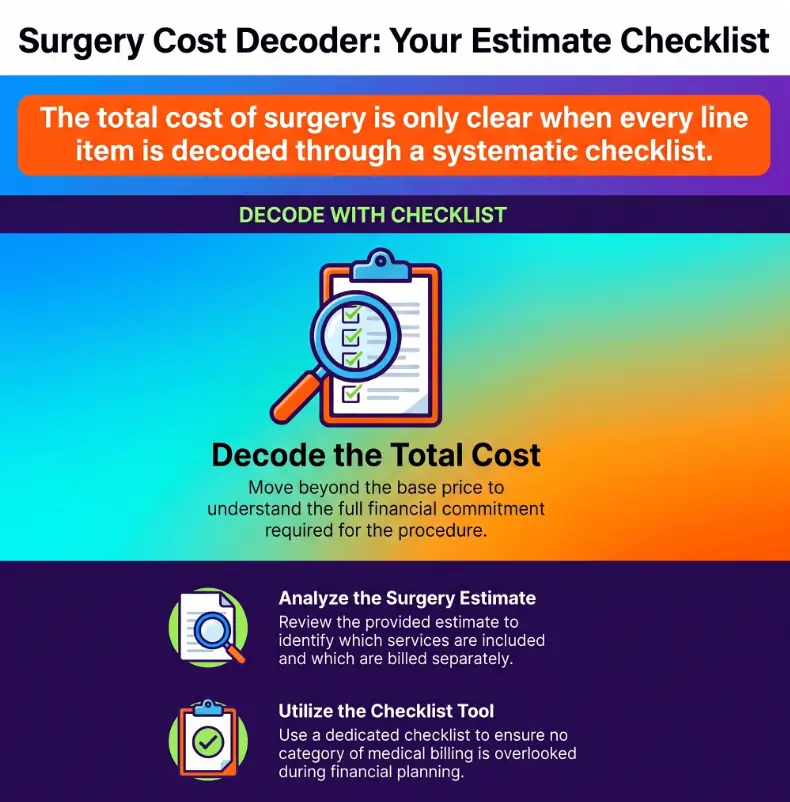
Is a Surgeon Quote the Same as the Total Surgery Cost?
Usually, you should not assume so. A quote from a surgeon may describe the surgeon’s own professional services while other parts of the surgery are billed by the hospital or ambulatory surgery center and by other professionals involved in your care.
CMS makes this separation especially clear for uninsured and self-pay patients. Its Good Faith Estimate guidance notes that estimates currently cover a single provider or facility, and its surgery example specifically advises requesting an estimate from the surgeon and another from the hospital.
That distinction matters because a perfectly accurate surgeon quote can still leave you with an incomplete picture.
Key takeaway: Treat a surgeon’s quote as one component of the cost file unless the written estimate explicitly says it is a bundled price and identifies exactly which professional and facility services are included.
A quote, a charge, and your final responsibility are different numbers
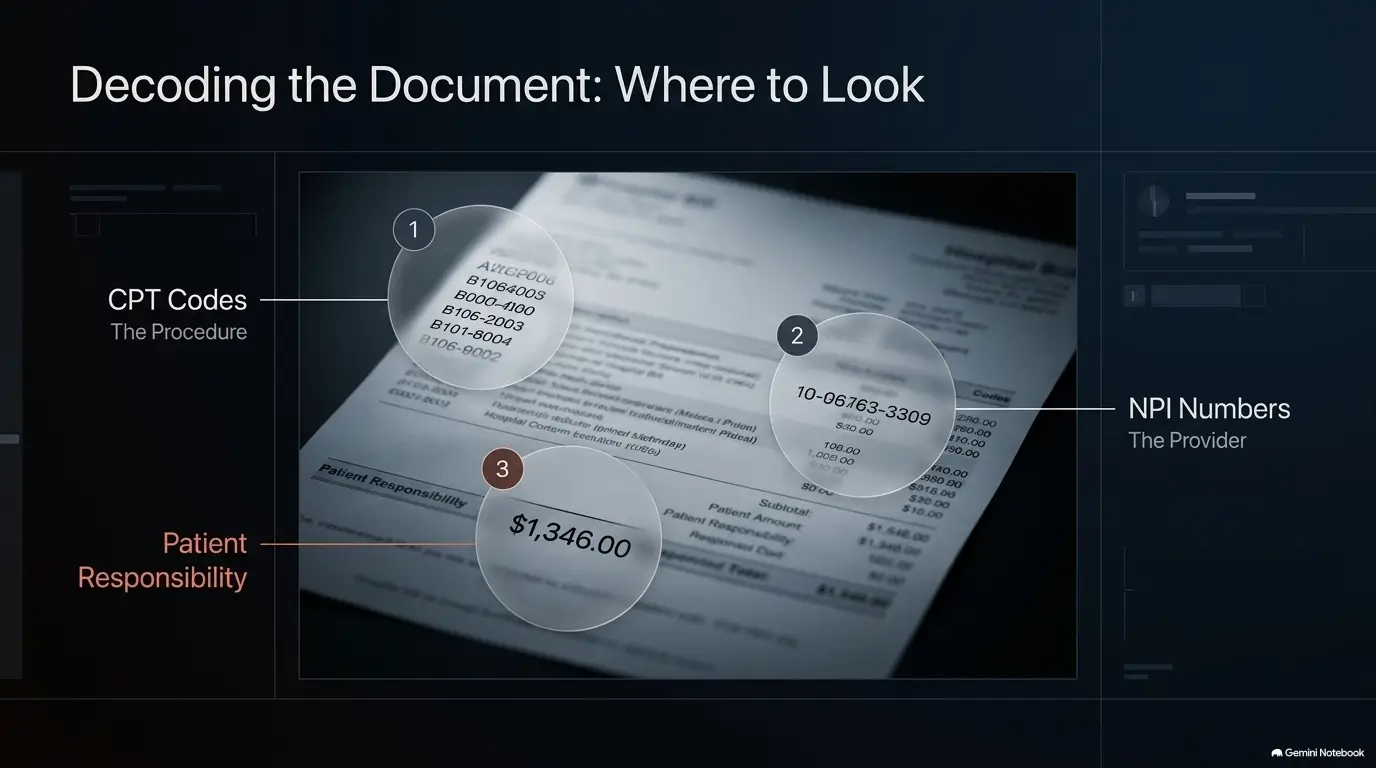
The provider’s quoted or billed charge is not necessarily what an insured patient pays. Health plans may apply negotiated amounts, deductibles, copayments, coinsurance, exclusions, and other benefit rules before calculating patient responsibility.
HealthCare.gov describes a patient’s total health care costs as involving more than the plan premium, including deductibles, copayments, coinsurance, and the plan’s out-of-pocket rules.
If you are comparing quotes, keep three columns in your notes: provider estimate, insurer-allowed or negotiated amount if available, and estimated patient responsibility. Mixing those numbers together is one of the quickest ways to make a surgery look cheaper or more expensive than it really is.
Which Charges Can Be Missing From a Surgeon’s Quote?
The missing pieces depend on the procedure and setting, but the facility and anesthesia are two of the first places to look. Other procedures may involve additional professional, diagnostic, device, laboratory, or recovery-related charges.
| Potential biller | What the charge may cover | Question to ask | Why it matters |
|---|---|---|---|
| Surgeon | Professional surgical services | What exactly is included in your quote? | The quote may cover only the physician component. |
| Hospital or surgery center | Operating room, recovery area, supplies, nursing, facility resources | Can I get a written facility estimate? | The facility component can be separate from the surgeon. |
| Anesthesia group | Anesthesia professional services | Who will bill me, and are they participating with my plan? | The anesthesia group may be a separate organization. |
| Other clinicians | Assistant surgeon, consulting physician, or other professional care when applicable | Which additional professionals are expected? | One surgical encounter can generate multiple professional claims. |
| Diagnostics or pathology | Laboratory analysis, imaging, or pathology when medically relevant | Is separate diagnostic billing expected? | These services may not appear on the initial surgeon quote. |
| Devices or supplies | Implants, braces, durable equipment, specialized supplies when required | Are device or supply charges included? | Procedure-specific items can change the estimate. |
| Recovery services | Physical therapy, medications, home equipment, or follow-up services | Which post-operative services should I budget separately? | The surgery-day estimate may stop before recovery costs begin. |
For orthopedic procedures, a useful next step is to compare the surgeon’s number against a broader orthopedic surgery estimate checklist and then examine the facility fee separately. Related guides explain separate anesthesia bills and orthopedic bills from multiple providers.
The surgery cost stack
Professional surgical services
Hospital or surgery-center resources
Anesthesia and other expected services
Network, allowed amounts, deductible and cost sharing
Result: Your likely patient responsibility appears only after these layers are considered together.
What Changes Your Final Out-of-Pocket Surgery Cost?
If you are insured, the sticker price alone rarely answers the budgeting question. Your out-of-pocket cost depends on how the procedure and each associated service interact with your specific health plan.
Important variables can include:
- whether the surgeon is in network;
- whether the hospital or ambulatory surgery center is in network;
- how your plan handles other professionals involved in the procedure;
- the plan’s allowed or negotiated amount;
- how much of your deductible remains;
- copayment or coinsurance rules;
- your accumulated eligible out-of-pocket spending for the plan year;
- whether prior authorization or another coverage requirement applies;
- whether a particular service is covered;
- whether the procedure changes after surgery begins;
- and whether additional medically necessary services become necessary.
HealthCare.gov explains that deductible, copayment, coinsurance, and out-of-pocket maximum rules can all affect what a patient pays for covered care. Your actual plan documents and insurer remain the authority for your own benefits.
Key takeaway: “Covered” does not mean “free,” and “authorized” does not tell you the final dollar amount. Coverage, network participation, prior authorization, and patient cost sharing are separate questions.
Technical depth: billed charge vs allowed amount vs patient responsibility
For insured care, three numbers are often confused.
Billed charge: the amount submitted by a provider or facility.
Allowed amount: the amount your health plan recognizes under its contract or benefit rules for a covered service.
Patient responsibility: the portion assigned to you after applicable plan rules are processed.
A useful mental model is:
Provider claim → plan rules and allowed amount → deductible/copay/coinsurance → applicable out-of-pocket rules → patient responsibility
This is why multiplying the surgeon’s quoted charge by your coinsurance percentage can produce the wrong answer. Your insurer may calculate cost sharing from a different allowed amount, and separate claims may be processed individually.
How to Build a More Complete Surgery Estimate Before You Book
You do not need to become a medical billing specialist. You need a repeatable way to identify the expected billers and put their answers in one place.
Step 1: Ask what the surgeon’s quote actually includes
Do not ask only, “Is this the surgery price?” Ask for the scope in writing.
- Is this only your professional fee?
- Does it include follow-up visits?
- Does it include an assistant surgeon if one is expected?
- Are implants or surgical devices included?
- Which costs will be billed by someone else?
- Which facility will perform the procedure?
- Which anesthesia group is normally used there?
Step 2: Request the facility estimate separately
Contact the hospital or ambulatory surgery center’s estimating or patient financial services team. Give them the planned procedure, surgeon, anticipated date, and insurance information if you are using insurance.
US hospitals are subject to federal hospital price-transparency requirements that make pricing information publicly available through machine-readable data and a consumer-friendly presentation of shoppable services. These resources can help with comparison, but they should not automatically be treated as your complete personalized patient responsibility.
Step 3: Identify separately billing professionals
Ask the facility which outside or separately billing groups are normally involved. The answer may include anesthesia and, depending on the procedure, other professional services.
Do not assume that seeing the hospital and surgeon on your insurer’s directory answers every network question. Planned surgery can involve several organizations even though the patient experiences it as one appointment.
Step 4: Put every estimate on one worksheet
| Entity | Estimate received? | Network verified? | Estimated patient amount | Open question |
|---|---|---|---|---|
| Surgeon | Yes / No | Yes / No | Record amount | What is excluded? |
| Facility | Yes / No | Yes / No | Record amount | What services bill separately? |
| Anesthesia | Yes / No | Yes / No | Record amount | Which group is scheduled? |
| Other expected provider | Yes / No | Yes / No | Record amount | Is participation confirmed? |
| Recovery services | Yes / No | As applicable | Record amount | Separate benefit or visit limit? |
If you want a dedicated pre-surgery framework, use the site’s orthopedic surgery estimate guide rather than trying to reconstruct the whole cost stack from memory.
Insurance, Network Status, and Surprise Bills: What Should You Verify?
For insured patients, network status deserves its own verification step. A hospital being in network does not necessarily mean every professional involved is employed by that hospital or participates in the same network.
The federal No Surprises Act provides protections for people with most types of private health insurance against certain unexpected out-of-network bills, including qualifying non-emergency services associated with visits to an in-network hospital, hospital outpatient department, or ambulatory surgical center. The rules have important limits and exceptions, so they should not be used as a substitute for checking your specific planned care in advance.
CMS also explains that certain specialists, including assistant surgeons, cannot ask patients to waive applicable federal protections through the notice-and-consent process in the circumstances covered by those rules.
Do not assume:
“The hospital is in network” is useful information, but it is not the same question as “What will my entire episode of care cost?”
What to ask your insurer
Use a specific script instead of asking, “Is my surgery covered?”
Insurance verification script
“I am planning a scheduled surgery with Dr. [name] at [facility]. I want to verify my benefits before I pay anything.”
“Can you confirm whether the surgeon and facility are currently in network for my exact plan?”
“Does this procedure require prior authorization, and has it been approved?”
“What deductible, copayment, or coinsurance rules would normally apply to the surgeon and facility claims?”
“How much of my applicable deductible and out-of-pocket amount have I accumulated so far this plan year?”
“How should I verify the anesthesia group and other professionals who may bill separately?”
“Can you give me a reference number for this call or send the benefit information in writing?”
If authorization is part of the process, work through an orthopedic prior authorization checklist before assuming an appointment on the calendar means the insurance side is finished.
For spine procedures in particular, the site’s guide to surprise bills after spine procedures can help with the next layer of billing risk.
Self-Pay Surgery: When Does a Good Faith Estimate Help?
If you are uninsured or choosing not to use health insurance, a written Good Faith Estimate can give you significantly more structure than a verbal price quote.
CMS states that uninsured or self-pay patients generally have a right to a Good Faith Estimate when qualifying care is scheduled sufficiently in advance or when they request one. The estimate should itemize expected charges from the provider or facility issuing it.
There is an important limitation: the current federal Good Faith Estimate framework may produce separate estimates from separate providers or facilities. CMS specifically advises surgical patients to request estimates from the surgeon and hospital and notes that services supplied by another provider may not appear on the first estimate.
That makes a Good Faith Estimate useful, but not magical. You still need to ask who else is expected to bill.
Under current CMS guidance, an eligible uninsured or self-pay patient may be able to use the federal patient-provider dispute process when a provider or facility’s bill is at least $400 above that provider or facility’s Good Faith Estimate. CMS also currently states that the dispute must be initiated within 120 calendar days of the date printed on the initial bill. Record that date and the receipt date separately. Because these are current federal rules, verify the requirements before relying on them for a dispute.
The site’s orthopedic Good Faith Estimate guide is the natural next step if you are paying without insurance.
Key takeaway: If you are self-paying, request written estimates from each major provider or facility you expect to bill you. One document may not represent the entire surgical episode.
CMS provides additional information on how Good Faith Estimates work for uninsured and self-pay patients.
When Is the Cheapest Surgery Quote Enough?
A cheaper quote can be perfectly reasonable when you are comparing the same procedure, equivalent clinical circumstances, the same billing scope, and similarly suitable providers and facilities. Paying more simply because a number looks more “premium” is not a useful strategy.
The cheaper option may be enough when:
- the surgeon and facility meet your clinical requirements;
- you have verified what the quote includes and excludes;
- network status is appropriate for your plan;
- the same expected services are being compared;
- the facility setting is medically appropriate;
- and you are not sacrificing an important medical, safety, access, or continuity factor merely to obtain a lower advertised number.
In other words, you do not need an expensive paid consultant simply to collect basic estimates if the surgeon, facility, insurer, and billing departments can give you the information directly. A spreadsheet or sheet of paper may be enough.
When paying more may be reasonable
A higher-cost option may be reasonable when the difference reflects something that genuinely matters to your care rather than a vague prestige signal. Examples can include a surgeon’s relevant expertise for a complex case, a particular facility required for your clinical situation, or other medically meaningful factors discussed with your treating clinicians.
Cost should be part of the decision, but surgery is not a commodity where every quote necessarily represents identical care.
| Cost-planning approach | Best for | Main advantage | Main limitation | What to verify |
|---|---|---|---|---|
| Surgeon quote only | Very early planning | Fast starting point | May omit other billers | Exactly what the quote includes |
| Multi-provider estimates | Self-pay or comparison shopping | Shows more of the cost stack | Unexpected care may still change the bill | Surgeon, facility, anesthesia and other expected services |
| Multi-provider estimates plus insurer verification | Insured patients preparing to proceed | Adds plan-specific cost context | Still an estimate, not a guaranteed final claim result | Network, benefits, authorization and cost sharing |
Which Surgery Estimate Mistakes Can Cost You Money?
The most expensive mistakes usually come from confusing one correct answer with the answer to a different question.
| Mistake | Why it costs money | Safer move |
|---|---|---|
| Treating the surgeon quote as an all-in price | Facility and other professional bills may sit outside it. | Ask for an inclusion and exclusion list. |
| Checking only whether the hospital is in network | Other organizations may bill separately. | Identify expected professional groups before the procedure. |
| Assuming prior authorization equals a price guarantee | Authorization and cost sharing answer different questions. | Verify authorization and benefits separately. |
| Comparing billed prices rather than patient estimates | The insurer may calculate responsibility using plan-specific amounts. | Request an estimated patient responsibility where available. |
| Paying a large prepayment without understanding reconciliation | The final processed claims may differ from the estimate. | Ask how overpayments, underpayments, refunds, and adjustments are handled. |
| Ignoring recovery costs | Therapy, medicines, equipment, or follow-up needs may extend beyond surgery day. | Create a separate recovery budget. |
| Discarding estimates and call records | You lose documentation that may help resolve discrepancies. | Save estimates, portal messages, reference numbers, and bills together. |
Key takeaway: Do not spend hours hunting for a universally correct surgery price online when your biggest unknown is a missing biller. Find the entities first. Compare prices second.
A deposit is a payment toward a bill, not another surgery cost. Keep the receipt, biller’s name, service date, and account number. CMS explains that an Explanation of Benefits is not a bill and may not show what you already paid. Match each deposit to the same provider and services before paying the remaining balance.
Hypothetical example: the processed claim assigns you $2,400 for one provider’s covered services, and that provider has credited your $800 deposit to those services. The remaining balance is $1,600, not $2,400 plus another $800. Ask for the account ledger if the credit is missing. A deposit paid to the surgeon does not automatically pay a separate hospital or anesthesia bill; confirm any refund or transfer with the relevant billing office.
What Should You Ask Before Paying for Surgery?
Before paying a deposit or pre-service amount, divide your questions by who can actually answer them. The surgeon cannot reliably answer every insurance question, and the insurer cannot define the surgeon’s billing package for them.
Questions for the surgeon’s office
- What services are included in this quote?
- What common surgery-related costs are excluded?
- Which facility will be used?
- Which procedure is currently planned?
- Is an assistant surgeon expected?
- Are implants or other specialized items expected, and are they included in this estimate?
- Which follow-up visits are included?
Questions for the facility
- Can you provide a written facility estimate?
- Does the estimate represent my insurance information or a general charge?
- Which professional services are not included?
- Which anesthesia group usually covers this surgeon and procedure?
- Are there expected laboratory, pathology, imaging, device, or other separately billed services?
- If I prepay, how is the account reconciled after insurance processes the claims?
Questions for the anesthesia group
- Are you participating with my exact health plan?
- Can you provide an estimate or explain how the patient portion is calculated?
- Will your professional charge appear separately from the facility bill?
- Who should I contact if the scheduled anesthesia provider changes?
Questions for your insurer
- Are the surgeon and facility in network today?
- What authorization requirements apply?
- What cost-sharing rules apply to the planned procedure?
- What deductible remains?
- How much eligible out-of-pocket spending has been credited this year?
- How should I verify expected ancillary providers?
- What should I do if an unexpected out-of-network bill arrives?
If affordability remains the barrier after you have clarified the expected charges, ask the provider about financial assistance, discounts that may apply to your circumstances, and payment arrangements before turning automatically to high-cost borrowing. The site’s orthopedic payment plan guide can help you frame that conversation.
For insured readers who want to understand how cost sharing fits together, HealthCare.gov’s guide to deductibles, copayments, coinsurance, and total health care costs provides a useful foundation.
FAQ
Does a surgeon’s fee normally include the hospital fee?
Do not assume it does. The surgeon and facility may issue separate estimates and bills. Ask the surgeon’s office to state in writing whether the quote includes any facility charges.
Can anesthesia be billed separately from surgery?
Yes, anesthesia professional services may be billed separately from the surgeon and facility. Before planned surgery, ask which anesthesia group is expected and how to verify its participation with your plan.
If the hospital is in network, are all doctors there automatically in network?
You should not rely on that assumption. Federal surprise-billing protections apply in important situations involving qualifying out-of-network services at an in-network facility, but the protections have defined scope and exceptions. Verify your planned care when possible.
Does prior authorization tell me how much surgery will cost?
No. Prior authorization addresses a coverage or utilization requirement under the plan. Your patient responsibility can still depend on network status, allowed amounts, deductible, cost sharing, and how the claims are ultimately processed.
Should I compare the cash price with my insurance price?
It can be reasonable to ask about both when the provider offers a self-pay option, but compare more than the immediate dollar amount. Ask whether paying cash means the claim will not be submitted to insurance and whether that spending will therefore receive any credit under your health plan’s rules. Confirm the consequences with both the provider and insurer before choosing.
Can a hospital price estimator tell me the total surgery cost?
It can be a useful planning tool, but do not automatically assume it includes every separately billed professional or unexpected service. CMS hospital price-transparency resources are useful for comparing hospital pricing information, while a complete pre-surgery cost check still requires identifying the expected billers.
What should I do if the final bill is much higher than the estimate?
First compare the estimate, insurer explanation of benefits if applicable, and itemized bill. Ask which service created the difference and whether it came from a separate provider, changed procedure, corrected claim, or other adjustment. If you were uninsured or self-paying and received a qualifying Good Faith Estimate, check the current federal dispute rules before paying a disputed amount. CMS currently describes a federal dispute route for qualifying bills that exceed the relevant estimate by at least $400.
Your 15-Minute Surgery Cost Check
If surgery is already scheduled, you can make the financial picture substantially clearer without spending an afternoon on hold.
- Open the surgeon’s estimate. Circle every phrase describing what is included.
- Write down the facility name. If no facility appears, call the surgeon’s office and ask.
- Call or message the facility. Request its estimate and ask which professional groups normally bill separately.
- Write down the anesthesia group. Do not leave “anesthesia” as an unnamed question mark.
- Log into your insurer portal. Check the surgeon and facility against your exact plan, then call if anything is unclear.
- Verify authorization. If required, record its status without assuming that authorization determines your price.
- Create one total-cost worksheet. Put surgeon, facility, anesthesia, other expected services, and recovery costs on separate lines.
- Save everything. Keep written estimates, insurer messages, call reference numbers, prepayment receipts, explanations of benefits, and final bills together.
You still will not possess a guaranteed crystal-ball number. Surgery can change because medicine is not a fixed-price assembly line. But you will have replaced one seductive quote with something much more useful: a map of the people and organizations that may actually send you a bill.
That is the number worth building before you pay.
Last updated: October 14, 2026
Targeted review: October 17, 2026. The added deposit example checks payment reconciliation; it does not guarantee the amount of any claim. Other sections retain their stated review scope.
Targeted editorial update: October 21, 2026. Added a topic-specific follow-up record and recheck triggers, revised the title and search description, and removed unverified first-person claims or clarified selected wording where found. The existing body was retained. This update is not a complete legal, coverage or clinical review; confirm current rules and individual decisions with the relevant official source or service.