
Written from a family caregiver perspective. The operator cares for an older mother with rheumatic, spinal and knee problems and is not a medical professional. This article offers general information, not individual clinical clearance.
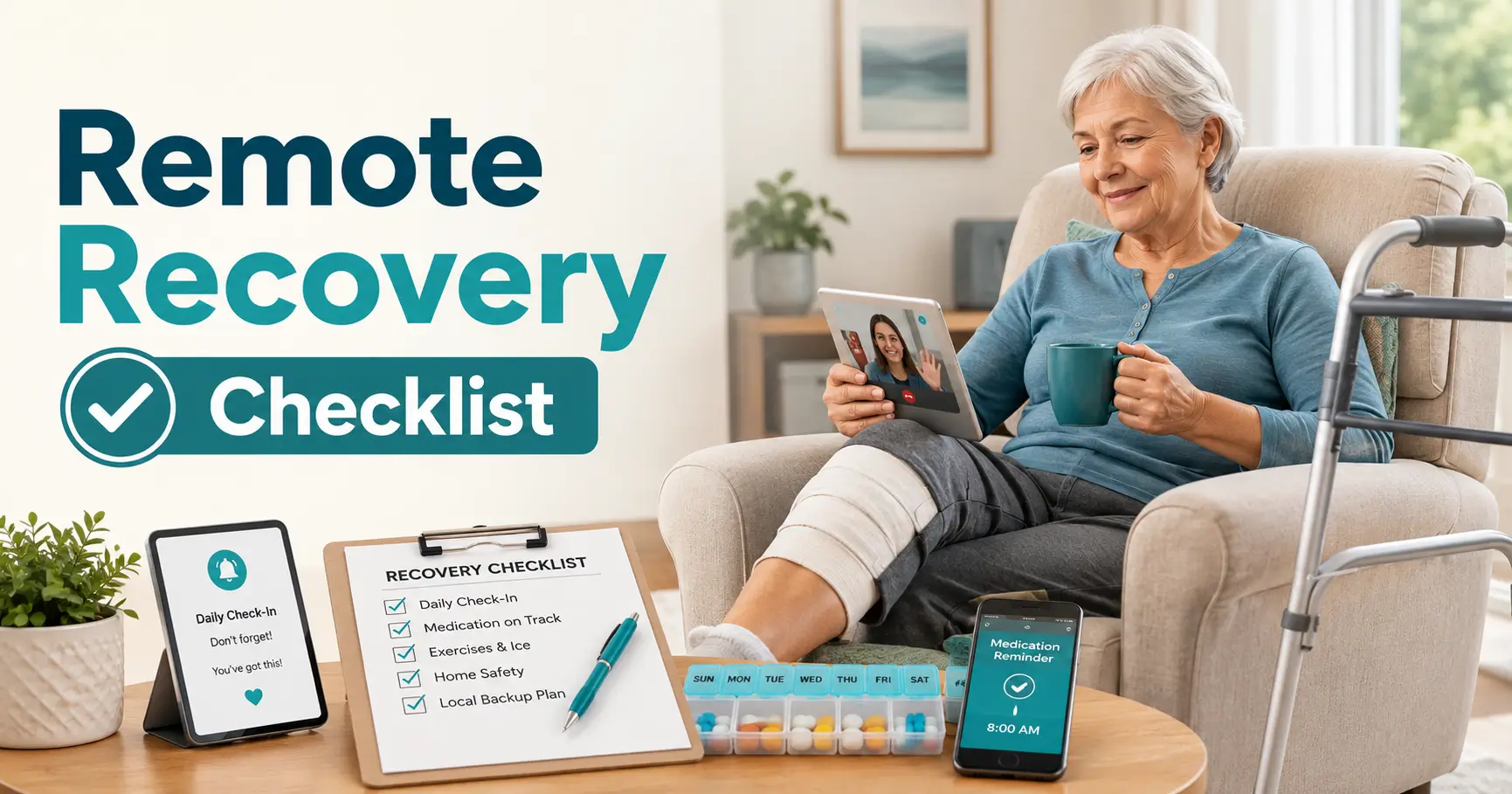
A practical recovery coordination guide
Long-Distance Caregiver Checklist
After Knee Replacement
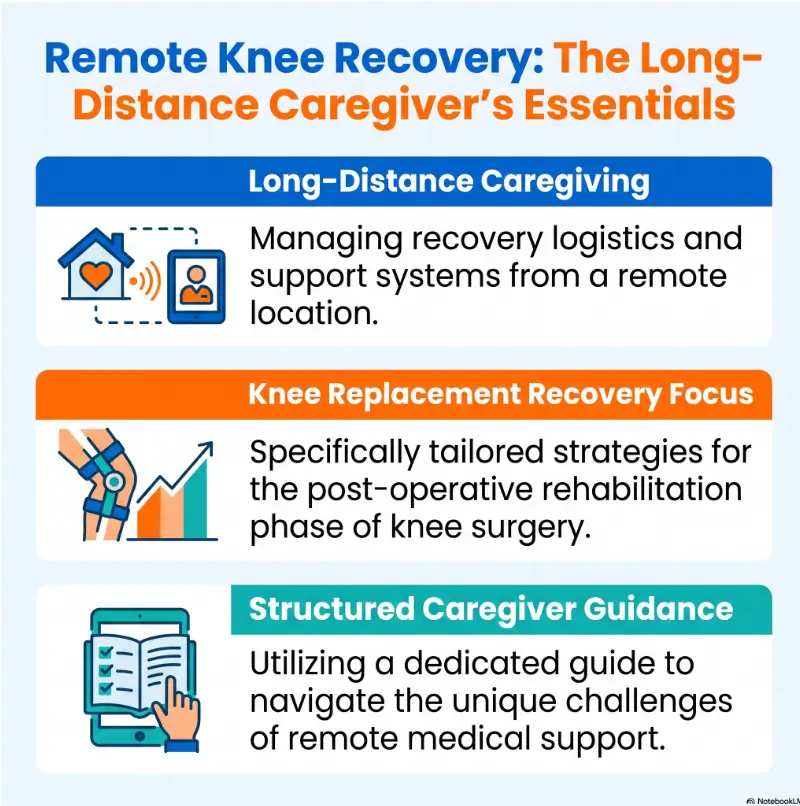
Caring from another city can feel like trying to hold an umbrella over someone from three states away. You can coordinate medications, appointments, meals, transportation, and daily check-ins, but you cannot steady a walker, inspect a slippery bathroom floor, or open the door after a fall.
The answer is not to call every twenty minutes. It is to build a small recovery system before the patient is left alone: clear instructions, named local helpers, observable check-in questions, secure home access, and a written escalation plan.
This guide turns a thick discharge packet and a cloud of family promises into practical actions. It will help you decide what can be managed remotely, what requires a nearby person, and which changes should move the conversation from a family group chat to a healthcare professional.
Build the plan
Create one shared source for contacts, medications, appointments, access, and local roles.
See what calls miss
Use observable questions instead of accepting “I’m fine” as a complete recovery report.
Know when to escalate
Separate routine support, same-day clinical questions, urgent evaluation, and emergency action.
The goal is not remote control. It is reliable coordination with a human safety net nearby. 🧭
Snapshot: This checklist is for adult children, relatives, and friends helping someone recover from knee replacement from another city. It shows how to choose the right level of local support, organize the first days at home, conduct useful check-ins, reduce avoidable risks, and respond when recovery stops looking routine.
Table of Contents
READER WORKSHEET
Long-distance caregiver handoff
Connect remote check-ins with someone who can help locally.
Confirm and prepare
Add your working notes
Keep names, account numbers, member IDs, and other identifying details out of this worksheet.
Complete your worksheet to organize the next step. Blank amounts remain unknown.
How to use the result: This worksheet cannot monitor a person or provide emergency response. Follow the discharge team’s escalation instructions.
This worksheet does not save entries between visits or send them to a provider. Download before leaving; the downloaded file may contain your notes. It is a planning aid, not a diagnosis, safety assessment, coverage decision, or final bill.
Before You Coordinate: Know What Distance Care Cannot Do
Before You Act
This article provides general organization and caregiving guidance. It cannot tell an individual patient how much to walk, when to change a dressing, how to adjust a medication, whether a symptom is harmless, or when a particular person is ready to be left alone.
The surgeon’s instructions, discharge paperwork, physical therapy plan, pharmacist guidance, and the patient’s known medical conditions should control those decisions. Confirm any uncertainty with the appropriate healthcare professional rather than trying to solve it through family consensus.
Chest pain, difficulty breathing, fainting, coughing up blood, or other possible emergency symptoms should not be managed through messages or a scheduled video call. Seek emergency assistance according to the patient’s discharge instructions and local emergency procedures.
What a Long-Distance Caregiver Can Do Well
Distance caregivers are often excellent coordinators. They can keep the calendar coherent, confirm that prescriptions were collected, arrange rides, document questions, recruit local help, order practical supplies, and make sure important changes reach the clinical team.
They can also notice patterns that a tired patient may miss. Three days of skipped meals, increasing sleepiness, repeated missed doses, or worsening difficulty getting to the bathroom may become obvious when one person maintains a consistent daily record.
When the Home Plan Needs More Than Calls
A remote plan becomes fragile when the patient cannot safely manage transfers, bathroom trips, food, fluids, medications, or communication. It is also weak when no dependable adult can enter the home promptly.
- The patient is confused, unusually drowsy, or unreliable about medication instructions.
- The patient cannot rise, walk, or use the bathroom safely with the prescribed device.
- There is no nearby person available for the first night or other high-risk periods.
- The patient has significant vision, hearing, memory, balance, or dexterity limitations.
- The discharge team recommends home health, rehabilitation, or ongoing supervision.
- The home has stairs, narrow paths, difficult bathroom access, or other barriers that have not been tested.
If these issues are present, tell the discharge team before the patient goes home. A hopeful family plan is not a substitute for a clinically appropriate one.
Arrange Consent Before an Urgent Call
Ask the patient how they want information shared and who may speak with clinicians, receive appointment updates, enter the home, or handle scheduling. A healthcare office may need the patient’s authorization before discussing protected information with family members.
Also agree on boundaries. The patient should know which check-ins are expected, what information will be shared with siblings or helpers, and what circumstances will trigger an in-person visit or emergency call.
Key takeaway: Long-distance care can organize recovery, but it cannot replace hands-on help. The plan is only as strong as the person who can physically enter the home when a screen is not enough.
Choose the Right Support Level Before Paying for Help
Good, Better, Best Is About Risk, Not Luxury
Families often begin by shopping for equipment because equipment has a price tag and a tidy product description. Human help is harder to compare. Yet a shower chair cannot notice confusion, and a medication organizer cannot determine whether the wrong tablets were placed inside it.
The appropriate setup depends on the patient’s mobility, cognition, home design, medical instructions, and available local network. Use the following table as a planning framework, not a medical clearance tool.
| Support level | What it may include | Best suited to | Main limitation |
|---|---|---|---|
| Good | Family check-ins, meal delivery, rides, a local key holder, and basic home setup | A reliable patient who has been cleared for home recovery and can manage essential tasks | Depends heavily on the patient reporting problems accurately |
| Better | Scheduled local visits, first-night support, medication verification, appointment accompaniment, and backup transportation | A patient who is mostly independent but may tire easily, need help during risk points, or live alone | Gaps may remain between scheduled visits |
| Best | The level of professional or continuous support recommended by the healthcare team, potentially including home health or rehabilitation services | A patient with greater medical, mobility, cognitive, or home-safety needs | Availability, eligibility, coverage, and out-of-pocket costs vary |
When Free Family Help Is Enough
A family-and-friends plan may be enough when responsibilities are specific, people are dependable, and the patient can safely perform the tasks that remain between visits. “Call me if you need anything” does not count as a scheduled service.
Give each helper a defined assignment: Tuesday dinner, Wednesday pharmacy pickup, Thursday therapy ride, evening pet care, or a morning home check. Specific work is easier to complete and easier to replace when someone cancels.
When Paid Help May Be Worth Considering
Paid support may be useful when relatives cannot cover the necessary hours, the patient needs nonmedical personal assistance, transportation is unreliable, or the home requires preparation that family members cannot complete safely.
Before paying, clarify whether the service provides companionship, household assistance, personal care, transportation, skilled clinical care, or some combination. Those categories are not interchangeable, and the people providing them may have different qualifications and limits.
- What tasks are included, and which tasks are prohibited?
- Is the worker able to assist with transfers or mobility devices?
- Can the service provide the same person consistently?
- What happens if the assigned worker cancels?
- How are after-hours concerns handled?
- What are the minimum visit length, cancellation policy, and total expected charges?
- Does the patient’s healthcare team need to authorize or prescribe any part of the service?
For a clearer way to compare purchases with human support, see the guide to home equipment versus caregiver hours after surgery.

Build a One-Page Recovery Command Center
Capture the Five Contacts That Prevent Frantic Searching
Record the surgeon’s office, after-hours clinical number, therapy provider, pharmacy, and local helper. A 911 call placed in another city may reach your own area and may not transfer to the patient’s jurisdiction. Save and verify the published 10-digit law-enforcement contact for the patient’s community, as recommended by the National 911 Program. A nearby helper can call 911 from the incident location.
Do not bury these details inside a forty-message thread. Put them on the first page of the shared document and print a copy for the patient’s nightstand or kitchen counter.
Translate the Discharge Packet Into Dated Actions
Discharge instructions are often organized by topic, while family life is organized by time. Convert each instruction into a dated or recurring action without changing its meaning.
- Medication names, timing, purpose, and prescribing contact
- Wound or dressing instructions exactly as written
- Prescribed exercises and therapy appointments
- Follow-up visits and transportation arrangements
- Equipment delivery, setup, and return dates
- After-hours contact procedures
- Symptoms and thresholds that require a call or emergency action
A shared calendar handles dates. A one-page summary handles the moment when someone needs the right answer quickly. The two tools should agree with each other.
Keep One Source of Truth
Choose one family communication channel and one master document. Multiple spreadsheets, separate sibling notes, and private text chains create quiet contradictions.
The person coordinating the system should record confirmed information, date meaningful changes, and identify the source. “Dad said the nurse said to stop it” is not a usable medication instruction.
A structured caregiver group chat after surgery can reduce repeated questions, while a doctor-visit summary template can keep clinical updates from dissolving into family folklore.
The Remote Recovery Loop
1. Prepare
Contacts, consent, calendar, transportation, supplies, local access.
2. Verify
Confirm the patient is home, prescriptions are present, and instructions match.
3. Observe
Use repeatable questions, ordinary observations, and a daily record without asking for extra movement demonstrations.
4. Escalate
Contact the right helper, clinician, urgent service, or emergency responder.
The First 72 Hours: Close the Handoff Gaps
Confirm the Patient Actually Arrived Home Ready
“Discharged” does not automatically mean settled. Confirm who drove the patient, whether the home was unlocked and prepared, whether the walker or other prescribed device is available, and whether food, water, a charged phone, and bathroom access are within reach.
Ask the local helper to stay long enough to see the patient move through the essential route from the resting area to the bathroom. A path that looked fine before surgery may feel very different when the patient is tired, medicated, and using a walker.
Verify That Prescriptions Are Physically in the Home
Do not settle for “the pharmacy has them.” Confirm that the medications were collected, the labels are readable, and the list can be compared with the discharge paperwork.
If a label, printed instruction, or prior medication list appears to conflict with the new discharge plan, contact the pharmacist or clinical team. Family members should not decide which instruction wins.
Large-print organization may help some patients. The guide to pill-bottle labels after surgery offers practical visibility ideas without changing the prescribed directions.
Make the First Night a Named Assignment
The first night should not rely on someone merely stopping by. Follow the anesthesia and discharge instructions for a responsible adult’s presence and the duration of supervision; remote calls are not a replacement. Ask the discharge team to name the required support before the patient is left alone.
The helper may need to confirm safe bathroom access, food and fluid intake, medication timing, phone charging, lighting, and the location of essential supplies. They should also know whom to contact if something changes.
Illustrative planning example
Illustrative example, not a reported patient case: a household has an unanswered question about local support roster. The useful next step is to record the uncertainty, identify who can answer it and agree on a follow-up action, rather than assume that a familiar routine is suitable.
Remote Check-Ins That Produce Useful Information
Use the Same Six Questions Every Day
Consistency makes change easier to notice. Ask the questions in roughly the same order and record answers in plain language.
- How is today’s pain different from yesterday’s?
- Which scheduled or as-needed medications have been taken or missed?
- What have you eaten and drunk since the last check-in?
- Have you been able to use the bathroom normally and safely?
- What walking and prescribed exercises were completed?
- Is there any new swelling, drainage, fever, dizziness, unusual sleepiness, calf discomfort, chest symptom, or breathing difficulty?
The goal is not to interrogate the patient. It is to create a short rhythm that makes it easier to report a change without having to decide whether it is “important enough” to mention.
Replace “How Are You?” With Observable Prompts
Broad questions often produce broad reassurance. A patient may say “fine” because the call came during a good ten-minute window, because they do not want to worry anyone, or because describing recovery is exhausting.
- “Please show me where the walker is parked.”
- “Read the entries on today’s medication log.”
- “What did you eat at the last meal?”
- “Describe the route you used to reach the bathroom.”
- “Which assigned exercises did you complete?”
- “What is harder today than it was yesterday?”
Visual information has limits, too. Camera lighting can disguise skin color, swelling, drainage, and clutter. Use video as one source of information, not as a remote examination.
Schedule Calls Around Risk Points
Useful times may include after waking, after therapy or prescribed exercise, and before the patient settles for the night. The right schedule depends on the discharge plan and how much local help is present.
A patient with reliable overnight support may need fewer remote contacts than a patient who lives alone. More calls are not automatically safer if nobody can respond physically when a problem is discovered.
Create a Missed-Call Escalation Ladder
Decide what happens before a call goes unanswered. A simple ladder might include a second call, a text message, a call to the local recovery captain, an in-person welfare check, and emergency assistance when the circumstances justify it.
Set the timing according to the patient’s condition and normal habits. A missed noon check-in from someone who is usually punctual may mean something different from a delayed casual evening call.
Key takeaway: “I’m fine” is a feeling, not a complete status report. Ask for observable details and compare today with yesterday.
Medication and Therapy Guardrails for Family Caregivers
Build a Medication System That Does Not Depend on Memory
Use the current, surgeon-approved medication list as the reference. A written log, alarms, readable labels, and an organizer may help, but only when the patient or local helper can use them correctly.
Separate scheduled medicines from medicines taken only when needed. Record the prescribing contact and the question line for missed doses, side effects, duplicate ingredients, or instructions that appear inconsistent.
MedlinePlus advises contacting the provider after knee replacement for concerns such as pain that does not improve after medication, calf pain or swelling, wound changes, uncontrolled bleeding, and chest symptoms. The patient’s own discharge instructions may include additional or different thresholds. MedlinePlus discharge guidance
Track, Clarify, and Escalate, but Do Not Prescribe
A family caregiver should not increase, combine, skip, replace, or stop a prescribed medicine based only on a phone or video conversation. This includes pain medicines, blood thinners, sleep aids, supplements, and over-the-counter products.
When a dose is missed or side effects appear, check the written instructions and contact the pharmacist or prescribing team. Do not automatically double the next dose.
Make the Prescribed Therapy Plan Visible
Walking, assistive-device use, exercises, and progression should follow the patient’s specific plan. AAOS recovery guidance distinguishes prescribed exercises from general walking and emphasizes following the instructions of the surgeon and physical therapist. AAOS exercise guidance
Instead of asking, “Did you do your exercises?” ask which assigned activities were completed, how many were prescribed, and whether pain, dizziness, weakness, nausea, or an equipment problem interrupted the session.
Encouragement should not become pressure. More repetitions, longer walks, and faster progression are not automatically better. The caregiver’s job is to support the plan, not redesign it from another ZIP code.
Show me the nerdy details
A remote-care system works best when it records trends rather than isolated numbers. One pain rating, one photograph, or one missed exercise rarely tells the full story.
Track time, direction, and function. Note whether pain is improving or worsening, whether the patient can complete essential tasks, and whether new symptoms appeared alongside the change.
This record does not diagnose a complication. It gives the pharmacist, nurse, surgeon, therapist, or emergency professional a clearer timeline when the family asks for help.
Key takeaway: The caregiver’s medication role is to organize, document, and ask. Dose changes, substitutions, and clinical decisions belong with qualified professionals.
Home Safety and Local Backup: What the Camera Cannot Fix
Test the Routes the Patient Will Actually Use
Ask a local helper to inspect the route between the bed or chair, bathroom, kitchen, and exit. Check for cords, loose rugs, pets, poor lighting, unstable furniture, narrow turns, wet flooring, and objects that require bending or reaching.
Do not judge the route from standing eye level. The helper should walk it slowly while imagining a wider turning radius, limited balance, fatigue, and a mobility device occupying extra space.
Nighttime deserves its own test. The article on creating a safer night bathroom path after knee surgery covers lighting and route details that daytime checks often miss.
Create an Easy-Reach Zone
Keep the phone, charger, water, glasses, tissues, medication log, discharge instructions, and frequently used items where they can be reached without climbing, deep bending, or unnecessary trips.
Place the walker or prescribed device where the patient can reach it before standing. A consistent walker parking spot at home can reduce the temptation to take “just two steps” without it.
Name One Local Recovery Captain
A recovery captain is not expected to do everything. This person is the primary nearby contact who can enter the home, verify a concern, coordinate other helpers, and report meaningful changes to the long-distance caregiver.
- Same-day home checks
- Prescription pickup
- Meal or grocery support
- Transportation and appointment accompaniment
- Pet care
- Building access or key management
- Backup when another helper cancels
Choose someone who answers reliably and respects the patient’s privacy. Proximity is helpful, but dependability is the real currency.
Prepare Secure, Lawful Home Access
With the patient’s consent, arrange a spare key, lockbox, building authorization, concierge note, or other secure access method. Test it before surgery.
Ask the twenty-minute question: Who can physically enter the home promptly if the patient falls, becomes confused, or stops answering? If the answer is nobody, the plan needs a stronger local layer.
| Need | Low-cost option | Paid option to compare | What to verify |
|---|---|---|---|
| Meals | Family rotation or prepared freezer meals | Meal delivery or nonmedical home assistance | Diet instructions, delivery access, and whether food must be reheated |
| Transportation | Named friend or relative | Medical or mobility-aware transportation service | Vehicle access, assistance level, cancellation policy, and return ride |
| Home checks | Neighbor or family member | Nonmedical caregiver service | Tasks permitted, visit length, backup staffing, and total cost |
| Clinical support | Scheduled calls to the clinical team | Home health or rehabilitation when ordered or recommended | Eligibility, authorization, coverage, credentials, and visit scope |
Symptoms That Should Change the Plan
Seek Emergency Help for Possible Medical Emergencies
Difficulty breathing, chest pain or discomfort, coughing up blood, fainting, severe lightheadedness, or a fast or irregular heartbeat can be associated with pulmonary embolism or another emergency. The CDC advises seeking immediate medical help for possible pulmonary embolism symptoms. CDC clot symptoms
Do not ask the patient to wait for the next scheduled call, send more photographs, or “see how it feels in an hour” when emergency symptoms may be present. Call emergency services according to the patient’s location and situation.
Contact the Clinical Team Promptly About Possible Blood-Clot Symptoms
New swelling in one limb, unexplained calf pain or tenderness, warmth, redness, or discoloration should be reported promptly. These signs are not specific enough for a family member to diagnose a clot, but they warrant professional guidance. CDC clot symptoms
Some swelling can occur during recovery. What matters is the pattern, severity, associated symptoms, and the thresholds in the patient’s instructions. Do not assume that every swollen day is an emergency, and do not dismiss a new or rapidly changing symptom as routine.
Report Wound, Bleeding, Fever, and Pain Concerns
Contact the provider for incision changes, concerning drainage, increasing redness or swelling, persistent fever, uncontrolled bleeding, worsening pain, or pain that remains uncontrolled despite following the medication instructions.
Use the patient’s written temperature limits, dressing instructions, and after-hours procedures. Avoid removing dressings, applying products, or changing wound care based on advice from unverified online sources.
Escalate Changes in Function or Awareness
New confusion, inability to stay awake, repeated falls, inability to stand or walk safely, failure to eat or drink, repeated vomiting, or inability to take essential medication can signal that the current home plan is no longer sufficient.
Call emergency services for sudden confusion, difficulty waking, slow or difficult breathing, collapse, or stroke-like symptoms. For other new functional decline or inability to manage essential tasks, obtain prompt clinical assessment and arrange the recommended local help. Do not try to diagnose the cause from a video call.
Key takeaway: New chest or breathing symptoms, serious changes in awareness, concerning calf symptoms, wound deterioration, and uncontrolled bleeding should not remain inside the family chat.
Common Caregiving Mistakes and Safer Alternatives
Seven Helpful Moves That Can Backfire
| Common mistake | Why it fails | Safer alternative |
|---|---|---|
| Assuming daily calls replace local care | A call cannot assist with a transfer, inspect the whole home, or enter after a fall | Name a nearby person who can arrive promptly |
| Asking only “How are you?” | It invites a polite, incomplete answer | Use repeatable questions and observable prompts |
| Giving medication advice | Family members may miss interactions, duplicate ingredients, or clinical reasons for the prescription | Document the issue and contact the pharmacist or clinical team |
| Buying equipment without testing it | The item may not fit the patient, room, doorway, or prescribed plan | Confirm dimensions, instructions, return terms, and professional recommendations |
| Treating every swollen day as an emergency | It increases anxiety and may obscure meaningful change | Track the pattern and use clinical thresholds |
| Calling a dangerous change “normal recovery” | Urgent symptoms may be allowed to worsen | Use a written escalation plan and seek professional help promptly |
| Letting one good day cancel support | Pain, energy, balance, and function can fluctuate | Reduce support according to progress and professional guidance |
How to Avoid Wasting Money on Recovery Purchases
Before buying a recovery product or booking a service, identify the exact problem it is meant to solve. “Make recovery easier” is too vague. “Allow the patient to reach the bathroom without carrying items while using the prescribed walker” is a useful requirement.
- Confirm the item or service fits the clinical plan.
- Measure doors, chairs, bathroom spaces, and vehicle access where relevant.
- Check whether the patient can operate the item independently.
- Compare rental, purchase, borrowing, and professional-service options.
- Review delivery dates, assembly needs, return policies, and sanitation rules.
- Ask whether insurance or another benefit may require prior authorization or a specific supplier.
- Do not let an expensive device replace necessary human supervision.
The cheapest option is not always the one with the lowest sticker price. A bargain item that arrives late, does not fit, or requires unsafe setup is simply clutter wearing a receipt.
Reduce Support in Steps, Not All at Once
As the patient becomes more independent, remove one support layer at a time. For example, keep the evening local visit while reducing one daytime call, or retain transportation support after meal help is no longer needed.
If the patient’s function suddenly worsens after support is reduced, restore the previous layer and contact the clinical team when appropriate. Recovery is not a staircase with identical steps.
The guide on signs a parent needs more help after surgery can help families reassess whether independence is being assumed too early.

Frequently Asked Questions
How Often Should a Long-Distance Caregiver Check In?
Match the schedule to the discharge plan, the patient’s reliability, and the amount of local support. Early recovery may call for several structured contacts each day, while a patient with dependable in-person assistance may need fewer remote calls.
Should Someone Stay Overnight After the Patient Comes Home?
Ask the discharge team. Overnight help may be especially important when the patient has mobility difficulty, medication side effects, memory concerns, limited bathroom access, or no other person in the home.
Can a Family Caregiver Speak Directly With the Surgeon’s Office?
The patient may need to authorize the release of medical information. Arrange permissions before surgery or discharge when possible, and ask how the office prefers to receive nonurgent questions.
What Should I Ask During a Video Check-In?
Ask about medications, food and fluids, bathroom use, walking, prescribed exercises, incision changes, swelling, calf symptoms, dizziness, alertness, chest symptoms, and breathing. Request observable details rather than a general wellness rating.
How Can I Tell Whether Swelling Is Normal?
You should not try to make that decision remotely. Some swelling can occur during recovery, but new, severe, rapidly increasing, one-sided, painful, warm, red, or discolored swelling should be discussed promptly with the clinical team. Follow the patient’s written instructions.
What Should I Do If the Patient Misses a Medication Dose?
Check the medication instructions and contact the pharmacist or prescribing team. Do not automatically double the next dose or create a replacement schedule without professional guidance.
What If the Patient Refuses Local Help?
Ask what feels uncomfortable about the arrangement. The concern may be privacy, cost, loss of independence, or distrust of a particular helper. Offer choices and explain the specific tasks that cannot be performed remotely.
If the proposed home plan appears unsafe, notify the discharge team rather than quietly accepting responsibility for a system that cannot work.
When Can Daily Monitoring Be Reduced?
Reduce monitoring according to functional progress and guidance from the surgeon, therapist, or home-health team. Pain improvement alone does not prove that medication management, balance, transportation, or bathroom access are fully independent.
Run the 15-Minute Recovery Readiness Drill
Demonstrate Each Item Instead of Promising It Is Handled
Before surgery or discharge, ask the patient and local recovery captain to locate or demonstrate the following items. This is a rehearsal, not a conversation about good intentions.
- Open the final discharge instructions and identify the after-hours contact process.
- Place every current prescription beside the approved medication list.
- Have a helper inspect the empty bathroom route; observe only necessary, already-approved patient travel with the prescribed assistance.
- Show where the phone, charger, water, glasses, and medication log will remain.
- Open the shared calendar and identify the next appointment, ride, and therapy session.
- Test the spare key, lockbox, or building access arrangement.
- Name the person who can arrive when remote help is not enough.
Turn Every Gap Into a Named Task
Anything that cannot be demonstrated becomes a task with an owner and deadline. “Need a bathroom light” becomes “Alex installs and tests the plug-in light before discharge.” “Need a ride” becomes “Priya confirms pickup, vehicle access, and return transportation by Tuesday.”
This small drill closes the article’s central loop: distance is not the problem by itself. Unverified assumptions are. In fifteen minutes, you can replace several of them with names, dates, working equipment, tested access, and a clear next action.
Your next step
Create one shared page tonight. Add the five essential contacts, the first three days of appointments and medications, the local recovery captain, and the missed-call escalation ladder. That single page will do more work than a dozen reassuring but unassigned promises.
Last updated: October 14, 2026
Make remote support an accepted assignment
Use these prompts for a private note or your next care-team conversation. Record what is known and mark unanswered questions; completing this table does not establish safety, independence or treatment eligibility.
| Record or clarify | Question and next action |
|---|---|
| Local support roster | Who has agreed to be physically present when required, including overnight? |
| Information sharing permission | Which updates may reach which relatives, and how will the clinical team verify consent? |
| Missed call or unavailable helper | Who acts locally, what is the backup, and where are agreed emergency instructions kept? |
Keep the person’s own report separate from a helper’s observation. Share only with consent and only with people who need the information. Do not put identifying health details in public comments. The visit preparation tool can organize questions; it cannot assess symptoms or approve a task.
Background resource: NHS: falls and getting help. This resource supports general care planning; it does not validate every instruction elsewhere in this article.
Targeted caregiver edit: October 21, 2026. Added the topic-specific handover questions and clarified narrative examples and planning limits. Earlier clinical sections retain their previous review scope; this update is not a full medical review.