

A high deductible plan can make recommended orthopedic care difficult to arrange, even when you want to follow the plan. Cost, transport, work, appointment availability and unclear instructions are different barriers. This guide helps you tell the relevant team what is preventing access, ask for appropriate help and record the real answer. It does not choose a cheaper treatment or decide that waiting is safe.
Use the six essential access checks, compare care recommendations, barriers and help requests, read two fictional writing examples, or build the care access, support inquiry and actual-answer record. For detailed price comparison of the same service, use our separate orthopedic HDHP quote comparison guide. This page focuses on getting an unanswered access problem to the right person.
Needed assessment must not wait for cost checks or support paperwork. With back pain, new bladder or bowel changes, loss of feeling around the genitals or anus, symptoms such as weakness or numbness in both legs, chest pain or pain after a serious accident needs emergency assessment. Sudden severe joint pain, swelling, heat or difficulty moving needs urgent assessment; fever may be absent. Use appropriate local urgent/emergency services, including 911 for U.S. emergencies. These selected examples are not a complete triage list. Do not wait for a deductible answer, appointment estimate, assistance application or routine reply when urgent assessment is needed. NHS back-pain guidance; NHS joint-infection guidance.
This U.S.-focused article is caregiver-written education, not individual medical, insurance, financial, legal or tax advice. The operator is not a professional adviser. The treating team assesses clinical needs; the applicable plan and actual service arrangements determine benefits. A helper should work with the person’s permission and priorities. You do not need a complete worksheet, a symptom pattern or a series of failed treatments before asking for help.
Table of Contents
High deductible plan: six essential care access checks
| Check | Actual fact to preserve | Question to resolve |
|---|---|---|
| 1. Clinical recommendation | Recommended service, explained purpose, source and actual timing instructions. | What does the treating team recommend, and what remains unclear? |
| 2. Actual access status | Referral, clinic acceptance and booking status for that service. | What has happened, and what is only proposed or requested? |
| 3. Barrier preventing access | Affordability, transport, work, availability, communication or another obstacle. | What specific help would address the actual obstacle? |
| 4. Appropriate contact | Clinical, scheduling, plan or support role and the question intended for it. | Who can answer this part rather than the whole problem? |
| 5. Actual reply and conditions | Source/date/scope of the real answer, any offer and what is still unknown. | Was help suggested, assessed, offered or actually arranged? |
| 6. Next owner and implementation | Real agreement, responsible role, follow-up and actual arrangement. | Who acts next, and has the agreed help become available? |
These are documentation checks, not a treatment ladder, urgency scale or mandatory sequence. Questions can be handled in parallel. A high deductible does not establish that primary care, physical therapy, a specialist or imaging is the right or wrong next step. A blank field is an uncertainty to discuss, not permission to cancel, delay or replace care.
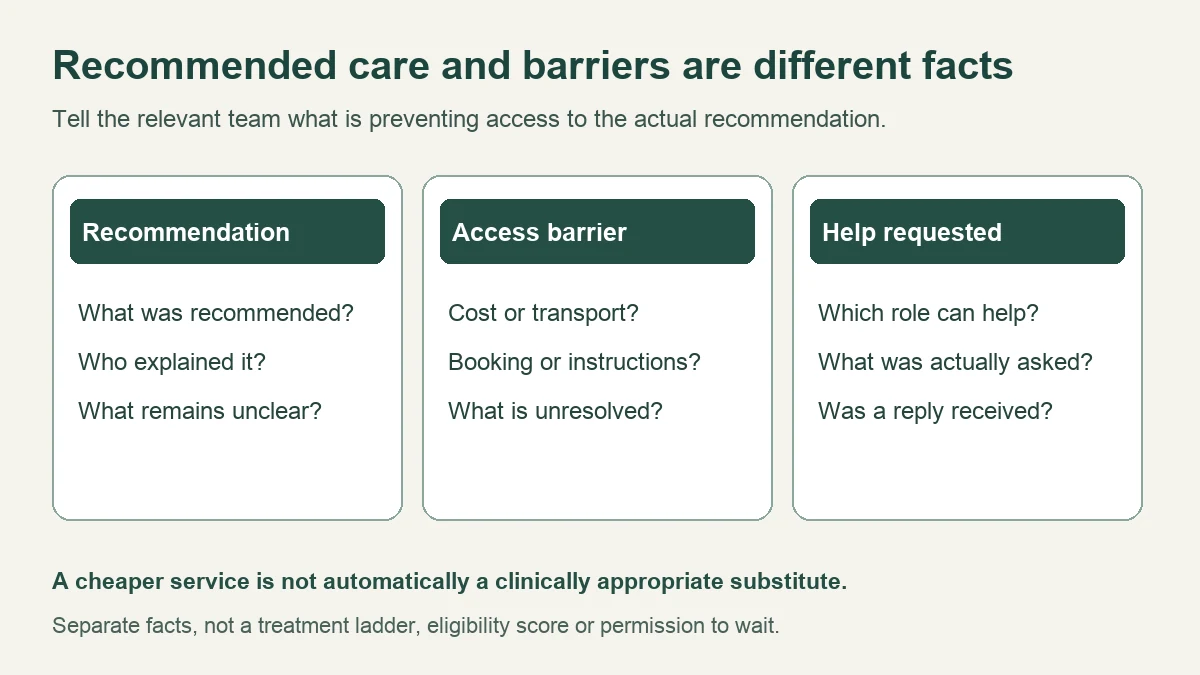
Keep the actual recommendation separate from the affordability problem
Start with what the treating team actually recommended and why, using the explanation you received. Preserve any real timing advice and what to do if symptoms change. If you do not understand the recommendation, say so. Do not invent a clinical purpose, infer that a visit has no value or decide that a less expensive service is an equivalent substitute.
A useful question is: “I want to follow this recommendation, but this barrier is preventing me from arranging it. Who can help, and does the clinical team need to know that access is incomplete?” This communicates the problem without asking a scheduling desk to make a clinical decision. The team may discuss alternatives, but their appropriateness and availability need an actual assessment and answer.
If the advice is unclear or apparently conflicting, keep each source and its wording together and ask the relevant professionals to clarify. This article provides no universal waiting period, self-treatment course, minimum visit count or symptom test. New or worsening concerns may need assessment before the administrative question is answered. Do not repeat painful tasks to produce evidence of need.
The high deductible plan explains part of the financing context, not the cause or seriousness of symptoms. Difficulty paying is not lack of effort. Needing an interpreter, help understanding a letter or an accessible appointment is also an access concern worth naming. Record pain and practical limitations without turning them into a score that decides whether care is deserved.
Care recommendation, barrier and help request: compare the facts
| Actual recommendation or situation | Barrier to describe | Help question for the relevant role |
|---|---|---|
| Recommended follow-up not yet booked | Expected cost cannot be managed with current resources. | Which support or financial-assistance contact can explain available options and their conditions? Keep the treating team informed of the access problem. |
| Appointment available but difficult to reach | Transport, mobility, travel or companion arrangements are unresolved. | Is any transport or access support available for this appointment, and who confirms it? Availability is not assumed. |
| Instructions or booking process unclear | Language, hearing, reading, digital access or conflicting messages. | Which communication support and clarification route can the service provide? |
| Required referral or service paperwork unconfirmed | It is unclear whether a requirement applies, was sent or was received. | What rule applies to this exact service, and who can verify the actual request status? |
| Two cost answers do not match | Service components, billing entities or benefit assumptions may differ. | Which conditions explain the difference, and who will provide the missing clarification? |
| Support discussed but still unavailable | A suggestion or application has not become a real arrangement. | What is the actual status, what remains outstanding and who owns the next action? |
These examples are questions, not promises that every service has financial assistance, transport or a particular appointment option. Do not disclose full health, income or insurance records to public forms. Use the relevant service’s designated private route if documents are genuinely requested, and ask what is needed rather than sending everything.
Ask the right role about the part it can answer
| Role | Useful question | Boundary |
|---|---|---|
| Treating clinical team | What is the actual recommendation, and what should I do about new concerns or an access barrier? | A price estimate or insurer call does not replace clinical advice. |
| Clinic scheduling or referral contact | Was the referral received, does this clinic accept the appointment and what is actually booked? | A proposed slot is not a confirmed appointment or a benefits decision. |
| Plan or designated benefits contact | What applies to this exact provider, site and service, including any deductible and applicable requirements? | A general network answer or authorization does not guarantee every charge. |
| Provider billing or estimate contact | Which service and billing entities are included, and which estimate assumptions remain open? | The higher estimate is not automatically true; the lower one is not automatically complete. |
| Financial assistance or care support contact, where available | What help can be considered, which service/provider is covered and what are the real conditions? | An inquiry or application is not eligibility, approval or implementation. |
| Patient or permitted helper | What barrier, question and real reply should stay together? | The helper does not select clinical substitutes, accept financing or disclose records without appropriate permission. |
You do not need to call two offices within fifteen minutes or complete every call before receiving care. Contact the roles needed for the real uncertainty. Keep the question short enough for the role to act on, then record the answer and its scope. If a person redirects you, note the suggested contact without treating the redirection as proof that the problem is solved.
Deductible, benefits and estimates: preserve their conditions
HealthCare.gov describes a high deductible health plan as having a higher deductible, usually with a lower premium than a traditional plan. That general description does not calculate your responsibility for a particular service. Ask about the exact plan, service, provider and location, the applicable remaining deductible and any other cost-sharing or pending-claim assumptions used in the answer.
Keep the deductible balance distinct from a service price, estimated member payment and a coverage decision. Do not add a full billed charge to an already calculated patient-responsibility estimate or apply the same remaining deductible repeatedly. This access organizer performs no cost arithmetic. For matching service components and payment routes, follow the separate same-care HDHP quote comparison tool.
When answers conflict, preserve both statements, their dates and conditions. Ask whether they concern the same service, billing entities, network, location and deductible information. Do not treat the larger figure as a safer truth, promise that the smaller figure is binding or infer that a benefits inquiry changed the clinical plan. Record the clarified answer when actually received.
CMS explains protections when using insurance, including protections from certain surprise out-of-network bills. Their scope and exceptions matter; they are not a blanket promise of free emergency care or coverage of every out-of-network service. Necessary emergency assessment should not be postponed while checking a deductible or a network directory.
CMS explains good faith estimates for people not using insurance, subject to the applicable rules. This is a separate context from an insured member-responsibility estimate; a high deductible alone does not make the two identical. CMS notes that an estimate is not provided during emergency care. Ask the actual service which estimate and rules apply; this guide does not tell you to switch payment routes.
Ask about support without assuming approval or accepting financing
State the access problem plainly: “I cannot currently arrange the recommended visit because of this cost or practical barrier. What help can be considered, and who can explain the terms?” An answer might identify a support contact or an application route. Record that as a lead, not as approval or a reason to stop discussing the access gap with the clinical team.
CMS’s medical-bill payment options action plan recommends asking the health care facility’s billing department about financial help. Assistance depends on the actual program and circumstances. An application may need information through a private channel; do not place income records, member numbers or identifying medical details in this site’s public tool.
IRS guidance on tax-exempt hospital financial-assistance policies explains that the policy identifies covered care and providers. Do not assume that a hospital’s policy covers every separately billing clinician, an independent clinic or all planned services. Ask which actual provider and service any offer covers, and what is still outside it.
If a payment arrangement or financing is discussed, request the written terms and ask about interest, fees, total obligation and the effect on other assistance. An inquiry, written offer, acceptance and actual arrangement are different facts. CFPB guidance on medical credit cards and payment plans advises asking about financial assistance and explains financing risks. This article does not recommend borrowing, choosing a product or agreeing to payments.
Practical support also needs confirmation. A suggested transport service, interpreter request or rescheduling possibility is not an actual arrangement. Ask who confirms availability and what remains necessary. If a proposed appointment or setting differs from the clinical recommendation, ask the treating team whether it is appropriate rather than assuming cost or convenience establishes suitability.
If HSA funds are relevant, keep account questions separate from clinical access and insurance benefits. Under IRS Publication 969, qualified unreimbursed expenses incurred after an HSA is established may be paid from it, subject to the rules. Do not reimburse the same expense twice or also claim an itemized deduction for that reimbursed amount. Eligibility to contribute and use of an existing HSA are separate questions. A deductible label alone does not settle an individual tax question.
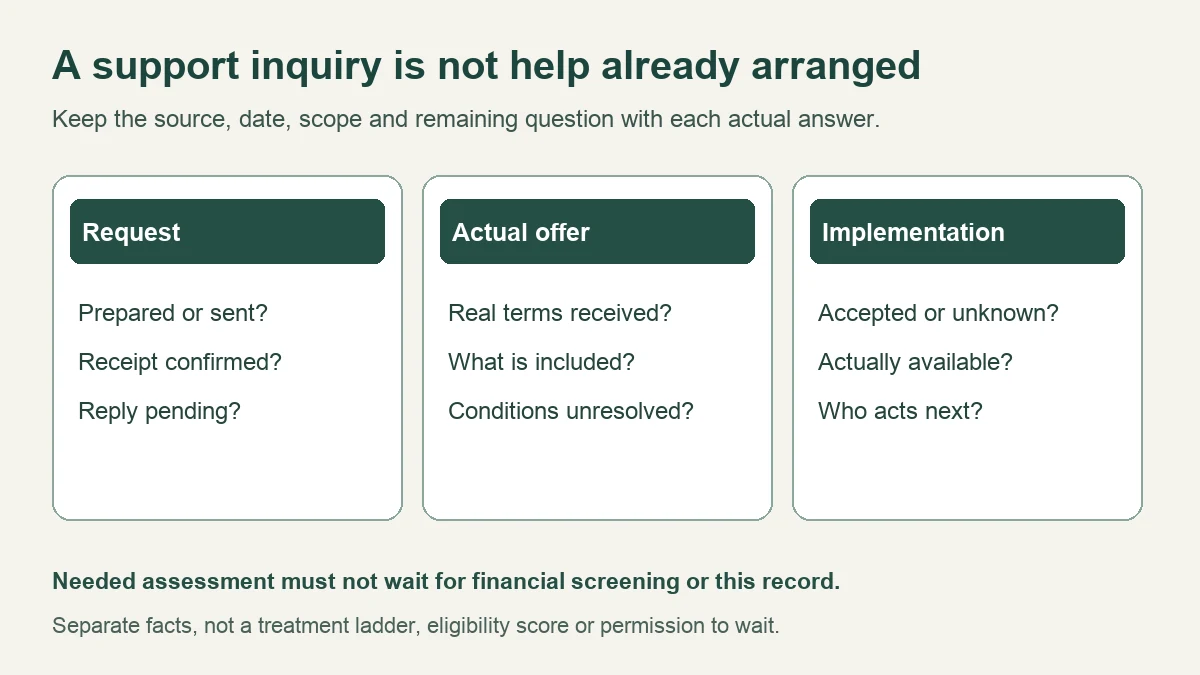
Close the gap between a suggestion, a reply and real help
| Actual status | Record it as | What remains unconfirmed |
|---|---|---|
| Question drafted | Prepared; not sent. | Whether anyone received or answered it. |
| Contact attempted or inquiry sent | Actual attempt or sending, with date if known. | Receipt, review and response. |
| Application or request received | Confirmation from the actual receiving role. | A support decision or appointment arrangement. |
| Offer or decision received | Real wording, service scope, source, conditions and date. | Whether it was accepted or implemented. |
| Help actually arranged | What became available, by whom and any unresolved problem. | That other services, future appointments or changing circumstances are also covered. |
After an answer, ask who acts next and how to follow up if the agreed action does not happen. Preserve an actual agreement rather than inventing a standard callback deadline. A sent question does not extend a real notice deadline. Keep any actual notice and obtain appropriate plan-specific assistance if its meaning or process is unclear.
When help does not resolve the obstacle, keep the remaining barrier visible and tell the relevant care/support team. Do not relabel a request pending as denied, a general webpage as personal approval or a booking as confirmation that every cost is covered. New symptoms or an urgent clinical concern should receive appropriate assessment without waiting for this follow-up chain.
Two fictional writing examples
These examples demonstrate recording only. They are not real cases, medical instructions, financial advice, assistance approvals or savings results. The tool’s example buttons replace existing entries and mark the output fictional. Neither example supplies a cheaper clinical substitute or permission to postpone care.
Example A: recommended visit, cost and transport unresolved
| Record area | Fictional entry |
|---|---|
| Recommendation / access | Clinician-recommended follow-up; actual purpose and timing advice must come from the treating team. Follow-up is not booked in this fictional example. |
| Barrier | Expected cost and transport make arranging the visit difficult. No income or identifying details supplied. |
| Help request / contact | Question about an appropriate support contact and any available assistance prepared; not sent. No eligibility assumed. |
| Actual answer / next owner | No real reply supplied. Record the actual response and agreed next owner; no cancellation, substitute treatment or delay decision is made. |
The useful result is a specific access question that can reach the appropriate role. If the clinical recommendation or timing is unclear, preserve that question too. The reader does not need to prove they tried harder or complete a cheaper treatment before asking for help.
Example B: conflicting estimates, clarification still pending
| Record area | Fictional entry |
|---|---|
| Care / estimates | Existing recommendation. Two reported estimates may contain different components, billing entities or benefit assumptions; no amount invented. |
| Benefits / barrier | Actual network, applicable deductible information and estimate conditions need confirmation. |
| Contact / actual reply | Questions about the mismatch and access help sent in this fictional example; receipt unconfirmed and reply pending. No actual answer supplied. |
| Next step | Preserve both sources. Record the actual clarification and any real conditions. No financing chosen, support accepted or appointment confirmed. |
Do not choose the higher estimate as the truth or the lower one as the complete price. This example records the disagreement and the role asked to clarify it. Use the separate quote-comparison guide for detailed inclusions; use this record to track whether the access problem actually receives an answer and an owner.
Private care access, support inquiry and actual-answer record
Download the offline tool before entering actual health, insurance or personal notes. Use fictional entries on this public page because surrounding services may include ads and analytics. The tool sends nothing, uses no browser storage and does not automatically save. Its offline copy contains no external assets or automatic network requests. Keep completed copies and exports private.
Use one care-access discussion per record, with matching A/B labels if several services or offers are involved. Unknown, not asked, request pending and not applicable according to an actual answer are valid entries. A paper note with the same headings works. Nothing about a completed form verifies clinical suitability, a deductible balance or support eligibility.
Care access, support inquiry and actual-answer record
Keep the real care recommendation, practical barrier, help requested, actual reply and arrangement actually implemented separate. This organizer does not decide where to seek care, whether to wait or how to pay.
Download the offline tool before entering actual health, insurance or personal notes. Use fictional entries here; the surrounding site may contain ads and analytics.
Offline copy. This file has no ads, analytics, external assets or automatic network requests.
The tool uses no network requests, browser storage or automatic saving. Refreshing or closing may lose entries. Keep exports private; omit names, member numbers, financial identifiers and full records. Do not delay needed assessment for this form, financial screening or a routine reply.
Start with the fictional example or download a blank offline copy.
Paper alternative: actual recommendation; access status; barrier; existing change; exact service; actual benefits answer; help requested; offer and implementation; contact; real reply; unresolved point; next owner. Unknown and pending are valid.
My care access, support inquiry and actual-answer record
Unverified personal record for discussion. Entries verify no clinical recommendation, benefits answer, support decision or payment result.
Guide: living.kioptrix.com/orthopedic-pain-management-with-high-deductible/
Rebuild after editing, then copy, download text or print. Downloading an offline copy includes current entries, so keep the file private. Exporting does not contact a clinic, submit an application, request authorization, agree to financing or book or cancel care. A blank field creates an optional clarification question, not a score or a requirement to wait.
Common high deductible care access questions
Does a high deductible mean I should try cheaper care first?
No clinical sequence follows from the financing label. Ask the treating team what care is appropriate and tell it about barriers. This guide does not select a visit type or a period of self-management.
Can I wait until my deductible is met?
This article cannot decide that waiting is safe. Ask the clinical team about the actual recommendation and timing, and seek appropriate assessment for concerning changes. Do not delay urgent care for cost checks.
Does applying for help mean I can afford the appointment?
No. A request, assessment, actual offer, acceptance and help available are different facts. Record the real terms and any remaining access barrier.
Which estimate should I trust when they differ?
Preserve both sources and conditions. Ask about the same service, included charges, site, network and deductible assumptions. Neither the higher nor the lower figure is automatically correct.
Can I use this tool to calculate my payment or choose financing?
No. It organizes unverified facts and real replies. It determines no payment amount, financing choice, assistance eligibility, coverage decision or medical recommendation.
Sources, corrections and review limits
- HealthCare.gov: High Deductible Health Plan — general financing definition, not a clinical pathway.
- CMS: Medical bill rights when using insurance; rights when not using insurance — different protections and estimate contexts.
- CMS: Medical bill payment options — financial-help inquiry starting point, not eligibility.
- IRS: Financial assistance policies — tax-exempt hospital policy scope and provider distinctions.
- CFPB: Medical credit cards and payment plans — questions and risks; no product recommendation.
- IRS Publication 969 — HSA contribution/distribution distinctions and records.
- NHS: Back pain; NHS: Septic arthritis — selected warning symptoms, not U.S. payment or referral rules.
Source check and editorial update: October 29, 2026. Removed the universal treatment ladder, eligibility screen, cost tiers, visit-deferral advice, fifteen-minute calling instruction and higher-estimate-as-truth rule. Replaced the mismatched AAFP source link and repeated generic treatment discussion with topic-specific access and real-reply records. The existing URL, original publication date, author and classification are retained.
This is caregiver-created education, not a validated clinical or financial instrument. No independent clinical/financial review, real-reader study, assistance approval or savings outcome is claimed. The featured image is AI-generated fictional artwork; diagrams show separate facts rather than an approved care sequence. Our background and editorial approach.