

Choosing rehab after surgery starts with the individual care plan and the help actually available, not a ranking of buildings. A clinical recommendation, a provider’s acceptance, an insurance answer and a completed handover are different facts. Keep each visible before assuming a proposed arrangement is in place.
Start with the setting roles and limits, use the six essential support checks, read two fictional writing examples, or open the support, acceptance and handover record. The record gathers questions; it does not select a setting, establish eligibility or clear discharge.
Emergency symptoms come before paperwork. New chest pain, significant trouble breathing, collapse or inability to wake needs emergency help now. Slow or difficult breathing in a person who cannot be awakened may indicate opioid overdose: call 911 in the U.S., give naloxone if available according to its instructions, and follow emergency-dispatch instructions. Do not wait for a facility, insurer or this worksheet. NHLBI pulmonary embolism information; CDC overdose response.
This caregiver-written guide supports discharge conversations after orthopedic surgery in a U.S. context. The operator is not a medical professional. The treating and discharge teams assess clinical needs with the patient; services, insurance rules and terminology vary. Record the patient’s priorities, access needs and willing helpers without assuming family members can provide care. No independent clinical review or validated placement assessment is claimed.
Table of Contents
Rehab after surgery: setting roles and limits
| Setting or service | Role to discuss | Limit and specific question |
|---|---|---|
| Home with outpatient rehabilitation | The person lives at home and attends scheduled therapy elsewhere when clinically appropriate. | A therapy appointment does not provide home nursing, bathroom help or overnight care. Who covers the route, transfers and time between appointments? |
| Home health services | Eligible skilled nursing or therapy delivered through visits at home. | Visits are not continuous supervision. Which services, frequency, start date and gaps has the agency actually confirmed? |
| Skilled nursing facility (SNF) | A setting that may provide needed skilled nursing or therapy and related care. | The name does not establish individual clinical need, available services, acceptance or payment. Can this provider meet the assessed plan, and what remains conditional? |
| Inpatient rehabilitation facility (IRF) | Intensive rehabilitation with physician supervision and coordinated professional care for people assessed as needing that level. | Ambitious mobility goals or limited family help alone do not establish eligibility. What is the team’s actual assessment, and has the provider accepted? |
These rows compare roles, not quality grades or a sequence everyone should move through. Home with services is not one uniform package, and outpatient therapy and home health have different arrangements. Ask about the specific patient, provider and dates. A referral list can help identify options but cannot verify an available bed, a first visit or the care actually offered.
For Medicare, home health guidance describes eligibility for intermittent skilled services and homebound status; it excludes round-the-clock home care and personal care alone. SNF guidance describes skilled-care eligibility and a qualifying hospital-stay requirement with exceptions. IRF guidance requires certification of the need for intensive rehabilitation, ongoing medical supervision and coordinated care. These summaries do not establish anyone’s coverage; ask about the applicable plan and current requirements.
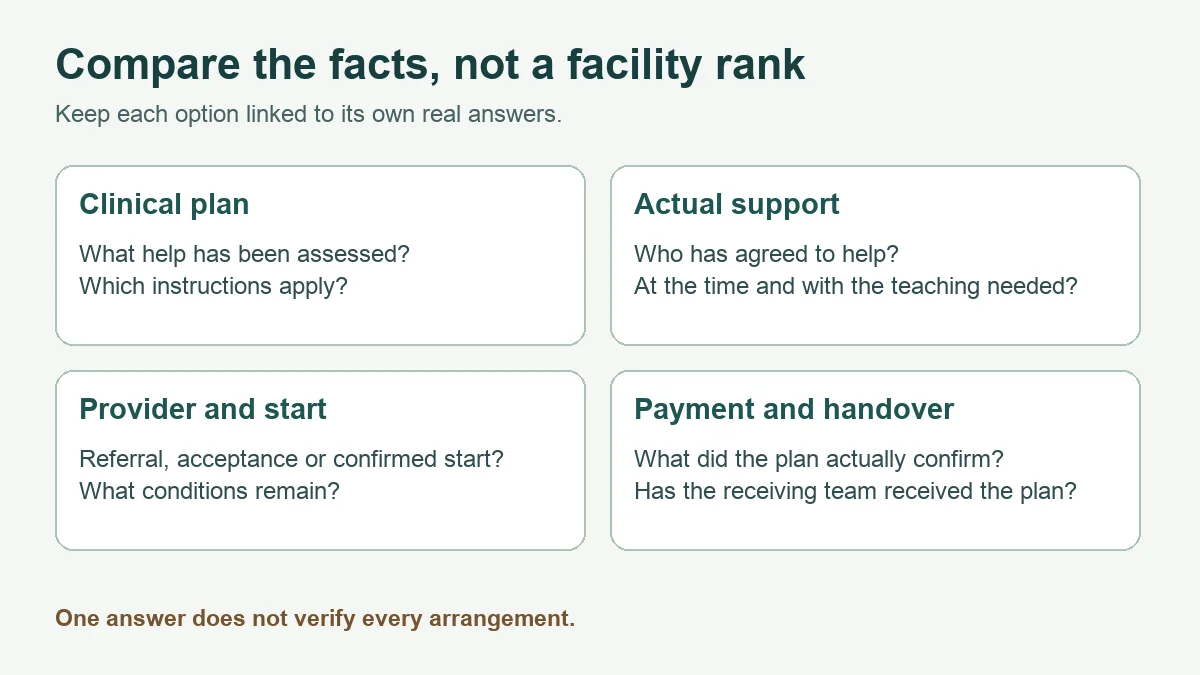
Six essential support checks before an arrangement is assumed
| Check | Record the actual fact | Useful question |
|---|---|---|
| 1. Current care plan | Movement, wound, medicine and therapy instructions with source/date; conflicting wording. | Which instructions currently apply, and who will reconcile the difference? |
| 2. Help at the needed time | Task, timing, help level already assessed, willing helper, teaching completed and uncovered intervals. | Who can provide this specific help overnight or between visits? |
| 3. Actual offer and acceptance | Proposed service, provider response, outstanding conditions, start or arrival date. | Is this a referral, an offer, conditional acceptance or a confirmed start? |
| 4. Insurance and cost scope | Plan response, authorization if required, network/service questions and actual estimate. | What precisely was confirmed, for which service and dates, and what remains unresolved? |
| 5. Professional handover and practical access | Sending/receiving team receipt, medicines, equipment, transport and follow-up arrangements actually confirmed. | Who is arranging the handover, and has the receiving team confirmed receipt? |
| 6. Actual answer and next owner | Question drafted or sent, reply received, scope, agreed action and unresolved point. | Which person will act on the remaining gap and what follow-up was actually agreed? |
A completed row is a note, not verification. A blank row can be important on its own; there is no pass score or minimum number of missing items. Ask for help with an incomplete record. The discharge team remains responsible for its professional work; this page does not transfer care coordination to a family member.
Describe task and time gaps instead of adding family minutes
Daily time totals miss whether help is available at the moment it is needed, whether the task requires trained assistance and whether a helper is willing and physically able. Use the assessment and teaching actually given by the relevant professionals. Do not test stairs, transfers or walking to fill out a chart, and do not invent a help level from a pain rating.
| Existing need or arrangement | What to record | What the entry cannot establish |
|---|---|---|
| Bed, chair or bathroom transfer | Actual instruction; time help is needed; helper and completed teaching; unresolved gap. | That a relative can safely perform the task because they are available. |
| Overnight support or time between visits | Who has actually agreed to be present, when and for which tasks. | That a daytime visit covers the whole night or that a phone contact is hands-on help. |
| Home entry, stairs and travel | Actual route and equipment arrangements; assessment or teaching already provided. | That changing rooms, avoiding stairs or buying a device makes the plan clinically suitable. |
| Wound, medicines and therapy | Current instructions and responsible professional; real availability and clarification request. | A new dressing plan, dose, exercise progression or medicine-before-therapy interval. |
| Patient and helper preferences or barriers | Communication needs, willingness, health, work, access, cost and transport barriers actually raised. | That family availability is unlimited, required or a substitute for formal support. |
If the needed help is unavailable or unclear, tell the discharge team what is missing and ask what arrangements can address it. Keep an offered alternative separate from one actually arranged. A person’s preference for home and a caregiver’s limits can both matter; neither should be converted into blame or a promise the helper cannot make.
Separate provider acceptance, insurance and clinical handover
Use the same option labels throughout the note. For option A, record its offer, provider response, start date, insurance answer and handover status together; do the same for option B. An answer from one organization should not be silently attached to another option. Dates and sources help show which statement is current.
| Statement received | What it may mean | Still ask |
|---|---|---|
| A referral was sent | A request has been transmitted. | Was it received, reviewed and accepted? Who follows the outstanding request? |
| We provide rehabilitation | A general service description. | Can this provider meet the actual plan, and is a place or visit available for the proposed date? |
| The provider accepted | An acceptance within the stated conditions. | Is the start/arrival confirmed, what conditions remain, and what care will actually begin? |
| Insurance authorization received | A plan decision with a particular scope, if authorization is required. | Which provider, service, dates and conditions does it address? What patient costs remain? |
| Discharge information sent | The sending step has occurred. | Which receiving professional has the current instructions, medicine information and unresolved questions? |
For Original Medicare SNF questions, distinguish inpatient admission from observation status and ask whether a qualifying-stay requirement or an exception applies. Medicare Advantage may have different plan processes, including network and authorization requirements. Other insurance can differ again. The Medicare SNF page explains these distinctions; this article gives no universal stay length, price or payment guarantee.
Ask the relevant professionals about the actual medicine list, last administrations and next instructions during a transition. Record what they explain; do not calculate a replacement schedule. AAOS: Managing Orthopaedic Surgery-Related Pain With Medications supports discussion of individualized pain treatment and medicine risks. It is not a rehabilitation-placement guideline and supplies no personal clearance from this page.
Transport booking, equipment delivery and a follow-up appointment each answer a different practical question. Ask who will handle a delay or unavailable item and how that affects the actual transition plan. A family worksheet can carry questions, but it cannot replace clinician-to-clinician communication or a receiving provider’s assessment.
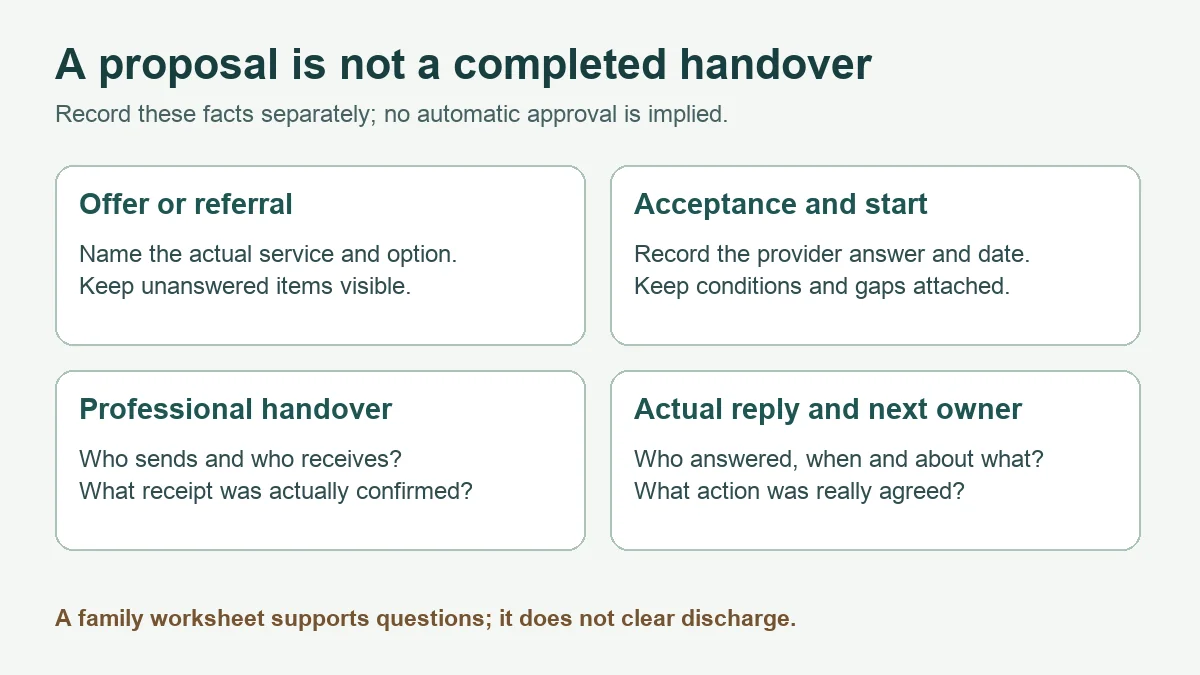
Report concerning changes without waiting for placement answers
If the person has emergency symptoms, use emergency services rather than the scheduling or insurance route. NHLBI describes breathlessness, pain with breathing and related pulmonary-embolism symptoms. CDC describes overdose signs and response. These examples explain selected dangers; they are not a complete triage checklist and the tool does not assess urgency.
For new calf pain or swelling, new weakness or loss of function, worsening pain, concerning drowsiness or an unsafe movement situation, seek prompt clinical assessment rather than relying on a facility comparison. If severe symptoms or rapid deterioration occur, obtain emergency help. Ask for assistance with an unsafe task instead of repeating it for a record. A planned transfer or a previously reassuring answer does not assess a new change.
For increasing redness or pain at the surgical site, drainage or fever, contact the healthcare provider immediately, as explained in CDC: Surgical Site Infection Basics. Keep the actual wound instructions and report the change; this page does not supply a temperature threshold, waiting period or wound-treatment plan. You do not need every sign to be present before asking for help.
For a service gap, ask the discharge or receiving team the specific question and record the actual response. Clinical changes need a clinical route; insurance and booking staff cannot reconcile a medicine instruction or assess a new symptom. If no reply arrives and care is needed, seek appropriate care rather than treating “pending” as advice to wait.
Two fictional writing examples with unresolved arrangements
These are fictional demonstrations, not patient stories, medical advice or evidence of better outcomes. Neither example chooses a setting or invents a professional answer. The tool’s example buttons replace current entries and label the resulting brief fictional.
Example A: proposed home visits with an overnight gap
| Record area | Fictional entry |
|---|---|
| Preference and proposal | The person would prefer home. Home health was mentioned, but agency acceptance and actual services are unconfirmed. |
| Task and help | Overnight bathroom assistance needs discussion against the current individual assessment. Daytime help was discussed; overnight availability and teaching are not confirmed. |
| Start and question | First visit date unknown. Ask the discharge team who can meet the assessed need before and between visits. |
| Actual contact / answer | Question prepared, not sent. No actual professional answer, coverage result or go-home clearance supplied. |
The useful distinction is between the proposed visit and help at another time. A preference, a possible helper and a service name do not close the gap. Record the actual answer and agreed arrangements if received, including anything still unresolved.
Example B: facility referral with separate pending answers
| Record area | Fictional entry |
|---|---|
| Provider status | Facility named and referral discussed. Acceptance, arrival date and conditions remain pending. |
| Insurance status | Plan contacted in this fictional example; authorization requirements, service scope and cost questions are unresolved. |
| Handover and access | Receiving-team receipt, transport, medicine availability and equipment have not been confirmed in the note. |
| Actual contact / answer | Questions sent in this fictional example; no actual provider, insurer or clinician answer received. Ask who owns each remaining task. |
Do not summarize this as “everything is approved”. Preserve each unanswered question and the relevant role. Even a real acceptance would not, by itself, prove that the clinical handover or insurance discussion had been completed.
Private post-discharge support, acceptance and handover record
Download the offline tool before entering actual health or personal notes. Use fictional entries on this public page because the surrounding site may contain ads and analytics. The tool itself sends nothing, uses no browser storage and does not automatically save. Its offline copy contains no external assets. Keep completed copies and exports private.
Use one discharge discussion or review period per record. For several options, use matching A/B labels in each field. For several tasks, keep task names consistent too. Unknown, not asked and reply pending are useful entries. No new physical task or treatment trial is needed to complete the form.
Post-discharge support, acceptance and handover record
Keep needed help, actual availability, provider acceptance, insurance answers and professional handover distinct. Use matching A/B option and task labels across fields.
Download the offline tool before entering actual health or personal notes. Use fictional entries here; the surrounding site may contain ads and analytics.
Offline copy. This file has no ads, analytics, external assets or automatic network requests.
The tool uses no network requests, browser storage or automatic saving. Refreshing or closing may lose entries. Keep exports private; omit names, identifying contact details and full medical records. Do not delay care for a record or routine reply.
Start with the fictional example or download a blank offline copy.
Paper alternative: question; current instructions; task/time/help; actual helper; proposed service; acceptance/start; insurance/cost answer; actual handover; gap; contact; actual reply; next owner. Unknown and pending are valid.
My support, acceptance and handover record
Unverified personal record for discussion. Entries verify no instruction, support, acceptance, coverage or handover. This record does not choose a setting or clear discharge.
Guide: living.kioptrix.com/choosing-rehab-after-surgery/
The brief adds optional questions for blank fields. Every entry remains unverified, even if no field is blank. Rebuild after editing; then copy, download text or print the brief. Downloading or copying does not send it to a care team. If scripting is unavailable, use a paper note with the same headings and actual replies.
Common questions about choosing rehabilitation after surgery
Is inpatient rehabilitation automatically better than home or an SNF?
No general ranking follows from those names. The team assesses the individual need, and the actual provider must address the proposed plan. Clinical appropriateness, acceptance, availability and insurance are separate questions.
Does home health mean someone will stay overnight?
Do not assume that. Confirm the actual service and visit schedule. Medicare home health does not pay for round-the-clock home care; separate help may still be unresolved.
Does insurance authorization mean the entire transfer is ready?
It does not establish every other arrangement. Read the actual scope and confirm provider acceptance, start, clinical handover, equipment, medicines and transport through the relevant teams.
Should we take pain medicine a fixed time before therapy?
This guide supplies no fixed interval. Ask the prescribing and therapy teams to explain the current individual instructions and reconcile conflicts. Record their actual answer without independently changing dose or timing.
Do we need a complete record before asking for help?
No. Ask with what is known. Missing information or an unavailable helper can be the reason for the conversation. Urgent care should never wait for a completed record.
Sources and editorial limits
- Medicare: Home health services — skilled-service eligibility and service limits; not continuous caregiver coverage.
- Medicare: Skilled nursing facility care — skilled-care eligibility, hospital-status questions, exceptions and plan differences.
- Medicare: Inpatient rehabilitation care — intensive rehabilitation, medical supervision and coordinated care requirements.
- AAOS: Managing Orthopaedic Surgery-Related Pain With Medications — medicine education, not a setting-selection guideline.
- NHLBI: Pulmonary Embolism — selected clot-related emergency symptoms.
- CDC: What to Do If You Think Someone Is Overdosing — overdose recognition and emergency response.
- CDC: Surgical Site Infection Basics — infection signs and immediate provider contact.
Source check and editorial update: October 29, 2026. Replaced the unvalidated tier ranking, time-sum calculator and general medicine-before-therapy timing with setting-specific questions and an actual-arrangements record. Removed the unattributed patient anecdote and repeated generic pain material. This is selected education, not a systematic review or validated clinical instrument. Sources do not prove the worksheet improves clinical outcomes.
The original URL, publication date, author and classification are retained. The hero is AI-generated fictional artwork; the two diagrams illustrate record distinctions. No independent medical review or real-reader study is claimed. For the site’s background, see our editorial approach. For an actual referral between services, the referral progress record focuses on sent, received and booked states rather than choosing a rehabilitation setting.