

For a parent’s orthopedic pain visit, prepare the questions they want answered, the medicine information actually known, and a way to record the real answer. After the appointment, distinguish a proposed change, a clarified instruction and a medication list actually updated. A reassuring conversation alone does not show that every record now agrees.
Use the six essential medication questions, the source / actual-use / question table, two fictional writing examples or the before, during and after visit record. This guide follows an orthopedic appointment and its unanswered questions; it is not a daily pill tracker or a medication-selection tool.
Some situations need advice before a scheduled visit. If someone cannot be awakened, has slow or difficult breathing or blue/gray lips, call 911 in the U.S. now. If opioid overdose is suspected, give naloxone if available according to its instructions, follow the dispatcher’s guidance and stay until help arrives. For a possible wrong or extra dose, contact Poison Help promptly at 1-800-222-1222 in the U.S. without waiting for symptoms; elsewhere use local services. Emergency symptoms require emergency services. Do not guess a replacement or counteracting dose. CDC overdose response; HRSA Poison Help.
This is caregiver-written education for visit preparation, not individual prescribing, diagnosis or an interaction check. The operator is not a medical professional. The parent’s preferences and permission guide a helper’s role; an adult child does not automatically take over the conversation or decisions. Use the service’s arrangements for consent, communication and support when those are unclear.
Table of Contents
Six essential medication questions for an orthopedic pain visit
| Question to bring | Information that makes it specific | Answer to record |
|---|---|---|
| 1. Which instruction currently applies? | Actual product, label or written wording, source/date and any conflicting version. | The real clarification, its source and who will resolve anything still inconsistent. |
| 2. What is this medicine intended to help in the current plan? | The parent’s priority and actual question about pain, daily activity, sleep or treatment burden. | The goal actually explained, with uncertainty and remaining concerns kept visible. |
| 3. Who will review the complete combination? | Prescriptions from all services, OTC products and supplements, with actual use and unknown details. | Who will review which information; a referral for review is not a completed interaction assessment. |
| 4. What should we do about this observed change or practical barrier? | An existing effect, unwanted change, opening/reading difficulty or unclear instruction. | Actual advice and contact route. Do not diagnose a side effect from sequence alone. |
| 5. What written instructions or clarification should we leave with? | The exact point not understood, including any relationship to a therapy or procedure appointment. | The individual answer actually given; no general pre-therapy interval or blanket pre-procedure medicine rule. |
| 6. Who updates the list and follows unanswered questions? | The list currently used, proposed change and permitted recipients. | Real update status, actual recipient/receipt and next owner agreed, rather than an assumed handover. |
Choose the questions that fit the parent’s actual concern; six is a navigation aid, not a required checklist or a test before care. The clinician or pharmacist may need different information. A concise note with a clearly marked unknown is more honest than a reconstructed dose or an answer borrowed from another patient.
AHRQ: Be More Engaged in Your Healthcare supports bringing medicines and questions, asking for explanations and written instructions, and contacting the clinician when instructions remain unclear after a visit. Our six-question structure is an editorial organizer, not an AHRQ-validated instrument or proof of better outcomes.
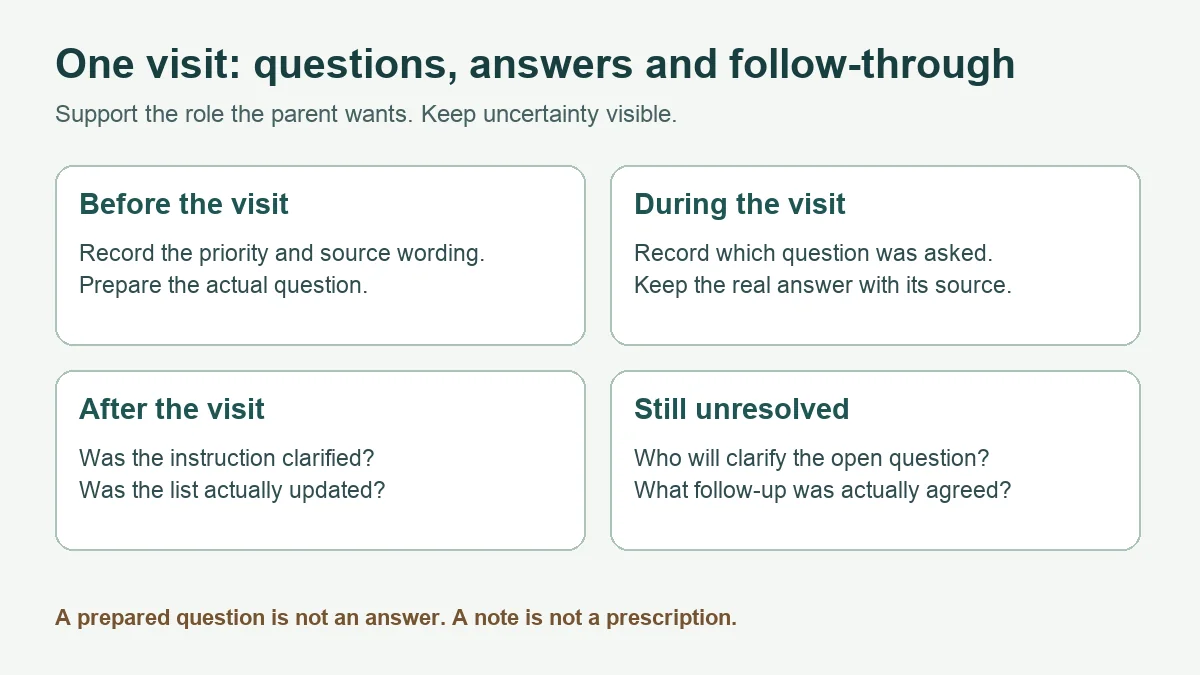
Before the visit: agree on help and preserve source records
Ask what the parent wants to discuss first and what help they want with asking, note-taking or sharing. Leave room for them to speak and to ask for a private conversation. If the family’s concern differs, label whose observation or question it is rather than presenting it as the parent’s account. Ask the service about an interpreter or accessible communication when needed.
Bring the current list and packaging or the service’s preferred record when details are unclear. Include items used outside the orthopedic service. Record what is actually known and mark uncertainty. Do not rely on tablet colour, an old printed list or a family memory as proof that a current instruction has been checked.
| Record area | Existing fact to bring | What still needs clarification |
|---|---|---|
| Product identity | Name, active ingredient if known, strength and formulation from the actual source. | Uncertain product, multiple labels or a record that may be outdated. |
| Written instruction | Exact wording, source and date of the existing instruction. | Whether it remains current and whether another version conflicts. |
| Actual use | What the parent reports or another agreed source actually records. | Not remembered, not taken as written or incomplete information; no inferred next dose. |
| Existing effect or burden | What was already noticed, when known, and how it affects the parent. | What the clinician needs to assess; no automatic cause or interaction conclusion. |
| Priority question | A short question with matching product or question label A/B. | Who should answer and what cannot wait for the routine appointment. |
FDA’s medication safety tips for older adults recommends a current list that includes prescription and nonprescription medicines, vitamins and supplements, with medicine details and use. It also advises discussing interactions and bothersome effects with professionals rather than selecting or changing doses yourself. This general safety source does not decide which pain medicine is appropriate for this parent.
A useful appointment question can be simple: “This is the wording we have, and this part is unclear. Who can confirm the current instruction?” Preparing it does not require a complete record. For a possible dosing error or concerning new symptoms, seek appropriate advice now rather than waiting to finish gathering information.
During the visit: attach the real answer to the actual question
Keep product and question labels consistent. If A concerns an unclear as-needed instruction and B concerns another service’s prescription, record each answer under the matching label. A general explanation about one item should not silently become an instruction for another. Record who answered and the scope of the explanation.
Ask for written wording where a medicine instruction is changed or remains unclear. To check understanding, explain what you understood and ask the professional to correct it: “I understood this part; what have I missed?” Do not turn an uncertain recollection into a fresh schedule. An appointment summary, a prescription label and a verbal explanation can contain different information that needs reconciliation.
| What happened in the visit | How to record it | Keep this distinction |
|---|---|---|
| Question prepared but time ran out | Not asked; actual contact question and intended role. | Preparation does not equal professional advice. |
| Question asked; further review needed | Asked; reply pending; who is following it if actually agreed. | An appointment or review request is not the answer itself. |
| An answer received | Actual wording or clearly labelled summary, role/date and any written source. | A summary may be incomplete; preserve the question that remains. |
| Two instructions differ | Both sources/dates and the specific difference. | Do not combine versions or choose one because it is newer-looking. |
| Practical difficulty raised | What makes the plan hard to use and assistance actually offered. | Asking for accessible packaging or support does not show it has been arranged. |
The prescribing clinician, pharmacist, orthopedic team and therapy service can have different roles. Ask who can clarify the actual issue and who will coordinate across services. Do not assume an orthopedic appointment means the complete medication combination has been reviewed. The worksheet assigns no professional responsibility and makes no dose, taper, continue/stop or procedure-preparation decision.
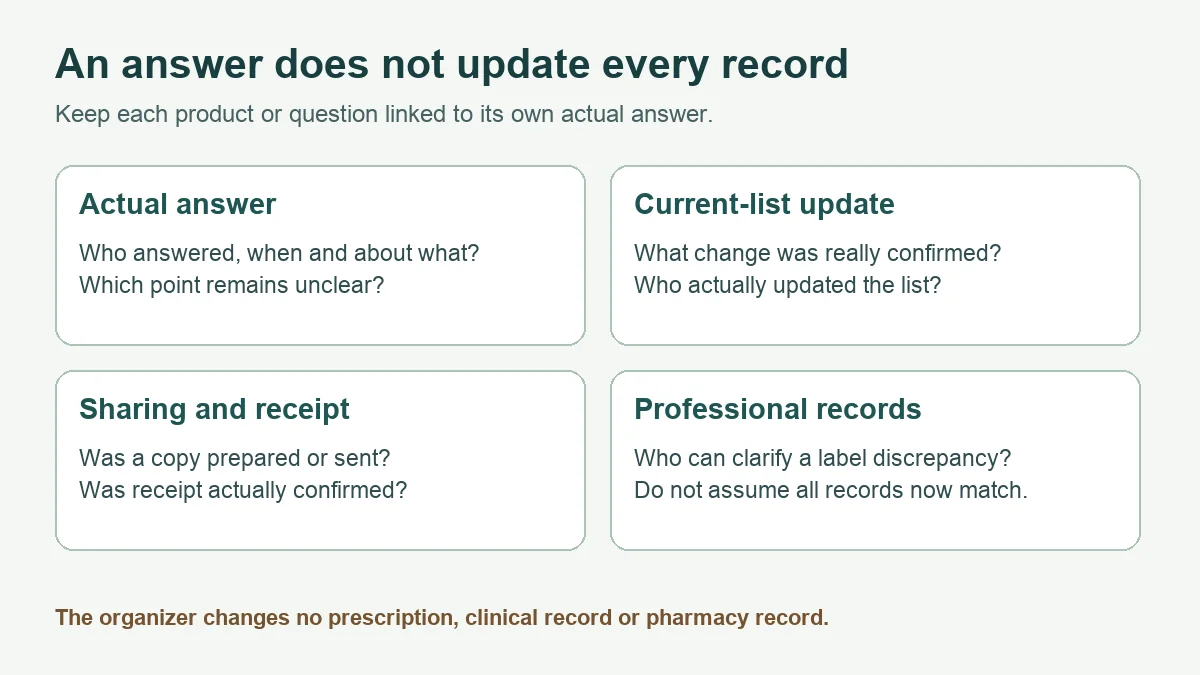
After the visit: confirm the list update and actual receipt
Separate three facts: a change was discussed, the instruction was clarified, and the current list was actually updated. Record the real source and status for each relevant item. If clarification is pending, keep it visibly pending and contact the appropriate professional; this page does not say which medicine instruction to follow while a conflict is unresolved.
| Follow-through item | Actual fact to record | Unfinished state to keep visible |
|---|---|---|
| Current instruction | Clarification actually received, source/date and remaining uncertainty. | Awaiting clarification; no replacement instruction generated. |
| List update | Which item was actually updated, by whom and from which confirmed source. | Update proposed or not yet made. A filled worksheet does not edit a clinical record. |
| Sharing | With permission, copy prepared, actually sent and receipt confirmed if known. | A prepared copy or sent message does not establish receipt or review. |
| Professional records | Ask the service who reconciles any clinical or pharmacy discrepancy. | A family list update does not establish that prescribing and pharmacy records match. |
| Next question | Actual contact, reply and agreed next owner/follow-up. | No agreed owner or unanswered question; no invented waiting deadline. |
Keep previous source information distinguishable from the current confirmed record rather than silently blending it. Ask the relevant service how to correct an outdated label, duplicate record or unclear visit summary. Do not alter a product, dispose of an in-use medicine or reorganize doses on the basis of this worksheet. A clinician or pharmacist can address the actual situation.
For ongoing benefit, drowsiness or balance observations, the older-adult medicine-review record has a different purpose. For agreed support when family live far away, use the remote medication-support guide. This page stays focused on an orthopedic visit’s questions, answers and list-update follow-through.
Two fictional writing examples
These examples demonstrate recording, not clinical advice or real patient outcomes. No specific medicine, dose or personal professional answer is supplied. The tool’s example buttons replace entries and label the brief fictional.
Example A: unclear as-needed wording before an appointment
| Visit stage | Fictional entry |
|---|---|
| Before | Parent wants help asking how existing as-needed wording relates to a therapy appointment. Product details and exact wording must come from the actual record. |
| Question | “What does the current instruction mean for this situation, and who can clarify it?” No pre-therapy interval or extra dose supplied. |
| During / actual answer | Question prepared, not yet asked. No clinician or pharmacist answer recorded. |
| After / list status | No confirmed change or list update. Record the actual answer and agreed owner when received. |
A blank answer is the correct representation of an unanswered question. The example does not tell a reader to repeat a medicine, change timing or perform a therapy task to see what happens. If the uncertainty requires advice before the appointment, seek it through the appropriate service.
Example B: visit explanation differs from an existing label
| Visit stage | Fictional entry |
|---|---|
| Source records | An older label and a visit explanation differ. Keep both sources and dates; do not combine them into a new instruction. |
| Question and contact | “Which wording currently applies, and who will confirm the current instruction?” Sent in this fictional example; reply pending. |
| Actual answer | No real professional answer supplied. Neither version is selected by the worksheet. |
| List update and receipt | Update awaiting clarification; no current list sent or receipt confirmed. Record those facts only when they actually occur. |
The example shows a contact still open, not a medication decision. If a possible wrong or extra dose or urgent symptom is involved, use the appropriate urgent advice route instead of treating “pending” as permission to wait.
Private visit questions, actual answers and list-update record
Download the offline tool before entering actual health or personal notes. Use fictional entries on this public page because the surrounding site may contain ads and analytics. The tool sends nothing, uses no browser storage and does not automatically save. The offline copy contains no external assets; keep completed files and exports private.
Use one orthopedic visit or follow-up discussion per record. For several products or questions, keep matching A/B labels in the source, question, answer and update fields. “Unknown”, “not asked”, “reply pending” and “not updated” are valid. A paper note using the same headings works too.
Before, during and after: questions, actual answers and list-update record
Follow one orthopedic visit and its unresolved questions. Use matching A/B product or question labels. A question, an actual answer and a current-list update are separate facts.
Download the offline tool before entering actual health or personal notes. Use fictional entries here; the surrounding site may contain ads and analytics.
Offline copy. This file has no ads, analytics, external assets or automatic network requests.
The tool uses no network requests, browser storage or automatic saving. Refreshing or closing may lose entries. Keep exports private; omit names, identifying contact details and full medical records. Do not delay care for a record or routine reply.
Start with the fictional example or download a blank offline copy.
Paper alternative: permission and priority; product source; existing instruction; actual use; prepared questions; question asked; actual answer; clarification; current-list update; actual recipient; next owner. Unknown and pending are valid.
My visit questions, actual answers and list-update record
Unverified personal record for discussion. Entries verify no product, instruction, answer, list update or receipt. This organizer changes no clinical or pharmacy record.
Guide: living.kioptrix.com/orthopedic-pain-management-3/
The brief adds optional questions for blank fields. All entries remain unverified even when every field has text. Rebuild after editing, then copy, download text or print. Exporting does not notify a professional, update a prescription or reconcile a pharmacy record. You do not need a completed form before asking for help.
Common questions about a parent’s orthopedic visit
Should we bring only the pain medicines?
Bring the complete information requested by the service, including prescriptions from other services, OTC products and supplements. Ask who will review the combination; this page does not check interactions.
What if nobody remembers exactly what was taken?
Record the uncertainty and the available source. Ask the relevant professional how to clarify it. Do not guess a replacement or repeat dose; possible dosing errors need prompt appropriate advice.
Can the helper replace the parent’s answers?
Support the role the parent wants and the service’s consent and communication arrangements. Label the helper’s observation separately rather than presenting it as the parent’s account.
Does a written brief mean the medicine list is now current?
No. It verifies nothing and changes no clinical or pharmacy system. Record the actual clarification, update, sender and receipt separately.
Must we wait for the next orthopedic appointment?
No. Unclear instructions, concerning symptoms or a possible error may need earlier advice. Emergency symptoms require emergency services; a routine review or worksheet should not delay help.
Sources and review limits
- FDA: 5 Medication Safety Tips for Older Adults — medication-list details, actual use, professional advice and interaction awareness; not individualized pain prescribing.
- AHRQ: Be More Engaged in Your Healthcare, reviewed November 2024 — before, during and after appointment preparation; not validation of this tool.
- CDC: What to Do If You Think Someone Is Overdosing — opioid-overdose signs and emergency response.
- HRSA Poison Help: What You Can Do — immediate poison-service advice and not waiting for symptoms.
Source check and editorial update: October 29, 2026. Expanded the short preparation guide into a focused before/during/after orthopedic visit workflow with six questions, source/use/answer distinctions, two fictional examples and a private offline organizer. Original URL, publication date, author and classification are retained. No dose, timing calculator, interaction score or automatic medication-list update is provided.
This is selected caregiver education, not a systematic evidence review or a validated clinical instrument. No independent medical review, real-reader usability study or improved clinical outcome is claimed. The hero is AI-generated fictional artwork; diagrams explain recording stages. Our background and editorial approach.