

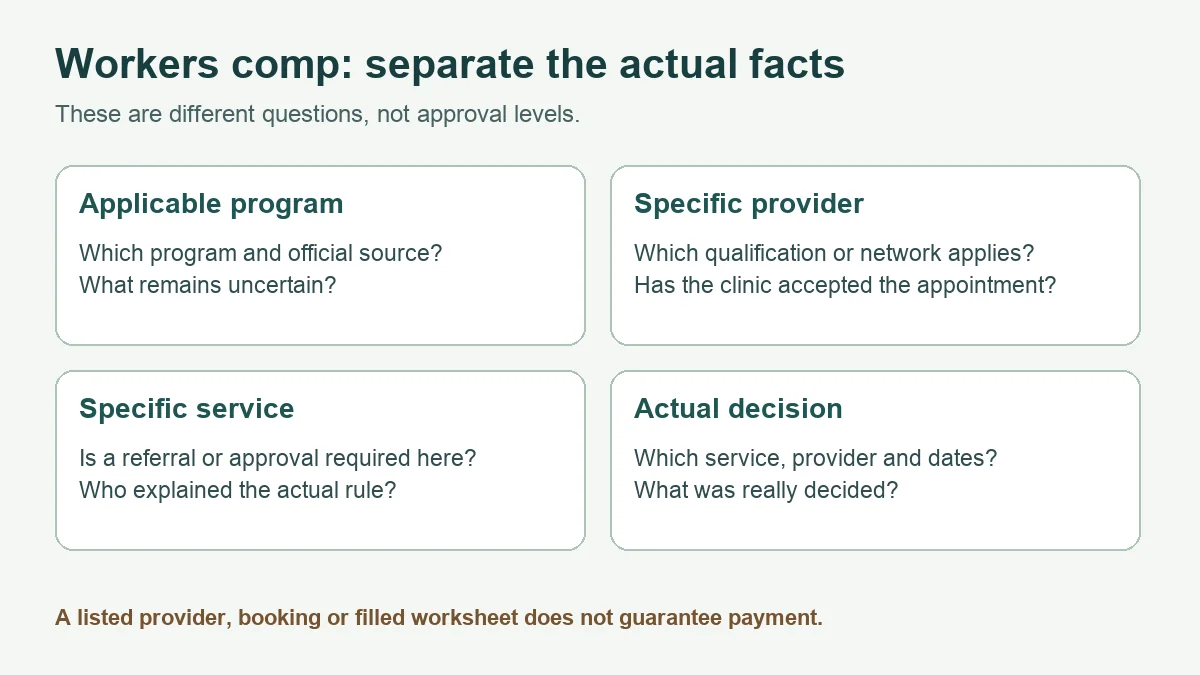
Workers comp provider questions start with the program that actually applies and the specific fact you need confirmed. An agency-authorized provider, a network participant, a clinic willing to see you and an approved service are different facts. No universal approval ladder connects them, and one confirmed item does not verify the whole claim.
Use the six essential checks, compare provider and service facts, read two fictional writing examples, or build the program, provider, service-request and actual-decision record. The organizer helps preserve questions and real replies; it does not select a doctor, determine jurisdiction, authorize treatment or guarantee payment.
Urgent clinical needs come before this record. Chest pain, serious breathing difficulty or collapse needs emergency help. With back pain, new bladder or bowel changes, loss of feeling around the genitals or anus, or pain, weakness, tingling or numbness in both legs needs emergency assessment. Sudden severe joint pain with swelling, heat or difficulty moving needs urgent assessment; fever may be absent. Use appropriate local urgent/emergency services, including 911 for emergencies in the U.S. Do not wait for clinic, network or referral checks when immediate assessment is needed. These selected examples are not a complete triage list or a payment guarantee. NHS back-pain guidance; NHS joint-infection guidance.
This is U.S. caregiver-written education, not individual medical, insurance or legal advice. The operator is not a professional adviser. Program rules, claim facts and provider processes differ. Ask the relevant agency, clinic, authorized claims contact or qualified adviser about your actual situation. A helper should support the worker’s preferences and permission rather than assume control of the claim or clinical decisions.
Table of Contents
Six essential workers comp clarification checks
| Check | Actual fact to preserve | Question to clarify |
|---|---|---|
| 1. Applicable program | Program and agency named in actual documents or a real official answer; uncertainty. | Which program governs this situation, and what source confirms it? |
| 2. Claim and provider facts | Actual claim status; specific provider qualification/network where applicable; clinic acceptance. | Which of these facts is confirmed, and by whom? |
| 3. Specific service requirement | Actual recommendation and whether a referral or separate authorization is required for it. | What rule applies to this service, provider, stage and program? |
| 4. Request and decision | Prepared, sent, receipt confirmed and actual decision, with source/date/scope. | Has the request been received, and is there a real decision or just an unknown status? |
| 5. Actual notice | Title, issuer, service scope and stated next step or deadline. | Which program-specific explanation or assistance applies to this document? |
| 6. Actual reply and next owner | Question asked, real answer, remaining point and next action actually agreed. | Who will act on each unresolved clinical, clinic or claim question? |
These checks are not coverage levels, legal eligibility criteria or a score. Some items may not apply; record that only with the relevant source or actual answer. A missing item is a question to clarify, not a finding that care must stop or the claim is invalid. You can ask for help with an incomplete record.
Identify the applicable program before borrowing a rule
USAGov’s workers’ compensation overview distinguishes state programs from federal programs for federal employees and other specific groups. Use it as a starting point to locate the appropriate official program. It does not decide which jurisdiction applies to an individual case, especially where work, employment arrangements or locations create uncertainty.
Look at the actual notice or existing claim correspondence for the named program and responsible organization. If that information is absent or conflicting, ask the appropriate agency or qualified program-specific adviser. A postcode, current residence, employer name or clinic directory alone should not be used by this worksheet to determine the governing system.
Keep an insurer, third-party administrator, employer contact and government agency distinguishable. They may answer different questions or act within different authority. A representative’s answer should retain its role, date and scope; do not convert it into a universal legal rule. The same caution applies when a webpage describes only one state or a particular federal program.
Provider status, clinic acceptance and service approval are separate
| Fact being checked | Useful actual evidence or answer | What it does not establish |
|---|---|---|
| Agency provider authorization, where applicable | The relevant official program information for the specific professional, with date/source. | Clinic willingness to accept the appointment, or every service’s approval. |
| Network or other provider arrangement, where applicable | Actual program/network information and the answer for this situation. | That the same rule applies in another jurisdiction or to another service. |
| Clinic acceptance | The office’s real response about this clinician, appointment and intake requirements. | Acceptance of the whole claim or a guaranteed payment result. |
| Referral | Actual recommendation, sending source and receipt status if known. | That separate authorization is required or has been granted. |
| Service decision | Real decision with service, provider, dates, conditions and issuing role. | Approval of other services, later dates or the whole clinical plan. |
| Claim status | Actual notice or program answer about the claim and its scope. | A substitute for the clinical assessment or every service-specific fact. |
When a clinic says it handles workers comp, ask which specific question that statement answers. Do not assume a generic participation statement verifies the provider, applicable rule, appointment and service together. Equally, do not invent a new permission step where the program does not require one. Ask who can clarify the actual requirement.
Use state examples within their actual limits
| Official example | What it illustrates | Limit to preserve |
|---|---|---|
| New York WCB: Health Care | Except for emergency cases, treating providers must be Board-authorized; the page also explains exceptions involving specific provider arrangements. | Board authorization, clinic acceptance and a service authorization are different. This is New York guidance, not a nationwide provider-choice rule. |
| New York WCB: Medical Treatment Guidelines FAQs | Treatment consistent with applicable guidelines may not require a separate prior authorization; exceptions and other request routes exist. | Do not decide guideline compliance from a symptom or checklist, and do not require approval for every visit. |
| California DWC: Medical Care | MPNs, predesignation and other arrangements can affect provider choice; the page explains choices within an applicable MPN after the first appointment. | California’s arrangements are not a universal state or federal sequence, and a network listing is not every service decision. |
These examples show why the program and exact question matter. They are not a comparison of which system offers better care, a summary of every exception or instructions to select a provider. Open the relevant official guidance and ask about the actual circumstances. A short note can say: “Which provider-selection rule applies here, and which source or notice explains it?”
There is no requirement from this article to make two calls on the same day or obtain an insurer’s permission before every appointment. Contact the roles needed to resolve the real uncertainty. A clinic may clarify acceptance while an agency clarifies program rules and a clinician explains the recommendation. Record each answer separately rather than treating one person as the source for every issue.
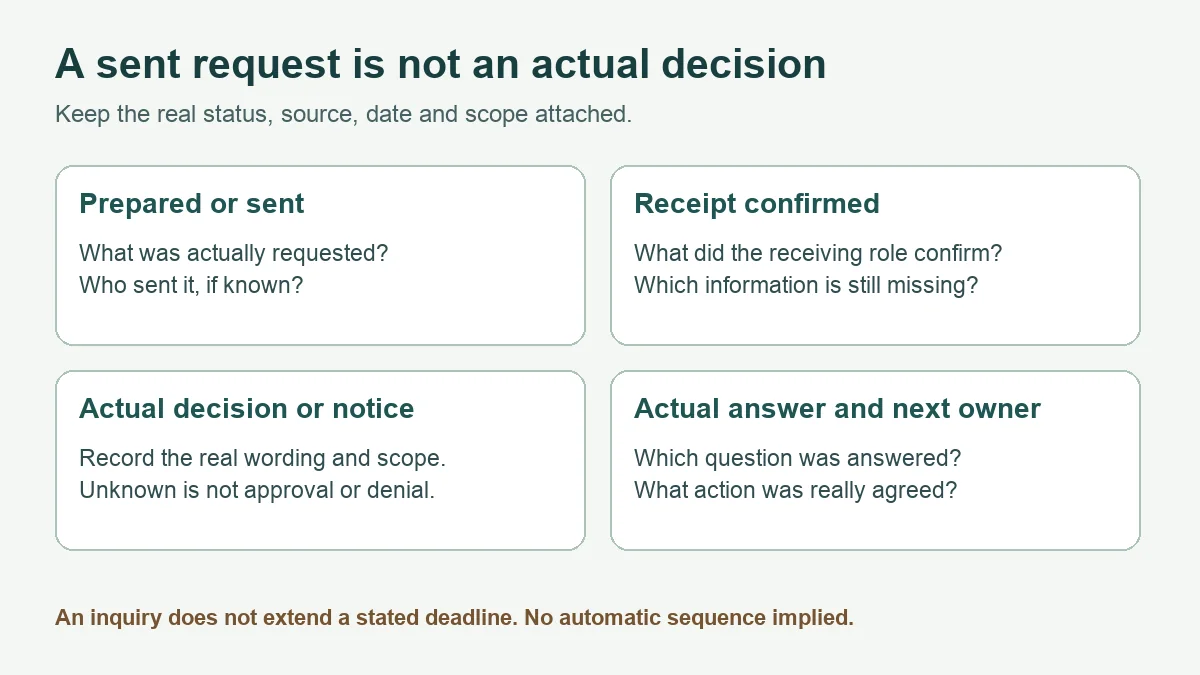
Track the specific request and the actual decision
Use matching A/B labels when several services are involved. For service A, keep its provider, scope, applicable requirement, request status and actual decision together. Repeat for service B. An answer about a visit should not silently become approval for imaging, therapy, a procedure or a different professional.
| Actual status | What to record | Conclusion to avoid |
|---|---|---|
| Requirement unconfirmed | The specific service and the role asked to explain the applicable rule. | Every service needs approval, or this one certainly does not. |
| Question or request prepared | Draft scope and intended recipient. | It has been sent or entered into a claims system. |
| Sent; receipt unknown | Actual sending date/source if known and the receipt question. | It is under review, approved or denied. |
| Receipt confirmed | Who confirmed what was received and any real request for further material. | A receipt is the substantive decision. |
| Decision received | Exact service scope, issuer/date, conditions and remaining uncertainty. | An approval applies to every related service, or a denial decides all aspects of the claim. |
| Status unclear after contact | Actual contact and unanswered question. | Silence or a scheduling delay is automatically a denial or approval. |
Do not add overlapping waits to predict lost recovery, invent a standard delay or label a completed form “claim-safe”. Ask for the real status and applicable response process. Contact can be useful, but this guide supplies no guaranteed time saving or outcome from a call, a particular tone or a complete packet.
For a referral handoff between clinical services, the referral progress record focuses on sent, received and booked facts. This workers comp record adds program-specific provider and service requirements plus actual decisions. Neither establishes medical necessity, coverage or a clinical specialty sequence.
Preserve real notices, truthful history and clinical instructions
If a notice or decision arrives, record its real title, date, issuer, scope and stated next steps or deadline. Keep the document privately and seek appropriate program-specific agency assistance or qualified legal advice when it is unclear or disputed. Do not substitute a general internet deadline, infer that an inquiry extends the stated time or wait for this worksheet to be complete before responding.
A recommendation, a service authorization and a clinical instruction are different. Ask the treating team what the actual clinical plan means; ask the appropriate program contact about any administrative requirement. Do not select an orthopedist, pain specialist, scan, injection or return-to-work path from a blog sequence. A newly concerning symptom may require care before an administrative question is resolved.
Describe what actually happened and what you remember, including gradual onset, uncertainty and legitimate changes. Separate the worker’s account, another person’s observation and the clinician’s actual medical reasoning. Do not invent work causation, repeat a task to create evidence, hide a new symptom or rewrite history to resemble an approval-friendly example. Ask about correcting factual record errors through the relevant service’s normal process.
If a work-status instruction is relevant, preserve its actual wording, source and date. Keep a proposed workplace arrangement distinct from duties or help actually implemented, and ask the relevant professionals about any mismatch. This article supplies no work restriction, legal causation finding, fitness clearance or instruction to perform an unsafe task.
A family helper can keep questions and permitted records organized. That support does not make the helper a legal representative or replace clinical and professional responsibilities. Use the actual service’s consent and communication arrangements and keep identifying claim and health details out of public forms and comments.
Two fictional writing examples
These examples demonstrate recording only. They are not real worker cases, jurisdiction determinations, legal advice or proof of payment. No clinical referral path is selected. The tool’s example buttons replace entries and label the brief fictional.
Example A: provider listed, service requirement still unknown
| Record area | Fictional entry |
|---|---|
| Program / source | State-program question; actual jurisdiction and applicable rules need confirmation from real sources. No state is selected by the worksheet. |
| Provider / acceptance | Provider appears on a relevant list in this fictional example. Current listing scope and clinic acceptance are not yet confirmed. |
| Service requirement | Proposed specialist discussion. Whether a referral or separate authorization is required is unknown. |
| Actual contact / answer | Question prepared for the relevant clinic or program contact; not sent. No actual answer or decision supplied. |
The useful result is a set of separate questions. The example does not tell the worker to proceed, wait or pay merely because a name appears on a list. Record the actual answers and their scope; seek appropriate care when needed.
Example B: request sent, receipt and decision unconfirmed
| Record area | Fictional entry |
|---|---|
| Service | Use the actual request scope, provider and dates; none are invented by the example. |
| Request / decision | Request sent in this fictional example. Receipt and review status unconfirmed; no actual decision received. |
| Contact | Question about receipt, actual status and next owner sent in the fictional example; reply pending. |
| Notice / next step | No real notice supplied. Preserve any actual notice and its response instructions; an inquiry does not establish an extension. |
This record preserves an unknown status without calling it a denial or approval. If a real decision or notice is later received, attach its actual scope and dates to the matching service. Use appropriate assistance for the applicable program rather than inferring a challenge process from another state’s example.
Private workers comp clarification and actual-decision record
Download the offline tool before entering actual health, claim or personal notes. Use fictional entries on this public page because the surrounding site may contain ads and analytics. The tool sends nothing, uses no browser storage and does not automatically save. Its offline copy contains no external assets. Keep completed copies and exports private.
Use one claim discussion or service period per record, without entering identifying claim numbers here. For several service questions, use matching A/B labels across the fields. Unknown, not asked, reply pending and not applicable according to an actual answer are useful entries. A paper note using the same headings works too.
Workers comp program, provider, service-request and actual-decision record
Keep the applicable program, specific provider facts, service requirements, request status and actual decision separate. Use matching A/B service labels; these are facts to clarify, not approval levels.
Download the offline tool before entering actual health, claim or personal notes. Use fictional entries here; the surrounding site may contain ads and analytics.
Offline copy. This file has no ads, analytics, external assets or automatic network requests.
The tool uses no network requests, browser storage or automatic saving. Refreshing or closing may lose entries. Keep exports private; omit names, claim numbers, identifying contacts and full records. Do not delay care or a notice response for this form.
Start with the fictional example or download a blank offline copy.
Paper alternative: program/source; actual claim status; specific provider facts; clinic acceptance; service; applicable requirement; sent/received status; actual decision; actual notice; contact; real answer; next owner. Unknown and not applicable according to an actual answer are valid.
My workers comp program, request and actual-decision record
Unverified personal record for discussion. Entries verify no applicable rule, provider status, request, decision or payment result. This is not legal or medical advice.
Guide: living.kioptrix.com/workers-comp-approved-pain-management/
Blank fields add optional questions, not a missing-approval score. Every entry remains unverified even when all fields contain text. Rebuild after editing, then copy, download text or print. Exporting does not contact a clinic or agency, file a claim, request authorization or appeal a decision. Nothing in the record determines an amount to pay or a response deadline.
Common workers comp clarification questions
Does a clinic accepting workers comp mean every service is approved?
No. Ask what the statement actually confirms. Program requirements, specific provider facts, clinic acceptance and service decisions can differ.
Must I obtain separate authorization before every appointment?
Do not assume so. Ask which rule applies to the actual service and program. Some services may not need separate prior authorization; this organizer cannot decide that for you.
Does no reply mean a denial?
Do not relabel an unknown status. Record the actual receipt, decision or notice when known, and ask the appropriate role about the real process. Do not assume an inquiry extends a deadline.
Can the tool choose my program or provider?
No. It records unverified source information and questions. It does not determine jurisdiction, provider choice, coverage or a clinical specialty pathway.
Do I need a complete record before seeking help?
No. Incomplete information can be the reason to ask. Clinical urgency and an actual notice response should not wait for a completed worksheet.
Sources, corrections and limits
- USAGov: Workers’ compensation — state/federal program distinction and official program entry points; not an individual jurisdiction decision.
- New York WCB: Health Care — Board-authorized providers and program-specific exceptions.
- New York WCB: Medical Treatment Guidelines FAQs — service-specific authorization distinctions and exceptions; not nationwide rules.
- California DWC: Medical Care — California provider arrangements, MPNs and treatment-review context.
- NHS: Back pain and NHS: Septic arthritis — selected clinical warning signs, not U.S. workers comp rules.
Source check and editorial update: October 29, 2026. Replaced the universal approval ladder, claim-safe diagram, delay calculator and same-day two-call instruction with separate program, provider, service and actual-decision facts. Removed approval-oriented history examples and unsupported time-saving claims. The original URL, publication date, author and classification are retained.
This is selected caregiver education, not a comprehensive legal review or validated claim instrument. No independent workers comp legal/clinical review, real-reader study or improved claim outcome is claimed. The hero is AI-generated fictional artwork; diagrams illustrate separate facts rather than an approval pathway. Our background and editorial approach.