

Walker pain deserves a review of the person, the actual device and the task—not an assumption that the walker is the cause. If pain occurs while using a walking aid, describe what already happened, bring the current instructions and ask what was assessed. Then keep the actual explanation, any change instructed and what was really carried out separate. This guide helps older adults and helpers prepare that conversation.
Go directly to the warning signs, instructions–task–pain comparison, seven reassessment checks, two writing examples, or free offline review record. A brief account is enough to ask for help. You do not need a diary, pain score or repeated walking test.
Scope: pain already noticed when using a prescribed or recommended walker. This is a symptom-review and communication guide, not a device ranking, fitting tutorial or exercise plan. The family-caregiver site operator is not a medical professional. No independent clinical review of this article or worksheet is claimed.
Table of Contents
Warning signs come before walker pain paperwork
Seek emergency assessment for severe joint pain after a fall or injury, new inability to walk or put weight on a joint, a joint that appears out of place, or loss of sensation/tingling around a joint after injury. A painful joint with hot/swollen surrounding skin, or joint pain with fever, shivering or feeling generally unwell, needs urgent medical assessment. Do not treat these as a routine handle-height question. These selected examples are supported by NHS joint-pain guidance; they are not a complete triage list.
New bladder or bowel control changes, difficulty starting urination or inability to urinate, saddle-area numbness, or severe/worsening weakness or numbness in both legs can signal a serious back problem requiring emergency care. See NHS sciatica emergency warnings. Call local emergency services for an emergency—911 in the United States. Do not wait for a fitting appointment or finish this form first.
Contact the treating team about worsening or recurring pain, pain affecting usual activity or sleep, a new walking difficulty, a near fall, or a change that makes the current plan difficult to follow. Do not keep repeating an unsafe or painful task to demonstrate the problem. Seek appropriate assistance and actual clinical guidance for the task that remains unsupported; this page supplies no substitute transfer method or safe waiting period.
Compare current instructions, actual use, pain and change
| Current instruction or context | Actual task already performed | Pain / change already noticed | Question for reassessment |
|---|---|---|---|
| Exact walker and weight-bearing/help instructions, if known. | The ordinary trip or task, surface and help actually used. | The person’s words: where, when and what changed. | What needs assessment beyond the device itself? |
| Standing/sitting education actually received. | Chair, bed or toilet transfer already attempted; available support. | Pain during rising or lowering; any existing loss of balance. | Do the actual transfer, instructions and assistance need review? |
| Actual walking/turning instruction and movement restrictions. | Existing doorway, corner or route event. | Pain, numbness, weakness or difficulty already noticed. | Which clinical and training questions remain? |
| Current grip or fitting instruction; device configuration. | How hands/arms were used during the completed task, as already known. | Hand, wrist or shoulder discomfort; no cause assumed. | What was assessed, and is fit, task demand or another explanation relevant? |
| Actual pain-management instructions. | What was really used, as known; any barrier to following the plan. | Effect, lack of effect or unwanted change already noticed. | What advice applies now, and what clarification is needed? |
Keep “my wrist hurt after the trip” separate from “the grip caused the pain.” The first is an observation; the second is a possible explanation that has not been established. Similarly, a knee hurting during a transfer does not identify a diagnosis or prove that seat height is the cause. Report uncertainty openly rather than filling it with a device theory.
If timing, assistance or the model is unknown, write unknown. A caregiver can record what they saw while preserving the person’s own account separately. Do not require a person to repeat a walk, stand without needed help, or recreate a near fall for a more precise entry.
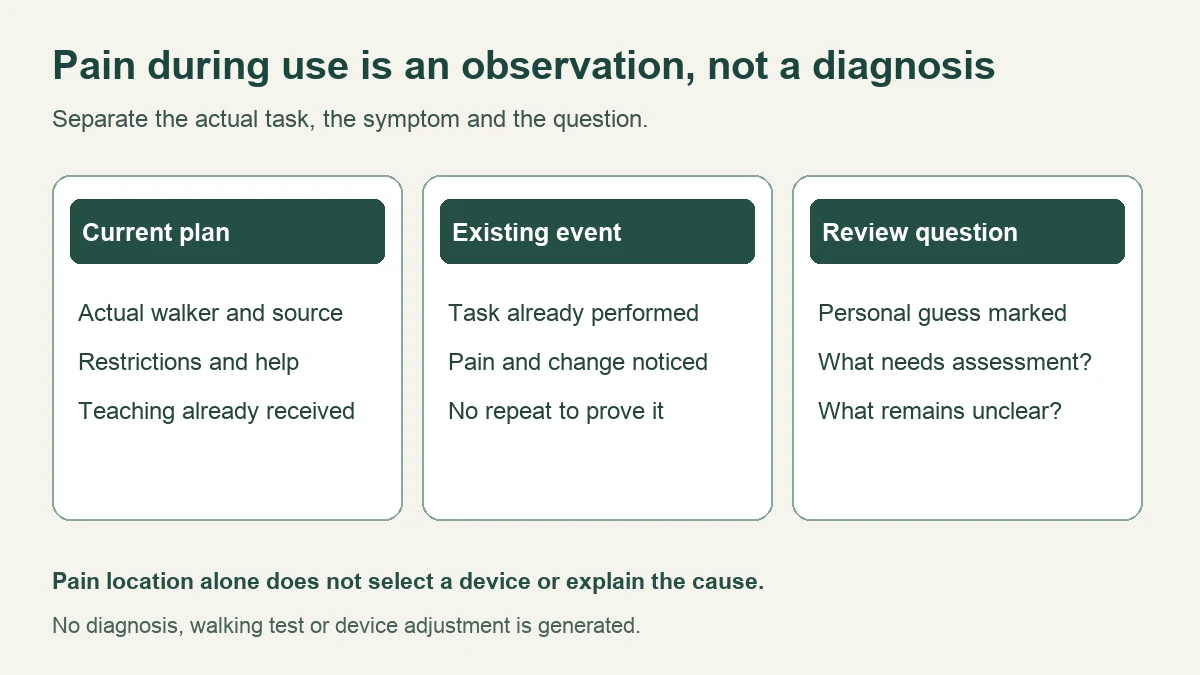
Walker pain: seven essential reassessment checks
Keep the real instructions and their source
Bring the current device recommendation, weight-bearing and movement restrictions, help requirements and education already received. Identify who gave each instruction and when, if known. If two instructions conflict, retain both and ask the responsible clinical team which applies. Do not combine a general internet sequence with fragments of individual advice into a new method.
Describe one task already experienced
Choose the task that matters to the person: getting up, going to the bathroom, turning in a doorway or completing an ordinary route. Include the setting and actual help. A short account of pain and change is useful even when the person cannot give a number, a precise duration or a complete history. There is no requirement to prove an endurance limit.
Keep a personal explanation as a question
You may wonder about fit, hand loading, the route, an underlying condition or something else. Label that uncertainty. Ask, “What did the assessment show, and what remains uncertain?” A device photograph, location of discomfort or relief after rest cannot settle the cause. A plausible explanation is not an actual clinical finding.
Record what reassessment actually occurred
Separate a message sent, an appointment booked, equipment inspected, movement reviewed and symptoms clinically assessed. These may happen in different encounters. Record the scope and the real answer received. If only the device was checked, leave the symptom explanation open rather than writing that everything was assessed.
Retain the explanation and any real change instruction
Write the explanation as received, including uncertainty and what it did not cover. Keep a proposed change separate from an instruction actually given. Clarify unclear or conflicting advice about the device, activity, assistance or pain plan with the relevant professional. The record cannot choose between those instructions or authorize a change.
Confirm the change and teaching actually happened
A recommendation, referral or booking is not completed fitting, teaching or support. Record the actual action and who completed it, any education received, the assistance really available and what remains pending. A changed device does not automatically remove required help. Do not describe a plan as implemented just because one part was arranged.
Bring back existing observations and the next question
If a change has actually been implemented under the real plan, record observations from ordinary permitted use already experienced: better, unchanged, worse, mixed or not yet observed. Do not extend a walk to test success. Record the follow-up answer and remaining owner or plan only when supplied. A change followed by improvement does not, by itself, prove the original cause.
What a device review can—and cannot—answer
Device type matters. A standard frame, two-wheeled walker and four-wheeled rollator are not interchangeable solutions for sore hands or difficult walking. Cleveland Clinic’s walker guide describes different designs, fitting and training. Its general education does not select a device for the person or explain the cause of their pain.
The Alberta Health Services four-wheeled-walker handout specifically says that this aid is not for non-weight-bearing, partial-weight-bearing or feather-weight-bearing instructions. It also identifies hand-brake ability as important. Do not switch to a rollator simply to avoid lifting another frame; ask about suitability under the actual restrictions. This handout concerns four-wheeled walkers, not every mobility aid.
Conventional fitting guidance includes handle level and elbow position, but a diagram is not an individual fit verdict. For walker pain, ask what fit and technique review is appropriate for the actual person, device and task. Avoid adding loose padding, changing wheels/tips/accessories or improvising repairs from this article. Use the actual product instructions and obtain appropriate supplier and clinical advice for an existing problem.
MedlinePlus advises against pulling on or tilting a walker to stand and recommends asking a provider or therapist for help with use difficulties. Keep that safety principle. Detailed sitting, standing, turning and stair methods still need to match the device, individual restrictions and teaching actually received. This page does not supply a universal transfer sequence or ask for solo practice.
Useful questions include: “Was my actual task reviewed?”, “What method and help apply to me?”, and “Has the person helping me received the needed education?” If an apparent fault or unsupported transfer is involved, do not recreate it for a photo or proof. Ask for an actual plan for the immediate care need, alongside the equipment job.
Keep home barriers and the pain plan within their proper scope
Report a route or support problem already known: clutter, poor lighting, a difficult doorway or unavailable assistance. CDC fall-prevention guidance supports home-hazard attention and medication review for dizziness or sleepiness. It does not diagnose walker pain or prescribe a walking dose. Ask the appropriate team to review the actual home task; do not build improvised supports or remove required help.
Bring the actual pain plan and what was really used, including any effect, unwanted change or difficulty following it. Ask the prescribing clinician or pharmacist about unresolved medicine questions; do not add a dose, stop a prescribed medicine or substitute a treatment based on this guide. If medication makes the person dizzy or sleepy, include that concern in the review rather than assuming the walker alone explains a new difficulty.
The earlier general heat/cold section has been removed. Its arthritis-specific source did not justify a treatment pathway for all pain occurring during walker use. This version asks for the person’s actual instructions and response instead. No universal heat/cold duration, walking schedule, pain cutoff or “try this first” delay is provided.
This page addresses pain explanation, reassessment and actual change implementation. For delivery, setup, fitting/education handover and completed equipment correction, see Home Care Equipment: 7 Essential Handover Checks. For a corner/turn-specific training discussion, see Turning With a Walker: Questions for Individual Training. A completed equipment handover or turn lesson does not itself settle an unexplained symptom.
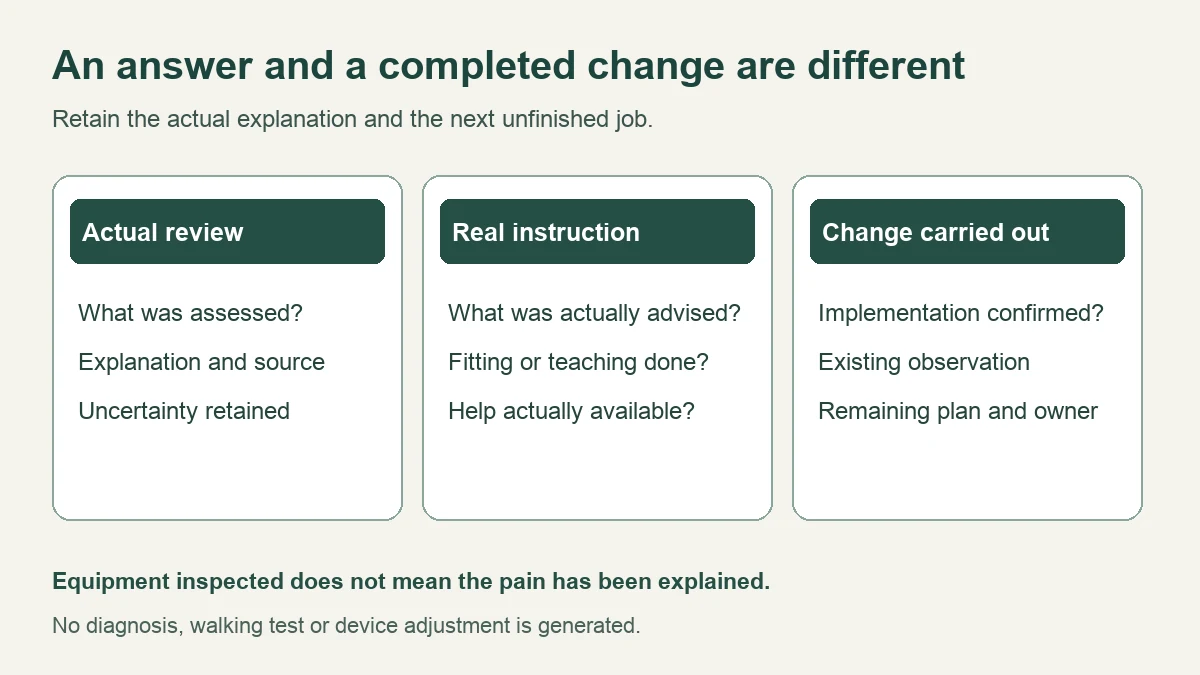
Two fictional walker pain review writing examples
Both examples are invented notes, not verified patients, clinical explanations, instructions or outcomes. They demonstrate how to leave missing information visible. They do not establish a diagnosis, permission to continue a task or a safe time to wait.
Example A: wrist discomfort without a confirmed explanation
| Record category | Fictional entry |
|---|---|
| Current instruction | Walker use was recommended. Exact model and restrictions are not supplied here. |
| Actual task / pain | The person described wrist discomfort after an indoor trip already completed. No repeat walk requested. |
| Personal question | Could fit, task demands or another issue be relevant? No grip-related diagnosis established. |
| Actual assessment / answer | Question prepared; no completed assessment or clinical explanation supplied. |
| Change / implementation | No adjustment, replacement aid, new treatment instruction or improvement claimed. |
A question to take forward: “This discomfort occurred during ordinary use. What needs assessment, what is the explanation or uncertainty, and what should the actual plan be?” The account preserves the symptom without promising that a softer grip, different height or new device will solve it.
Example B: equipment checked, pain explanation still unclear
| Record category | Fictional entry |
|---|---|
| Existing concern | Pain already noticed during walker use remains unresolved. |
| Actual action | Equipment was reportedly checked. The scope of symptom assessment is not supplied. |
| Actual explanation | No clinical explanation for the pain recorded; equipment inspection is not rewritten as diagnosis. |
| Change instruction | Clarification requested. No new clinical instruction supplied. |
| Implementation / next plan | No pain-management change confirmed as implemented. Next assessment owner and real answer remain unconfirmed; no relief outcome claimed. |
A follow-up question: “What was assessed beyond the equipment, what is the explanation or remaining uncertainty, and who is responsible for the next plan?” This keeps the unfinished clinical question visible without dismissing a useful technical inspection.
Private reassessment, actual explanation and change record
Download the offline tool before entering actual health or care details. Use fictional entries on this webpage because surrounding ads and analytics may be present. The tool itself makes no network requests, uses no browser storage and does not automatically save. The offline export contains no external assets or automatic network requests.
Use one unresolved issue and omit identifying details, private contacts and full reports. The fields organize information; they do not validate it. Blank items produce optional questions, not a diagnosis, score, adjustment, treatment or walking test. Paper with the same headings works. Needed care and assistance come before this record.
Walker pain reassessment and change record
Keep observations, a personal guess, the actual clinical explanation and a completed change separate.
Download the offline tool before entering actual health or care details. Use fictional entries here; surrounding ads and analytics may be present.
Offline copy. No ads, analytics, external assets or automatic network requests.
The tool makes no network requests, uses no browser storage and does not automatically save. Refreshing may lose entries. Omit names, addresses, contact details, identifiers and full reports. Needed care must not wait for this record.
Start with the fictional example or download a blank offline copy.
Paper alternative: actual instructions; task; pain; changes; personal question; contact and assessment; actual explanation; actual change instructions; fitting/teaching completed; help; implementation; next plan.
My walker pain reassessment and change record
Unverified personal record for discussion. Entries verify no diagnosis, clinical instruction, safety or completed change.
Guide: living.kioptrix.com/walker-pain-management-for-seniors/
Build a record, then copy, download text or print/save PDF. Editing hides the old result until rebuilt. Example buttons replace entries and label their output fictional. Offline downloads include current entries; keep completed copies private. Refreshing or closing may lose unsaved notes. Nothing is sent to a clinician by this tool.
Common questions about pain while using a walker
Does pain mean my walker is wrong?
No cause is established by the timing alone. Bring the symptom, task and actual instructions to the appropriate professional; fit and the clinical explanation are separate questions.
Should I adjust height or buy another aid?
A webpage cannot decide that. Ask what review and actual instruction apply to the person and device; do not infer a remedy from pain location.
Does an equipment check close the pain question?
Only record what was actually assessed and explained. A technical check may be useful while the clinical explanation and next plan remain unresolved.
Do I need a pain score or full diary first?
No. Describe what is already known. Do not delay needed care, repeat a painful task or complete a walking test to fill the record.
What counts as a completed change?
The actual action, teaching or assistance has occurred—not merely been proposed, referred or booked. Keep pending work and the real next owner visible.
Sources, review wording and limits
Editorial revision and source check: October 30, 2026. The former unqualified “Reviewed” wording has been replaced to distinguish editorial/source checking from independent medical review. This is not a clinician-reviewed article. The representative image is an AI-generated fictional consultation scene, not a real patient, device fitting or demonstration of correct posture. The two diagrams are editorial communication aids.
- MedlinePlus: Using a walker — general device-use education, professional help and the no-pulling-to-stand principle. It does not diagnose this reader’s pain.
- Cleveland Clinic: How to use a walker — device types, conventional fit and training background, not individual selection or symptom assessment.
- Alberta Health Services: How to choose and use a four-wheeled walker — restrictions and brake ability for that device class; not a universal walker protocol.
- NHS: Joint pain — selected urgent/emergency warning examples and clinical review for activity/sleep disruption; UK service numbers are not presented as U.S. pathways.
- NHS: Sciatica — selected serious back/neurological warning signs, not evidence that walker pain is sciatica.
- CDC: Preventing falls and hip fractures — home hazards and medicine-related dizziness/sleepiness review; not a pain-treatment study.
The seven checks, tables and tool are editorial aids, not validated diagnostic, triage or fitting instruments. No direct device testing, independent clinical review or reader-outcome study is claimed. Further improvement would require qualified clinical review and real usability evidence. Actual device instructions and individualized clinical care remain necessary.