

Knee osteoarthritis care should consider your pain, sleep, activities and priorities together. A useful daily-life plan is one you understand and can actually put into practice with the help you need. If part of the plan is unclear, unavailable or not helping, bring that issue back for review. This guide helps older adults and chosen helpers separate the current instructions, what really happened, changes noticed, barriers, actual answers and changes carried out.
Use the goal–plan–experience comparison, read seven essential care-plan checks, see two fictional writing examples, or download a free offline plan record. You can start with one concern. No complete diary, pain score, repeated exercise or home severity test is needed before asking for help.
Scope: implementing and reviewing an individual plan after a diagnosis of knee osteoarthritis. Gradual symptoms do not establish that diagnosis, and an existing diagnosis does not explain every new change. This is caregiver-written education from a family-caregiver-run site; the operator is not a medical professional, and no independent clinical review is claimed. The article supplies no individual exercise dose, medicine change or device prescription.
Table of Contents
Warning signs come before a knee osteoarthritis plan review
Seek emergency assessment for severe joint pain after an injury or fall, new inability to walk or put weight on a joint, a joint that appears out of place, or loss of sensation/tingling around a joint after injury. Joint pain with hot/swollen surrounding skin, or with fever, shivering or feeling generally unwell, needs urgent assessment. These are selected examples from NHS joint-pain guidance, not a complete triage checklist.
New one-sided calf or thigh pain, swelling or skin-color change can be a clot warning and needs urgent medical assessment. Do not require severe pain before seeking help. If these symptoms occur with chest pain or breathlessness, seek emergency care immediately. See NHS DVT guidance. Use local emergency services—911 for a U.S. emergency. Do not wait for a routine appointment, a home-plan trial or a completed worksheet.
For worsening or recurring pain, repeated giving way, sleep disruption, difficulties with ordinary activities or a plan you cannot follow, contact the appropriate treating team for review. Necessary care should not depend on first changing a chair, trying a product or proving that a routine failed. If an activity is unsafe or required help is missing, obtain appropriate assistance and individual guidance for that immediate care need.
Compare goals, current instructions, actual performance, changes and barriers
| Your goal or concern | Current instruction | Actual performance | Change already noticed | Barrier / review question |
|---|---|---|---|---|
| Pain and sleep | Actual pain plan and source, if known. | What was really used, as already known. | Effect, lack of effect, sleep disruption or unwanted change. | Unclear advice, access or side effects to discuss. |
| An activity that matters to you | Actual exercise or activity plan; restrictions and help required. | Completed, partly completed or not started; actual help. | Pain, confidence, activity or other existing observations. | Teaching, help, affordability or feasibility problem. |
| A daily task such as meal preparation | Actual task/support advice, if received. | What really happened in the current setting. | Difficulty, fatigue, discomfort or no change. | Which part needs individual review rather than an improvised fix? |
| Using a recommended aid | Actual item and use instructions. | Education and assistance actually available. | Problem already noticed; no cause inferred. | Is an equipment or clinical question still unanswered? |
| Receiving follow-up | Actual contact and review plan, if supplied. | Question prepared, message sent, booked or review received. | What remains unresolved. | Who owns the next answer and implementation? |
The table compares facts; it does not award points or choose which goal matters most. “I want less night pain,” “I want help with meals” and “I want to understand the exercise plan” are all valid priorities. A caregiver’s preferred goal should not replace the person’s own concern. Keep the person’s words separate from what a helper observed and share with consent.
Unknown, partial and not started are useful entries. A plan that was not feasible is different from a plan fully implemented without the expected response. Neither description decides the cause or the next treatment. It gives the clinical conversation a clearer starting point without blaming the person.
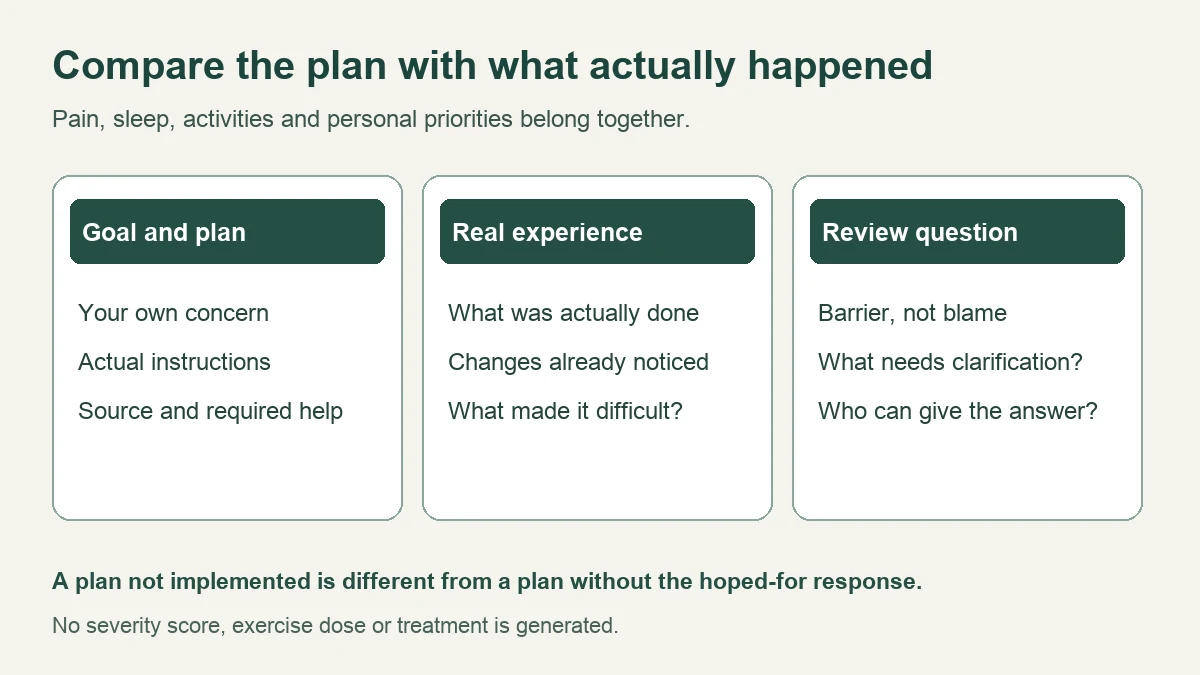
Knee osteoarthritis: seven essential care-plan checks
Start with the person’s priorities
Ask what the person most wants addressed now. Include symptoms, sleep, daily activities, social participation and concerns about treatment. There is no universal rule that walking ability matters more than pain relief, or that being able to complete a task means pain is acceptable. Keep the goal in their own words; it need not be a number or a deadline.
Keep the actual plan and instruction sources
Retain the care instructions already given and who supplied them. Include relevant exercise, medicine, activity, device, movement or assistance instructions without filling gaps from a blog. If two sources conflict, record both and ask the responsible team which applies. A general guideline is background, not a personal amendment to the plan.
Describe what was actually possible
Record ordinary permitted activity already experienced and which parts of the plan were completed. Include actual help or teaching received. Do not perform an extra walk, repeated chair rise or painful movement for this record. A planned appointment or available leaflet is not completed education, and a willing helper is not automatically trained assistance.
Keep changes separate from explanations
Describe pain, sleep, swelling, giving way, confidence, daily activities or other changes already noticed. Better, unchanged, worse, mixed and not yet observed are valid descriptions. Timing alone does not prove that an exercise, medicine, shoe or home arrangement caused the change. New concerns may require reassessment rather than being assigned to ordinary arthritis.
Name the barrier without inventing a workaround
A plan may be difficult because instructions are unclear, teaching was missed, help is absent, treatment is unaffordable or another health concern interferes. Describe the obstacle and the support requested. Do not substitute a different activity, adjust a medicine or improvise furniture from this article. Ask the appropriate professional for an actual workable plan.
Record the answer and the change actually agreed
Separate a proposed option from the clinician’s actual explanation or instruction. Keep the source, conditions, remaining uncertainty and follow-up advice as received. An acknowledgement, referral or appointment booking is not a clinical answer. If no answer has arrived, leave the item unconfirmed rather than writing an assumed interim instruction.
Confirm implementation and the remaining next plan
Record what actually changed, who acted, education received, help available and what is still pending. A revised plan on paper may remain unimplemented. Bring back existing observations from ordinary use under the real plan; do not test a longer activity to prove benefit. Retain the actual follow-up answer, responsible role and agreed review arrangement when supplied.
What clinical guidance supports—and what it does not prescribe here
NIAMS osteoarthritis guidance describes treatment goals that include symptom relief, joint function and health-related quality of life. That supports considering pain and daily life together. It does not support a universal function-first ranking or a claim that a home modification will outperform treatment.
NICE recommends therapeutic exercise tailored to individual needs and describes possible initial discomfort and longer-term benefits of consistent participation. That does not validate this article’s former walking times or warm-up sequence. Ask what exercise, progression, response and review instructions apply to your actual plan; the worksheet sets none.
If weight management is relevant, discuss individual support rather than borrowing a target. NICE addresses this for people living with overweight or obesity. This page sets no weight-loss target or diet and makes no assumption from age, appearance or a knee diagnosis. Other health conditions and practical needs belong in that conversation.
For medicines, NICE includes topical NSAIDs for knee osteoarthritis and highlights oral NSAID toxicity, other medicines and individual risk factors. Ask the prescriber or pharmacist about the actual products and instructions, especially unclear combinations or unwanted effects. Do not add doses, combine products or stop a prescribed medicine based on this record.
Keep questions about heat, cold, footwear, braces and walking aids attached to actual instructions and professional review. NIAMS discusses exercise, symptom-relief approaches and assistive devices; these are options to discuss, not a ready-made daily schedule for every older adult. A general description cannot establish which option fits a particular person.
The source links support the clinical background. The seven checks and record fields are editorial communication aids created for this guide. The sources have not tested or endorsed the worksheet, and a filled form does not establish treatment success, safety or adherence.
Resolve home-plan gaps without a trial-and-error routine
A note such as “I could not carry out this part because the expected help was absent” is more useful than labelling the person unmotivated. Ask what teaching, assistance, access or review is needed and which service owns the answer. Include the person’s preferences about help and sharing information. Do not assume a family member has agreed to a task or can provide physical assistance.
For a chair, bathroom, kitchen or route concern, describe the setting already known. Avoid unstable cushions, improvised risers or changes that bypass existing restrictions. A home assessment can address the actual person and task. This guide gives no furniture dimension, transfer sequence or exercise experiment for the reader to try.
CDC fall-prevention guidance supports attention to hazards, lighting and medicines that can cause dizziness or sleepiness. It does not prove that a particular home feature caused the knee pain. Report a near fall, new difficulty or medication concern separately from a furniture question; do not assume an equipment purchase resolves it.
Financial or service-access barriers are also relevant. Record the actual service requested and answer received, such as a teaching request still pending or an appointment offered that the person cannot attend. The worksheet does not determine insurance coverage, promise a home visit or replace contacting the relevant service.
Use the person’s goal to frame a question: “This is the plan I was given, this is what I could do, and this is the part that remains difficult. What should change, what help is needed, and who will arrange it?” The question seeks a real explanation and workable next plan without proposing a dose or declaring treatment failure.
Review real answers and confirm that changes were carried out
NICE follow-up guidance calls for review when agreed approaches are difficult or are not working within the agreed follow-up time. Ask how to obtain help and what review arrangement fits the person’s needs. This page supplies no universal number of days or a requirement to exhaust home changes before seeking care.
| Event | Record the actual status | What remains separate |
|---|---|---|
| Question prepared | Concern written down. | It may not have been sent. |
| Request received | Acknowledgement actually received. | Assessment and advice may still be pending. |
| Review completed | What was assessed and actually explained. | Questions outside that review remain open. |
| Change instructed | Actual change, source and conditions. | It may not yet be put in place. |
| Teaching/support provided | Who received what education or help. | A booked session is not a completed one. |
| Change implemented | Actual action completed and remaining obstacle. | No symptom benefit is assumed. |
| Follow-up received | Existing observations and actual response. | Keep any unresolved question and next owner visible. |
An equipment check can be useful while pain or sleep concerns remain unexplained. A new exercise handout can be useful while support remains unavailable. Keep that partial progress visible rather than closing the entire issue when one job is complete.
This article concerns implementing and reviewing a diagnosed knee osteoarthritis care and daily-life plan. The separate walker pain reassessment guide focuses on pain during walker use. The equipment handover guide covers delivery, setup, teaching and completed correction. Those tasks can support this plan, but neither replaces a review of symptoms or the person’s goals.
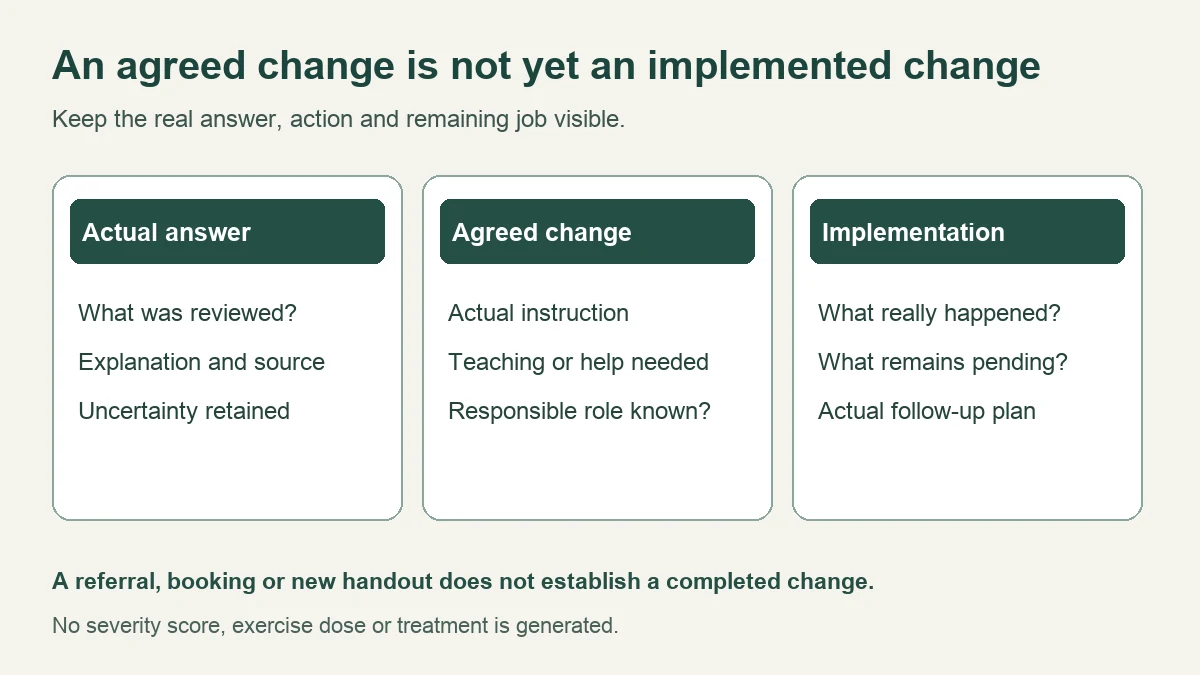
Two fictional knee osteoarthritis plan writing examples
These are invented documentation examples, not verified patients, medical advice or successful treatment stories. They demonstrate missing information without creating a recovery deadline, exercise dose or outcome. The tool’s example buttons replace entries and label output fictional.
Example A: a plan was given, but needed support is missing
| Record category | Fictional entry |
|---|---|
| Goal | The person wants help making the agreed plan workable at home. |
| Current instruction | An exercise plan was reportedly given; exact instructions and dose are not supplied here. |
| Actual performance | Plan not fully carried out. Needed teaching or assistance is not confirmed. |
| Change / barrier | No treatment response claimed. Expected help or setup is unavailable. |
| Actual answer / implementation | Question prepared, not yet sent. No reply, revised dose, substitute activity or completed support change invented. |
Writing example: “I have not been able to carry out this part of the plan because the expected help is missing. What support or clarification is needed, who can arrange it, and what actual instructions apply while this remains unresolved?” This records a feasibility issue without calling the treatment ineffective or blaming the person.
Example B: some parts were performed, pain and sleep concerns remain
| Record category | Fictional entry |
|---|---|
| Goal | Have pain, sleep and ordinary activities considered together. |
| Current plan / actual use | An individual plan exists and some parts were reportedly performed. Details are not reproduced. |
| Observed change | Pain and disrupted sleep remain concerns; no cause or treatment-failure verdict established. |
| Barrier / actual reply | Feasibility of each part is unclear. Review question reportedly raised; actual answer not supplied. |
| Change / next plan | No revised instruction, completed change or relief outcome claimed. Explanation, implementation and follow-up remain to be clarified. |
Writing example: “These concerns remain after the parts I could perform. What was assessed, what is the explanation or uncertainty, and what change—if any—is actually advised? How will the change be put in place and reviewed?” This does not require another activity trial before asking for review.
Private goals, actual answers and change implementation tool
Download the offline tool before entering actual health or care details. Use fictional entries on this webpage because surrounding ads and analytics may be present. The tool itself makes no network requests, uses no browser storage and does not automatically save. Its offline export has no external assets or automatic network requests.
Start with one goal or unresolved issue; any field can remain blank. Omit names, identifiers, addresses, contact details and full reports. Blank fields create optional clarification questions, not a severity grade, treatment choice or exercise schedule. Paper with the same headings works. Needed care must not wait for this record.
Knee osteoarthritis plan, answers and implementation record
Start with one goal or unresolved issue. You can leave any field blank; no full diary is needed.
Download the offline tool before entering actual health or care details. Use fictional entries here; surrounding ads and analytics may be present.
Offline copy. No ads, analytics, external assets or automatic network requests.
The tool makes no network requests, uses no browser storage and does not automatically save. Refreshing may lose entries. Omit names, addresses, contact details, identifiers and full reports. Needed care must not wait for this record.
Start with the fictional example or download a blank offline copy.
Paper alternative: goal; current instructions; actual performance; changes noticed; barrier; communication; actual answer; agreed change; implementation; next plan.
My knee osteoarthritis plan and change record
Unverified personal record for discussion. Entries verify no diagnosis, advice, completed change or treatment outcome.
Guide: living.kioptrix.com/knee-osteoarthritis-pain-management/
Build, then copy, download text or print/save PDF. Editing hides the old result until rebuilt. Offline exports include current entries; keep completed copies private. Refreshing or closing may lose unsaved notes. Nothing is sent to a clinician, booked, assessed or medically approved by the tool.
Common questions about daily-life planning
Should function always come before pain relief?
No. Ask for pain, sleep, activities, treatment concerns and the person’s own priorities to be considered together. Completing a task does not make its pain acceptable.
How many minutes should I walk or warm up?
This guide cannot set that. Retain the actual individual instructions and ask about uncertainty, response and progression. No standard time or chair-rise test is generated.
Does new pain mean the current exercise plan failed?
The observation alone cannot decide that. Explain what was actually performed, what changed and what was not feasible; ask for appropriate assessment and an actual answer.
Should I fix the chair before asking for clinical review?
A home concern and a clinical concern may both need attention. There is no required order or successful home trial before seeking care.
When is a change complete?
When the actual action, education or support has occurred. A proposal, prescription, referral or booking should retain its own status.
Can a helper complete the record?
With the person’s involvement and consent where appropriate. Keep the person’s account, the helper’s observation and professional advice separate; use a private agreed sharing route.
Sources, corrections and review limits
Editorial revision and source check: October 30, 2026. This rewrite removes the function-first ranking, arbitrary activity times, self-eligibility framing and unverified one-week improvement story. It replaces competing home instructions with actual-plan questions. Earlier dates do not indicate independent medical review. No independent clinical review of this version is claimed.
- NICE NG226: Osteoarthritis recommendations — tailored care, exercise, medicines and follow-up background. UK clinical guidance is not a U.S. service entitlement or an individual prescription.
- NIAMS: Osteoarthritis—Diagnosis, treatment and steps to take — symptom/function goals and treatment background; not evidence for this worksheet or a fixed daily routine.
- NHS: Joint pain — selected urgent/emergency examples, not a home-management eligibility test.
- NHS: DVT — clot warning examples and emergency escalation; not a diagnosis of a reader’s leg symptoms.
- CDC: Preventing falls and hip fractures — home-hazard and medication-review background, not proof of the cause of knee pain.
The new representative image is an AI-generated fictional plan discussion, not a real patient, clinical examination or benefit claim. Two editorial diagrams explain the record stages. The old promotional image, duplicate artwork, unsupported narrative and unreviewed video framing are not used in this rewrite.
The seven checks and tool are editorial communication aids, not validated diagnostic, treatment-selection, adherence or safety instruments. No direct product test, real patient result or reader-outcome study is claimed. Qualified clinical review and independent reader usability testing would be needed to strengthen the evidence for this resource itself.