

A PT copay is a fixed amount under the applicable benefit; coinsurance is a percentage of the allowed amount, usually after an applicable deductible. Neither label tells you the whole cost. Confirm the exact service, location, benefit rules and current balances before using a number. A clinic estimate, a modeled estimate, an insurer’s explanation of benefits (EOB) and a current clinic bill are different records.
Use this guide to check six inputs, follow two fictional examples or build a conditional estimate and actual-record comparison. Unknown amounts remain unknown. The tool does not confirm coverage, approve a bill, diagnose an overcharge or tell you what to pay.
This is general U.S. insurance-cost education from a family-caregiver-run site, not individual insurance, legal or clinical advice. The operator is not a professional adviser. Your therapist determines the appropriate care plan; financial examples do not prescribe visit frequency or justify delaying needed care. Complex benefits, coordination between payers, Medicare-specific rules and disputed claims need individual clarification.
Table of Contents
On this page
PT copay and coinsurance: compare the actual conditions
HealthCare.gov’s deductible explanation distinguishes fixed copayments from percentage-based coinsurance and notes that benefits can apply before a deductible is met. The important question is which rule applies to this PT service. A line on an insurance card may not describe evaluations, treatment, hospital outpatient services and excluded extras in the same way.
| Situation | Information needed | What a simple estimate can say |
|---|---|---|
| Covered in-network copay; deductible waived | Applicable copay for each visit, included services and remaining applicable out-of-pocket limit. | Sum the applicable copays, limited by that remaining cap under these assumptions. Do not use allowed amounts as copays. |
| Covered in-network coinsurance after deductible | Allowed amount for each visit, remaining applicable deductible, coinsurance rate and remaining applicable out-of-pocket limit. | Apply the remaining deductible first, then the percentage to the remainder, with the applicable cap. |
| Copay after deductible, mixed cost-sharing or separate facility charges | Exact processing rule and each billing component. | The tool does not model these combinations. Ask for a service-specific explanation instead of forcing a familiar formula. |
| Out-of-network, excluded service, pending or denied claim | Applicable coverage, allowed basis, contract terms, processing status and relevant protections. | Do not apply the in-network model or assume the entire billed charge is owed. |
Copay does not automatically mean cheaper, and coinsurance does not automatically mean unpredictable. A known copay can simplify a narrow estimate, but comparisons still depend on included services and benefits. HealthCare.gov’s coinsurance examples use the allowed amount rather than treating the billed charge as the percentage base.
Estimating current visits and choosing a health plan are different tasks. A PT-only comparison excludes premiums, other household care, networks and benefit differences. For plan selection, compare estimated yearly costs and access as a whole. HealthCare.gov’s total-cost guidance includes premiums as well as costs when care is used; the tool below does not select a plan.
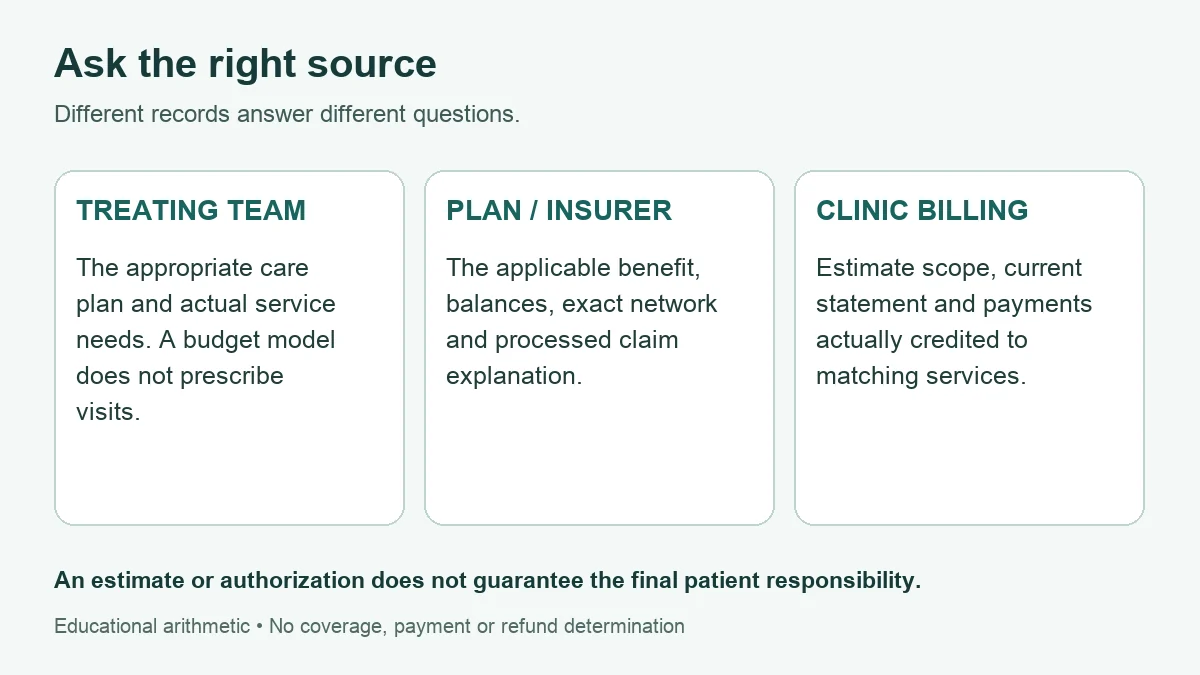
Who can clarify each part of the PT cost record?
| Role / document | Useful information | Boundary |
|---|---|---|
| Therapist / treating team | Recommended services, goals, clinically appropriate visit plan and changes. | An insurance calculation does not determine how much treatment you need. |
| Clinic billing office | Service scope, expected billing components, estimate, itemized statement and credited payments. | An estimate is not the insurer’s final claim determination. |
| Insurer / plan documents | Applicable benefit, exact network/location, balances, authorization conditions and processed claim explanation. | A benefit conversation or authorization is not a guarantee that every charge will be paid. |
| Your records | Sources and dates, questions asked, EOB, current statement and payments credited to matching services. | An arithmetic difference is a question to reconcile, not proof of an error or refund. |
| This tool | Conditional arithmetic and a private record of what you enter. | It verifies no source, network status, coverage, account balance or payment obligation. |
Ask each party the question they can answer. For example, the clinic can explain whether a current balance includes another date of service; the plan can explain how its patient-responsibility figure was processed. Record an actual response rather than interpreting a prepared question or sent message as confirmation.
Six essential checks before calculating a PT copay or coinsurance estimate
Match the service and setting
Identify evaluation versus follow-up, the expected services, the exact clinic location and potential separate billing components. Ask whether the quoted amount covers the whole encounter. A hospital-owned location does not, by its name alone, establish the benefit or price. If the scope changes, the old estimate may no longer be comparable.
Confirm the benefit and exact network
Ask the plan which benefit applies to those services at that location: a deductible-waived copay, coinsurance after deductible, or a combination requiring separate explanation. Confirm network status for the planned service and billing entities. Do not treat a generic “we accept your insurance” statement as a complete benefit verification.
Record applicable balances and their date
Use the remaining applicable deductible and remaining applicable out-of-pocket amount, not just their annual totals. Record individual/family applicability and whether any claims are pending. Other services or later processing can change balances. If the course crosses a plan period or benefit change, make separate models with newly confirmed inputs.
Use the right amount for each entered visit
For coinsurance, use the total allowed amount for the covered visit scope; for the tool’s copay model, use the applicable visit copay. Evaluation and follow-up amounts may differ. Enter known amounts separately rather than multiplying an early visit’s patient share across all later visits. A billed charge or cash quote is not automatically an allowed amount.
Check what the model cannot include
Clarify authorization, visit limits, excluded services, separate charges and mixed cost-sharing. An authorization does not promise payment. If a service is denied, ask about the reason, claim processing and responsibility rather than automatically treating the full charge as yours. Do not invent missing inputs to get a numerical answer.
Keep estimates separate from actual records
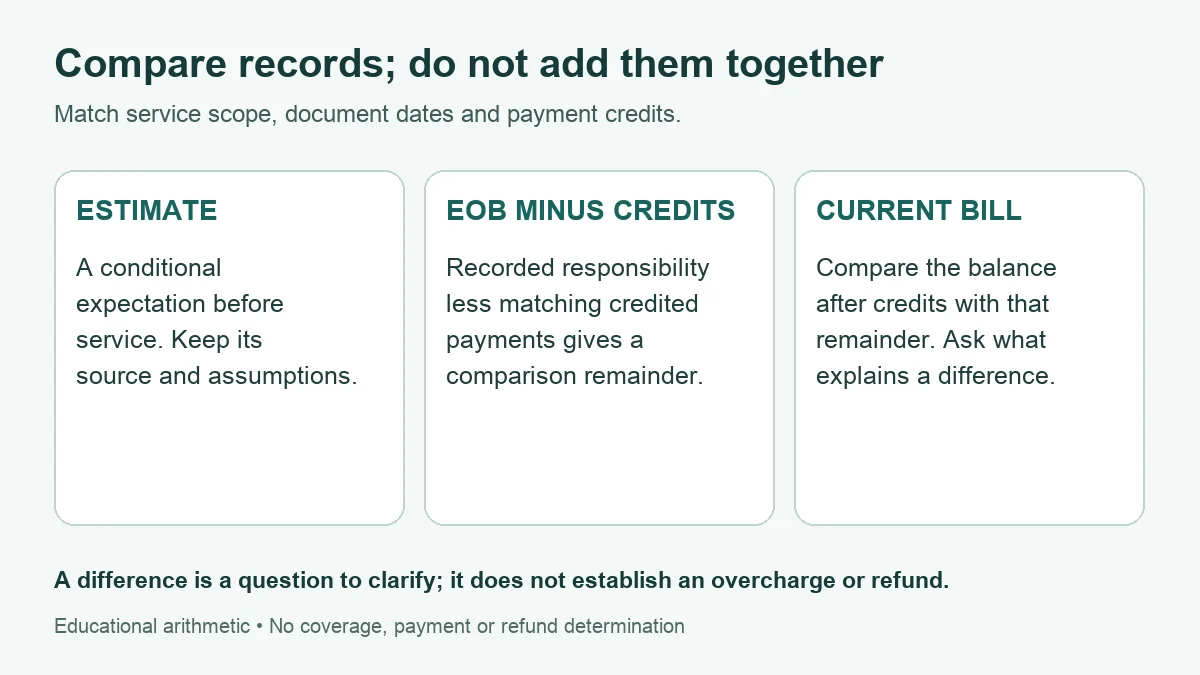
Keep the estimate’s source and assumptions. After service, match the processed EOB to the current clinic statement and payments actually credited to that same scope. A mismatch can reflect timing, posting, another service or a correction. Keep the actual answer and next owner; a tool result does not resolve the account.
HealthCare.gov’s preauthorization definition explicitly distinguishes authorization from a promise of coverage. If cost is a barrier, discuss appropriate options and billing questions with the relevant team. Do not change prescribed treatment or postpone urgent care to complete a cost worksheet.
How the conditional arithmetic works—and where it stops
For a simplified covered in-network coinsurance course, let T be the sum of the entered allowed amounts, D the remaining applicable deductible, c the coinsurance rate as a decimal and R the remaining applicable out-of-pocket limit. Before per-visit rounding, a simplified total is min(R, min(T,D) + max(0,T−D) × c). This is a model with explicit assumptions, not a universal claim-processing formula.
The tool applies the same logic visit by visit, rounds the percentage component to cents and caps the modeled patient share at the remaining applicable limit. Each input line is one visit’s total allowed amount. In its separate deductible-waived copay model, each line is that visit’s applicable copay; deductible and percentage fields are ignored. No numerical estimate is given for an unknown or mixed benefit.
Both models assume covered in-network services under one unchanged applicable benefit and plan period, accurate balances, no other claims and no extra excluded or separately shared amounts. They do not reconstruct family accumulation rules, coordinate payers, process claims, price out-of-network care or determine legal protections. Even known inputs can change. Actual coding, processing and rounding can produce different figures.
The applicable cap matters: HealthCare.gov’s out-of-pocket-limit explanation describes the limit for covered in-network care and lists excluded categories such as premiums, noncovered services and out-of-network costs. Do not extend the modeled cap to every possible charge. If only the annual maximum is known, leave the remaining-cap field blank and ask for the current applicable balance.
Two fictional examples: a changing estimate and a bill question
Every figure below is fictional arithmetic, not a typical PT price, actual quote, recommended visit schedule or promised saving. The examples show two different jobs: estimating a course under assumptions and comparing documents after service. The tool’s example buttons replace current entries.
Example A: the deductible is crossed within the entered visits
Assume eight covered in-network visits, each with an allowed amount of $175, $500 of applicable deductible remaining, 20% coinsurance afterward and $1,500 of applicable out-of-pocket limit remaining. No other claims, separate copays or benefit changes occur. Eight is only the number of lines in this fictional example.
| Entered visit(s) | Conditional arithmetic | Modeled patient share |
|---|---|---|
| 1–2 | $175 per visit applied to the deductible. | $350 total; $150 deductible remains. |
| 3 | $150 deductible plus 20% of the remaining $25. | $155; the deductible is now met in this model. |
| 4–8 | Five visits at 20% of $175. | $175 total. |
| Eight entered visits | $350 + $155 + $175. | $680 conditional total; $820 of the modeled out-of-pocket limit remains. |
If the same fictional inputs instead had only $600 of applicable out-of-pocket limit remaining, the model would cap its total at $600. That does not make excluded charges free or establish that real benefits work this way. If the allowed amounts, balances, service scope or plan period are unknown, do not copy these values into a personal estimate.
Example B: the EOB remainder and current bill differ
For one matching, processed fictional service scope, the clinic initially estimated $40. The later EOB records $70 patient responsibility. A $40 payment has been credited to that scope, but the current clinic statement shows $50 remaining. These are four different figures, not four charges to add together.
| Record | Fictional amount | How to use it |
|---|---|---|
| Earlier clinic estimate | $40 | Historical estimate, not a payment or guarantee. |
| EOB patient responsibility | $70 | Processed insurer figure; the EOB is not a bill. |
| Payment actually credited | $40 | Subtract once when comparing with the EOB responsibility. |
| Arithmetic EOB remainder | $30 | $70 − $40; a comparison figure, not an instruction to pay. |
| Current clinic balance | $50 | Ask what explains the $20 difference from the arithmetic remainder. |
A useful question is: “For this date and service scope, the EOB shows $70 responsibility, $40 is credited and the current statement shows $50 due. Can you explain the $20 difference and identify any other service, posting delay or correction?” Record the actual reply. The example establishes no overcharge, debt, payment deadline, refund or appeal result.
From estimate to EOB, credited payment and current bill
CMS’s EOB reading guide explains that an EOB is not a bill and may not show payments already made. Keep the service scope and document dates visible. A current balance after credits differs from an original charge. An account-wide statement may include multiple visits; do not compare it to one EOB line without matching the scope.
The tool’s optional comparison uses three known amounts for the same processed scope: EOB patient responsibility P, payments actually credited Q and current clinic balance B. It shows max(0,P−Q), then the difference between B and that remainder. It does not subtract your payment again from B, because the requested B input is already a balance after credited payments.
Use no numerical reconciliation when records are pending, denied, unmatched or incomplete. If credited payments exceed the entered EOB responsibility, the tool identifies a question about account credits and scope; it does not announce a refund. A zero difference only means the entered arithmetic matches. It cannot verify correct coverage, coding, payment posting or the underlying documents.
Ask for a clear explanation and record the responsible office, response date and next action. If the claim status or statement is corrected, retain the earlier version privately and update the comparison. If you need help with a denial, payment dispute or applicable protections, use the plan’s actual notices and appropriate assistance rather than relying on a calculator to decide responsibility.
Free PT copay, coinsurance and actual-record tool
The first section offers a conditional model for two simple benefits. The rest records sources, a clinic estimate, actual documents and unanswered questions. You can skip the model and still prepare a useful record. Unknown inputs stay unknown; a blank field does not become zero. Select the same-scope option only when your records refer to matching processed services, while remembering the tool cannot independently verify them.
Try fictional examples online; download the offline copy before entering real health or insurance notes. The live site may use site services. The downloaded HTML tool has no ads, analytics, external assets, browser storage or automatic network requests. No account or email is needed. Entries are not automatically saved; exported files contain your entries and should be kept private. Avoid names, member IDs, account numbers and pasted complete documents.
Build the cost record, copy it, download text or print/save PDF. Editing an input hides the old output until you rebuild it. Invalid amounts, missing required model inputs and unsupported benefits produce a clarification message instead of a misleading total. The output records assumptions and questions. Nothing is submitted to an insurer or clinic, and no coverage, payment or refund decision is made.
PT copay and coinsurance: estimate and actual-record tool
Keep conditional arithmetic, clinic estimates, EOB patient responsibility, credited payments and current bill balances separate. This tool cannot confirm coverage, a debt, an overcharge or a refund.
For actual health or insurance notes, download the offline tool first. Try the fictional example here. The offline copy contains no site ads, analytics or external assets and needs no account.
Offline copy. This file contains no ads, analytics, external assets or automatic network requests.
The tool uses no network requests or browser storage. Unsaved changes can be lost on refresh or close. Exported files contain your entries; keep them private. Avoid names, identifiers and pasted medical records.
Start with the fictional example or download a blank offline copy.
If the tool does not load, use paper: service and benefit assumptions; estimate; EOB responsibility, credited payments and current bill; actual answer and next question. Unknown amounts remain unknown.
My conditional PT cost record
Unverified figures for discussion. The model is educational arithmetic, not a claim calculation, coverage decision or instruction to pay, withhold payment or seek a refund. Confirm the documents and current balance with the plan and clinic.
Guide: living.kioptrix.com/physical-therapy-copay-vs-coinsurance/
Questions that prevent a misleading PT cost comparison
Is copay always the better choice?
No. Compare the same services and applicable benefits. A fixed payment may simplify one estimate, while coinsurance can be lower under other inputs. Selecting an insurance plan also requires premiums, other care, access and coverage considerations; a PT-only calculation cannot choose a winner.
Can I use a cash quote as the allowed amount?
Not automatically. A self-pay price, billed charge, contracted allowed amount and patient responsibility describe different things. Confirm which amount the plan uses for the exact covered service. If considering self-pay, ask how claim submission and deductible or out-of-pocket credit would work; the tool does not determine that.
Does a visit cap tell me how much therapy I need?
No. A benefit limit and a clinical recommendation are separate. Ask the treating team about appropriate care and the plan about coverage. No six-week course, frequency or visit threshold is prescribed here.
Should I add the EOB amount to the clinic balance?
No. They may describe overlapping responsibility, and the clinic balance may already reflect credited payments. Match the records and scope before doing arithmetic. An EOB is not a new invoice.
What if my deductible or cap balance is unknown?
Leave it unknown and obtain the applicable remaining balance and its date. The estimator does not infer it from an annual plan limit. Other pending claims or a new plan period can require a new estimate.
What about out-of-network PT or a denied claim?
Do not use the simple covered in-network model. Ask about the relevant benefit, processing, allowed basis, contract and protections. CMS describes surprise-billing protections for specific situations; this does not make every out-of-network PT bill protected or establish what you owe.
For a broader care-budget discussion, see Chronic Back Pain Costs. This page has a narrower purpose: conditional PT arithmetic and matching estimates to actual records. For changes noticed after treatment, the separate Pain After Physical Therapy record organizes clinical questions; cost calculations do not assess symptoms or exercise suitability.
Sources, corrections and limits of this guide
- HealthCare.gov: Deductible and Coinsurance — general definitions and cost-sharing examples, not PT-specific prices or validation of this tool.
- HealthCare.gov: Out-of-pocket maximum/limit — covered in-network scope and excluded categories.
- HealthCare.gov: Your total costs for health care — yearly plan comparisons include premiums and other care costs.
- HealthCare.gov: Preauthorization — authorization is not a promise of coverage.
- CMS: How to read an explanation of benefits — EOB versus bill and payments already made.
- CMS: Ending Surprise Medical Bills — protections in specified settings and circumstances; not a blanket rule for all PT bills.
Editorial correction and source check: October 28, 2026. Replaced the retained body, removed repeated winner claims, unsupported patient-story framing, generic visit-phase assumptions and misleading “official PT math guidance” labels. Figures are explicitly fictional and conditional. The new tool separates model results, estimates, processed responsibility, credited payments and current balances. The representative image is AI-generated fictional artwork; body diagrams are editorial explanations, not actual claim documents.
The operator has not claimed independent insurance, billing, legal or clinical review, real-patient validation, market-price research or a user study. Functional and arithmetic checks do not establish coverage accuracy, clinical benefit, savings or suitability for an individual plan. Our background and editorial approach.