
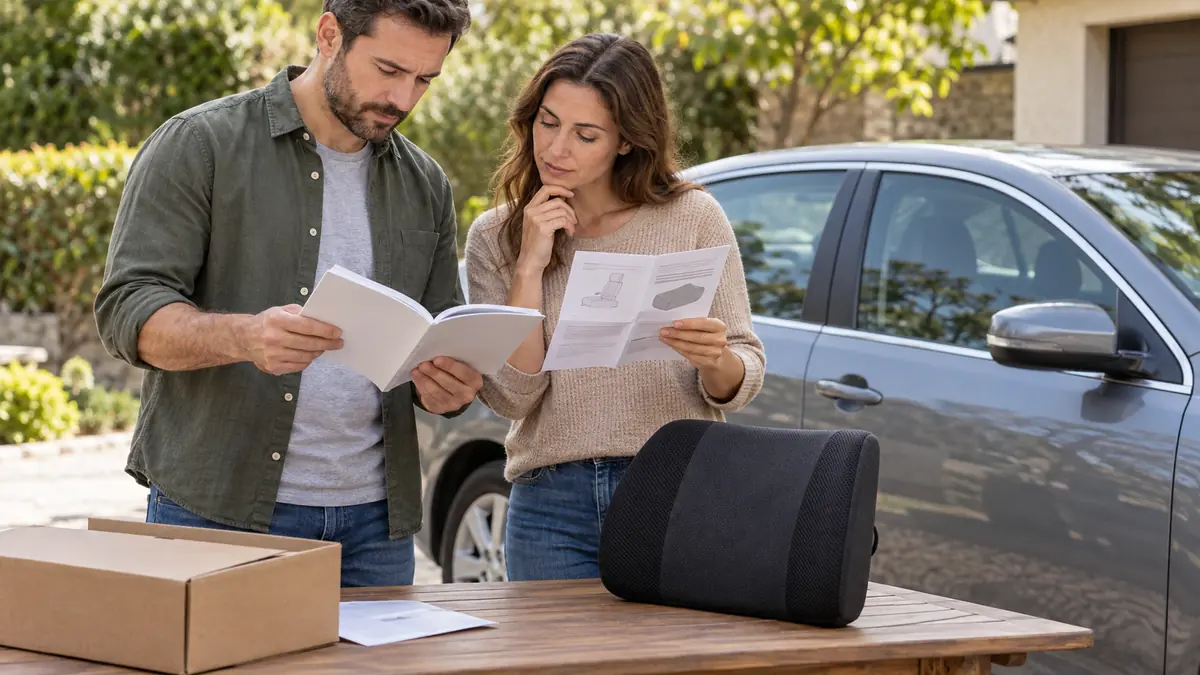
A purchased lumbar support cushion still needs questions answered for the actual vehicle and seat. Delivery, an orthopedic label or an impression of comfort does not establish compatibility or fitness to drive. Keep the product instructions, vehicle guidance, real replies and any correction actually completed together, without treating one as proof of all the others.
Use the product–vehicle–instruction comparison, follow seven essential vehicle follow-up checks, read two fictional writing examples, or download the free offline actual-reply and correction record. Start with one unanswered point; no road test, braking test or longer journey is required.
This guide focuses on follow-through after an accessory has been bought, supplied or proposed for a particular vehicle. The separate seat cushion versus lumbar roll comparison addresses selection-stage questions. Here the task is to preserve the exact scope of an answer and distinguish an agreed correction from work actually completed.
This is general education from a family-caregiver-run website, not a vehicle inspection, accessory approval or individual driving assessment. The operator is not a medical or vehicle-safety professional. No actual product/vehicle combination, manufacturer reply or clinical outcome has been verified by this guide. A completed worksheet certifies nothing.
Table of Contents
Needed care and driving concerns come before accessory follow-up
Do not drive if symptoms or medicine effects impair control, alertness or reactions. A lumbar support does not compensate for that problem. Seek the appropriate individual advice and another transport arrangement. FDA medicine-and-driving guidance describes risks including drowsiness, dizziness, blurred vision and slowed or uncoordinated movement. A cushion purchase does not change a medicine warning or authorize a medicine adjustment.
Back pain with new bladder/bowel changes, numbness around the genitals or anus, or pain, weakness or numbness in both legs needs emergency assessment. Severe sudden or rapidly worsening pain, especially with feeling unwell or fever/shivering, needs urgent advice. See NHS back-pain warnings. Do not drive yourself for emergency care or repeat travel to see whether a support helps. UK sources support symptom education, not U.S. contact numbers.
For a serious emergency, use local emergency services, including 911 in the U.S.; MedlinePlus emergency guidance gives general examples. These are selected warnings, not a complete triage checklist. Needed care must not wait for a seller, vehicle service or completed record. No safe waiting time, diagnostic drive or emergency-braking trial is supplied.
Compare the actual lumbar product, vehicle and instruction scope
A question about one accessory in one seating arrangement is not automatically answered by a reply about another model, a different seat or general back support. Identify known details without publishing a VIN, registration, route or home address. If a relevant feature or instruction is unknown, record that uncertainty rather than assuming compatibility.
| Information to compare | What is actually known | Unresolved point to keep visible |
|---|---|---|
| Lumbar accessory | Actual item, model or version if known, product instructions and whether it was changed. | A product category or general fit claim is not confirmation for this vehicle. |
| Vehicle and seat | Actual vehicle/version, seat position, driver or passenger role and relevant known features. | An answer about another vehicle or seat may be outside scope. |
| Vehicle instructions | Relevant owner-manual edition, section and wording actually read. | An unread link, missing warning or generic manual is not confirmation. |
| Known relationship or concern | An existing question about seating, reach, visibility, restraint relationship or a seat-related system. | No new installation, control test or journey is needed to discover a concern for this form. |
| Reply and conditions | Actual source, answer, exact scope and any conditions it states. | A product explanation, service acknowledgement and vehicle-specific answer are different. |
| Correction and completion | Real agreed action, owner, review or education and what was actually done. | A promise, booking or delivery is not completed correction or verified compatibility. |
Describe whether the item is behind the back, under the occupant or part of the factory seat using known information only. This identifies the question; it is not a placement recommendation. Built-in lumbar adjustment, an added back support and a seat cushion are not interchangeable evidence. Do not infer an accessory dimension or approved installation from this article’s diagram.
Seven essential lumbar support vehicle follow-up checks
Keep the actual accessory identifiable
Record the real item and instructions rather than just lumbar cushion or orthopedic support. Note known product changes, extra layers or a replacement without endorsing them. A purchase receipt can establish purchase, not suitability, correct installation or treatment benefit.
Keep the vehicle, seat and occupant role explicit
Use the actual seat and vehicle guidance. Driver and passenger questions differ, and a reply concerning one seat may not cover another. Do not transfer a prior answer to a different car, model year or seating arrangement by assumption. Keep vehicle identifiers and private locations out of the public page.
Preserve actual instructions and the mismatch
Retain relevant product and vehicle wording, source and known date or edition. Ask which actual arrangement the instruction addresses. If guidance is missing or seems inconsistent, record the specific point. The worksheet cannot choose an interpretation or make an absent warning into permission.
Ask the role that can address the unanswered part
A product source may explain materials or its own manual. A vehicle manufacturer or appropriate service contact can address vehicle-specific information within its remit. Clinical and individual driving questions require their own appropriate advice. No universal sequence of departments or guarantee of an answer is supplied.
Retain the real answer and its conditions
Keep what was actually said, by whom, for which product/vehicle/seat and with what limits. Ask whether the reply addresses the exact question. An acknowledgement, offered appointment or general comfort statement should not be recorded as a completed compatibility answer or clinical assessment.
Separate an agreed correction from actual completion
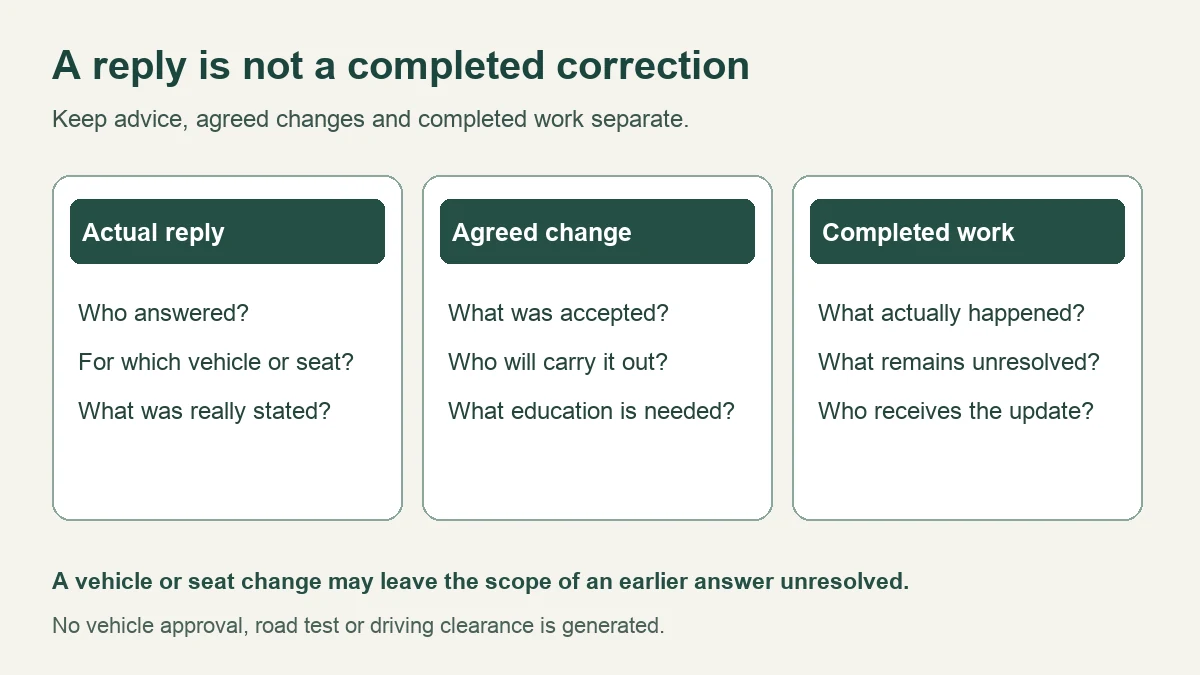
Record the action actually agreed, who accepted it and any education or further review needed. Then describe what really happened. Do not mark a proposed change complete because the item arrived or a service visit was booked. A user-entered completion note is still unverified by this tool.
Carry unresolved needs into the next arrangement
Keep any remaining vehicle, symptom, medicine or assistance question with the accepted next owner if known. A different driver may address the driving role while passenger seating, restraints or transfers remain open. Do not turn a future reply into a reason to delay needed care or invent an interim setup.
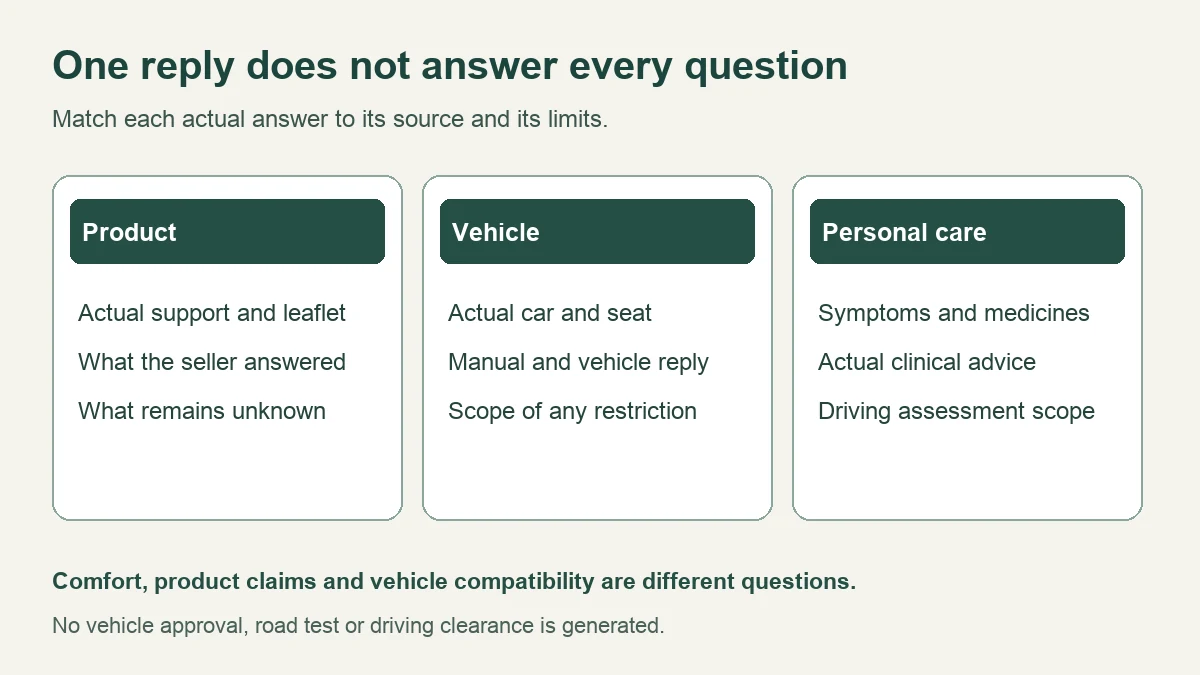
Separate product replies, vehicle information and clinical advice
| Answer received | What it can address in its actual scope | What must remain separate |
|---|---|---|
| Product-source reply | Actual item description, supplied instructions or a feature explanation. | Whether this vehicle and seat permit the actual arrangement; the person’s fitness to drive. |
| Vehicle/manual/service reply | Relevant vehicle information and stated conditions for the actual question. | Diagnosis, symptom significance, medicine effects or driving ability. |
| Clinical or appropriate driving-assessment advice | The individual health or driving question actually assessed. | Automatic approval of every accessory or installation in a vehicle not addressed. |
| Administrative acknowledgement | Receipt or an appointment/status update. | A substantive answer, completed review or correction. |
| Completion report | The action actually reported as completed and by whom. | Independent verification by this website or proof of a safe driving outcome. |
A useful follow-up question is: “Does this answer cover this actual accessory, vehicle and seat? Which part remains outside your answer, what action was agreed, and who will confirm completion?” Retain partial answers without stretching their scope. Do not combine several incomplete replies into a claim that the whole arrangement was approved.
Keep clinical advice separate from product marketing. Less discomfort, a supportive feeling or an orthopedic label does not establish a harmless cause of pain or permission to drive. Likewise, a vehicle answer should not be described as a medical assessment. The record preserves real statements; it does not adjudicate conflicting instructions.
What the driving and restraint sources actually support
CCOHS driving ergonomics explains that vehicle seating involves control reach, visibility and movement demands that differ from ordinary chair sitting. It discusses seat and lumbar adjustment. It does not clinically test the reader’s purchased cushion or approve an actual product/vehicle pairing. Use it to understand why the whole seating relationship matters, not to copy a generic fitting sequence or road-test duration.
NHTSA seat-belt guidance explains proper lap-and-shoulder belt use: the lap portion across the hips rather than the stomach, and the shoulder portion across the chest rather than behind the back or under the arm. These general principles are not an accessory approval. Follow the actual vehicle’s instructions and seek an appropriate answer about an unresolved restraint or seating concern.
Ask about any relevant seat-related systems described in the actual manual instead of assuming every car has the same features or every accessory has the same effect. This article does not claim that every cushion disables an airbag, that all additions are prohibited or that a stationary impression can verify system performance. No safety system should be bypassed or altered to make an accessory work.
FDA medicine-and-driving information supports discussing actual medicines, warnings and effects with the relevant professional. It does not supply a universal delay after a dose or authorize changing treatment to accommodate a journey. Individual symptoms, restrictions and medicine questions remain necessary even if a vehicle-related question is answered.
The NHS moving-and-handling page is background on helping another person move and obtaining appropriate education. It is not condition- or procedure-specific automotive guidance, a lumbar-cushion efficacy study or a source of vehicle approval. Its UK social-care arrangements do not establish services or funding elsewhere. The former article overstated this source’s role; this version limits it explicitly.
Record correction, review and completion without a safety verdict
| Stage | Record the actual event | Do not substitute |
|---|---|---|
| Question prepared or sent | Exact unresolved point, recipient role and known status. | A claim that the issue was assessed. |
| Substantive reply | Actual wording, source and product/vehicle/seat scope. | A generic seller claim or receipt acknowledgement. |
| Action agreed | Real correction/review/education, conditions and accepted owner. | An action invented by the worksheet. |
| Completion | What was done, by whom and which part remains incomplete. | A booking, delivery or promise. |
| Unresolved need | Open question and actual alternative arrangement if supplied. | A safe time to drive, compatibility certificate or assumed care solution. |
No traffic, braking, pedal-force, endurance or symptom-provoking test is needed to complete this record. Existing observations should be recorded after travel, never while the vehicle is moving. If an existing setup is being discussed in person, any review belongs in a safely parked setting and within actual professional and vehicle instructions. This is not an instruction to install the item or a parked self-clearance test.
If a lumbar product, vehicle, seat or other relevant condition changes, preserve the earlier reply and its original scope. Ask whether it still applies rather than silently reusing it. A new note does not confirm a new arrangement. Keep the real answer, remaining conditions and action actually completed together.
Where driving is not appropriate, an alternative driver does not settle every passenger need. Appropriate seating and restraints, access, actual movement instructions and required help remain relevant. For a surgical passenger journey, use the separate lumbar-fusion car travel guide. For symptoms during manual driving, see the manual-driving discussion guide. Neither provides clearance from a cushion record.
Two fictional lumbar support vehicle follow-up examples
These are invented writing examples, not real products, manufacturer replies, vehicle approvals, clinical advice or successful outcomes. Neither supplies an installation method, accessory dimension, test drive or safe journey length. They retain unanswered questions rather than modelling a successful purchase.
Example A: comfort reported, actual vehicle answer absent
| Record | Fictional entry |
|---|---|
| Product / role | A purchased lumbar accessory is being discussed; exact model and vehicle details are not supplied. |
| Known issue | Prior comfort was reported, but relevant owner-manual conditions remain unconfirmed. |
| Reply scope | A product source described general features. No vehicle-specific or individual clinical answer is supplied. |
| Correction / completion | Purchase happened; review, correction and education are not claimed complete. |
| Open question | Which actual vehicle instructions and individual advice apply? No installation, driving permission or outcome is invented. |
A note could say: “The item was purchased and felt comfortable, but the response I have covers product features only. Please clarify the actual vehicle and seat question, what your reply covers, and what review or action remains.” This does not make comfort a reason to try the arrangement in traffic.
Example B: the vehicle or seat changed, previous scope is unconfirmed
| Record | Fictional entry |
|---|---|
| Change | A previously discussed support is proposed with a different vehicle or seat. |
| Earlier reply | Its original scope concerns another arrangement; applicability is not established. |
| Actual response | A service acknowledged a new question. No substantive review or clinical answer supplied. |
| Action / completion | A review or correction is proposed; acceptance, completion and education remain unconfirmed. |
| Remaining need | Retain the real reply, conditions and accepted owner. Alternative driving does not resolve passenger support automatically. |
A note could say: “This arrangement differs from the one covered by the earlier reply. Which instructions and conditions apply now, who has accepted the review, and what correction or education has actually been completed?” The record supplies no temporary setup or permission to wait for a reply when care is needed.
Private lumbar vehicle reply and correction record
Download the offline tool before entering actual health or personal details. Use fictional entries on this webpage because surrounding ads and analytics may be present. The tool itself makes no network requests, uses no browser storage and does not automatically save. Its offline export contains no external assets or automatic network requests.
Begin with one unresolved point. Blank fields create optional questions, not a compatibility score or driving clearance. Omit names, identifiers, private contacts, VINs, registrations, addresses, routes and full medical records. Use relevant information and an agreed private sharing route. Paper with the same headings works; needed care never depends on a full record.
Lumbar support vehicle reply and correction record
Begin with one unresolved point. Blank fields generate questions, not compatibility approval or fitness to drive.
Download the offline tool before entering actual health or care details. Use fictional entries here; surrounding ads and analytics may be present.
Offline copy. No ads, analytics, external assets or automatic network requests.
The tool makes no network requests, uses no browser storage and does not save automatically. Refreshing may lose entries. Omit names, identifiers, private contacts, vehicle identifiers, routes and full reports. Needed care comes before this record.
Start with the fictional example or download a blank offline copy.
Paper alternative: actual product; vehicle and seat; manual; known issue; health question; product response; vehicle answer; individual advice; agreed change; completion; remaining need and owner.
My lumbar support, actual vehicle reply and correction record
Unverified personal record for discussion. Entries verify no diagnosis, advice, completed change or treatment outcome.
Guide: living.kioptrix.com/lumbar-support-cushion-for-driving/
Build, copy, download text or print/save PDF. Editing hides prior output until rebuilt. Example buttons replace entries and label output fictional. Offline copies include current entries and should be kept private. Closing or refreshing may lose unsaved notes. The tool contacts no service, verifies no reply and does not approve or inspect a vehicle.
Common lumbar accessory follow-up questions
Does a seller saying it fits settle my vehicle question?
Not automatically. Keep the actual answer, source and scope. Ask whether the exact vehicle, seat and configuration were addressed and what remains outside the response.
Does less pain establish fitness to drive?
No. Symptom, medicine, individual driving and vehicle questions remain distinct. Do not test ability in traffic to fill a record.
Can the form certify compatibility after every field is filled?
No. All entries remain unverified. There is no pass, approval, safety score or installation prescription.
Can an earlier reply be reused after changing seats or cars?
Do not assume the scope transfers. Preserve the earlier context and ask whether it applies to the actual changed arrangement.
Does another driver solve the whole journey?
No automatic conclusion follows. Passenger seating, restraints, access and help may still need an actual arrangement.
What confirms correction is complete?
Record the actual action and responsible role, relevant education and remaining gap. A promise or booking is different from completed work, and this tool independently verifies neither.
Sources, corrections and review limits
Editorial revision and source check: October 30, 2026. The former short comfort-and-driving overview is rewritten as post-purchase vehicle-specific follow-up. The relief-promising image, repeated preparation card and overstated source description are replaced. The original URL and publication date remain. No cushion dimensions, road test, braking sequence, treatment claim or universal driving timer is supplied.
- CCOHS: Driving and ergonomics — general seating/control/visibility relationships; not a product efficacy or compatibility test.
- NHTSA: Seat belts — general restraint use; not approval of an accessory in an actual vehicle.
- FDA: Some medicines and driving do not mix — medicine warnings and professional discussion; not a personal driving assessment.
- NHS back-pain warnings and MedlinePlus emergency guidance — selected symptom examples, not a complete triage assessment.
- NHS: Moving, lifting and handling someone else — general caregiver education, not vehicle or cushion-specific instructions.
The seven checks, comparisons and tool are editorial communication aids, not validated compatibility or fitness-to-drive instruments. No actual vehicle manual, named product, installation, service response or patient outcome has been independently assessed here. The representative image is an AI-generated fictional instruction discussion beside a parked vehicle; no installation is demonstrated. Diagrams distinguish sources, scope and actual completion. Independent qualified review and reader usability research would strengthen this guide.