
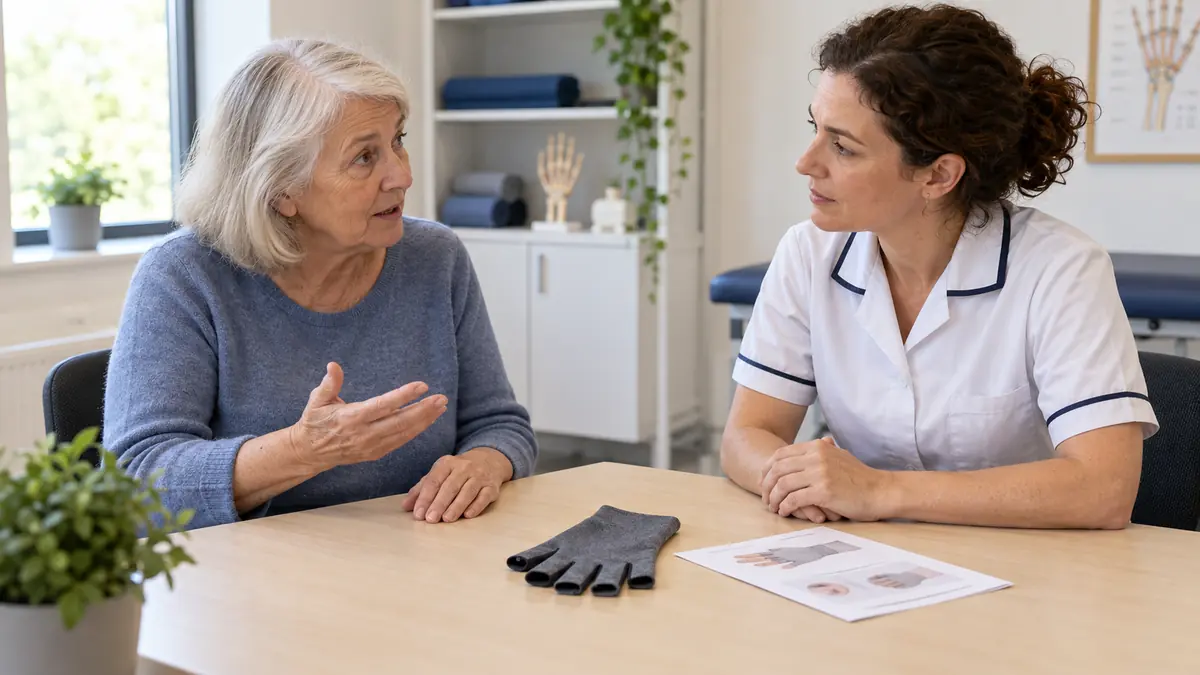
Compression gloves for arthritis raise different questions about pressure, warmth, personal comfort and actual care goals. A glove that feels comforting does not establish why it helped, treat the underlying disease or authorize a harder grip task. This guide connects the evidence question with the actual glove, education received, experience already noticed and the professional answer still needed.
Use the research-scope comparison, follow seven essential comfort and care checks, compare individual instructions with actual wear, read two fictional writing examples, or download the free offline glove discussion record. Start with one question; no purchase or trial is required.
This is general education from a family-caregiver-run site. The operator is not a medical professional and no independent clinical review is claimed. The focus is the purpose of a compression glove and the gap between expected benefit, actual education, lived experience and care follow-through. This article does not select a pressure grade, size, product, wearing schedule or hand exercise programme.
Table of Contents
Respond to a glove concern before completing a record
Pressure soreness, worsening discomfort, a raised itchy rash, fingertip colour changes, pins and needles or numbness should not be treated as proof that compression is working. South Tees’ compression-glove leaflet advises discontinuing wear and contacting the therapist for these concerns. Do not tighten the glove, reproduce the symptom or extend wear to gather evidence. This page supplies no restart instruction.
Severe finger pain, inability to move a finger or hold things, a changed finger shape or colour, or loss of feeling after injury needs urgent medical advice. Fever/shivering with finger pain also needs urgent advice. See NHS finger-pain warning guidance. Do not test grip or use a glove to see whether the problem settles. Use appropriate local services; UK service numbers are not U.S. instructions.
For a serious acute emergency, use local emergency services, including 911 in the U.S. MedlinePlus emergency guidance provides general examples. The warning examples here are not a complete triage checklist. If symptoms are severe, changing or unresolved, needed assessment comes before routine fitting messages or a completed worksheet. No safe waiting interval is supplied.
Compression gloves: what the A-GLOVES trial can and cannot tell you
Read the 2021 A-GLOVES randomized trial with its population and comparison, not as a universal glove verdict.
| Study element | What was examined | Boundary to preserve |
|---|---|---|
| Population | 206 adults with rheumatoid or undifferentiated inflammatory arthritis. | Not every hand condition or postoperative need. |
| Comparison | Compression versus loose-fitting gloves of similar thermal qualities. | Not a no-glove comparison. |
| Outcome and timing | At 12 weeks, no clinically important additional pain, stiffness or function benefit. | Research follow-up, not reader instructions. |
| Reported problems | Reported adverse events: 51% versus 36%; heat/itching disrupted sleep. | Not a prediction for every product or reader. |
Do not infer that ordinary gloves are proven treatment, that pressure caused a person’s comfort, or that no one could feel benefit. A report can be meaningful without identifying its mechanism. This record neither endorses a substitute glove nor dismisses the person’s experience. It asks what the finding means for the actual condition and goal.
A research report is not an individual fitting or wearing instruction. It does not prescribe the study product, research pressure or follow-up period to a reader. Keep a study conclusion, product manual and real professional advice in their separate roles. The earlier description of this research as condition- or procedure-specific “advice” is corrected here.
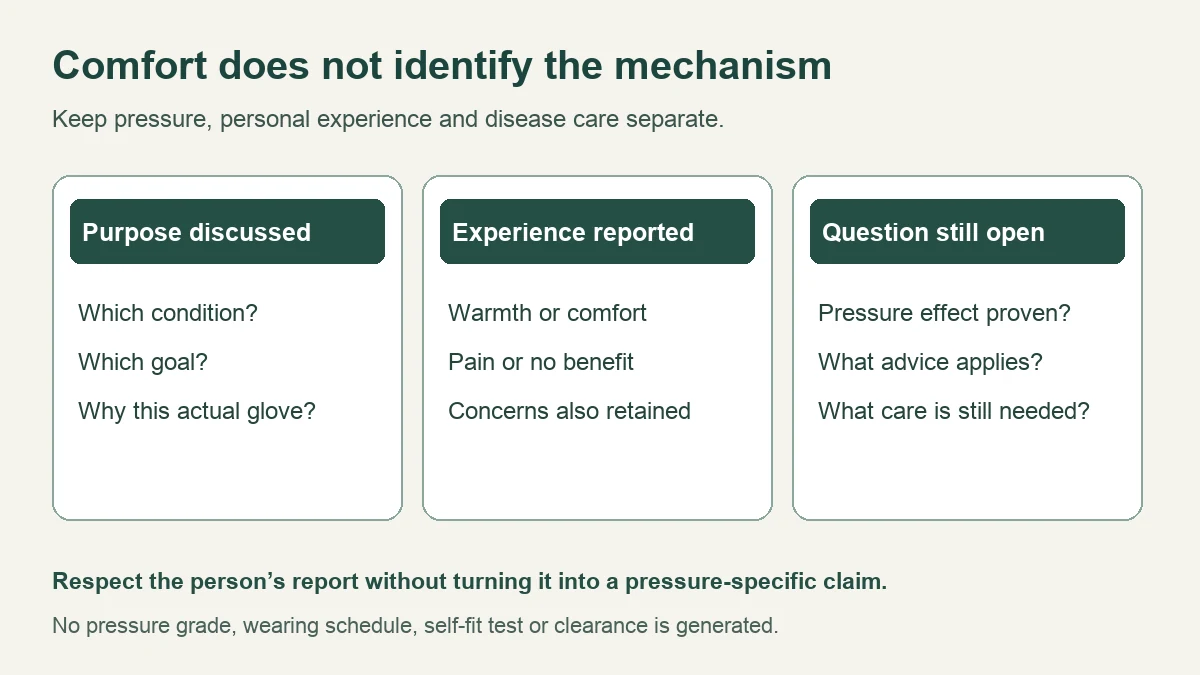
Separate pressure, warmth, comfort and disease treatment
| Question | What to describe | Conclusion not established by the description alone |
|---|---|---|
| Compression purpose | Why this actual glove is being proposed and which condition was explained. | That more pressure will produce more relief or that the product is appropriate. |
| Warmth or comfort | The person’s own words about an experience already noticed. | A pressure-specific effect or proof of tissue recovery. |
| Disease treatment | The actual diagnosis and treatment discussion with the relevant team. | That a comfort aid replaces disease-directed treatment or medicine advice. |
| Practical task | A task already affected and any real instruction or help needed. | That wearing a glove permits a painful grip, more typing or a jar-opening test. |
| Fit and safety | Actual product, education and skin/sensation concerns. | That the absence of an obvious problem establishes suitability or correct fit. |
Ask: “Is the aim compression for a particular care need, warmth, comfort, or something else? What benefit is realistic for the condition explained to me?” A word such as arthritis on a package does not specify the diagnosis, intended outcome or individual plan. Do not self-classify hand pain to match a product claim.
Pain relief, comfort, sleep, hand function and underlying disease control are different goals. A person does not need to prove a functional loss before reporting pain. Equally, a comfortable moment does not establish disease improvement or activity permission. Record both favorable and unfavorable experiences without forcing a single conclusion.
Seven essential compression glove comfort and care checks
Retain the condition and the person’s own priority
Record what condition was actually explained, by whom if known and what remains uncertain. Ask what the person wants help with: pain, comfort, a task, sleep or another concern. Do not diagnose from glove response or assume that all hand symptoms are arthritis.
Name the expected benefit without promising it
Keep a hoped-for benefit separate from evidence and a reported outcome. Ask what supports compression for this goal and what alternatives deserve discussion. There is no buying score, stronger-pressure preference or rule that a reader must try a product before asking.
Identify the actual glove and service involved
Use known model, size, material and product details without inventing a pressure rating. Record whether it was proposed, supplied or changed. A delivery, familiar brand or another person’s recommendation does not establish correct fit. Ask which relevant service should assess the actual concern.
Keep individual education and unanswered instructions
Retain actual fit, wearing, care and problem-response instructions with source and scope. Ask what remains unclear, including day/night use or activities, rather than adopting a universal schedule. Conflicting advice needs appropriate clarification; the worksheet does not choose a prescription.
Describe actual wear or non-use without a test
Record events already experienced, or not used or stopped. No minimum days, grip challenge, extra typing, tighter glove or overnight trial is needed. If a symptom concern occurs, take the appropriate care route rather than collecting a complete log.
Keep comfort and concerns side by side
Preserve the person’s report of warmth, comfort, pain, no benefit or mixed experience. Record skin, sensation, colour or practical concerns separately. Timing alone does not diagnose poor circulation, allergy or a fit error. A favorable experience does not cancel a concerning change.
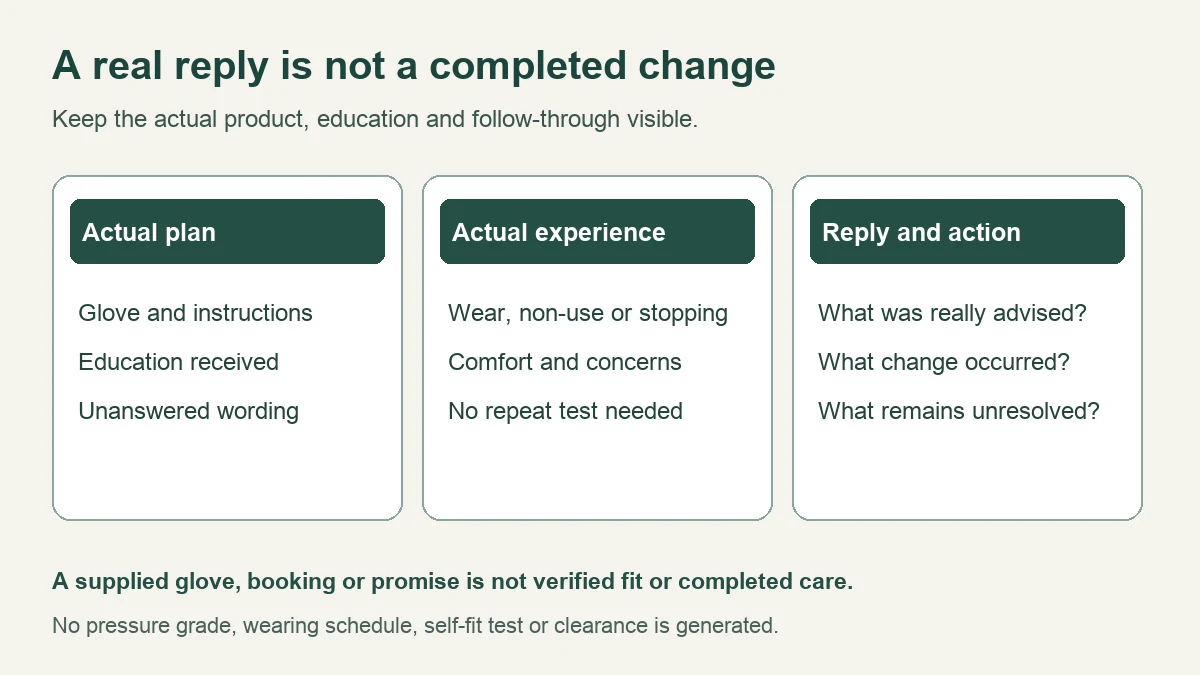
Close the gap between reply and implemented change
Keep actual contact, real professional answer, agreed change, education received and action completed distinct. Identify the real next owner if accepted; leave unknown if not. A booked review, promised replacement or sent message is not completed care or proof of a resolved symptom.
Compare the proposed glove plan with actual wear and education
| Topic | Actual advice or proposal | Actual event / gap to discuss |
|---|---|---|
| Purpose and product | Condition, care goal and actual glove addressed by the team. | Does the supplied product match the discussion? What is unknown? |
| Fit and wearing education | Instructions actually given and teaching received. | What education happened, what was only scheduled and what remains unclear? |
| Day/night and task context | Individual instructions for the actual person and device. | Actual wear or non-use; no universal overnight or grip routine inferred. |
| Comfort and problems | Person’s report and any response advice already supplied. | What was noticed, stopped or communicated without another exposure? |
| Review and change | Actual answer and agreed action, if received. | Was the change or teaching completed, and what need remains open? |
A useful question is: “This was the purpose discussed, this is the glove supplied, this is the education received, and this is what already happened. What individual explanation or change applies, who will provide any needed teaching, and what has actually been completed?” This asks for clarification without presenting a family interpretation as a clinical finding.
A glove is also not interchangeable with a wrist splint. The separate wrist-splint and typing guide addresses that device discussion. Do not transfer a night-splint recommendation or task instruction to a compression glove. This page focuses on glove purpose, individual education and actual experience rather than a keyboard setup.
For symptoms or glove questions, ask the relevant clinician, hand therapist or designated device service which role can answer. A seller can describe the product but does not thereby assess the person. If the explanation addresses washing or material only, keep the benefit, fit or symptom question open rather than marking every issue resolved.
Problem responses and practical limits need their own plan
South Tees’ patient leaflet separates precautions from wearing and care advice. It also warns that grip can be reduced while driving. This is guidance for the glove service described, not a trial proving effectiveness or a universal plan for every glove. Ask about actual activity instructions and do not assume a glove is suitable because it feels supportive.
Use the individual skin-check and care education actually received. Do not turn “check fit” into a home pressure test, add layers or cut or alter a glove from this article. Ask the relevant team about an unresolved issue and appropriate next steps. Stopping for a concern does not supply a self-selected restart plan or a substitute product recommendation.
A generic hand exercise, grip routine or medicine change is outside this page. Needed disease care and symptom assessment should not be delayed for shopping, a diary or a product experiment. If prescribed treatment raises a question, retain the real advice rather than treating the glove as a replacement. Comfort and a treatment decision are different facts.
Keep relevant notes private and share with appropriate agreement through the service’s actual route. A helper can record what was witnessed without overriding the person’s account. The worksheet does not grant access to records, assess decision-making ability or contact anyone automatically.
Two fictional compression glove discussion examples
These are invented writing examples, not actual patients, product tests, prescriptions or successful outcomes. Neither supplies a pressure, wearing duration, self-fit test or new treatment. They show how to preserve uncertainty and a real concern without asking for another trial.
Example A: comfort is reported, pressure-specific benefit is unconfirmed
| Record | Fictional entry |
|---|---|
| Condition and goal | A hand arthritis diagnosis was reportedly explained; the person wants comfort. Exact diagnosis and current instructions are not supplied. |
| Actual experience | Warmth and comfort were reported from prior wear. No extra session or grip test requested. |
| Interpretation | The person wonders whether compression caused the benefit. That mechanism is not established by the account. |
| Question / actual answer | Ask about relevant evidence, actual purpose and individual advice. A question is drafted; no professional reply supplied. |
| Next action | No new product, completed teaching or promised benefit is claimed. The unanswered purpose and advice remain visible. |
A note could say: “The glove felt warm and comfortable. I do not know whether compression explains that experience. For the condition explained to me, what is the actual goal, what benefit is realistic, and what advice applies to this glove?” The person’s experience is retained without turning it into proof of a pressure effect.
Example B: comfort and a sensation concern coexist
| Record | Fictional entry |
|---|---|
| Experience | Warmth or comfort and tingling were noticed during prior wear. |
| Action | Wear stopped in line with published stop-and-contact advice. No repeat exposure requested. |
| Uncertainty | Cause and clinical urgency are not determined by the record. Appropriate help must not wait for a fuller note. |
| Actual answer / change | No individual explanation, restart permission, fitting correction or completed education is supplied. |
| Remaining need | Communicate the concern through the appropriate route, retain the real answer and confirm required follow-through. Urgent signs take the urgent route. |
A note could say: “The glove felt comforting, but tingling was also noticed and wear was stopped. I need the concern addressed, not a stronger glove or another trial. What individual advice applies and what review or education is needed?” This is not a reason to wait for routine office hours or label the cause as poor fit without assessment.
Private compression glove, education and actual-answer record
Download the offline tool before entering actual health or care details. Use fictional entries on this webpage because surrounding ads and analytics may be present. The tool itself makes no network requests, uses no browser storage and does not automatically save. The offline export has no external assets or automatic network requests.
Start with one question. Blank fields produce optional questions, not a diagnosis, fit score or wearing plan. Omit names, addresses, identifiers, private contacts, skin photographs and full reports. Paper with these headings works. Needed care and appropriate advice come before a completed form.
Compression glove, education, experience and actual-answer record
Begin with one question or concern. Blank fields generate optional questions, not a fit score, wearing plan or treatment recommendation.
Download the offline tool before entering actual health or care details. Use fictional entries here; surrounding ads and analytics may be present.
Offline copy. No ads, analytics, external assets or automatic network requests.
The tool makes no network requests, uses no browser storage and does not save automatically. Refreshing may lose entries. Omit names, identifiers, private contacts and full reports. Needed care comes before this record.
Start with the fictional example or download a blank offline copy.
Paper alternative: condition; goal; actual glove; education; wear or non-use; comfort; concern; contact; real answer; completed change; remaining need and owner.
My glove, education, experience and actual answer
Unverified personal record for discussion. Entries verify no diagnosis, advice, completed change or treatment outcome.
Guide: living.kioptrix.com/compression-gloves-for-arthritis/
Build, copy, download text or print/save PDF. Editing hides the old result until rebuilt. Example buttons replace entries and mark the result fictional. Offline exports include current entries, so keep completed files private. Closing or refreshing may lose unsaved notes. Nothing is sent, fitted or clinically verified by the tool.
Common questions about compression gloves for arthritis
Does comfort prove the pressure is helping?
No causal conclusion follows from that report alone. Keep comfort meaningful in its own terms and ask what explains the actual care goal.
Does the research prescribe a pressure or twelve-week trial?
No. The study population, comparison and follow-up are research features, not instructions for the reader.
Can this choose a glove size or overnight schedule?
No. Ask about the actual device and individual fit and wearing education. No score, measurement rule or universal schedule is generated.
Should I keep wearing it to show the symptom?
No repeat exposure is needed for the record. Follow the problem-response advice above and obtain appropriate help for the concern.
Does an appointment mean the issue was corrected?
No. Keep actual review, explanation, teaching and completed change separate from a booking or promise.
Can I use the glove instead of prescribed arthritis care?
This page gives no replacement plan. Keep disease treatment and comfort aids separate and discuss actual treatment questions with the relevant professional.
Sources, corrections and editorial limits
Editorial revision and source check: October 30, 2026. This version expands the trial comparison and boundaries, separates compression from reported comfort, adds device-specific problem advice and replaces the repeated preparation card and generic artwork. The original URL and publication date remain. No pressure grade, overnight timetable, treatment trial, shopping ranking or grip challenge is prescribed.
- A-GLOVES randomized trial, 2021 — defined inflammatory-arthritis population, glove comparison and outcomes; not an individual wearing instruction.
- South Tees: Isotoner/compression glove patient leaflet — selected precautions and contact advice for its service; not comparative efficacy evidence or a universal schedule.
- NHS finger-pain guidance — selected urgent symptom examples, not a diagnosis from a glove response.
- MedlinePlus: Recognizing medical emergencies — general emergency examples, not a complete triage assessment.
The comparisons and seven checks are editorial communication aids, not a comprehensive systematic review or validated suitability instrument. No independent clinical reviewer, direct product test, verified fitting or reader-outcome study is claimed. The representative image is an AI-generated fictional glove discussion, not a demonstration of correct wear or a promised result. Two diagrams explain purpose, experience and actual follow-through. Qualified review and independent reader usability research would strengthen the resource.