
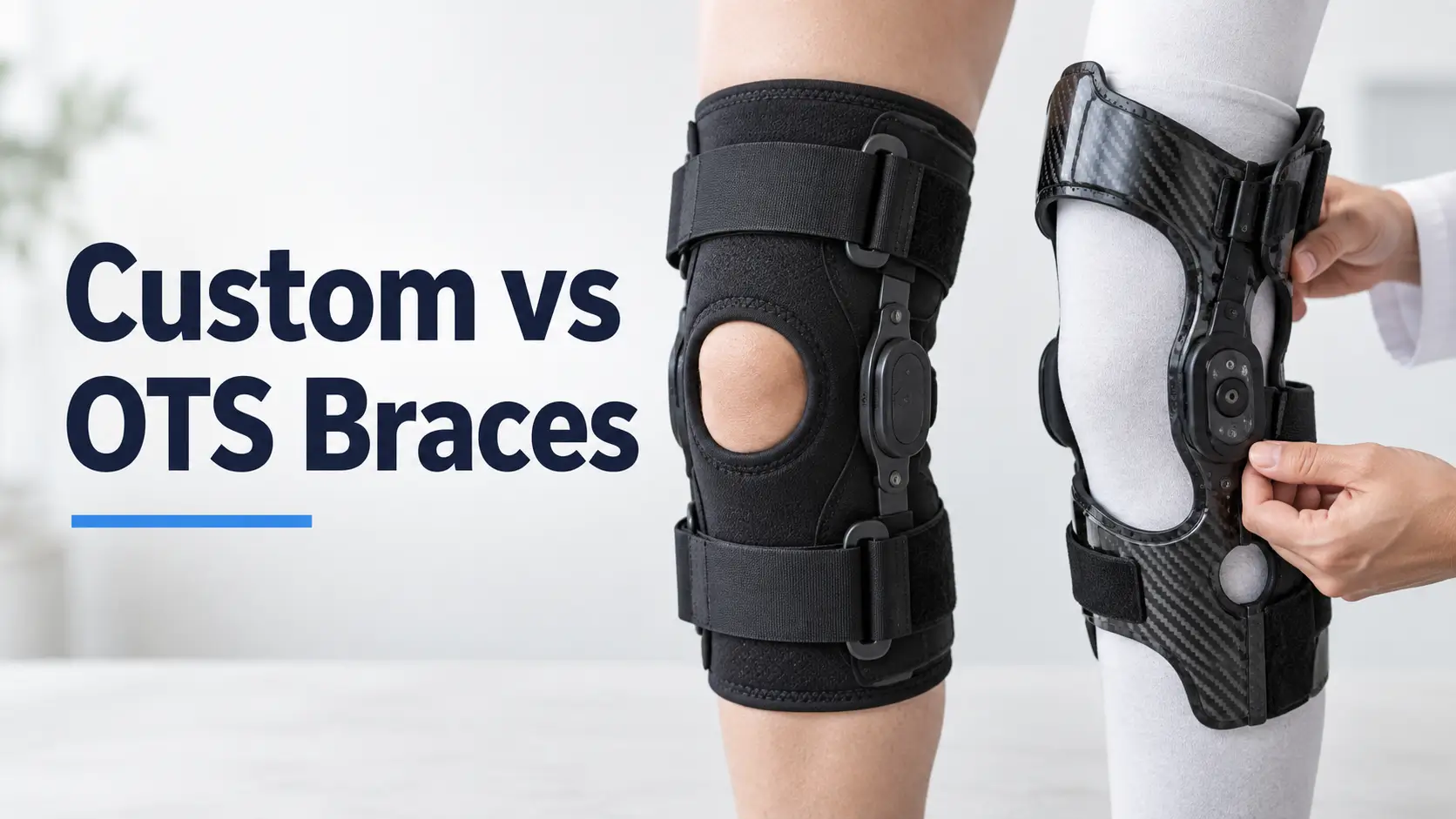
The main difference between a custom-fit and an off-the-shelf orthopedic brace is not simply price or comfort. It is how much professional modification the brace requires to fit and function correctly. An off-the-shelf brace is prefabricated and requires only minimal adjustment. A custom-fitted brace may also start as a prefabricated product, but it requires more substantial modification by someone with appropriate expertise. A truly custom-fabricated brace goes a step further and is individually manufactured for one patient.
That distinction matters when comparing braces for knee instability, ankle problems, spinal support, post-surgical protection, or other orthopedic needs. It can also affect billing codes, Medicare coverage, supplier requirements, follow-up adjustments, and what documentation is needed to justify a more individualized device.
Table of Contents
Custom-fit, custom-fabricated, and off-the-shelf are not the same thing
The terminology is easy to blur together, especially because braces sold online may use words such as “customizable” or “custom fit” as marketing language. Medicare uses more specific definitions.
Under CMS DMEPOS quality standards, an off-the-shelf, or OTS, orthosis is a prefabricated device that needs only minimal self-adjustment for appropriate use. Its fitting does not require specialized expertise in trimming, bending, molding, assembling, or otherwise modifying the device for a particular patient.
A custom-fitted orthosis can still be prefabricated. The important difference is that it requires individualized modification by a person with appropriate expertise. The key is whether the final fitting requires specialized expertise beyond minimal self-adjustment. Simple bending or trimming for comfort can still count as minimal adjustment; the action alone does not establish a custom-fitted classification.
A custom-fabricated orthosis is different again. CMS describes it as an item made individually for a specific patient using clinically derived measurements, casts, tracings, scans, images, or other patient-specific information. It may involve substantial fabrication from basic materials before the final fitting.
| Brace type | How it is made or fitted | Typical adjustment level |
|---|---|---|
| Off-the-shelf | Prefabricated in standard sizes | Minimal self-adjustment |
| Custom-fitted | Prefabricated but professionally modified for the patient | More than minimal adjustment |
| Custom-fabricated | Individually made for one patient | Patient-specific fabrication and fitting |
This terminology is particularly important when insurance is involved. A brace advertised commercially as “custom fit” is not automatically a custom-fitted or custom-fabricated orthosis under Medicare coding rules.
When an off-the-shelf brace may be enough
An off-the-shelf brace can be entirely appropriate when the required support is available in a standard design and the brace can be fitted correctly with basic adjustments.
A prefabricated knee brace may remain off-the-shelf after basic fitting adjustments. Under the CMS Knee Orthoses Policy Article, the same prefabricated product can be classified differently depending on whether the final fitting requires specialized expertise. Permanent modification alone is not the dividing line. Ask the supplier to explain the fitting work and the proposed billing code.
This can make OTS braces attractive when a patient needs a device quickly. There is no fabrication period, and standard sizing may work well for people whose limb shape and dimensions fall comfortably within the manufacturer’s sizing system.
However, choosing a brace solely because it is available immediately can backfire if the device shifts, creates concentrated pressure, interferes with movement, or does not provide the intended stabilization. The useful question is not simply whether the brace fits around the limb, but whether it performs the clinical job for which it is being used.
If you are comparing braces because of insurance costs, see the related guide to orthopedic brace insurance coverage before assuming that buying a more expensive brace automatically produces better reimbursement.
When a custom-fitted brace can make sense
A custom-fitted brace occupies the middle ground that is often overlooked. The brace itself may be manufactured in quantity, but meaningful modification is required before it can appropriately fit the individual patient.
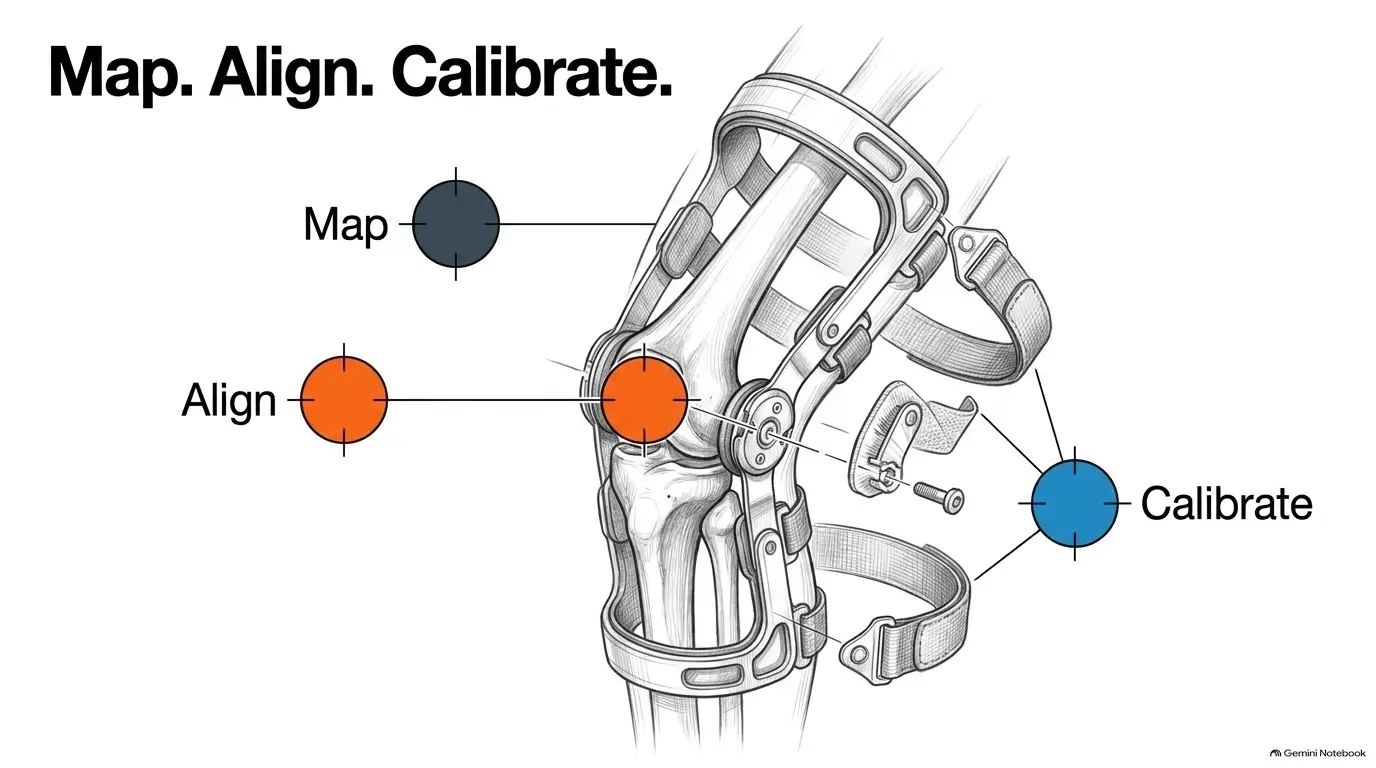
This may matter when the standard configuration does not properly align with the patient’s anatomy, when hinges or structural components need skilled adjustment, or when simply tightening straps cannot produce the required positioning and support.
The distinction is not merely semantic under Medicare rules. CMS states in its Knee Orthoses Policy Article that a prefabricated orthosis can be either off-the-shelf or custom-fitted. The determining factor is the fitting work required for the particular beneficiary.
For patients, this means two braces that look nearly identical can potentially be treated differently for coding purposes if one requires only minimal adjustment while the other requires substantial modification by a qualified practitioner.
When a custom-fabricated brace may be justified
Custom fabrication becomes more relevant when a standard-size or professionally modified prefabricated brace cannot adequately accommodate the patient’s anatomy or clinical requirements.
For Medicare-covered knee orthoses, the CMS Knee Orthoses Local Coverage Determination states that a custom-fabricated orthosis may be covered when a documented physical characteristic requires it instead of a prefabricated orthosis. Examples include deformity of the leg or knee, unusual relationships between thigh and calf size, or minimal muscle mass on which the brace can be suspended.
Importantly, those examples do not mean every patient with an unusual body shape automatically needs a custom-fabricated brace. CMS also instructs suppliers to consider prefabricated alternatives where appropriate, such as different sizes or longer straps.
That creates an important practical test: what problem does the custom device solve that an appropriately selected prefabricated brace cannot?
If nobody can clearly answer that question, it is worth asking for a more detailed explanation before accepting the higher-cost option.
Fit affects more than comfort
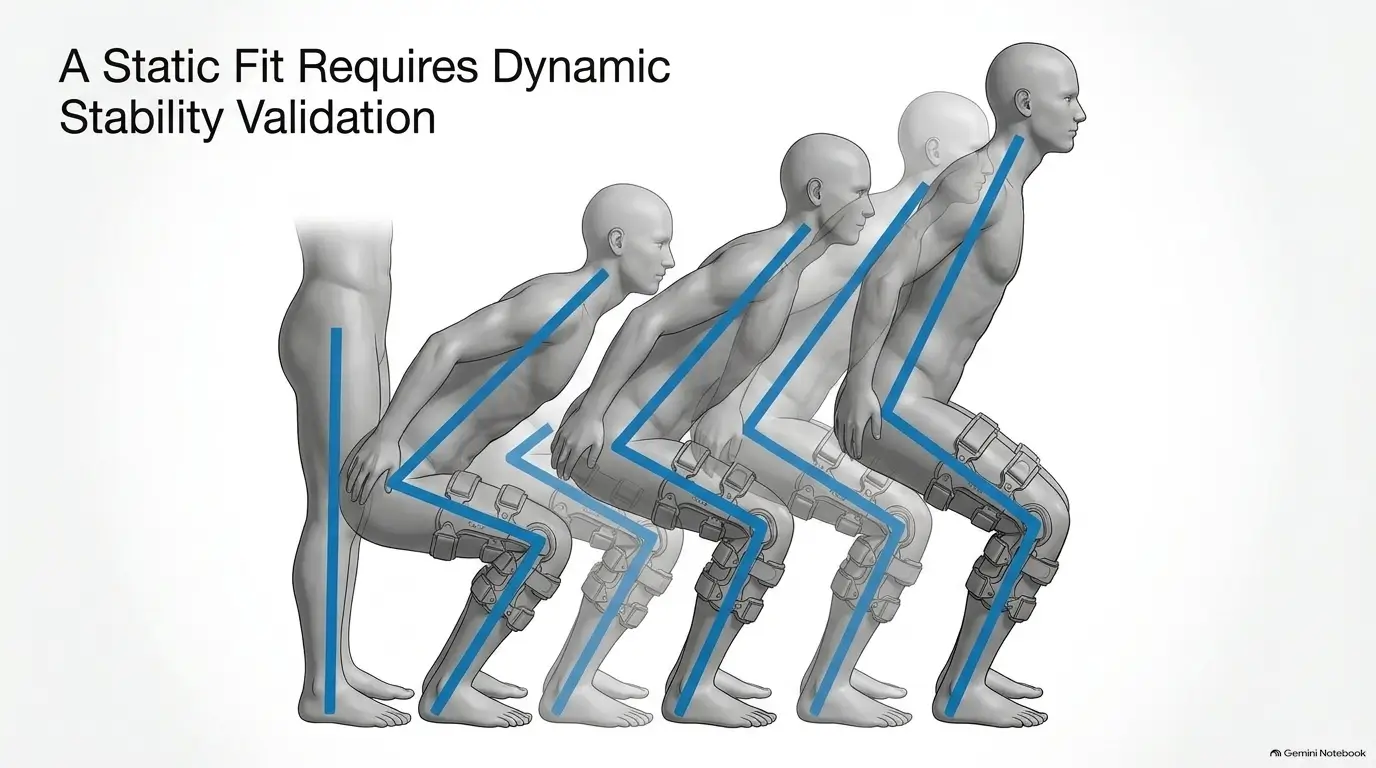
Patients understandably focus on whether a brace feels comfortable, but orthopedic brace fit also affects whether structural components remain in the intended position while the wearer moves.
A knee brace designed to help control instability, for example, cannot perform as intended if it continually slides down the leg or if its mechanical joints sit in the wrong position. An ankle brace may need to limit particular movements without creating excessive pressure elsewhere.
If you are deciding between different types of ankle support, the separate comparison of an ankle brace versus a walking boot explains why the amount of immobilization needed can matter as much as the brace’s fit.
Likewise, someone evaluating a hinged knee device may want to understand what those joints are intended to accomplish before focusing on custom versus standard sizing. The guide to a hinged knee brace for stairs looks more closely at that type of support.
Custom does not automatically mean clinically better
It is tempting to treat brace selection as a simple ladder: off-the-shelf at the bottom, custom-fitted in the middle, and custom-fabricated at the top. That is the wrong mental model.
These categories describe different methods of providing an orthosis. They do not form a universal quality ranking.
A properly selected off-the-shelf brace may meet the clinical need without unnecessary complexity. Conversely, a patient whose anatomy prevents a prefabricated brace from functioning correctly may have a strong reason for individualized fabrication.
CMS’s rules for lower-limb orthoses illustrate this point particularly well. Its lower-limb orthoses compliance guidance explains that for certain prefabricated devices there may be no physical difference between a brace coded as custom-fitted and one coded as off-the-shelf. The deciding issue is whether more than minimal self-adjustment is required.
How Medicare coverage changes the comparison
For Original Medicare, braces fall within the broader prosthetics and orthotics benefit under Medicare Part B when applicable requirements are met. CMS includes arm, leg, back, and neck braces within its DMEPOS framework, as described on its DMEPOS overview.
Coverage is not based simply on whether a doctor recommends “a brace.” The particular orthosis, diagnosis, medical necessity, documentation, supplier requirements, and relevant HCPCS code can matter.
For some knee orthoses, for example, CMS requires documentation of objective instability, a qualifying recent injury or surgery, or other code-specific conditions. When a custom-fabricated knee orthosis is billed, the medical record must also support why a prefabricated alternative is not sufficient.
That is why a discussion about the brace’s billing code can be more useful than asking only whether Medicare “covers custom braces.” Coverage rules apply to specific devices and circumstances rather than to every product carrying a custom label.
Questions to ask before paying for a custom brace
- Is this brace off-the-shelf, custom-fitted, or custom-fabricated under the insurer’s actual coding rules?
- What specific anatomical or functional problem makes this option preferable?
- Could a prefabricated brace provide the required stabilization if professionally fitted?
- What fitting work requires specialized expertise beyond minimal self-adjustment, and how will the supplier document it?
- What HCPCS code will the supplier bill?
- Does my insurance require prior authorization or particular documentation?
- Is the supplier in network or enrolled appropriately for my coverage?
- What will I owe if the insurer denies the claim?
- Are follow-up fitting and adjustments included in the quoted price?
These questions are especially useful before delivery because coverage disputes can become harder to untangle after a brace has already been supplied and billed.
What if insurance denies the more expensive brace?
A denial does not necessarily mean that no brace is medically appropriate. The dispute may concern the particular code, the documentation supporting medical necessity, whether a prefabricated alternative could have been used, supplier requirements, or another plan-specific condition.
Start by comparing the denial notice with the prescription, clinical notes, supplier documentation, and the exact brace code that was billed. If the problem involves missing evidence for a patient-specific device, ask the prescribing clinician or supplier what documentation was submitted to establish why a less individualized brace would not work.
The guide to a denied brace insurance appeal explains how to organize the next steps without assuming that every denial has the same cause.
A practical way to choose between the two
Instead of beginning with “Do I need a custom brace?”, start with the function the brace must perform.
- Define the clinical job. Is the brace intended to stabilize an unstable joint, restrict movement after injury or surgery, unload part of a joint, correct positioning, or serve another purpose?
- Check whether a standard device can perform that job. A prefabricated brace should not be dismissed merely because a custom option exists.
- Identify any fitting problem. Look for anatomical differences, poor suspension, pressure points, alignment problems, or other reasons a standard fit is inadequate.
- Determine what modification is actually required. Minimal strap adjustment points toward OTS classification; substantial professional modification may make the device custom-fitted.
- Ask whether individual fabrication is necessary. If so, the clinical record should explain what makes a prefabricated alternative insufficient.
- Verify coverage before delivery when cost matters. Ask about the HCPCS code, medical-necessity requirements, supplier status, authorization rules, and estimated patient responsibility.
Use these steps as questions for your clinical team and supplier, rather than as a way to select or modify a brace yourself. The treatment plan and prescribed restrictions need individual assessment.
The bottom line
An off-the-shelf orthopedic brace can be the right choice when a standard prefabricated device provides the required support with minimal adjustment. A custom-fitted brace becomes relevant when that prefabricated device needs skilled, patient-specific modification. A custom-fabricated brace is individually made and generally requires a clearer reason why prefabricated alternatives are inadequate.
Before paying extra for customization, ask what problem the customization solves. If insurance is involved, also ask how the brace will be coded and what documentation supports that classification. Those answers usually tell you more than the word “custom” printed on a brochure or product page.
Sources, scope, and editorial update
Checked October 27, 2026. The two CMS documents below display a revision effective date of January 25, 2026. They concern U.S. Medicare knee orthoses; check the policy version effective on your date of service and the requirements for your particular device and plan.
CMS Knee Orthoses Policy Article A52465: see Coding Guidelines for the distinction between off-the-shelf and custom-fitted prefabricated devices. Basic bending or trimming can still be minimal adjustment. The classification turns on the expertise required for the final fitting, rather than the presence of a modification alone.
CMS Knee Orthoses LCD L33318: see Coverage Guidance for device-specific eligibility and the Custom Fabricated Knee Orthoses section for documentation supporting a custom-fabricated device instead of a prefabricated alternative. Meeting a general description does not guarantee claim payment.
What changed: clarified minimal adjustment versus specialized fitting, identified the limits of knee-specific coverage examples, and added publisher and source transparency. This article does not compare clinical outcomes or recommend a brace for an individual. No independent clinician or insurance specialist has reviewed this update. Publisher: Hong Dal Oh, Living by Kioptrix. Contact the publisher about an error; do not send medical records or insurance identifiers.