
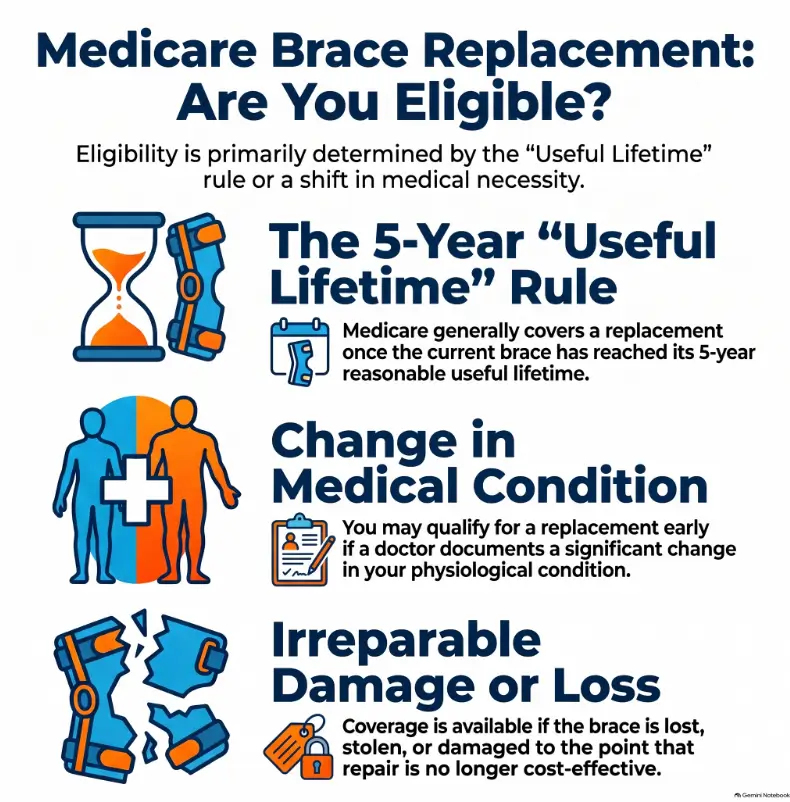
Medicare’s five-year rule is a replacement-payment guideline, not a promise of a free orthopedic brace every five years. Many orthoses have a five-year reasonable useful lifetime, but some knee braces have shorter, code-specific periods. Earlier replacement may also be considered when a brace is lost, stolen, damaged beyond repair by a specific incident, or no longer appropriate because your medical condition has changed.
Jump to the knee-brace HCPCS code table · Find your billing code
This guide focuses on U.S. Original Medicare. Before accepting a replacement, ask your supplier to identify the old brace’s billing code, delivery date, and applicable replacement policy. If you have Medicare Advantage, also check your plan’s approval and supplier requirements.
Table of Contents
What the five-year rule actually measures
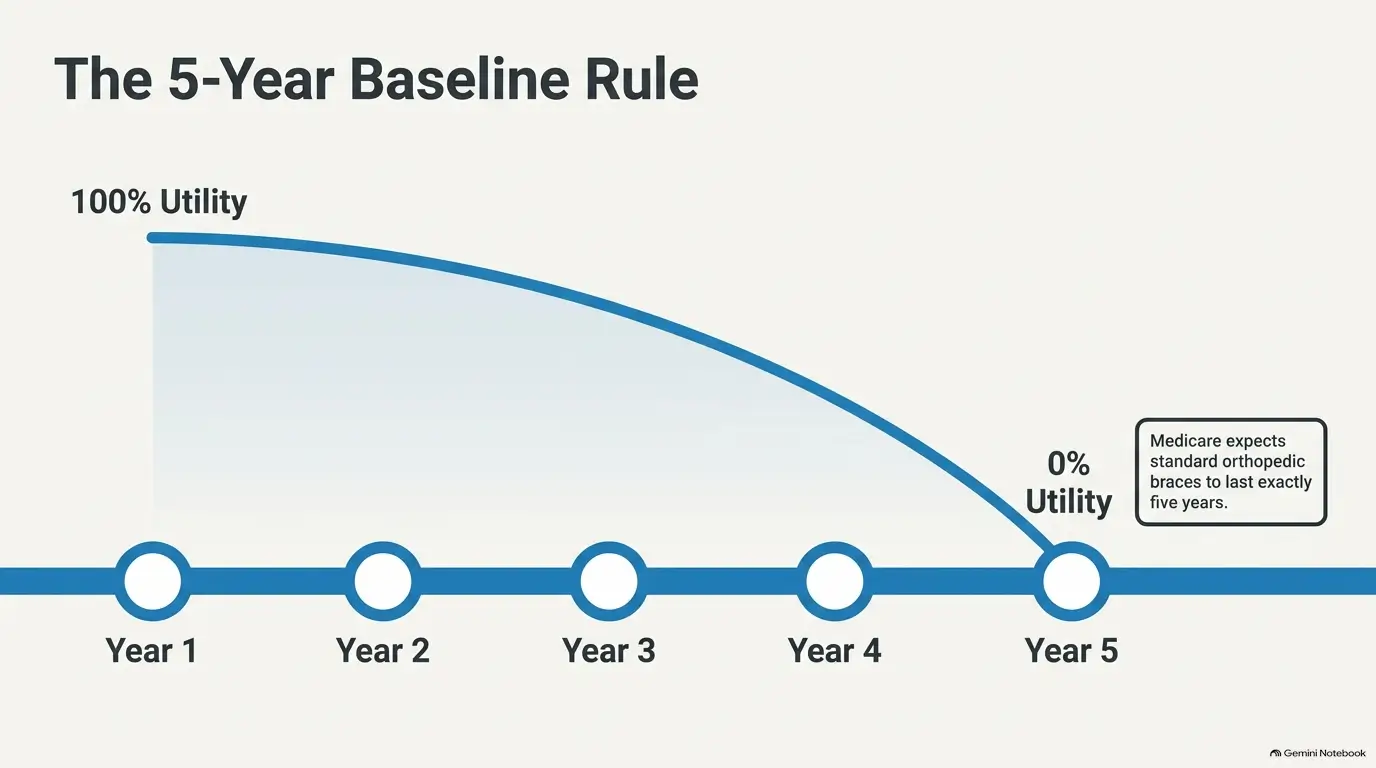
Reasonable useful lifetime, or RUL, is the period Medicare uses when considering how often it should pay to replace an item under normal use. The joint Medicare contractor guidance on useful lifetime, revised December 11, 2025, describes a general minimum of five years unless a national or local coverage policy specifies otherwise.
The clock is based on when the item was delivered to you, rather than its manufacturing date. RUL is also separate from the manufacturer’s warranty. A warranty expiring after a shorter period does not automatically make Medicare responsible for a new brace.
After the applicable RUL, someone who has continuously used the item may elect replacement under the relevant rules. Coverage still depends on medical need and required documentation. The anniversary alone does not establish that a particular new brace is covered.
Why a knee brace may follow a different schedule
Joint Medicare contractor guidance for orthoses identifies exceptions for certain knee braces with one-, two-, or three-year useful lifetimes. The applicable period depends on the HCPCS billing code, which identifies the type of device billed to Medicare.
Ask the supplier to check your exact code against the version of the Knee Orthoses Policy Article, A52465, that applies to your service date. A description such as “hinged knee brace” is not enough to determine the replacement interval.
Knee brace replacement periods by HCPCS code
Scope: knee orthoses only. These are Medicare reasonable useful lifetime (RUL) periods, not warranty lengths or automatic replacement entitlements.
| HCPCS code | RUL |
|---|---|
| L1810 | 1 year |
| L1812 | 1 year |
| L1820 | 1 year |
| L1821 | 1 year |
| L1830 | 1 year |
| L1831 | 2 years |
| L1832 | 2 years |
| L1833 | 2 years |
| L1836 | 3 years |
| L1843 | 3 years |
| L1845 | 3 years |
| L1850 | 2 years |
| L1851 | 3 years |
| L1852 | 3 years |
Custom-fabricated knee orthoses: the same policy separately specifies a 3-year RUL. Do not infer the billing category from the word “custom” in an advertisement.
Official source: CMS Knee Orthoses Policy Article A52465, Coding Guidelines → Repair/Replacement. Checked October 27, 2026; the displayed current version is effective January 25, 2026. Confirm the version applicable to your service date.
How to find and confirm your brace code
- Start with the paperwork. Look for a five-character HCPCS code beginning with L on your itemized supplier bill or claim details. A product name or model number is not enough.
- Ask the original supplier if the code is missing. Request the code actually billed, the delivery date, and the body part and side. Keep the original and proposed replacement codes separate in your notes.
- Use an exact match. Find that code in the table, then ask the supplier to confirm the applicable policy and starting date. If it is absent, leave the period unresolved; do not choose the nearest-looking code or assume five years.
- Confirm the proposed replacement before delivery. Ask for the replacement reason, required order or approval, and a written estimate of what you could owe. If you use Medicare Advantage, ask your plan as well.
Call prompt: “What code was billed for my old brace, when was it delivered, which policy sets its useful lifetime, and what evidence supports replacement now?” Record the answer and who provided it; do not post Medicare identifiers or medical records publicly.
For a back brace needed before the usual interval, use the early-replacement supplier call record. The knee-code table above does not establish a back-brace interval.
Early replacement: what happened to the original brace?
The reason for replacement matters. Under the joint orthoses guidance, loss, theft, irreparable accidental damage, and a documented change in medical or physiological condition can support consideration before the normal useful lifetime ends. A claim may initially be denied as “same or similar” and require review of supporting records.
For a medical change, the treating practitioner’s records should explain why the previous orthosis no longer meets your needs. An orthotist’s assessment can support that explanation, but supplier statements alone do not establish medical necessity.
Noridian’s replacement guidance distinguishes damage from wear. Damage comes from an identifiable event, such as a fire or accident. Wear develops through ordinary use over time. Replacement for ordinary wear is not covered during the applicable RUL merely because the item has deteriorated.
For example, a brace destroyed in a house fire and a brace with straps worn down through daily use present different replacement questions. These are hypothetical examples, not coverage decisions. For loss or damage, keep a dated explanation and any available incident documentation; the contractor may request a beneficiary statement, insurance report, or police report.
Check repair and warranty options
A loose strap or damaged component does not always require an entirely new brace. Ask the supplier whether adjustment, repair, or a replacement part can restore its function. Medicare contractor guidance on repairs allows payment for qualifying repairs to beneficiary-owned items when necessary to make them serviceable.
Parts or labor covered by a manufacturer’s or supplier’s warranty cannot also be billed to Medicare. Ask for an explanation of warranty coverage and a repair estimate before authorizing work. A repair assessment can also clarify whether the problem is ordinary deterioration or damage from a specific event.
What to confirm before accepting another brace
Use these questions to make the conversation with your supplier specific:
- What are the old and proposed braces’ HCPCS codes, and which body part and side do they cover?
- When was the previous brace delivered, and what useful lifetime applies?
- Is there a previous Medicare-paid item that could trigger a same-or-similar denial?
- What evidence supports replacement, and which records are still missing?
- What would I owe if Medicare pays—and if it denies payment?
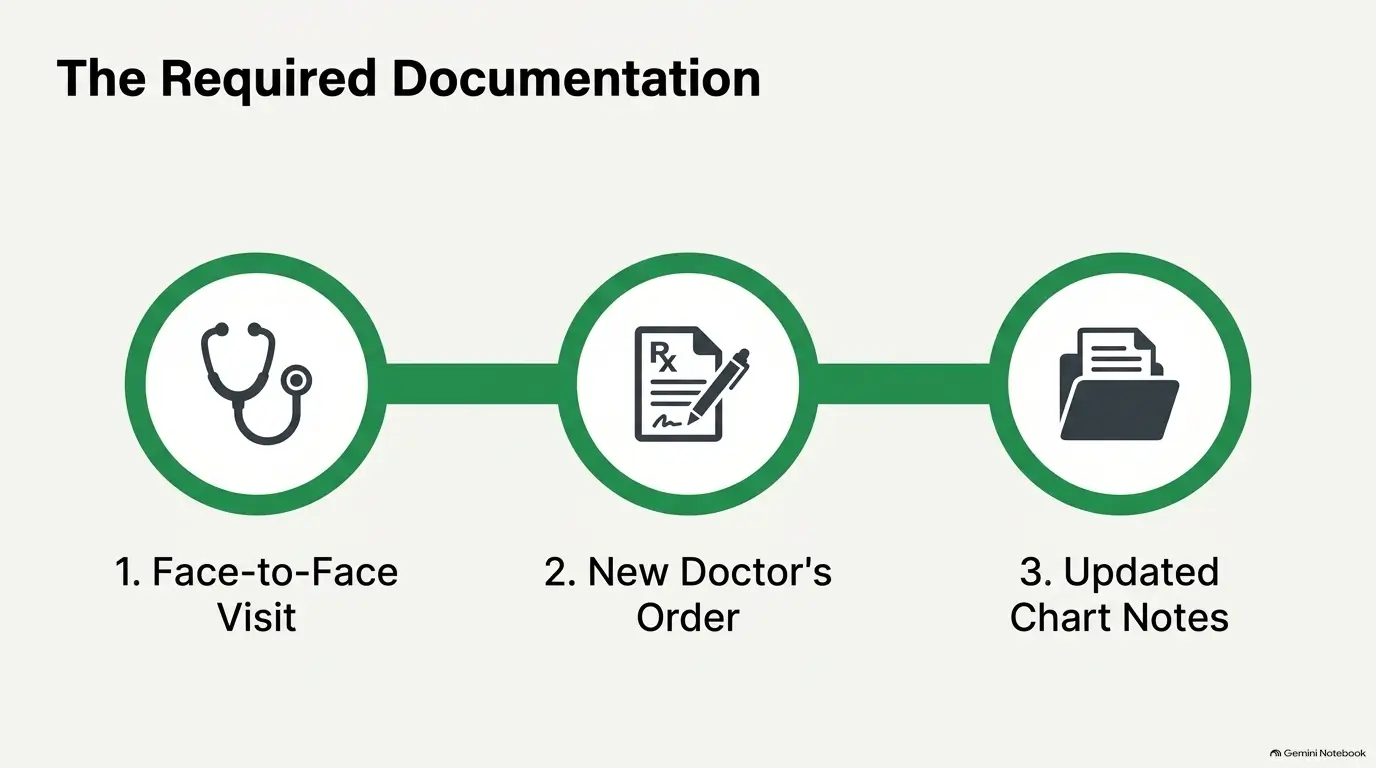
The standard Medicare documentation requirements generally require a new order when an item is replaced. Some items also require a completed written order before delivery. A new prescription is therefore an important part of the process, but it does not by itself overcome a replacement restriction or establish medical necessity.
For broader background, see our related article on orthopedic brace insurance coverage.
Replacement coverage still involves costs
According to Medicare’s brace coverage page, Part B covers medically necessary arm, leg, back, and neck braces ordered by a doctor or other healthcare provider. After the Part B deductible, you generally pay 20% of the Medicare-approved amount. Other insurance and the billing circumstances can affect your final responsibility.
As a hypothetical calculation, if the approved amount is $400 and your deductible is already met, 20% is $80 before any supplemental coverage. This is an arithmetic example, not a typical brace price or a quote. If the replacement is denied, your responsibility is a separate question.
For Original Medicare, a supplier expecting nonpayment may give you an Advance Beneficiary Notice of Noncoverage, or ABN. It should explain the expected reason for nonpayment and estimated cost. An ABN is not an official Medicare denial. Read whether your chosen option includes submitting a claim: without a submitted claim and payment decision, there is no claim denial to appeal.
If Medicare denies the replacement
Start with the explanation on your Medicare Summary Notice. Identify whether the issue is a previous brace, missing documentation, or another coverage requirement. Ask your practitioner and supplier for records addressing that specific reason.
The first appeal level in Original Medicare is a redetermination. Follow the submission instructions and deadline on your notice, and explain why the replacement should be covered. Medicare’s appeal instructions describe the information to include. Our related article covers appealing a denied brace insurance claim.
Medicare Advantage: check the plan before delivery
If you have Medicare Advantage, contact your plan about the proposed brace, supplier network, prior authorization, and expected cost. Medicare explains that plan requirements vary, and certain services or supplies typically require prior authorization. Use your plan’s decision and appeal instructions rather than assuming Original Medicare’s paperwork applies.
Before agreeing to delivery, get a clear answer to this question: “Which replacement rule applies to my brace, and what evidence supports this claim?” That connects the timeline to your actual device and circumstances.
Editorial update — October 27, 2026: Hong Dal Oh added the code-by-code knee-orthosis RUL table, source date, coverage limits, and code-confirmation steps with AI assistance. Original publication: October 25, 2026. The table was checked against CMS A52465; this update is not an independent medical review or a re-verification of every policy discussed elsewhere in this article.