
This site is written from a family-caregiver perspective. The operator is not a medical professional. This article provides general education and preparation prompts rather than an individual assessment.
Budget from the individual recovery plan
Use these prompts to prepare questions and arrangements. They do not diagnose a condition, determine coverage or clear an activity.
- What to record
- Surgery estimates, therapy arrangements, equipment, medicines, journeys, household help and work changes.
- What to ask
- Which costs are one-off, recurring or uncertain, and what care changes would alter them?
- Next action and owner
- Confirm current quotes and benefits, avoid counting the same charge twice and review the budget after plan changes. Write down who will act and when to follow up.
Keep personal records private. You can use the visit preparation organizer to arrange questions; do not post identifying health information in comments.
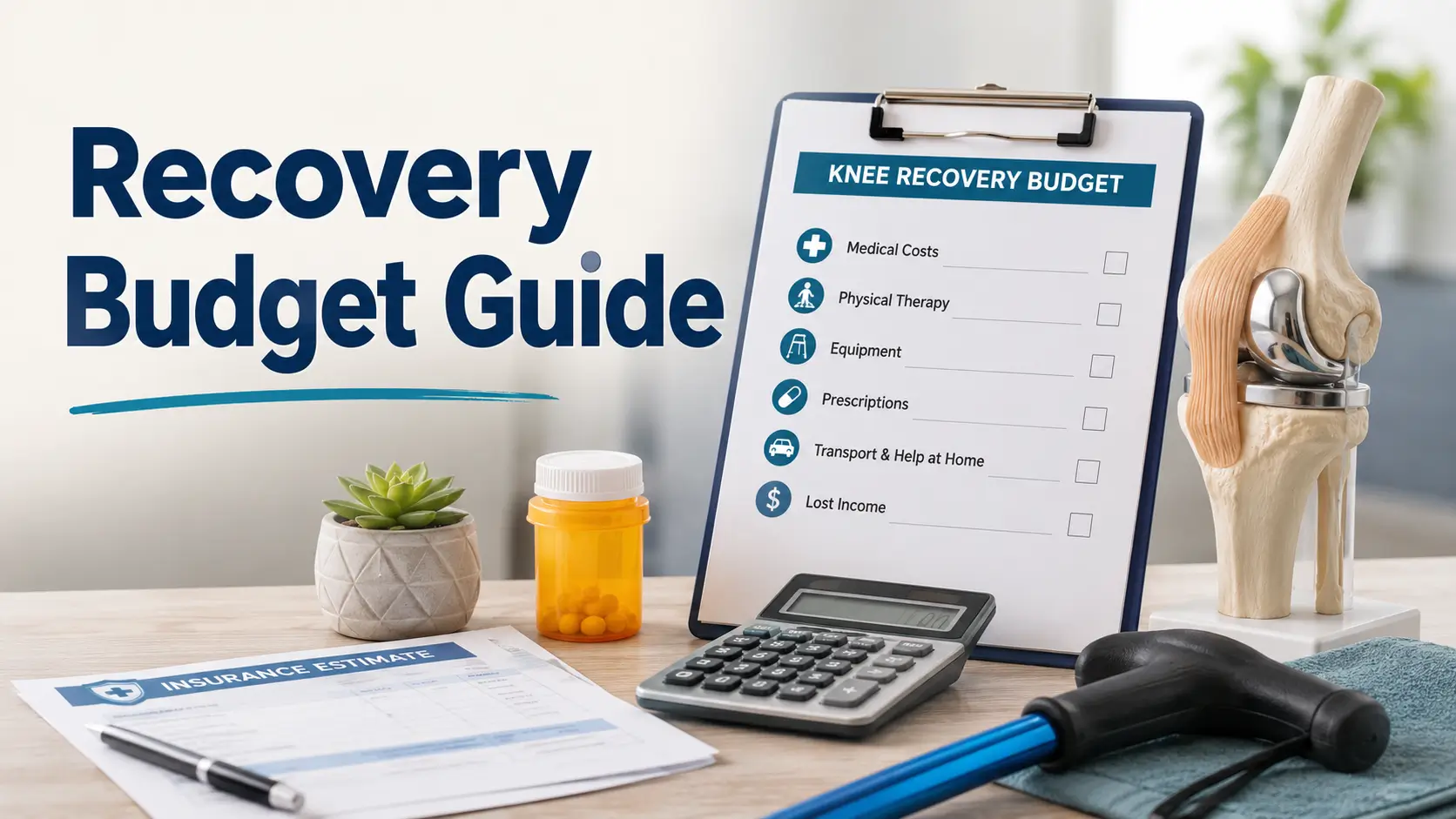
A useful knee replacement recovery budget should cover more than the surgery bill. Build it around five buckets: expected medical out-of-pocket costs, rehabilitation, equipment and prescriptions, household and transportation help, and income you may lose during recovery. The number that changes the budget most is usually not the hospital’s sticker price. It is what your insurance plan says you will actually owe, plus the recovery expenses insurance does not pay.
Start by getting an insurer or provider estimate for the surgery, then price the care that comes after it. Do not buy every recovery gadget in advance. Confirm what your surgeon, physical therapist, insurer, or equipment benefit actually calls for first. Recovery needs vary, and a budget cannot predict complications, changes in rehabilitation, or an individual return-to-work date.
This guide uses United States insurance and Medicare examples. The budgeting method still works elsewhere, but coverage rules, billing protections, and health-system costs must be replaced with the rules where you receive care.
Table of Contents
Build the Budget Around What You Will Pay, Not the Hospital Charge
The first trap is starting with the hospital’s gross charge and treating it as your personal cost. For an insured patient, the more useful figure is the estimated patient responsibility after network discounts, deductible, copayments, coinsurance, and other plan rules are applied.
Think of the recovery budget as this equation:
Recovery budget = medical bills you expect to pay, including surgery, rehabilitation, medicines, and covered equipment + other recovery costs outside those bills + lost income + your chosen contingency reserve. Use separate category rows for clarity, but count each expense once: subtract services already included in a surgical estimate or in your medical out-of-pocket total before adding them again.
The important distinction is between medical billing exposure and cash-flow exposure. Your insurance may reduce the first while doing little about the second. Grocery delivery, unpaid leave, pet help, parking, rides, extra meals, or temporary household assistance can quietly become the part of recovery that strains the monthly budget.
| Number you see | What it means | Use it for your budget? |
|---|---|---|
| Hospital gross charge | The provider’s undiscounted charge | Usually not by itself |
| Negotiated or allowed amount | The price recognized under an insurance arrangement | Useful when calculating cost sharing |
| Provider estimate | An estimate of expected charges or patient responsibility | Yes, but verify what is included |
| Deductible remaining | Amount you may still need to satisfy before certain plan payments change | Yes |
| Out-of-pocket maximum remaining | A potential plan-specific ceiling on certain covered cost sharing | Use as a guardrail, not automatically as your budget |
If you have employer or individual health insurance, request your current plan documents and Summary of Benefits and Coverage. The summary helps explain the plan structure, but the insurer’s cost estimator or member-services department may be more useful for a specific knee replacement.
Price the Surgery and Recovery as Separate Cost Events
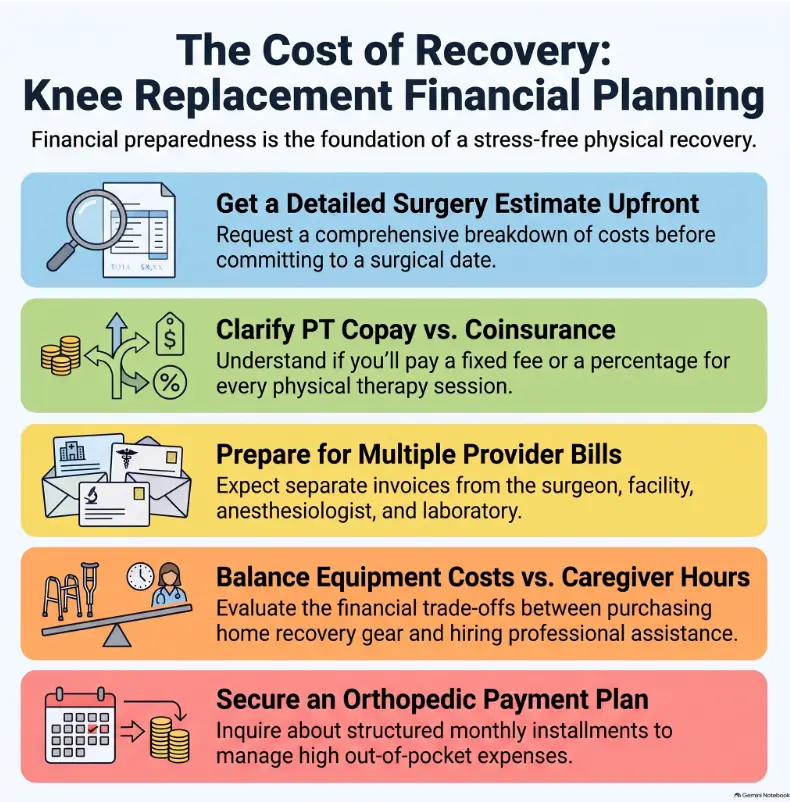
A single quote labeled “knee replacement” may not tell you what happens financially after discharge. Ask which professional and facility charges are included in the estimate and which services will be billed separately.
- hospital or surgical-facility charges
- surgeon services
- anesthesia services
- preoperative testing ordered for the procedure
- postoperative appointments
- prescription medicines
- physical or occupational therapy
- home health services, if clinically ordered
- walker or other prescribed equipment
- additional imaging, laboratory work, or treatment if the recovery plan changes
Some of these services may be bundled or included under a particular payment arrangement. Others may generate separate claims. Ask for a written list of included and separately billed services before relying on the total.
U.S. hospitals are subject to federal hospital price-transparency requirements. CMS explains the current requirements on its Hospital Price Transparency page. A hospital’s online estimator can be useful for comparison, but your insurer’s personalized estimate should still be checked because the amount you owe depends on your own benefits and accumulated cost sharing.
Run a 10-Minute Insurance Check Before You Set the Medical Number
Your medical-cost budget becomes much stronger once you replace assumptions with six plan-specific answers. Call the insurer using the number on your member card or use its secure member portal.
- Is the surgeon in network?
- Is the hospital or surgical facility in network?
- What deductible remains?
- What copayment or coinsurance applies to the planned setting?
- What amount remains before the applicable out-of-pocket maximum?
- What rules apply separately to physical therapy, home health, prescriptions, and durable medical equipment?
Also ask whether prior authorization is required and whether it has actually been approved. Authorization, network participation, and medical necessity are different questions. An authorization does not by itself guarantee that every person, item, or service involved will be paid exactly as expected.
Write down the date, representative’s name or identifier if provided, reference number, and the figures you were quoted. If the insurer has an online estimator, save a copy or screenshot of the result for your records.
Give Physical Therapy Its Own Budget Line
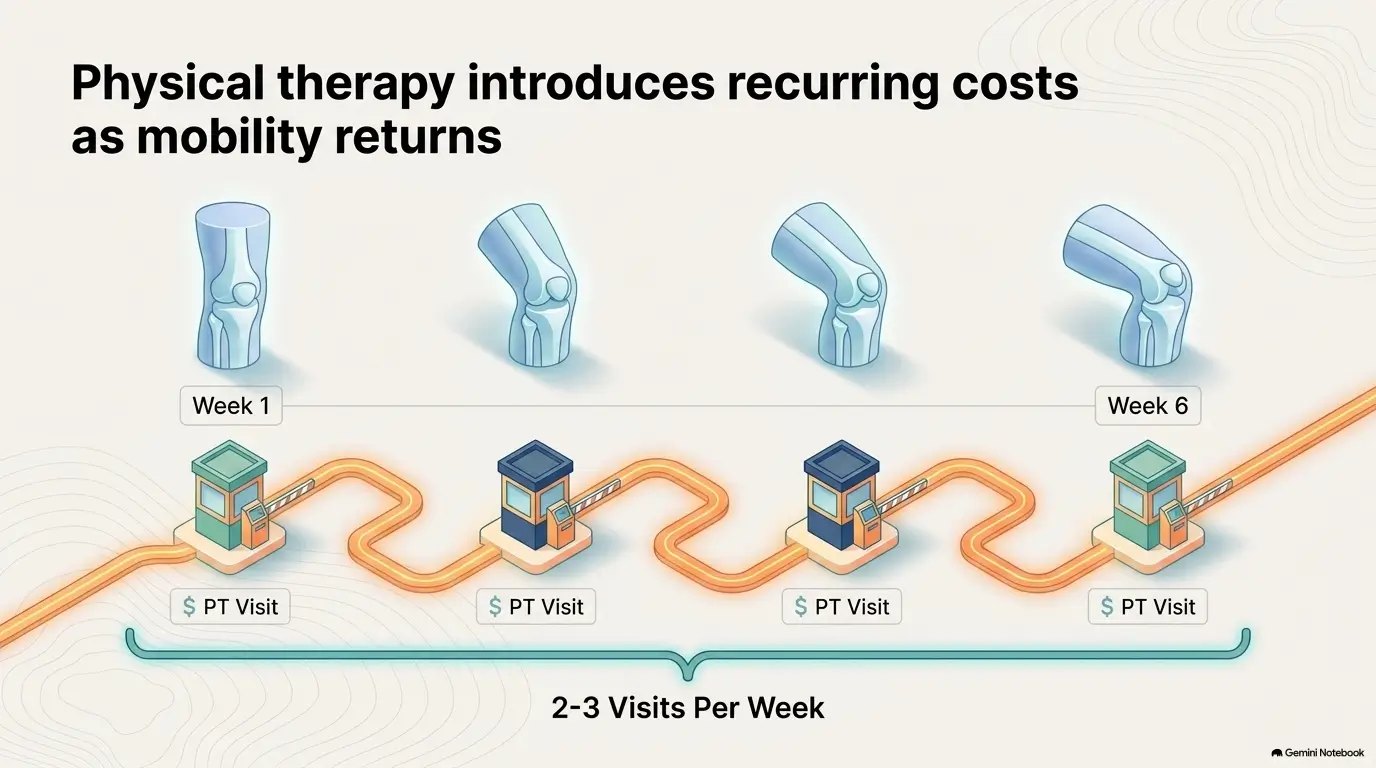
Physical therapy deserves a separate line because the financial structure may be different from the surgical episode. Depending on your insurance, visits may involve a copayment, coinsurance, a deductible, network restrictions, authorization requirements, or other plan conditions.
Do not guess how many sessions you will need from an internet recovery calendar. Ask the treating team what is currently planned, then confirm the benefit with the insurer. The clinical schedule may change as your recovery is reassessed.
Illustrative calculation: if your plan requires a $45 copayment and you are currently planning for eight covered visits, the working PT budget would be 8 × $45 = $360. That is only an example of the calculation method, not a typical copayment or recommended number of visits.
If you have Original Medicare, Medicare states that medically necessary outpatient physical therapy is covered under Part B when eligibility requirements are met. After the Part B deductible, the patient generally pays 20% of the Medicare-approved amount. Medicare also states that there is no annual dollar limit on medically necessary outpatient therapy. Check the current rules on Medicare’s physical therapy coverage page.
Saving money should mean checking network status, site of care, benefits, and clinically appropriate alternatives. It should not mean reducing medically recommended rehabilitation solely because a generic budget template predicted fewer visits.
Budget for the Small Recovery Costs That Arrive in a Crowd
The home-recovery category is where individually modest expenses can gather into a surprisingly large procession. List what you may actually need rather than buying a preassembled “knee surgery recovery kit.”
| Budget category | What to check before spending |
|---|---|
| Walker, cane, or other mobility equipment | Ask what is prescribed and whether insurance supplies, rents, or covers the item |
| Bathroom equipment | Ask whether your clinical team recommends a specific item for your home setup |
| Cold therapy supplies | Confirm what the surgical team recommends and what is optional |
| Prescription and over-the-counter items | Use the medication list actually provided to you and check pharmacy benefits |
| Meals and groceries | Estimate delivery fees or convenience-food costs only for the period you expect to need help |
| Housekeeping | Identify specific chores that cannot safely be postponed or delegated |
| Pet or childcare | Price only the tasks your normal support network cannot cover |
| Transportation | Include rides, parking, fuel, tolls, or accessible transport when relevant |
Before buying equipment, ask whether it can be borrowed, rented, supplied through insurance, or reused from something you already own. Paying more makes sense when a clinician recommends a particular device, fit or safety requirement matters, or the cheaper substitute does not perform the job you actually need.
The opposite mistake is false thrift. A household may save money by borrowing equipment yet create a larger problem by skipping necessary help with a task the recovering person cannot perform safely. Safety and clinical need should set the boundary, not the price tag alone.
Put Lost Income on the Same Page as Medical Costs
For many households, time away from work is a larger cash-flow issue than recovery supplies. Build the budget from income you can reasonably confirm, not the date you hope to be back at full capacity.
Create separate entries for:
- paid sick leave or paid time off you expect to use
- approved short-term disability benefits, if applicable
- unpaid leave
- reduced hours or phased return, if arranged
- lost self-employment or contract income
- unpaid time taken by a family caregiver
Keep uncertain disability payments, reimbursements, or employer benefits outside the “confirmed income” column until they are approved. A budget becomes fragile when it spends money that has not arrived yet.
A simple calculation is:
Income shortfall = normal take-home income for the budget period − income you can reasonably expect during that period.
If a partner or relative will provide substantial help, consider their lost wages, transportation, meals, or childcare costs too. Informal caregiving may be unpaid, but it is not always cost-free.
Match payment dates to income dates. An approved benefit is not necessarily available when a bill is due. Add the expected payment date beside each bill and the expected arrival date beside each confirmed income or reimbursement. Ask the benefit administrator about any waiting period and first-payment timing; record a date as uncertain if it has not been confirmed.
Hypothetical timing example: you need to pay $1,300 of recovery expenses by the end of the month, and a confirmed $300 reimbursement will arrive the following month. The eventual unreimbursed cost is $1,000, but you still need a way to cover the full $1,300 when it falls due. If the reimbursement is not approved, keep the $300 outside confirmed funding. Ask about payment timing or assistance before a shortfall becomes overdue debt.
Keep expenses and funding in separate columns. Moving your own savings into the recovery account does not reduce the cost; receiving reimbursement changes who ultimately funds an expense. Count a benefit only once, and do not subtract it again if it is already included in the income used to calculate your shortfall.
Use a Recovery Budget Worksheet Instead of One Big Guess
One total scribbled beside the surgery date is difficult to audit. A better worksheet shows which figures are confirmed, estimated, optional, or still unknown.
| Budget line | Amount to enter | Where to verify it |
|---|---|---|
| Surgery and facility | Your estimated patient responsibility | Insurer and provider estimate |
| Other professional charges | Estimated responsibility for separately billed services | Provider and insurer |
| Physical therapy | Expected cost sharing × currently planned visits | Insurer and therapy provider |
| Prescriptions | Expected pharmacy cost | Plan formulary or pharmacy |
| Equipment | Only items actually expected to be needed | Clinical team, insurer, equipment supplier |
| Transport | Rides, parking, fuel, tolls | Your schedule |
| Home or caregiver help | Expected paid help | Household plan and quotes |
| Meals and errands | Additional cost above normal spending | Your household budget |
| Income shortfall | Normal take-home income minus confirmed recovery-period income | Employer, benefit administrator, or your business records |
| Contingency | A reserve you choose for uncertain expenses | Your available cash and risk tolerance |
Mark each row confirmed, estimated, or unknown. That tiny labeling trick is useful because it tells you where another phone call can improve the budget. An unknown $0 is not the same thing as a confirmed $0.
Choose a Contingency Reserve Without Pretending You Can Predict Recovery
A contingency reserve is for financial uncertainty, not a prediction that something will go wrong medically. Possible uses include an additional ride, an altered therapy schedule, a prescription change, more household assistance, or a longer period of reduced work.
If you want a simple planning method, you can make an illustrative assumption such as reserving 10% of your currently estimated variable recovery expenses, or keeping one additional week of essential household expenses available. Neither figure is a medical or actuarial rule. Choose a reserve that fits your cash position rather than borrowing simply to satisfy an arbitrary percentage.
If the reserve would force high-cost debt, focus first on improving the estimates, checking financial-assistance options, identifying expenses that can be delayed, and asking providers about payment arrangements. A beautifully padded spreadsheet is not a victory if the padding itself becomes expensive debt.
When the Cheaper Recovery Option Is Enough
Many recovery expenses do not reward premium spending. The least expensive option is often sufficient when it performs the required function, meets the clinician’s recommendation, and does not create a new safety problem.
| Expense | Lower-cost first move | When paying more may be justified |
|---|---|---|
| Equipment | Check insurance, borrowing, or rental before buying | A prescribed specification, proper fit, durability, or safety requirement matters |
| Household help | Schedule family or friends for specific tasks | Reliable help is unavailable or assistance involves safety-sensitive tasks |
| Meals | Prepare simple food in advance or use ordinary grocery delivery | Meal preparation cannot be managed safely or reliably |
| Transportation | Coordinate trusted family or friends when appropriate | A medical or accessibility need requires specialized transportation |
| Home setup | Make targeted changes around actual obstacles | A therapist or other professional identifies a problem that needs a more substantial solution |
Be especially cautious with expensive recovery products marketed as universally necessary. Ask one useful question before paying: What specific problem will this solve that my current plan does not? If no one can identify a useful purpose, defer the purchase until your needs are clearer.
If You Are Paying Without Insurance, Get the Estimate in Writing
Self-pay budgeting requires a different starting point. In the United States, patients who do not have insurance or choose not to use it generally have federal rights to a good faith estimate for scheduled care when the applicable requirements are met.
CMS explains that a good faith estimate can include expected charges from the provider or facility issuing it, but separately scheduled services or care from other providers may not all appear on one estimate. For surgery, that means you should identify every organization likely to bill you rather than assuming one document covers the entire recovery. Review the current rules on CMS’s medical billing rights for uninsured and self-pay patients.
Keep each written estimate and compare it with the later bill. Do not rely only on a verbal quote.

FAQ About Knee Replacement Recovery Budgets
Should I simply budget up to my insurance out-of-pocket maximum?
Not automatically. An out-of-pocket maximum can be an important ceiling under certain health plans, but what counts toward it depends on the plan and type of care. Premiums, non-covered services, some out-of-network costs, household help, transportation, and lost income may sit outside that figure. Use the remaining maximum as one insurance data point, then build the nonmedical recovery budget separately.
What if I do not know how much physical therapy I will need?
Use the therapy schedule currently anticipated by the clinical team as a working estimate and mark the line as adjustable. Confirm how your insurance prices each visit. Update the budget when the treatment plan is reassessed rather than guessing a fixed recovery schedule before surgery.
Can I use an HSA or FSA for knee replacement recovery expenses?
Eligible medical expenses may qualify for reimbursement from an HSA or FSA, subject to the rules that apply to the account and the particular expense. Household convenience spending or lost wages should not simply be assumed to qualify. Keep receipts and verify uncertain expenses before using tax-advantaged funds. The IRS explains HSA and related account rules in Publication 969.
What if I cannot afford the estimated patient responsibility?
Contact the hospital or provider before assuming a credit card or personal loan is the only answer. Ask about financial assistance, payment plans, and whether the estimate can be reviewed for errors or missing insurance information. If surgery is medically necessary, discuss financial questions with the billing team rather than changing medical care on your own.
Your Next 10 Minutes
Open a note or spreadsheet and create five rows: medical care, rehabilitation, equipment and medicines, daily-life help, and lost income. Enter only numbers you can currently support. Put a question mark beside everything still unknown.
Then make two contacts: your insurer and the surgery billing office. Ask for your estimated responsibility, what is included, and which recovery services are likely to be billed separately. Those answers will do more for your budget than another hour browsing recovery products.
Once those figures are in place, the budget stops being a vague fear about “how much knee replacement recovery costs” and becomes a list of specific expenses you can verify, reduce where appropriate, and prepare for before surgery.
Last updated: October 15, 2026
- Orthopedic Surgery Cost Estimate: What to Check Before You Pay
- Physical Therapy Copay vs Coinsurance: What You May Actually Pay
- Why an Orthopedic Surgery Can Produce Bills From Multiple Providers
- Home Equipment vs Caregiver Hours After Surgery: Which Is Worth Paying For?
- Orthopedic Payment Plans: What to Check Before You Agree
Targeted update: October 17, 2026. Added a payment-timing example and separate expense/funding checks; simplified two figurative phrases. Other sections retain their existing review scope.
Targeted editorial update: October 21, 2026. Added a topic-specific record, question and follow-up guide and revised the title and search description. Existing useful material was retained; this update is not a complete medical, legal or insurance review. Confirm individual instructions, current prices and benefits with the relevant service.