
This site is written from a family-caregiver perspective. The operator is not a medical professional. This article provides general education and preparation prompts rather than an individual assessment.
Price the help that the care plan actually needs
Use these prompts to prepare questions and arrangements. They do not diagnose a condition, determine coverage or clear an activity.
- What to record
- Personal-care and transfer support, equipment, meals, transport, household jobs and benefit enquiries.
- What to ask
- What help remains necessary, what is covered and who handles the gaps or a helper’s absence?
- Next action and owner
- Confirm services and costs before changing support; home-health coverage is not a promise of all-purpose household assistance. Write down who will act and when to follow up.
Keep personal records private. You can use the visit preparation organizer to arrange questions; do not post identifying health information in comments.

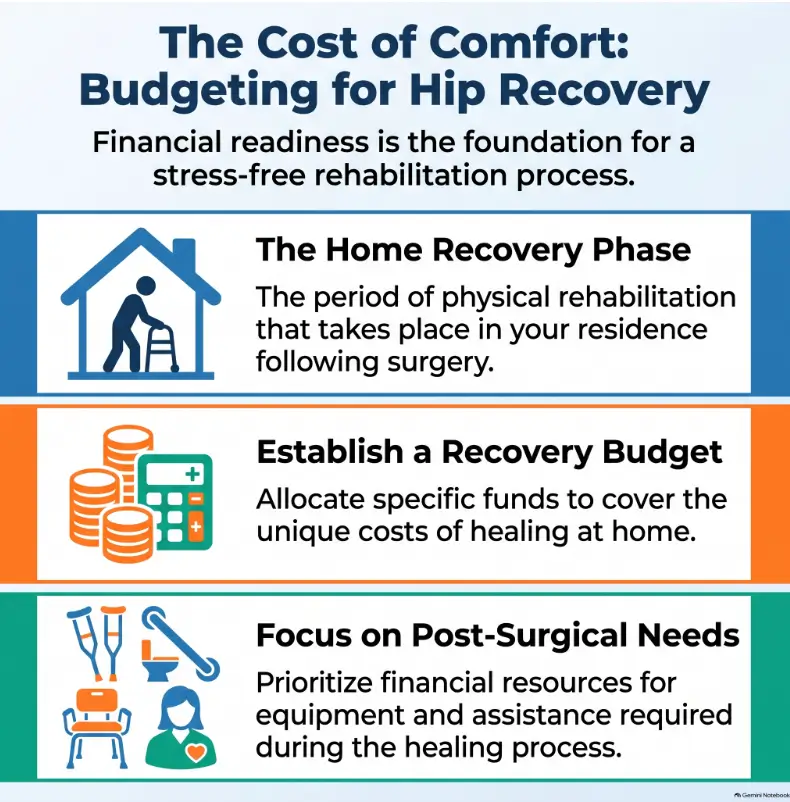
The hospital bill is only part of the financial picture after a hip replacement. Once you get home, costs can appear for mobility equipment, bathroom aids, paid help, transportation, meal delivery, housekeeping, pet care, and everyday supplies. The biggest variable is not the surgery itself but how much help you need to function safely at home and what your health plan actually covers.
Before buying recovery gear or booking private caregivers, ask your discharge team for a written list of recommended equipment and services, then verify coverage item by item. In the United States, some medically necessary equipment and qualifying home health services may be covered, while ordinary household assistance often is not. Your surgeon’s restrictions, mobility, home layout, available family help, and insurance plan can change the budget substantially.
Table of Contents
The Expensive Part May Begin After You Get Home
A hip replacement can temporarily turn inexpensive daily routines into paid services. Carrying groceries, changing sheets, walking a dog, getting into a shower, driving to physical therapy, or preparing dinner may suddenly require equipment or another person’s time.
That creates an important distinction: medical recovery costs and household recovery costs are not the same thing. Insurance may help with the former while leaving much of the latter to you.
| Possible Cost | Why It Appears | What to Check Before Paying |
|---|---|---|
| Walker or other mobility aid | Safer walking during early recovery | Prescription, medical necessity, supplier and plan coverage |
| Bathroom equipment | Difficulty with transfers, bending or bathing | Exactly which device your clinical team recommends and whether it qualifies for coverage |
| Home health care | Skilled nursing, therapy or qualifying assistance at home | Eligibility, ordered services and participating agency |
| Private caregiver | Help with dressing, meals, supervision or household tasks | Whether covered skilled care can meet part of the need first |
| Meals and groceries | Temporary difficulty shopping or cooking | Family help, prepared meals, pickup or delivery fees |
| Cleaning and laundry | Bending, lifting and carrying may be difficult | Which tasks truly need outsourcing and for how long |
| Transportation | You may not be cleared to drive immediately | Plan benefits, family rides and expected appointment schedule |
| Pet care | Walking, feeding or managing an active pet may be difficult | Temporary family or neighbor help before recurring paid care |
The practical mistake is budgeting carefully for the operation while treating everything after discharge as incidental. A few small services repeated for several weeks can become more consequential than one piece of recovery equipment.
Home Help Can Cost More Than the Recovery Equipment
The largest hidden expense for some households is human help. Someone may need to assist with bathing, dressing, meals, transportation, laundry, medication organization, pets or simply being present during difficult transfers.
For people with Original Medicare, however, “home health care” has a specific meaning. Medicare may cover qualifying part-time or intermittent skilled nursing, physical therapy, occupational therapy and certain home health aide services when eligibility requirements are met. It does not simply provide an all-purpose helper because ordinary household activities have become difficult. Medicare specifically excludes 24-hour home care, meal delivery, unrelated homemaker services such as shopping and cleaning, and personal care when that is the only care required. You can review Medicare’s current home health coverage rules before assuming that a caregiver expense will be reimbursed.
Private insurance and Medicare Advantage plans can have different rules and supplemental benefits. Ask the plan what service is covered, how many visits or hours are authorized, whether a network agency is required, and whether the benefit is skilled care, personal care or both.
If you are deciding between equipment and paid assistance, compare the tasks equipment can realistically replace versus the caregiver hours you still need. A grabber can retrieve a dropped sock. It cannot safely substitute for another person if you cannot transfer, bathe or move around the home without assistance.
Check Equipment Coverage Before Buying Everything Yourself
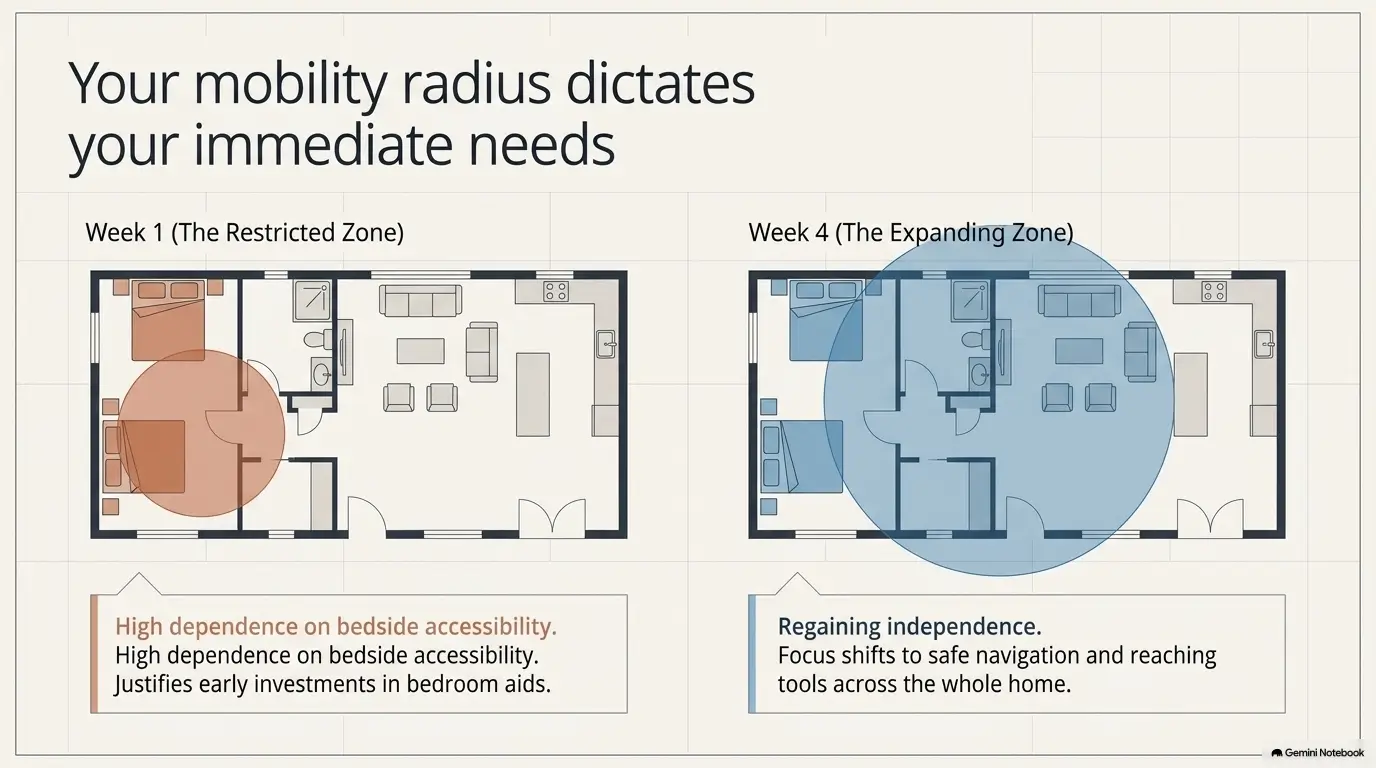
A long online shopping list is not automatically a good recovery plan. Some equipment may be medically necessary and potentially covered; some may be useful but entirely discretionary; some may not fit your body, bathroom or surgeon’s instructions.
Under Original Medicare, medically necessary walkers prescribed for home use can qualify as durable medical equipment. After the applicable Part B deductible, the beneficiary generally pays 20% of the Medicare-approved amount when the supplier accepts assignment. Medicare advises patients to verify both provider and supplier participation before obtaining the equipment. See the current Medicare walker coverage requirements.
Commode chairs can also qualify as Medicare-covered durable medical equipment when the requirements are satisfied. A retail toilet riser, however, should not be assumed to have identical coverage simply because it serves a similar practical purpose. Check the exact item your clinician is recommending against Medicare’s commode-chair rules or your own insurer’s benefit language.
This distinction matters because orthopedic recovery lists often include reachers, long-handled shoehorns, bathing aids, raised toilet equipment and other convenience or safety products. The American Academy of Orthopaedic Surgeons also recommends preparing the home and arranging practical support before joint replacement. Its home preparation guidance for joint replacement is useful as a planning checklist, but a recommended item is not automatically an insured item.
Before purchasing toilet equipment in particular, confirm the device and dimensions your recovery team wants. The practical issues described in this guide to choosing toilet-seat riser height can help you identify the measurements worth checking.
Small Household Costs Can Arrive in a Swarm
Many post-surgery expenses are inexpensive once and expensive when repeated. The useful question is therefore not simply “How much does this cost?” but “How many times will I need to pay for it before I can do the task again?”
Food and grocery logistics
You may be able to prepare food but not comfortably shop for it, carry bags, reach low shelves or stand through a long cooking session. The hidden expense may therefore be delivery charges, prepared foods or help from someone else rather than the groceries themselves.
Before paying for weeks of restaurant delivery, consider lower-cost substitutions such as frozen meals prepared before surgery, grocery pickup handled by a friend, or one larger delivery rather than several small orders. If you want to resume shopping yourself, use your clinical team’s mobility guidance rather than a calendar alone; this shopping-after-joint-replacement checklist can help you think through the practical obstacles.
Count the added food cost, then check the full payment due. Compare the same household and time period with the spending that would otherwise have happened. In a hypothetical week, ordinary groceries would cost $90. If replacement meals cost $130 and separate delivery fees and tips total $12, the added recovery expense is $130 + $12 − $90 = $52. The payment due for those meals is still $142. Do not report all $142 as an extra cost while also keeping the displaced $90 grocery spending in the same weekly plan.
Subtract only spending you actually avoid. If you still buy the usual groceries, the meal order is additional rather than a substitute. Include quoted service charges, delivery minimums, and tips only once; check whether a displayed total already contains them. Keep the regular household budget alongside this incremental-cost list so that a small extra cost does not hide a larger payment due.
Laundry and housekeeping
Laundry hides several separate movements: bending, lifting wet clothes, carrying a basket, reaching into a machine and walking while carrying a load. Cleaning can involve similar combinations of twisting, reaching and carrying.
You may not need a full housekeeping service. Paying for one difficult task, changing bed linens for example, can be cheaper than outsourcing everything. Move frequently used clothing and supplies to accessible locations before surgery where feasible.
Pets
A pet can create both a labor cost and a fall-management problem. Dog walking is the obvious expense, but feeding bowls placed near the floor, carrying food, litter care and an excited animal moving around a walker can also matter.
If pet care will fall to someone else temporarily, list feeding, bowl cleaning, food storage, litter care, and dog walking before your operation. Assign tasks that require bending, lifting, or handling an excited animal to a helper according to your own surgical restrictions.
Transportation
Do not assume you will resume driving on a particular postoperative day. Readiness depends on factors including the operated side, medications, mobility, reaction ability and your surgeon’s assessment. Until you are cleared, physical therapy, follow-up appointments, pharmacy trips and errands can create ride costs.
Ask for the likely appointment schedule before discharge. Knowing that schedule lets you organize family rides or compare transportation options before every appointment becomes a last-minute purchase.
Everyday recovery supplies
Ice products, dressings or other wound supplies, over-the-counter products, nonslip footwear, pill organizers and convenience items can look insignificant individually. Coverage varies by item and plan. Original Medicare, for example, generally does not cover ordinary medical supplies used at home in the same manner as qualifying DME, although supplies furnished as part of covered care can be treated differently.
Use the discharge instructions as the shopping list. Avoid building one from social-media recovery inventories, where the difference between useful and merely comforting can quietly become a cart full of duplicates.
Build the Budget From Tasks, Not Products
The cleanest way to estimate hidden home costs is to list activities you temporarily cannot perform safely, then attach a solution to each one. This avoids buying a device without knowing which problem it solves.
| Task | Current Plan | Cost Formula |
|---|---|---|
| Bathing | Equipment, family help or paid help | Equipment price + assistance sessions |
| Meals | Prepared food, family or delivery | Extra food cost + delivery fees × orders |
| Transportation | Family, community transport or paid rides | Rides × expected fare |
| Personal assistance | Family or caregiver | Hours needed × hourly charge |
| Cleaning or laundry | Delay, family or paid service | Visits × service charge |
| Pet care | Family, neighbor or professional | Visits or walks × charge |
| Equipment | Borrow, rent, covered DME or buy | Your expected out-of-pocket amount |
Illustrative calculation: instead of guessing a single “hip replacement home recovery budget,” calculate caregiver hours × quoted hourly rate, transportation rides × expected fare, delivery orders × fee, plus the actual out-of-pocket cost of approved equipment and supplies. Keep surgery bills, prescription cost sharing and outpatient treatment separate so you can see which part of the budget is truly caused by living at home.
This also exposes the most useful place to save money. If paid assistance dominates the estimate, shaving a few dollars from a reacher is irrelevant. The better question is whether specific caregiver tasks can safely be covered by family, an eligible home health benefit or a better home setup.
When the Cheaper Option Is Enough
You probably do not need to buy the premium version of every recovery product. Temporary use changes the economics.
- Borrowing can make sense for simple non-personal items when the equipment is appropriate, intact and safe for you.
- Renting can make sense when an item is needed briefly or the covered benefit is structured as a rental.
- Basic equipment can be enough when it meets the clinical need, fits the home and can be used safely.
- Family help can replace paid services when the helper is available, physically able to perform the task and the task does not require professional care.
- Rearranging the home can beat buying equipment when moving frequently used items, removing trip hazards or setting up a temporary living area solves the actual problem.
The cheapest option stops being good value when it creates a meaningful safety problem, does not fit properly or simply transfers the work to someone who cannot handle it.
When Paying More Becomes Rational
Extra spending is easier to justify when it buys something concrete: safer transfers, reliable supervision, appropriate professional care, a usable bathroom setup or help that no available family member can safely provide.
- You cannot safely get in or out of bed, a chair or the bathroom with the support currently arranged.
- You live alone and essential daily tasks cannot be postponed or handled remotely.
- Your home layout creates obstacles that your discharge team believes need modification.
- You need skilled nursing or rehabilitation services rather than ordinary household assistance.
- A caregiver would otherwise need to miss substantial work or perform tasks beyond their ability.
- The cheaper device is unstable, poorly fitted or inconsistent with recommendations from your surgeon, physical therapist or occupational therapist.
These are spending thresholds, not automatic instructions to hire someone or remodel the house. If you are unsure whether a problem needs equipment, training, another person or a different discharge arrangement, describe the exact task to your clinical team: “I cannot step into my shower without holding onto the door frame” is much more useful than “I think I need bathroom equipment.”
Your 10-Minute Hidden-Cost Check
Run this before discharge if possible. You are trying to uncover gaps while there is still someone available to answer them.
- Write down every recommended item. Ask which are medically necessary versus optional conveniences.
- Mark who is paying. For each item or service, write insurance, self-pay, family help or unknown.
- Circle every “unknown.” Those are your insurance calls, not your shopping list.
- List seven ordinary tasks. Bathing, dressing, meals, laundry, cleaning, transportation and pet care are a useful starting point.
- Assign a person or solution to each task. Avoid writing “we’ll figure it out.”
- Estimate frequency. One ride and ten rides are different budget problems.
- Ask when the need will be reassessed. Do not automatically purchase weeks of help because the first few days are difficult.
Keep the sheet next to your discharge instructions. It becomes both a budget and a gap detector.

FAQ About Home Costs After Hip Replacement
Does Medicare pay for someone to stay with me overnight?
Original Medicare’s home health benefit is not general round-the-clock home care. Medicare states that it does not pay for 24-hour care at home. Qualifying intermittent skilled services are different from hiring someone primarily to remain in the house, cook, clean or provide ordinary supervision. Medicare Advantage and other insurance arrangements may offer different supplemental benefits, so check your specific plan.
Will Medicare pay for my walker after hip replacement?
It can when the walker meets Medicare’s durable medical equipment requirements, is medically necessary and is prescribed for use in the home. Your out-of-pocket amount also depends on the deductible, Medicare-approved amount and supplier arrangements. Do not buy first and assume reimbursement will follow.
Should I buy a shower chair and raised toilet seat before surgery?
Ask the surgical or rehabilitation team what they expect you to need and what dimensions are appropriate. Recommendations can differ according to your mobility, surgical instructions, bathroom design and ability to transfer. Buying before measuring can leave you with equipment that technically fits the product description but not the bathroom or the person using it.
What if I live alone after hip replacement?
Tell the surgical team before discharge planning is complete. Living alone does not by itself determine where you must recover, but it changes practical questions about transfers, meals, medications, transportation, emergencies and household tasks. Ask which activities you must be able to perform safely before going home and which services can be arranged if you cannot yet manage them independently.
Before You Leave the Hospital, Ask These Questions
Spend five minutes turning vague recovery advice into a household plan. Ask: What equipment do I medically need? Which items require a prescription? Which services are being ordered for home? What will insurance probably not cover? Which daily activities should someone help me with at first? And who should I contact if the home plan turns out not to be safe?
Write the answers down before opening a shopping app or committing to weeks of paid assistance. The goal is not to make recovery artificially cheap. It is to spend where the expense actually solves a problem, while keeping convenience purchases from masquerading as medical necessities.
Last reviewed: 2026-10
Targeted review: October 17, 2026. Added a like-for-like household food example distinguishing additional expense from the payment due. Other sections retain their stated review scope.
Targeted editorial update: October 21, 2026. Added a topic-specific record, question and follow-up guide and revised the title and search description. Existing useful material was retained; this update is not a complete medical, legal or insurance review. Confirm individual instructions, current prices and benefits with the relevant service.
For Original Medicare home-health coverage and exclusions, see Medicare: home health services. Confirm the individual benefit with the plan or service.