

Functional Limitation Documentation Guide
How to Document Stairs, Sitting,
Walking, and Sleep Problems
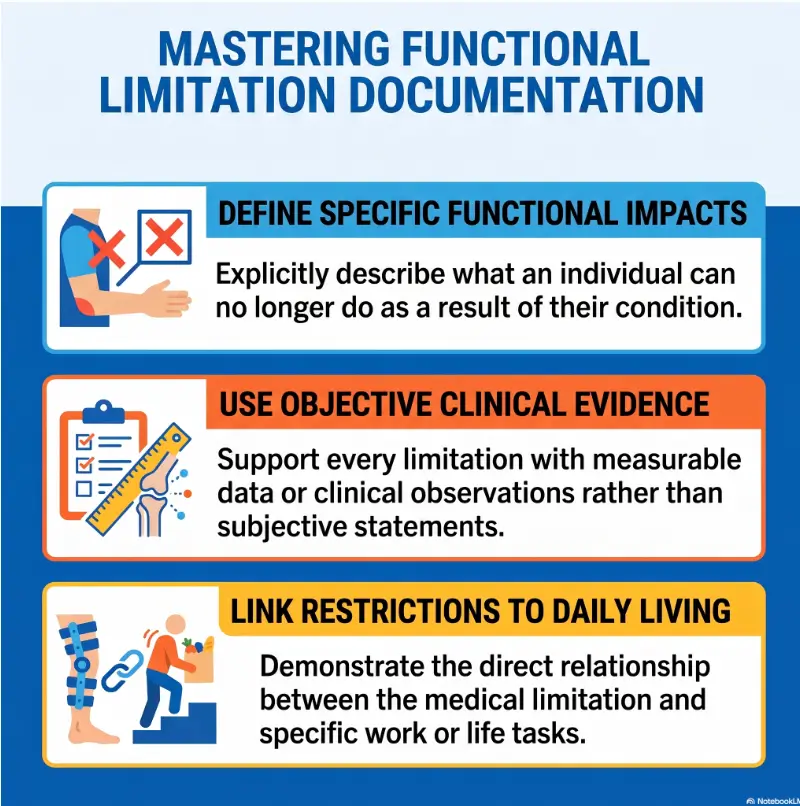
“I have trouble walking” may be completely true, yet it leaves several practical questions unanswered. How far can you walk? On what surface? With how many stops? What symptoms make you stop, and how long does it take before you can safely try another task?
Useful functional documentation turns a difficult day into a sequence another person can understand. It records the activity attempted, the measurable limit, the symptoms that appeared, the assistance used, and the recovery that followed. That structure can make medical conversations clearer without turning your life into a courtroom transcript.
This guide shows how to document stair use, uninterrupted sitting, walking tolerance, and disrupted sleep with enough detail to support better clinical discussions, accommodation requests, insurance records, or disability paperwork. Accuracy matters more than dramatic language. A plain, consistent record usually carries more meaning than a page crowded with adjectives.
The goal is not to prove that every day is terrible. It is to show what ordinary activities actually cost you. 🧭
Snapshot
Who it helps: Adults tracking functional limits for medical care, disability benefits, insurance, workplace accommodations, or legal records. What it solves: Vague notes that fail to explain real-world ability. Your next move: Create a seven-day baseline using the same five fields for every entry.
Table of Contents
Before You Act: A Diary Is Supporting Evidence, Not a Diagnosis
Functional documentation can help you remember patterns, explain symptoms, prepare for appointments, and organize information requested by an insurer, employer, attorney, or benefits agency. It does not establish a diagnosis, prove eligibility, replace clinical testing, or guarantee that a restriction will be accepted.
Medical providers, disability programs, insurance policies, workers’ compensation systems, and employers may apply different standards. A restriction that matters in one setting may need different supporting information in another. Confirm deadlines, forms, definitions, and documentation requirements with the organization handling your case.
Before You Act
Record what happened as accurately as you can. Do not test unsafe limits, stop prescribed treatment, recreate symptoms, omit good days, or adjust entries to resemble a benefits checklist. Ask a qualified clinician, benefits representative, employment professional, insurer, or attorney about decisions that carry medical, financial, employment, or legal consequences.
Who benefits from a functional log?
A patient preparing for an orthopedic, neurological, pain-management, sleep, or primary-care appointment may use a log to describe patterns that are hard to remember under fluorescent lights and a ticking exam-room clock. A worker may use similar information to discuss why prolonged sitting, repeated stair use, or walking between work areas has become difficult.
People applying for SSDI, SSI, long-term disability, workers’ compensation, or private insurance benefits may also be asked about daily activities. In those settings, personal notes are generally most useful when they remain consistent with medical records, treatment history, reported symptoms, and observable restrictions.
When a different approach is needed
Do not reconstruct months of daily entries as though they were written contemporaneously. Instead, label a retrospective summary clearly: “Written July 14 from calendar entries, messages, appointment records, and memory.” That is more honest and usually more useful than a suspiciously polished diary that appears overnight.
People with memory problems, medication confusion, cognitive symptoms, or severe fatigue may need a caregiver-assisted system. A trusted helper can record direct observations without deciding what the person “must have felt.” The distinction is small on paper and enormous in credibility.
Key Takeaway
A diary should describe your life, not perform for an audience. Specific, ordinary details are more useful than language engineered to sound disabled.
Start With Function, Not Just Pain Scores
Pain scores can be useful, but a number alone rarely explains what changed. Two people may both record “7 out of 10” while one finishes cooking with breaks and the other cannot safely stand long enough to prepare food.
Begin with the activity. Then document the event that interrupted it. Pain may be the reason, but weakness, numbness, instability, shortness of breath, dizziness, tremor, medication effects, poor concentration, or overwhelming fatigue may be equally important.
Use the five-field framework
- Activity attempted: Climbing the basement stairs, sitting through a meeting, walking to the mailbox, or trying to sleep.
- Measurable limit: Minutes, steps, flights, distance, awakenings, breaks, or repetitions.
- Symptoms: Pain location, weakness, numbness, breathlessness, dizziness, fatigue, balance trouble, or mental fog.
- Assistance or modification: Railing, cane, walker, another person, standing break, recliner, pillow, reduced pace, or task substitution.
- Recovery: Time before another activity, treatment used, lingering symptoms, or next-day effects.
Separate capacity from sustainability
Maximum ability answers, “Could you do it once?” Sustainable ability asks, “Could you do it safely, reliably, at a reasonable pace, and again when required?” Those are not interchangeable questions.
You may be able to sit through a 45-minute appointment because you reclined in the waiting room, changed position repeatedly, took medication beforehand, and canceled errands afterward. Recording only “sat for 45 minutes” erases the scaffolding holding that activity upright.
What numbers reveal that adjectives hide
| Vague entry | More useful functional entry |
|---|---|
| Stairs were awful. | Climbed 12 steps using the railing with both hands, paused once at step 7, and sat for 18 minutes afterward because of right-leg weakness and back pain. |
| I cannot sit long. | Sat in an office chair for 22 minutes before standing because of burning pain into the left thigh; remained standing for 8 minutes before resuming. |
| I barely walked. | Walked about 250 feet from the parking space to the clinic entrance with a cane and two stops; gait slowed during the final third. |
| I slept badly. | Awoke four times, including twice because of hip pain; estimated five hours of sleep and needed a 35-minute morning rest before showering. |
The Five-Part Functional Record
Stair Problems: Record the Climb, Descent, and Aftermath
Stair documentation often stops at “I avoid stairs.” That may describe your routine, but it does not show what happens when stairs are unavoidable. A useful entry separates going up, coming down, support used, pauses, safety concerns, and recovery.
Count steps, flights, landings, and pauses
Record the approximate number of steps rather than writing only “one flight.” Home staircases vary, and a six-step porch is not the same task as a long apartment stairwell.
- Number of steps or flights attempted
- Number and location of pauses
- Whether you used one foot per step or brought both feet onto each step
- Whether you turned sideways or changed technique
- Whether you carried anything
- Whether the stairs were straight, curved, narrow, wet, crowded, or poorly lit
Record support and direction
Note whether you used a railing, wall, cane, crutch, walker-compatible route, or another person. Also record which hand held the railing and whether carrying an object made the task impossible.
Going down may be harder than going up because of knee control, depth perception, weakness, balance, or fear of falling. For other people, climbing produces more fatigue or breathlessness. Keep the directions separate.
Document the post-stair cost
The most informative detail may occur after the final step. Did you sit immediately? Did your leg shake? Did pain remain elevated for an hour? Could you shower, cook, or leave for work afterward?
For families noticing that a parent has quietly stopped using part of the home, the guide to talking with a parent who avoids stairs because of pain can help separate convenience, fear, fatigue, and genuine safety concerns.
Key Takeaway
A completed staircase does not automatically show unrestricted stair ability. Record the support, pace, pauses, safety risk, and activity sacrificed afterward.

Sitting Limits: Measure the Clock Before You Shift
Sitting records are easily misunderstood because total sitting time is not the same as uninterrupted sitting tolerance. A person may spend much of the day seated while changing position every few minutes, reclining, standing frequently, or lying down between tasks.
Record uninterrupted sitting time
Start the clock when you sit. Record the first meaningful change, such as shifting repeatedly, standing, reclining, elevating a leg, removing pressure from one side, or ending the activity.
If you remain in the chair while constantly repositioning, note both facts. “Stayed at desk for 50 minutes” and “sat still for only 12 minutes before alternating between standing and leaning” tell very different stories.
Describe the seat and posture
- Chair type and approximate firmness
- Seat height and back support
- Upright, reclined, perched, or side-leaning posture
- Feet on the floor, footrest, or leg elevation
- Use of a cushion, lumbar roll, or heating or cooling device
- Whether the same limit occurs in a car, dining chair, couch, and office chair
Equipment can change function, sometimes substantially. An adjustable chair, footrest, cushion, or sit-stand setup may be worthwhile when it improves comfort and task endurance, but your record should show what changed after the adjustment rather than assuming a purchase solved the problem.
Connect sitting to the task
Sitting through a movie at home may involve reclining, changing positions, pausing, and using medication. Sitting at a workstation may require upright posture, sustained attention, typing, phone use, and limited freedom to move. Context makes the measurement meaningful.
Remote workers may find it useful to compare their notes with a practical sit-stand schedule for desk-job sciatica. The purpose is not to force a particular interval, but to identify whether planned changes reduce unplanned interruptions.
| Documentation option | Best for | Cost level | Main caution |
|---|---|---|---|
| Good: Paper notebook | Simple daily entries and low screen tolerance | Low | Harder to total patterns or share copies |
| Better: Basic spreadsheet or notes app | Sorting by activity, date, duration, and symptom | Low to moderate | Too many fields can make the habit collapse |
| Best for complex cases: Structured log plus professional review | Multiple conditions, conflicting records, formal evaluations, or high-stakes claims | Moderate to high | A paid review cannot replace accurate medical evidence or guarantee acceptance |
A free system is enough for many people. Consider paid software, printing services, occupational assessments, or professional assistance only when the complexity, stakes, or volume of records justifies the cost.
Walking Limits: Distance Is Only Half the Record
Walking ability changes with pace, terrain, slope, footwear, weather, crowding, symptoms, and whether a safe place to rest is available. “Walked around the store” is therefore less informative than it appears.
Choose a repeatable distance measure
You do not need laboratory equipment. Use a method you can repeat consistently:
- Minutes walked before the first stop
- Approximate feet or yards
- Step count from a phone or wearable
- Number of houses, blocks, aisles, or parking rows
- A familiar route, such as the bedroom to the mailbox
- Distance from a known parking space to a building entrance
Apps and wearables can support a record, but they may miss assistive-device use, limping, pain, effort, balance trouble, or the recovery required afterward. Treat device data as one piece of context, not an infallible witness strapped to your wrist.
Record walking quality and safety
- Pace compared with your usual pace
- Number and duration of stops
- Limping, dragging a foot, shortened steps, or leaning
- Use of a cane, crutch, walker, railing, cart, or another person
- Loss of balance, near-falls, actual falls, or fear that changes the route
- Symptoms that begin while walking versus symptoms that appear later
Repeated near-falls or “furniture walking” deserve direct attention. The fall-risk guide for older adults and the furniture-walking safety guide explain why getting across the room is not the same as moving safely.
Include the return trip and repeatability
A one-way distance may conceal the real problem. Record whether you could return without a ride, prolonged rest, increased assistance, or abandoning another task.
Also ask whether you could repeat the walk later that day. Someone may reach a clinic from the parking lot once, then spend the rest of the afternoon recovering. The destination was reached; the day was still functionally altered.
Quick Walking Checklist
Distance, pace, surface, slope, stops, gait change, support used, return trip, recovery, and whether you could repeat the route. Ten details, one much clearer picture.
Sleep Problems: Capture the Night and the Next Day
A sleep record is incomplete when it ends at sunrise. Nighttime disruption matters, but so do morning medication effects, delayed self-care, impaired concentration, unsafe sleepiness, missed work, and the need to rest during the day.
Record the night in plain time
- Time you went to bed
- Estimated time needed to fall asleep
- Number and approximate duration of awakenings
- Reason for waking, when known
- Final wake time and time you got out of bed
- Estimated total sleep
- Naps, including timing and length
Estimate honestly. You do not need to stare at the clock through every awakening. “Awake approximately 20 to 30 minutes” is better than invented precision.
Name what interrupted sleep
Possible reasons include pain, muscle spasms, numbness, bathroom trips, coughing, breathing symptoms, restless sensations, nightmares, medication timing, temperature, or difficulty changing position. Record what you observed without diagnosing the cause yourself.
When pain is the main issue, the guide on how to explain night pain to a doctor can help distinguish sleep-onset trouble, repeated waking, position intolerance, and morning consequences.
Complete the record with daytime effects
- Difficulty waking or getting out of bed
- Morning stiffness, headache, nausea, dizziness, or sedation
- Reduced concentration, memory, patience, or reaction time
- Late arrival, absence, reduced productivity, or canceled plans
- Unplanned naps or need to lie down
- Driving concerns or near-misses related to sleepiness
The National Heart, Lung, and Blood Institute provides a printable sleep diary that records both nighttime sleep and daytime habits. It can be useful when a simple, medically oriented format is preferable to building your own.
Show me the nerdy details
Functional records become more informative when they capture duration, frequency, intensity, variability, context, assistance, recovery, and repeatability. These dimensions answer different questions. Duration shows how long a limit lasts. Frequency shows how often it occurs. Repeatability shows whether the activity can be sustained across a normal day or workweek.
Variability is not automatically a contradiction. Symptoms may change with medication timing, sleep, physical demand, stress, temperature, treatment response, or the accumulation of activity. The useful task is to identify the conditions associated with better and worse function.
A strong summary therefore reports a range and a typical pattern rather than one heroic maximum or one catastrophic minimum. For example: “On five of seven days, uninterrupted sitting ranged from 18 to 28 minutes. The longest period was 41 minutes in a reclined seat after medication, followed by increased symptoms for approximately two hours.”
Build Entries a Clinician Can Actually Use
A clinician usually needs a pattern, not a daily novel. The best documentation system is brief enough to maintain and detailed enough to answer follow-up questions.
Use attempt, symptom, assistance, and recovery
A compact entry might read:
Sample Functional Entry
Tuesday, 8:10 a.m. Walked from the kitchen to the community mailbox, approximately 320 feet each way. Used a cane and stopped twice on the return trip because of right-leg weakness and burning pain. Sat immediately upon returning and postponed showering for 40 minutes. Symptoms returned to the pre-walk level after approximately 75 minutes.
That entry avoids medical conclusions. It gives the clinician observable components that can be compared with the examination, treatment response, and other records.
Distinguish typical, good, and bad days
Documenting only the worst days can create a distorted picture. Documenting only appointment days can do the same, particularly when appointments require unusual rest, transportation help, or canceled responsibilities.
- Typical day: The pattern that occurs most often.
- Better day: What improved, what you completed, and whether the improvement lasted.
- Worse day: The trigger when known, the added limitations, and how long the flare lasted.
- Unusual event: Travel, a family gathering, a medical procedure, or another activity that does not represent normal capacity.
A pain-flare trigger log may help when activity, sleep, medication timing, or prolonged positioning appears to affect function.
Real-world example: Document the hidden accommodations
Suppose Maria attends her niece’s graduation. A photograph shows her seated in the audience for two hours. Without context, the event may appear inconsistent with her reported 20-minute sitting limit.
Her contemporaneous notes explain that she arrived in a reclined car seat, used an aisle chair, stood six times, walked in the corridor twice, took prescribed medication, skipped the reception, and lay down for most of the afternoon.
The lesson is not to build a defense around every photograph. It is to document the modifications and consequences that ordinary summaries omit. A finished activity may show determination, family obligation, or necessity rather than unrestricted function.
Summarize before the appointment
Bring one page of patterns rather than asking the clinician to interpret 40 pages during a short visit. Include:
- The date range covered
- Typical and maximum uninterrupted sitting time
- Typical walking distance and support used
- Stair frequency, technique, and recovery
- Average sleep disruption and main daytime consequence
- Recent falls, medication effects, or major changes
- Two or three representative entries
You can pair the summary with an orthopedic appointment checklist or a doctor-visit summary template for caregivers when another person helps organize the appointment.
Evidence Beyond the Diary: What Can Support Your Account?
A functional diary is usually strongest when it fits into a larger record. Supporting information may explain why a limitation exists, how it has been evaluated, what treatment has been attempted, and whether similar problems were observed by others.
Medical and rehabilitation records
- Clinical notes describing gait, strength, range of motion, balance, fatigue, cognition, or sleep symptoms
- Physical therapy and occupational therapy evaluations
- Functional-capacity or work-capacity assessments
- Sleep studies, imaging, laboratory testing, nerve testing, or pulmonary testing when medically relevant
- Medication changes and documented side effects
- Prescriptions for a cane, walker, brace, wheelchair, seating modification, or other equipment
- Home-safety or accessibility recommendations
Testing and imaging should not be interpreted in isolation. A scan may help explain anatomy, but daily function also depends on symptoms, clinical findings, treatment response, safety, and the demands of the activity.
Workplace and third-party observations
Attendance records, modified duties, reduced schedules, ergonomic changes, parking accommodations, remote-work arrangements, or assistance from coworkers may show how function changed in a practical setting.
Family members can record what they directly observed: “He stopped twice between the car and entrance,” or “She has slept in the recliner four nights this week.” They should avoid guessing at pain intensity, writing rehearsed statements, or copying your wording.
When medical notes omit the problem
Absence from a note does not necessarily mean the limitation was rejected. It may mean the appointment focused on another issue, time was short, or the detail was never discussed clearly.
At the next visit, calmly state the function, measurement, and consequence: “I want to make sure we discuss sitting. On most days I need to stand after about 20 minutes, and I cannot resume sitting for another 10 minutes.” Ask the clinician which restrictions are medically supported and whether additional assessment is appropriate.
Evidence Hierarchy, Without the Drama
Your diary describes lived function. Clinical records evaluate medical findings. Workplace and family observations add context. Device data supplies measurements. None of these pieces should impersonate the others.
Common Mistakes and Consistency Traps
Most weak records are not ruined by one dramatic contradiction. They fade through small omissions: no measurements, no recovery time, identical copied entries, unexplained activity, or a diary that contains only unusually bad days.
Mistakes that reduce clarity
| Common mistake | Safer alternative |
|---|---|
| Writing only “pain was severe” | Name the activity, measurable limit, stopping symptom, and recovery. |
| Recording only maximum ability | Include typical ability, support, pace, and repeatability. |
| Copying the same sentence daily | Use the same fields but enter the actual details for that day. |
| Documenting only bad days | Record ordinary, better, and worse days. |
| Ignoring medication effects | Note timing, benefit, sedation, dizziness, or other observed effects. |
| Testing the limit for the diary | Record normal necessary activity without creating avoidable risk. |
| Changing language to match a form | Answer the form accurately and explain context separately. |
Explain apparent contradictions without arguing with the page
A record may show that you walked farther at a hospital than at home. That does not automatically invalidate either report. The hospital may have offered handrails, seating, a slower pace, assistance, medication timing, or a long recovery afterward.
Explain the difference in neutral terms. Avoid defensiveness and avoid pretending the stronger performance did not happen. Variability becomes understandable when the conditions are visible.
Distinguish necessary activity from comfortable activity
People often complete tasks because food is needed, a child must be collected, a medical appointment cannot be missed, or no helper is available. Completing a necessary activity does not show that it was comfortable, safe, efficient, or repeatable.
Record why the activity was necessary, what modifications made it possible, and what followed. Do not claim that necessity made the activity impossible if you completed it. Accuracy includes both accomplishment and cost.
Choose help based on the stakes
| Situation | DIY documentation may be enough | Consider professional guidance |
|---|---|---|
| Preparing for a routine appointment | A seven-day log and one-page summary | When symptoms are rapidly changing or difficult to measure |
| Requesting a simple workplace adjustment | A clear description of the job barrier and requested change | When the request is denied, medical documentation is disputed, or employment is at risk |
| Submitting an insurance or benefits form | Accurate answers supported by existing records | When definitions, deadlines, appeals, surveillance, or conflicting evidence create substantial risk |
| Managing fall risk at home | Basic route review and discussion with the clinician | After falls, repeated near-falls, new weakness, or uncertainty about equipment fit |
For workplace accommodation questions, review official guidance before paying for templates or generic letter services. A paid document that ignores your actual job duties or medical facts may be an expensive decorative object.
When Symptoms Need Prompt Medical Help
A diary should never delay urgent evaluation. Seek emergency help for severe breathing difficulty, chest pain, fainting, sudden paralysis, or another symptom that appears life-threatening.
Prompt medical assessment may also be needed for new or rapidly worsening weakness, repeated falls, major loss of coordination, new confusion, serious medication reactions, or sleepiness that makes driving or safety-sensitive work dangerous.
New bowel or bladder control problems occurring with back pain, leg weakness, numbness around the groin or saddle area, or rapidly changing neurological symptoms require urgent medical attention. Do not spend an hour formatting a diary entry first.
What to bring when seeking care
- The time the new symptom began
- Whether onset was sudden or gradual
- Recent injuries, falls, procedures, or medication changes
- Current medication list and known allergies
- Whether weakness, numbness, breathing, speech, bladder, bowel, or consciousness changed
- A companion when safe transportation or communication assistance is needed
For back-related neurological warning signs, MedlinePlus provides general information about symptoms that merit timely medical contact. Use emergency services when the situation appears urgent rather than relying on an online page to assess severity.
FAQ: Documenting Daily Functional Limitations
How often should I record stair, walking, sitting, and sleep problems?
Record often enough to show a pattern without making the system impossible to maintain. A seven-day daily baseline is a useful starting point. After that, you might record representative days, major changes, treatment responses, falls, unusual activities, or a clinician-requested monitoring period.
Should I document good days as well as bad days?
Yes. Good days show variability and help identify what improved function. Record the activity completed, conditions that helped, modifications used, and whether the improvement lasted or produced delayed symptoms.
How can I measure walking distance without special equipment?
Use minutes, steps, blocks, aisles, parking rows, familiar household routes, or a mapped route. Consistency matters more than perfect precision. State that the distance is approximate when appropriate.
Does needing breaks count as a functional limitation?
Breaks are relevant because they affect pace, productivity, safety, and repeatability. Record how often they occur, how long they last, what position or treatment is needed, and whether you can resume the same task afterward.
Should I give my symptom diary to my doctor?
Ask how the clinician prefers to receive it. A one-page summary with a few representative entries is often easier to review than a long unfiltered diary. Keep your original copy and follow the office’s privacy and messaging procedures.
Can a spouse or family member provide supporting observations?
They can record what they directly saw or did, such as helping you stand, carrying items, noticing repeated awakenings, or observing a near-fall. They should distinguish direct observation from information you told them.
Are smartwatch and sleep-app records useful evidence?
They may support information about steps, heart rate, activity timing, or estimated sleep, but accuracy and interpretation vary. Use the data as context and discuss medically significant readings with a qualified clinician.
What should I do when medical notes do not mention my limitations?
Raise the issue at the next appropriate visit using one or two measurable examples. Ask whether the limitation is medically consistent with the clinician’s findings and whether further evaluation, therapy assessment, or documentation is appropriate. Do not ask the clinician to record a restriction they do not support.
Can ordinary activities be misunderstood during a disability review?
Yes. Shopping, travel, exercise, caregiving, or attending an event may be interpreted without seeing the assistance, breaks, reduced pace, recovery, or tasks abandoned afterward. Record the full context accurately rather than avoiding every ordinary activity out of fear.
Your 15-Minute Next Step: Start a Seven-Day Baseline
Open a notebook, notes app, or spreadsheet and create five columns: activity attempted, measurable limit, symptoms, assistance or modification, and recovery time. Add the date and time above each entry.
Do not begin by documenting every breath and shoelace. Choose the four functions that brought you here: stairs, sitting, walking, and sleep. Record one representative entry for each relevant function today.
Your Seven-Day Baseline Template
- Activity: What did you attempt?
- Limit: How many minutes, steps, feet, breaks, or awakenings?
- Symptoms: What appeared or increased?
- Support: What assistance, equipment, posture, or modification was needed?
- Recovery: When could you safely resume another activity?
At the end of seven days, circle the pattern that occurred most often. Bring that one-page summary to your next appointment and ask: “Which of these limitations are medically supported, and is there anything you want me to measure differently?”
That question keeps the record honest and useful. It also turns documentation from a private pile of difficult moments into a clearer conversation about treatment, safety, work, and daily life.
Last reviewed: 2026-08