
Written from a family caregiver perspective. The operator cares for an older mother with rheumatic, spinal and knee problems and is not a medical professional. This article offers general information, not individual clinical clearance.

Patient-friendly symptom clarity
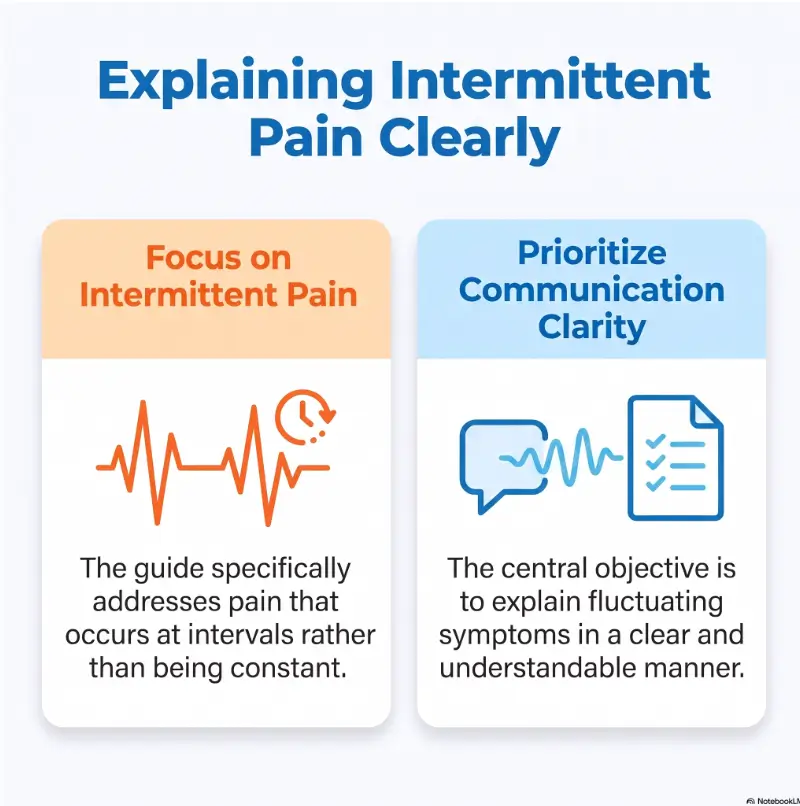
How to Explain Pain That Comes and Goes
Without Being Dismissed
Intermittent pain has a strange talent for vanishing right when you finally get help. It can be sharp at 7:12 a.m., gone by lunch, and impossible to prove by the time you sit on the exam table under that papery little flag of dignity.
The problem is not that your pain is too vague. The problem is that “it comes and goes” needs a better frame. Clinicians, caregivers, employers, and partners usually need the same practical clues: where it happens, when it starts, how long it lasts, what it feels like, what triggers it, what helps, and what it prevents you from doing.
This guide gives you a calm, appointment-ready way to explain pain that disappears before anyone else can see it. No drama costume. No detective novel. Just the kind of clear, useful language that helps other people understand what your body has been whispering, tapping, or occasionally banging a pan about.
Build a useful script
Turn scattered symptoms into a 7-part explanation clinicians can work with.
Know when not to wait
Separate ordinary tracking from red flags that need urgent care.
Make one episode count
Use one clear example instead of trying to remember every bad hour.
Small promise: by the end, you will have one sentence you can use at a doctor visit, urgent care desk, work conversation, or caregiver check-in. 🩺
Snapshot
This article is for adults, caregivers, and busy families trying to explain recurring pain clearly without sounding alarmist or being brushed off. You will learn what details to track, what words to use, when intermittent pain needs urgent help, and how to prepare a short symptom summary before an appointment.
Table of Contents
READER WORKSHEET
Intermittent pain pattern record
Describe an episode and the gaps between episodes in your own words.
Confirm and prepare
Add your working notes
Keep names, account numbers, member IDs, and other identifying details out of this worksheet.
Complete your worksheet to organize the next step. Blank amounts remain unknown.
How to use the result: The pattern record does not diagnose a cause. Do not reproduce a painful movement just to collect data.
This worksheet does not save entries between visits or send them to a provider. Download before leaving; the downloaded file may contain your notes. It is a planning aid, not a diagnosis, safety assessment, coverage decision, or final bill.
Before You Act: Pain Can Disappear And Still Matter
This guide is educational. It can help you organize symptoms and prepare for a better conversation, but it cannot diagnose pain, rule out a serious condition, or replace medical care.
The important thing to remember is simple: pain that comes and goes is not automatically harmless. Some serious problems can arrive in waves. Others start subtly, then become more obvious over time. A calm plan is useful, but false reassurance is not.
If you have chest pain, trouble breathing, fainting, sudden severe pain, confusion, weakness, trouble speaking, severe abdominal pain, symptoms after a major injury, or anything that feels like an emergency, seek urgent medical help rather than tracking symptoms at home.
Key takeaway
A pain log is for non-emergency patterns. It is not a substitute for urgent care when symptoms are sudden, severe, worsening, or paired with warning signs.
For official emergency warning signs, MedlinePlus has a plain-English guide that is worth bookmarking.
Who This Guide Helps, And Who Should Not Wait
Best fit: the person whose pain disappears before the appointment
Some pain has terrible timing. Your knee complains while climbing the porch steps, your stomach cramps after dinner, or your shoulder burns after laptop work. Then the appointment arrives, and your body puts on a little tuxedo and behaves.
This guide helps you preserve the useful details before they evaporate. You do not need perfect medical language. You need a clear pattern.
Best fit: caregivers helping someone describe vague symptoms
Caregivers often notice patterns the person in pain misses. Maybe Mom stops using the stairs after dinner. Maybe your partner rubs one side of the neck every time they drive. Maybe a parent says “I’m fine,” while quietly building their day around avoiding pain.
If you help someone prepare for appointments, pair this guide with a simple visit summary. A related resource, doctor visit summary template for caregivers, can help keep symptoms, medications, questions, and follow-up tasks in one place.
Not for: sudden, severe, or dangerous symptoms
Do not wait for an appointment if the pain is sudden and severe, appears after a serious fall or crash, comes with chest pressure, shortness of breath, fainting, confusion, weakness, numbness, trouble speaking, high fever, severe abdominal pain, or loss of movement.
When in doubt, it is reasonable to call a local nurse line, urgent care, your doctor’s office, or emergency services depending on the severity. The “right” choice is not about being brave. It is about matching the level of care to the level of risk.
The line in the sand
Track recurring, non-emergency pain. Do not “track and wait” through emergency warning signs. That line keeps this article useful without turning it into a paper umbrella in a thunderstorm.
The 7-Part Pain Script Doctors Can Use
The best way to explain pain that comes and goes is to make it specific enough that someone else can picture the episode. A clinician does not need a performance. They need clues.
Use this sentence structure as your base:
“I’m having pain that comes and goes in [location]. It usually starts when [trigger/time], lasts [duration], feels like [sensation], improves with [relief], and affects [daily activity].”
Location: point with one finger, then show the area
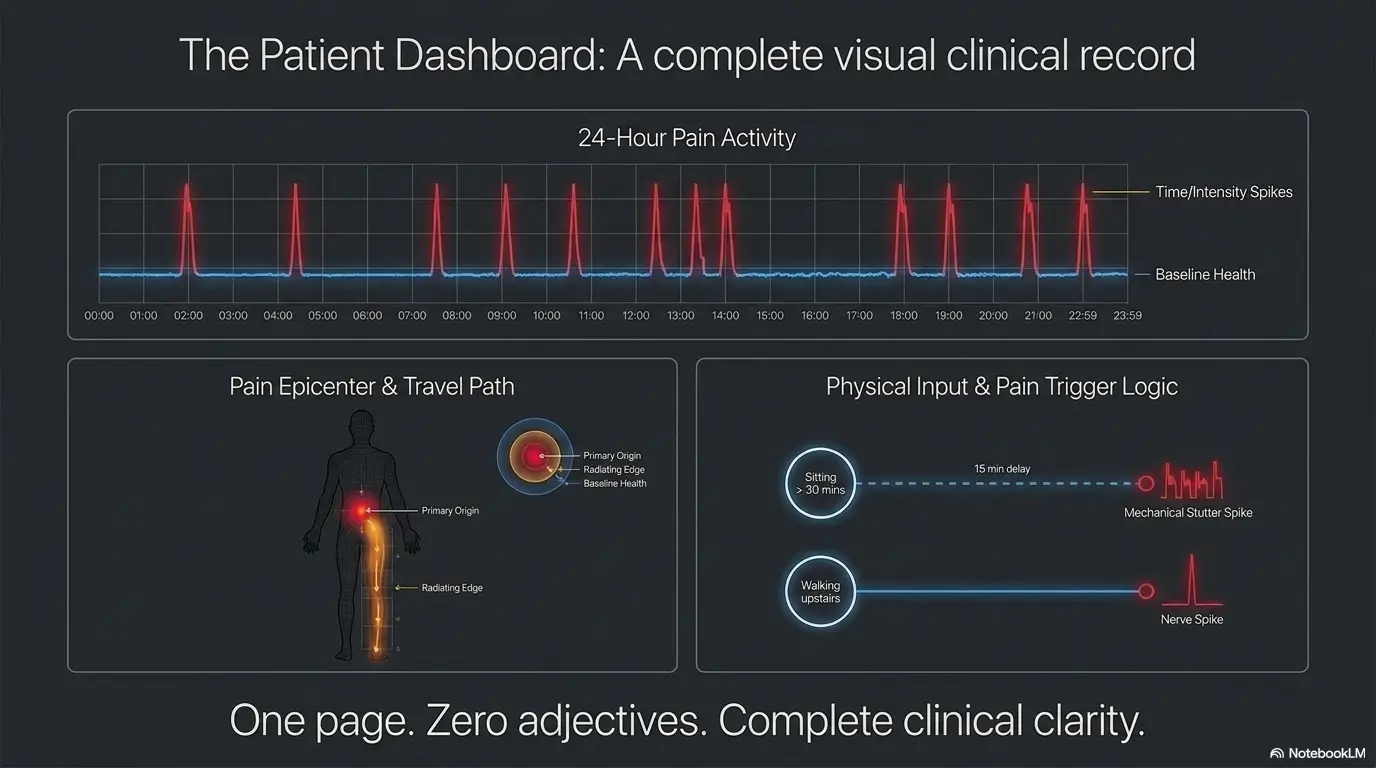
Start with the most exact location you can. “My back hurts” is a foggy window. “The pain starts just above my right hip and sometimes travels down the outside of my thigh” gives someone a map.
If the pain spreads, say where it starts first and where it travels. Do not skip the starting point. That first spark can matter.
Timing: say when it starts and how long it lasts
Timing turns a vague complaint into a pattern. Try phrases like “after walking two blocks,” “about 30 minutes after meals,” “when I first get out of bed,” or “near the end of my workday.”
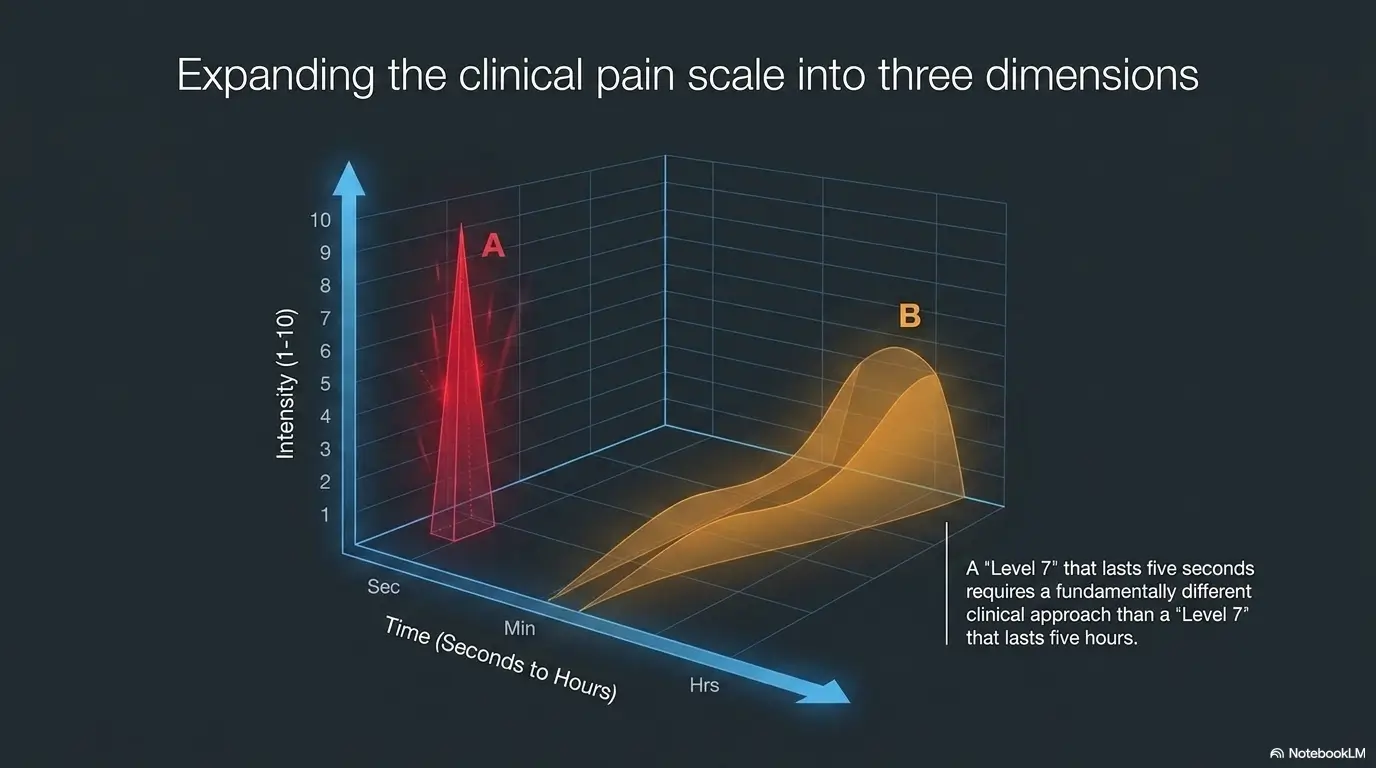
Duration matters too. A stabbing pain that lasts 10 seconds is different from pressure that lasts 25 minutes. Both deserve clear wording.
Sensation: use plain words, not medical theater
You can use ordinary words: sharp, dull, burning, tight, cramping, electric, throbbing, aching, stabbing, pulling, pressure, pins and needles, or heavy. If the word is imperfect, that is fine. Pain rarely arrives with a dictionary.
If you are stuck, compare the sensation to a physical experience: “like a muscle cramp,” “like pressure under the ribs,” “like a hot line down the leg,” or “like a toothache in the joint.”
Intensity: anchor the number to function
A pain score can help, but numbers alone are slippery. One person’s 6 is another person’s “I reorganized my whole life around this.”
Add what the pain stopped you from doing. “It was a 6, and I had to sit down halfway through grocery shopping” is more useful than “It was a 6” by itself.
Infographic: The 7-Part Pain Script
Where it starts
When it appears
How long it lasts
Sharp, burning, pressure
What brings it on
What helps
What it stops
Use all seven once, and your symptom story becomes much easier for another person to understand.
The Pain That Vanishes: Why Timing Is The Clue
Pattern beats drama
A dramatic description may get attention, but a repeatable pattern gets traction. “It hurts sometimes” is hard to act on. “It happens after sitting more than 40 minutes, then improves after I stand and walk for five minutes” gives the clinician something to test against your story.
This is especially useful for pain that changes your routine. If you have already started avoiding chores, stairs, driving, errands, or sleep positions, that matters. The article on pain changing your routine is a helpful companion if your day is quietly shrinking around symptoms.
“Only sometimes” is still a symptom pattern
People often downplay intermittent pain because they feel normal between episodes. That normal gap can be useful information, not a reason to erase the episode.
Tell the whole rhythm: “I feel normal most of the day, but the pain comes back after dinner,” or “It happens two or three mornings a week, then fades by noon.” The empty spaces between episodes are part of the pattern.
Illustrative planning example
Illustrative example, not a reported patient case: a household has an unanswered question about an episode already experienced. The useful next step is to record the uncertainty, identify who can answer it and agree on a follow-up action, rather than assume that a familiar routine is suitable.
The 3-Day Pain Log That Keeps The Story Straight
A pain diary should not become a second job. The best pain log is the one you will actually use when life is messy, dinner is burning, and your phone battery is performing its final opera.
For stable, non-emergency pain, three days or a few episodes may be an easy organizational window, not a minimum waiting period. Record only symptoms arising during ordinary permitted activities. Do not repeat a painful task, add an exercise test, or provoke pain to prove it exists. Seek care sooner for a changing pattern or warning signs.
Record the episode, not your entire day
You do not need to document every glass of water, every step, or every cloud formation. Write down the episode and the surrounding clues.
Try this format: start, stop, cause, relief. It is short enough to use and structured enough to help.
| Log item | What to write | Example |
|---|---|---|
| Start | Time and situation | 7:40 a.m., getting out of bed |
| Stop | How long it lasted | About 18 minutes |
| Cause | Possible trigger | Bending to feed the dog |
| Relief | What helped | Standing upright, heat, slow walking |
| Impact | What changed | Could not carry laundry downstairs |
Include related symptoms without writing a novel
Related symptoms can change the meaning of pain. Write down nausea, dizziness, sweating, shortness of breath, fever, swelling, numbness, weakness, rash, bowel changes, urinary symptoms, or pain spreading to another area.
Use plain wording. “Felt sweaty and lightheaded during the chest pressure” is more useful than trying to label what caused it.
Add photos when appearance or setup matters
If swelling, redness, bruising, rash, posture, desk setup, footwear, or a home task seems connected, one photo can help. Keep it relevant. A clinician does not need your full camera roll, including the accidental ceiling fan documentary.
If your issue is orthopedic, the guide on photos to bring to an orthopedic visit explains when pictures help and when they become noise.
Key takeaway
A useful pain log is not a memoir. Capture the episode, the likely trigger, what helped, and what the pain stopped you from doing.
For a deeper trigger-focused version, use the pain flare trigger log to connect episodes with food, posture, activity, sleep, stress, and medication timing.
Red Flags That Change The Plan
Some symptoms deserve immediate attention even if the pain comes and goes. This is not about panic. It is about not treating a fire alarm like a cooking timer.
Call emergency services for dangerous warning signs
Call emergency services for sudden chest pressure or squeezing that does not settle, pain spreading to the arm, jaw, back or neck, or chest symptoms with sweating, nausea, lightheadedness or breathlessness. Also call for sudden one-sided weakness, facial droop, speech difficulty, collapse, new confusion, or other life-threatening symptoms. Do not wait to finish a log or decide that a brief duration makes it safe.
If you are unsure whether chest pain is heart-related, it is safer to get medical help. Chest symptoms can be subtle, and “not dramatic” does not always mean “not serious.”
Schedule care when episodes are changing
Even when symptoms are not urgent, recurring pain deserves attention if it is becoming stronger, lasting longer, happening more often, waking you at night, limiting work, changing how you walk or use your arms, or causing you to avoid normal activities.
Do not wait until you can barely function. Function changes are medical information. They show how pain is affecting your real life, not just your pain score.
Use this red flag checklist before deciding to wait
- Is the pain sudden, severe, or unlike anything you have felt before?
- Is there chest pressure, trouble breathing, sweating, nausea, or dizziness?
- Is there fainting, confusion, trouble speaking, weakness, numbness, or trouble walking?
- Is there fever, major swelling, redness, warmth, or signs of infection?
- Did the pain follow a fall, crash, head injury, or spine injury?
- Is there severe abdominal pain, vomiting blood, or black or bloody stool?
- Is the pain rapidly worsening or not easing as expected?
If you checked yes to a serious warning sign, do not polish your pain script first. Seek appropriate medical help.
When Pain Comes And Goes In Specific Places
Location changes the questions. The same “comes and goes” phrase means different things when you are talking about chest pressure, back pain, head pain, abdominal pain, or joint pain.
Chest pain: do not downplay pressure or breathlessness
With chest pain, describe whether it feels like pressure, squeezing, burning, heaviness, sharp pain, or discomfort. Say whether it spreads to the arm, jaw, back, shoulder, or neck. Mention sweating, nausea, dizziness, shortness of breath, or symptoms that appear with exertion.
Symptoms settling does not establish that the episode was harmless. New or recurring chest pain still needs prompt medical advice; if heart-attack warning signs are present, call emergency services. Stroke-like symptoms require immediate assessment even if they disappear while help is on the way. Describe the timing after seeking the appropriate help.
Back pain: watch the legs and function
For back pain, describe radiation, numbness, tingling, weakness, and ordinary positions already observed. New difficulty passing urine, bladder or bowel control changes, numbness around the genitals/anus, or severe worsening weakness in both legs needs emergency assessment. Do not wait for a routine visit or collect more episodes first.
If your pain is spine-related, you may also find the spine doctor visit checklist helpful when preparing questions, imaging history, medication details, and activity limits.
Head pain: sudden, severe, or neurologic symptoms change the rules
For headaches that come and go, describe the location, onset speed, visual changes, nausea, sensitivity to light, fever, neck stiffness, head injury, weakness, numbness, confusion, fainting, or trouble speaking.
Mayo Clinic’s headache guidance is a useful official reference for warning signs that should prompt emergency or prompt medical care.
Abdominal or pelvic pain: track food, bowel, urine, and cycle clues
For abdominal or pelvic pain, timing is especially helpful. Note whether it appears before or after meals, with certain foods, with bowel changes, during urination, around menstruation, after exercise, or with fever, vomiting, blood, bloating, or severe tenderness.
Severe abdominal pain, pain with chest pressure, pain after trauma, or pain with serious systemic symptoms should be treated more urgently. Do not let the word “stomachache” make you minimize severe symptoms.
How To Talk To A Clinician Without Freezing Up
Medical visits move quickly. The room is bright, the paper crinkles, and your memory suddenly behaves like a browser with 47 tabs open. A short script protects you from freezing.
Open with the headline
Start with the reason you came in. Say: “I’m here because this pain keeps coming back, and it is starting to affect my day.”
That tells the clinician this is recurring, function-related, and worth sorting. Then give the most recent episode first.
Give one clear example before the whole history
Instead of starting with every episode since the beginning of time, choose one recent, typical event.
Appointment-ready wording
“Yesterday around 4 p.m., I felt a burning pain in my right lower back after sitting at my desk for about an hour. It lasted 25 minutes, improved when I stood up and walked, and I avoided driving afterward because I was worried it would flare again.”
That example gives location, timing, sensation, trigger, duration, relief, and impact. It is short, but it carries weight.
Say what you are worried about, plainly
You are allowed to say what scares you. Try: “I’m worried because it is happening more often,” or “I’m worried because my father had heart problems,” or “I’m worried because I am avoiding stairs now.”
A concern is not a demand for a specific test. It is context. Good care often starts when the hidden worry is finally named.
Ask: what would make this urgent?
Before you leave, ask: “What symptoms would mean I should seek urgent care instead of waiting?”
This question is small and powerful. It gives you a safety plan, not just a diagnosis plan. For broader appointment preparation, see this orthopedic visit checklist if your pain involves joints, bones, muscles, or spine concerns.
Show me the nerdy details
Clinicians often think in patterns: onset, location, duration, character, aggravating factors, relieving factors, associated symptoms, and functional impact. You do not need to know those labels, but your story becomes easier to evaluate when you include them.
The phrase “comes and goes” describes timing, but not meaning. The clinical value comes from connecting timing to repeatable triggers, body location, related symptoms, and changes in function.
That is why “left chest pressure after climbing stairs, lasting 12 minutes, with sweating and shortness of breath” is very different from “brief sharp rib pain when twisting, lasting five seconds, with no breathing changes.” Both should be described clearly, but they point the conversation in different directions.
Free Vs Paid Tools And Professional Help
You do not need an expensive app to explain pain well. For many people, a notes app, paper calendar, or printed worksheet is enough.
Paid tools, wearable trackers, specialist visits, physical therapy, urgent care, or telehealth may be worth considering when symptoms are frequent, confusing, limiting daily life, or hard to connect to triggers. The goal is not to buy your way into clarity. The goal is to choose the simplest tool that matches the risk and complexity.
Good, better, best options for tracking intermittent pain
| Option | Best for | Cost level | Watch out for |
|---|---|---|---|
| Good: paper note or phone note | Simple recurring pain with clear episodes | Free | Forgetting to include duration, triggers, and impact |
| Better: printable pain log or spreadsheet | Several episodes over a week | Free to low-cost | Making it too detailed to maintain |
| Best: clinician-guided tracking plan | Pain that affects work, sleep, walking, caregiving, or safety | May involve visit costs or insurance | Not asking what symptoms should prompt urgent care |
| Professional help sooner | Red flags, worsening symptoms, injury, weakness, numbness, chest symptoms, severe pain | Varies by setting | Waiting because symptoms temporarily improved |
When DIY tracking is enough for now
DIY tracking may be enough for a short period when pain is mild, familiar, non-emergency, not worsening, and not limiting your basic activities. Even then, set a boundary: if it becomes more frequent, stronger, longer-lasting, or function-limiting, schedule care.
If you are trying to avoid spiraling through search results at midnight, the guide on cyberchondria and chronic pain can help you research without turning every symptom into a catastrophe parade.
Questions to ask before paying for help
- Is this the right level of care: primary care, urgent care, specialist, physical therapy, or emergency care?
- What symptoms would make this urgent?
- What should I track before the next visit?
- Are there lower-cost options, such as an in-network clinic, telehealth visit, or home exercise guidance?
- Will imaging, therapy, medication, braces, injections, or referrals require insurance approval?
- What should I do if the pain improves, then comes back?
Key takeaway
The best tool is the one that helps you explain the pattern without delaying care. Free notes are fine for simple tracking. Professional help matters when symptoms are risky, worsening, confusing, or life-limiting.
For patient-centered pain conversations, the CDC offers guidance on discussing treatment goals, risks, benefits, and options with clinicians.
Explain Pain To Work, Family, Or A Caregiver
Not every pain conversation happens in a clinic. Sometimes you need to explain symptoms to a manager, partner, adult child, roommate, or caregiver without sharing your entire medical life.
Use function language at work
At work, focus on what the pain affects and what practical adjustment may help. Avoid guessing at a diagnosis unless a clinician has given one.
Work-friendly wording
“I’m having recurring pain that flares after long periods of sitting. I’m working with my clinician on it. For now, it would help if I could stand briefly every 30 to 45 minutes and avoid back-to-back meetings without a short break.”
If your pain affects work duties, documentation matters. Keep your language factual: task, limit, frequency, and what helps you stay productive.
Give family a job, not a cloud of worry
Family members often swing between underreacting and hovering. Give them a specific role.
- “Please remind me to write down the time if it happens again.”
- “Can you drive me if the pain returns after dinner?”
- “If I have chest pressure with shortness of breath, help me seek urgent care.”
- “Please come to the appointment and help me remember the timeline.”
If you are checking on a parent, use gentle, concrete questions. This parent pain check questions guide can help turn “Are you okay?” into a more useful conversation.
Avoid over-sharing while still being clear
You do not owe every person every detail. A good non-clinical explanation gives enough information for safety and planning without opening your private medical file on the kitchen table.
Try this three-part version: “I’m having recurring pain. It affects [specific task]. I may need [specific support] while I get it checked.”
Key takeaway
For doctors, give clinical details. For work and family, give functional details. The same pain story can be edited for the audience without becoming less truthful.
FAQ
How do I describe pain that comes and goes to a doctor?
Describe the location, timing, duration, sensation, intensity, triggers, relief, related symptoms, and effect on daily function. A useful sentence is: “The pain starts in this area, happens after this activity or time, lasts this long, feels like this, improves with this, and stops me from doing this.”
What should I write in a pain diary?
Write the time it started, what you were doing, where the pain was, what it felt like, how long it lasted, what helped, and what activity it affected. Add related symptoms such as nausea, dizziness, swelling, weakness, numbness, fever, or shortness of breath.
Is pain serious if it disappears?
It can be. Pain that disappears may still matter if it returns, worsens, lasts longer, appears with red flags, or changes your daily function. Do not ignore chest pain, sudden severe pain, trouble breathing, fainting, confusion, weakness, severe abdominal pain, or symptoms after a serious injury.
What words describe different types of pain?
Common pain words include sharp, dull, aching, burning, cramping, throbbing, stabbing, electric, tight, heavy, pressure, pulling, tingling, numb, sore, and tender. You can also describe pain by comparing it to a familiar sensation, such as a cramp, bruise, hot line, or toothache.
Should I track pain by time, activity, or food?
Track all three if they seem relevant, but keep it simple. Write when it happened, what you were doing, and whether food, caffeine, alcohol, posture, movement, sleep, stress, bowel habits, urination, or menstrual timing might be connected.
What if my pain is gone by the appointment?
Tell the clinician that the pain is not present right now, then describe the most recent episode clearly. Bring your pain log if you have one. A symptom does not need to be active in the room for its pattern to be important.
How do I explain pain without sounding dramatic?
Use factual language. Say what happened, how long it lasted, what helped, and what it stopped you from doing. You do not need to apologize, minimize, or exaggerate. Clear is better than dramatic.
When should intermittent pain be checked urgently?
Seek urgent care for chest pain or pressure, trouble breathing, fainting, sudden severe pain, confusion, weakness, numbness, trouble speaking, severe abdominal pain, symptoms after major injury, or pain with serious related symptoms. If you are unsure and symptoms feel dangerous, seek immediate medical help.
Make One Episode Clinically Useful In 15 Minutes
You do not need to solve the pain today. You need to make the next conversation clearer.
Set a timer for 15 minutes and write one recent episode using this exact format:
Your 15-minute next step
“I’m having pain that comes and goes in [location]. It usually starts when [trigger/time], lasts [duration], feels like [sensation], improves with [relief], and affects [daily activity].”
Then add one question: “What symptoms would mean I should seek urgent care instead of waiting?”
If you already have an appointment scheduled, bring that sentence with you. If you are still deciding where to go, review whether your symptoms fit primary care, urgent care, or emergency care. The guide on urgent care vs orthopedic clinic may help if your pain is related to bones, joints, muscles, or injury.
The deeper promise is this: you do not have to make pain sound bigger to make it matter. You only have to make it visible enough for someone else to follow the thread.
Last updated: October 14, 2026
Describe an episode even when pain has stopped
Use these prompts for a private note or your next care-team conversation. Record what is known and mark unanswered questions; completing this table does not establish safety, independence or treatment eligibility.
| Record or clarify | Question and next action |
|---|---|
| An episode already experienced | When did it start, where was it felt and what was happening without deliberately reproducing it? |
| Effect on daily life | What changed or was avoided, and what symptoms did the person report? |
| The request for the appointment | What would you like assessed or explained? A symptom-free appointment does not invalidate the earlier report. |
Keep the person’s own report separate from a helper’s observation. Share only with consent and only with people who need the information. Do not put identifying health details in public comments. The visit preparation tool can organize questions; it cannot assess symptoms or approve a task.
Background resource: NHS: falls and getting help. This resource supports general care planning; it does not validate every instruction elsewhere in this article.
Targeted caregiver edit: October 21, 2026. Added the topic-specific handover questions and clarified narrative examples and planning limits. Earlier clinical sections retain their previous review scope; this update is not a full medical review.