
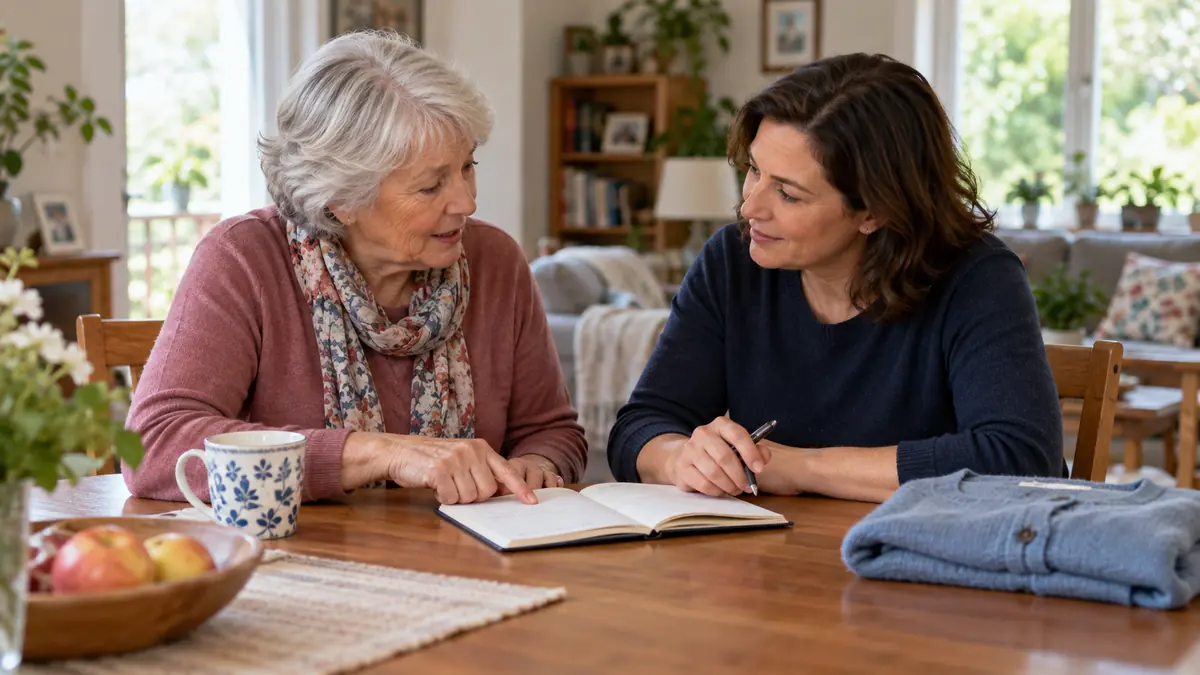
Pain and dressing difficulties can be discussed together without turning dressing into a test. Keep the person’s own pain report, a helper’s observation, uncertainty and the actual clinical explanation separate. Putting an item on does not prove mild pain; not attempting it does not establish a diagnosis or failure to recover.
Start with the report–observation–explanation comparison, follow seven essential visit checks, read two fictional writing examples, or download the free offline explanation-and-next-plan record. Existing information is enough. No repeated movement, timed task, filmed demonstration or required three-day diary is requested.
This page focuses on accurate clinical communication and follow-through after an existing dressing concern. The socks after hip surgery guide addresses actual garments, aids, application/removal teaching and help. Here the purpose is to describe experience and retain what was really explained, without selecting a technique, product, treatment or diagnosis.
Family-caregiver-written education, not individual medical advice or an independent clinical review. This is not a validated functional pain assessment, disability-evidence instrument or home examination. No actual patient, clinical explanation or treatment outcome has been verified for the article.
Table of Contents
Warning symptoms come before a pain or dressing diary
Use local emergency services for severe breathing difficulty or possible stroke symptoms. Examples include gasping or being unable to get words out, or sudden face weakness, one-sided arm weakness and speech changes. Do not finish dressing or complete a note first. In the U.S., call 911. NHS breathlessness guidance and NHS stroke guidance describe these warning contexts; stroke symptoms need immediate help even if they stop.
With back or leg symptoms, new difficulty starting urination, inability to urinate, loss of bladder/bowel control, numbness around the genitals or anus, or severe/worsening weakness or numbness in both legs needs emergency assessment. NHS sciatica guidance supports this back/leg warning context. It is not a source for diagnosing shoulder, hand or other dressing problems.
These are selected warnings, not complete triage. Follow actual discharge and contact instructions and seek appropriate care for new, worsening, unexplained or persistent concerns. Do not repeat a movement to check a warning or wait for a high score, a complete diary or a successful dressing attempt. The tool gives no safe waiting period or interim medicine or activity plan.
Use dressing as an existing example, not a test
Describe what already happened during ordinary activity permitted by the actual plan, including a task stopped or not attempted. A brief account can be useful even when details are uncertain. Do not remove an aid, ask someone to move a painful limb, bend further or repeat an unsuccessful task for a more complete record.
Retain actual postoperative or other instructions and the support used. If a task was not attempted because help was unavailable or instructions were unclear, say so. Do not convert missing help, restricted activity, different clothing or an adaptation into a conclusion about pain severity, tissue damage or motivation.
Your concern does not need to be a dressing problem to matter. Pain, sleep, fatigue, sensation, emotional concerns, daily tasks and practical barriers may all be relevant. The dressing event is one available example, not a priority above pain or a requirement for care.
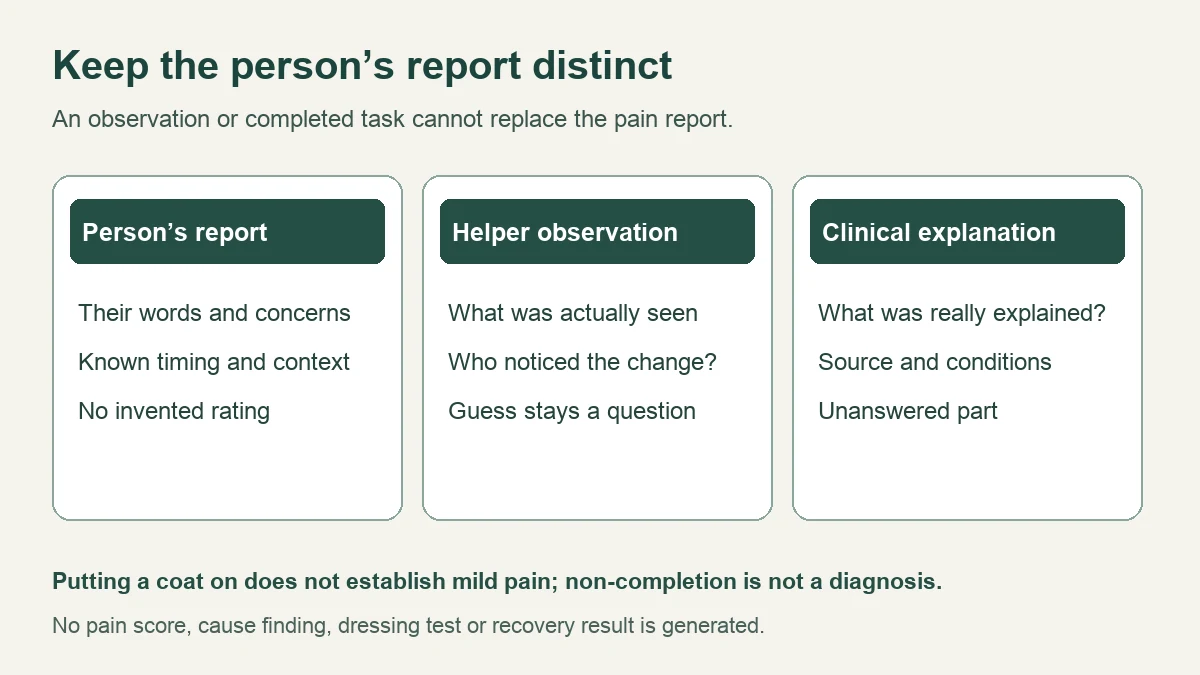
Separate pain reports, observations, uncertainty and clinical explanations
| Information type | Useful record | Unsupported conclusion to avoid |
|---|---|---|
| Person’s own report | Their words about pain, timing, other symptoms and what matters to them. | The task was finished, so the pain could not have been severe. |
| Helper’s observation | What was actually seen: a task stopped, help requested or an item not attempted. | A particular joint, nerve or diagnosis caused it. |
| Current instruction and support | Actual advice, aid, taught assistance or clothing adaptation used. | Using help proves poor progress or less need for care. |
| Uncertainty or interpretation | A guess clearly labelled as a question, or “not known.” | A change in dressing proves improvement, decline or a medication effect. |
| Actual clinical explanation | What the relevant professional really explained, source, conditions and unanswered part. | A booking, generic leaflet or partial reply answers every concern. |
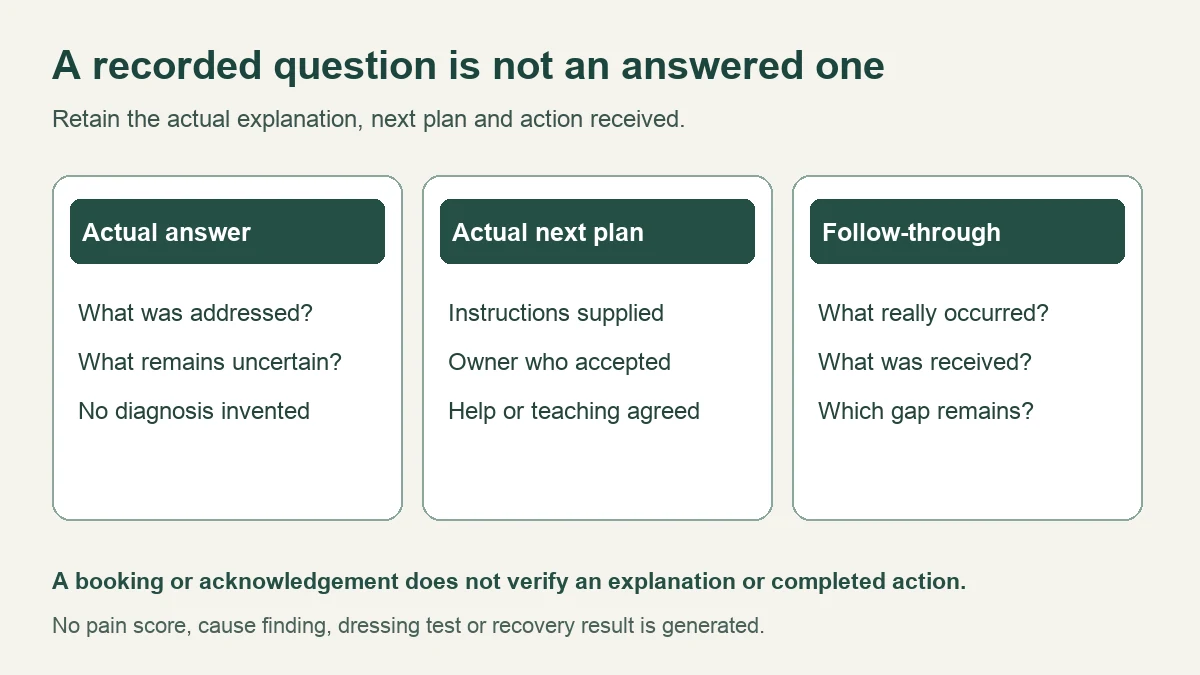
| Next plan and follow-through | Actual updated instructions, accepted owner and action received. | A requested service or future appointment is already completed. |
For example, “the helper fastened the coat” is an observation. “The person said their shoulder hurt” is their report. “It must be arthritis” is an interpretation unless it is a diagnosis actually supplied in the clinical context. Keep these records separate rather than silently editing one into another.
Respect the pain report and add context
IASP’s pain definition and explanatory notes describe pain as a personal experience and emphasize respecting a person’s report. They also explain that inability to communicate does not mean pain is absent. These principles support preserving the person’s voice; they do not validate a dressing score or identify a cause from task completion.
If a clinician requests a rating, use the scale and instructions they provide. You can retain the person’s own estimate alongside location, timing, other symptoms and daily impact. Do not manufacture a number when a scale is difficult, calculate it from facial expression or substitute a helper’s estimate for the person’s report. Ask about an appropriate assessment and communication approach.
A completed task can coexist with pain or effort and support. A task not completed may involve pain, instructions, dexterity, fatigue, balance, missing help or other circumstances. This is a reason to describe context and ask for assessment, not a cause checklist for the reader to select a diagnosis.
Seven essential pain and dressing visit checks
Keep the person’s own concern
Start with what the person wants explained or helped with. Retain their words where possible, including uncertainty. The record is not a persuasive script for a particular test, treatment, benefit or prescription.
Describe only an existing event or non-attempt
Use a task already affected, stopped or not attempted. Approximate timing is acceptable if known. No fixed observation period, painful demonstration or endurance trial is needed before making the concern valid.
Retain actual instructions and support
Record advice and help actually used, not a technique borrowed from another patient or the illustration. Aid use and assistance can change the task context without establishing whether pain improved or the condition resolved.
Separate observation from interpretation
Keep the person’s report, the helper’s observation and any guess in different places. State who noticed the change. A question about a possible cause remains a question until actually addressed.
Ask for suitable communication support
With permission, describe hearing, language, speech or memory barriers relevant to the discussion. Ask the team how to support the person’s communication and assessment. Difficulty speaking does not justify assigning a pain score from task completion.
Keep the real explanation and unanswered part
Record the respondent’s role, what they actually explained and any limits or uncertainty. Do not convert a request received, a planned examination or a clarification question into a diagnosis or new instruction.
Follow the actual next plan through
Retain updated instructions only as supplied, who accepted the next action and what teaching, review or help really occurred. Carry the remaining gap forward. The worksheet cannot change medicine, clear activity or decide that waiting is safe.
A short note you can copy before the visit
Start with one concern. You can copy the headings below onto paper. Missing details mean unknown, not no pain, no change or no need for help. No completed form is required before contacting a clinician.
| Heading | What to retain |
|---|---|
| Pain and other concerns | The person’s words, known timing, location, changes and other concerns. A rating only if supplied using appropriate instructions. |
| Existing task context | What already happened or was not attempted; actual instructions, aid and help used or unavailable. |
| Observation and uncertainty | What a helper saw, with permission; any interpretation kept clearly separate. |
| Question for the team | What needs explanation or practical support, without an assumed diagnosis or desired approval. |
| Actual explanation | Real reply, respondent’s role, conditions, uncertainty and remaining question. |
| Next plan / action received | Actual updated advice, accepted owner, teaching or support received and remaining gap. |
The National Institute on Aging booklet, archived by GovInfo, includes sections on describing pain and preparing questions. It supports discussing location, timing, character, other symptoms and existing treatment experience. It does not validate this article’s record or require a new treatment or movement trial. Use known information rather than experimenting to answer its prompts.
How a caregiver can help without speaking over the person
Ask permission before observing private self-care, recording details or sharing notes. Separate “I saw” from “they said.” Do not claim that a clothing adaptation, expression or completed task is a more truthful pain measure than the person’s report. If their own description is unavailable, record that limitation and ask for suitable clinical assessment.
A helper can organize information while leaving the person space to speak or use their preferred communication method. Record any assistance requested for the visit. Ask about accessible communication rather than assuming the helper should answer every question. This article does not supply a proxy pain-rating scale.
Keep notes private. Omit names, identifiers, private contacts and full reports from this website. Share relevant information with consent through the agreed care channel. No video, photograph or dressing demonstration is requested by the tool. A plain description is enough to start a question.
Keep actual explanations separate from the next plan
A focused question could be: “This is the pain report and the dressing event already experienced. This is the help and instruction involved. What does the assessment explain, what remains uncertain and what should happen next?” You do not need to propose a diagnosis to ask the question.
An explanation may leave uncertainty. Record what the clinician really said rather than making the note sound complete. If the reply asks for more information, record that request. If it arranges a review, record the arrangement. Neither event is automatically a cause finding, prescription or permission for unrestricted activity.
Retain any actual updated advice with its source and scope. Then record whether the follow-up, teaching or support was received. A person can still have pain after a task becomes easier; an easier task alone does not authorize a medicine change. If an instruction is missing or conflicting, ask the responsible team for clarification rather than choosing a plan from this record.
Two fictional pain and dressing communication examples
These are invented writing examples, not real patient stories, clinical instructions or verified outcomes. They show how to retain uncertainty and partial replies. Neither provides a diagnosis, pain score, new dressing method or treatment plan.
Example A: the coat went on, but pain still matters
| Record | Fictional entry |
|---|---|
| Person’s report | Shoulder pain while putting on a coat; no numeric rating invented. |
| Existing event / observation | The person paused and received help. The coat was eventually put on. No repeat attempt performed. |
| Uncertainty / question | Cause unknown. Ask about the pain and difficulty despite task completion. |
| Actual discussion example | The clinician requested clarification of the help used. This fictional communication reply gives no diagnosis or new clearance. |
| Next plan / remaining gap | Clarification request recorded. Further explanation, any updated plan and follow-through remain unconfirmed. |
A note could say: “The coat went on with help, but pain was reported. The clinician asked what help was used. I have not recorded a cause explanation or updated instruction.” The successful clothing task is not treated as evidence against the pain report.
Example B: task not attempted, communication and help gaps remain
| Record | Fictional entry |
|---|---|
| Person’s report | The person’s own description is not yet available. No absence of pain inferred. |
| Existing context / observation | A task was not attempted when needed help was unavailable. No unsupported attempt made for the note. |
| Uncertainty / question | Do not infer diagnosis or severity from non-completion. Ask how to support communication and address the gap. |
| Actual administrative reply | Question received and passed on. No clinical explanation supplied. |
| Next plan / remaining gap | Clinical answer, communication support and actual help remain unresolved. No method or medication instruction invented. |
A note could say: “The task was not attempted and the person’s own description is incomplete. The request was acknowledged, but an actual clinical answer and support arrangement are still missing.” Needed care comes before filling every field.
Private pain, dressing concern and next plan record
Download the offline tool before entering actual health or care details. Use fictional entries here because surrounding ads and analytics may be present. The tool itself makes no network requests, uses no browser storage and does not automatically save. Its offline copy contains no ads, analytics or external assets.
All fields are optional. Blank items generate questions, not a diagnosis, score or severity ranking. Omit names, identifiers, private contacts and full reports. The paper headings above are an alternative. Needed care must not wait for a completed record.
Pain, dressing concern and clinical explanation record
Start with one concern. Blank fields remain questions, not pain or recovery scores.
Download the offline tool before entering actual health or care details. Use fictional entries here; surrounding ads and analytics may be present.
Offline copy. No ads, analytics, external assets or automatic network requests.
The tool makes no network requests, uses no browser storage and does not save automatically. Refreshing may lose entries. Omit names, identifiers, private contacts and full reports. Needed care comes first.
Start with the fictional example or download a blank offline copy.
Paper alternative: person’s report; current instructions; task already affected or not attempted; helper observation; uncertainty; existing change; question; actual explanation; next plan; action received and remaining gap.
My pain, dressing concern and next plan record
Unverified personal record for discussion. Entries verify no diagnosis, advice, completed change or treatment outcome.
Guide: living.kioptrix.com/functional-pain-assessment/
Build, copy, download text or print/save PDF. Editing hides old output until rebuilt. Examples replace entries and mark output fictional. Offline downloads include current entries; keep completed copies private. Refreshing or closing may lose unsaved notes. No recipient is contacted; clinical explanations and follow-through are not independently verified.
Common pain and dressing questions
Does putting on socks or a coat prove pain is mild?
No. Keep the person’s report alongside the actual help, effort and circumstances. Completion does not determine severity or cause.
Do I need to repeat the task or keep three days of notes?
No. Use existing information. A diary requested by a clinician has its own purpose and instructions; this page requires no observation period before care.
Can a caregiver assign pain from expression or task performance?
This record does not do that. Retain observations and ask for suitable assessment when communication is difficult.
Does a completed record establish recovery or disability?
No. It is a communication aid, not a validated assessment, readiness score or benefits-evidence instrument.
Does an easier task mean medicine should change?
No. Record any real clinical instruction and its scope. The tool makes no medication recommendation.
Sources, corrections and review limits
Editorial revision and source check: October 31, 2026. Original URL and publication date retained. The previous correction’s patient-report and no-self-test principles are preserved. Added report–observation–uncertainty–explanation comparisons, actual replies and next-plan tracking. Replaced the “Your Socks Remember” image and removed unrelated assessment, clinic-search, insurance and claim keywords. No independent medical review or verified patient experience is claimed.
- IASP: Terminology — pain definition and explanatory notes — personal experience, report and communication; not a dressing test.
- NIA: Pain and Older Adults, GovInfo archived booklet — pain description and clinical conversation; no validation of this custom record.
- NHS: Sciatica — back/leg neurological warning context only.
- NHS: Stroke symptoms and NHS: Shortness of breath — corresponding emergency contexts, not causes of ordinary dressing difficulty.
The opioid-prescribing source previously used for goals is replaced by more direct pain-communication material. No prescribing advice is derived here. The representative image is AI-generated and depicts a fictional note discussion, not a dressing test or medical examination. The diagrams are editorial communication aids. Independent qualified review and reader usability testing would strengthen the guide; neither is claimed. Author background and editorial standards.