
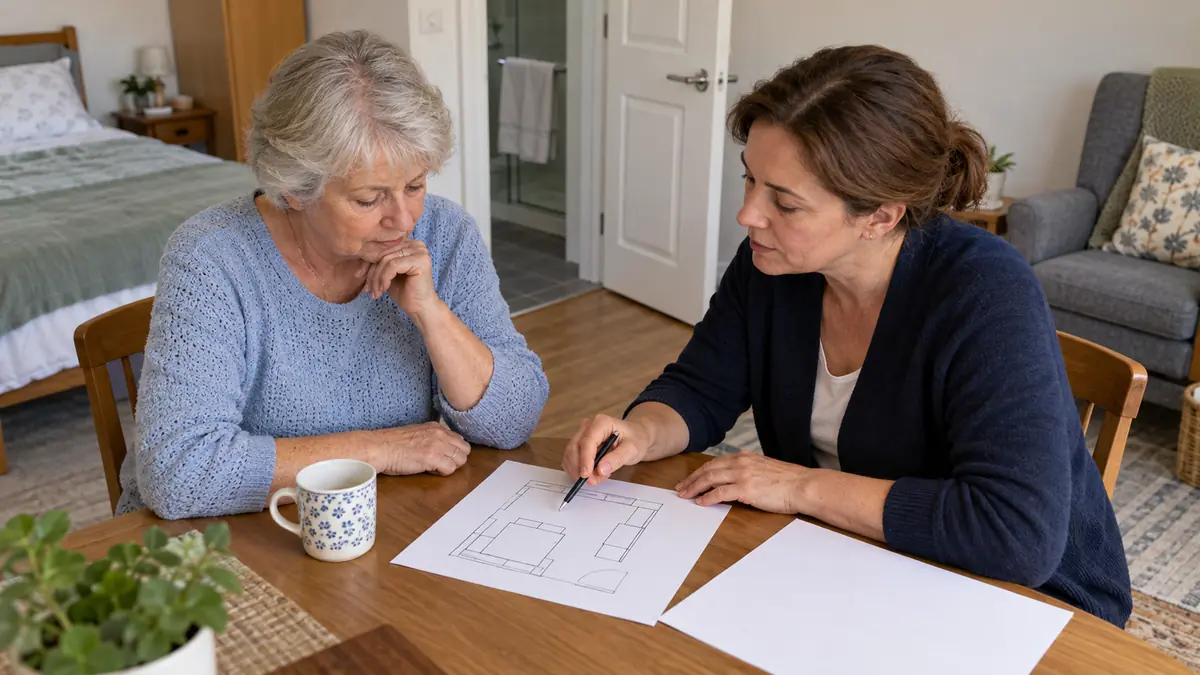
A knee replacement apartment setup needs linked planning: moving one item can affect another route, a door or the space required for help. Compare actual instructions, equipment and home conditions before treating a furniture proposal as a completed arrangement. Apartment size, a clear floor or a filled checklist cannot establish that home recovery is appropriate.
Use the route–instruction–change comparison, follow seven essential checks, read two fictional writing examples, or download the free offline answer-and-change record. Start with one unresolved connection. No walking trial, uncertain transfer, width-based score or recovery timetable is required.
This guide focuses on how a proposed layout or support change affects other routes, and what was actually answered and implemented. The walker-route measurement guide covers describing space and measurement limits. This page connects those descriptions across the apartment; it does not repeat a universal clearance standard or teach a movement technique.
Family-caregiver-written education, not individual medical, rehabilitation or building advice. No actual home, device fitting or discharge outcome has been independently assessed for this article. Its linked-space tables are editorial communication aids, not validated home-safety or discharge-readiness instruments.
Table of Contents
Warning symptoms and urgent care come before layout changes
Seek emergency help for chest pain or serious breathing difficulty after surgery, especially with leg pain and swelling. Use local emergency services, including 911 in the U.S. Do not wait for furniture changes, a form or a callback about equipment. NHS knee-replacement complication guidance identifies this combination as a possible blood clot in the lungs.
After a recent knee replacement, fever or shivering, wound discharge, throbbing or cramping leg pain, or knee redness, tenderness, swelling or pain that worsens or fails to improve needs urgent clinical advice. A significant fall, sudden inability to move or other severe change also needs urgent assessment. These selected warnings are not complete online triage. Do not repeat a difficult route to explain a new symptom.
Keep actual discharge instructions and contact arrangements available. Report an essential access or assistance gap to the responsible care/discharge team; a tidy room is not a substitute for help. This page supplies no safe waiting period, exercise, medicine change, device substitution or alternative recovery-location decision.
Compare routes, current instructions and effects of a proposed change
Use known facts or a helper’s description of the empty space, gathered safely and with permission. Include the starting point, doorway and destination. A sketch can show relationships without being to scale. Missing measurements stay unknown; do not involve the recovering person in a passage or transfer test to complete the record.
| Route / task | Current instruction or help to retain | Proposal to discuss | Effect elsewhere to check |
|---|---|---|---|
| Bed to toilet | Actual aid, movement and assistance instructions; known door and lighting concern. | A movable-storage or access change for review. | Does another turn, door opening or required helper position remain unresolved? |
| Chair and adjacent route | Actual transfer teaching, seat information and support requirement. | A proposed furniture or item location. | Does the new position affect the next route, aid access or another person’s access? |
| Bathroom access | Actual equipment and help plan; fixed obstacles and door swing. | An equipment or access option for individual review. | Could the item affect the door, exit or space needed for the task and help? |
| Food preparation to eating place | Actual aid use and meal-help arrangement. | A different eating location or accepted meal-delivery help. | Does furniture or storage now occupy another route? What task still needs help? |
| Room to building exit | Known doorway, threshold, lift, steps and actual transport/help plan. | An access or support question for the relevant people. | Are leaving, returning and the shared route addressed, rather than only the room? |
The table lists questions, not approved arrangements. The prescribed aid may physically fit while the required assistance or movement remains unresolved. Keep clinical instructions, product information, home descriptions and property questions distinct. No square footage, subtraction or checklist total can answer them all.
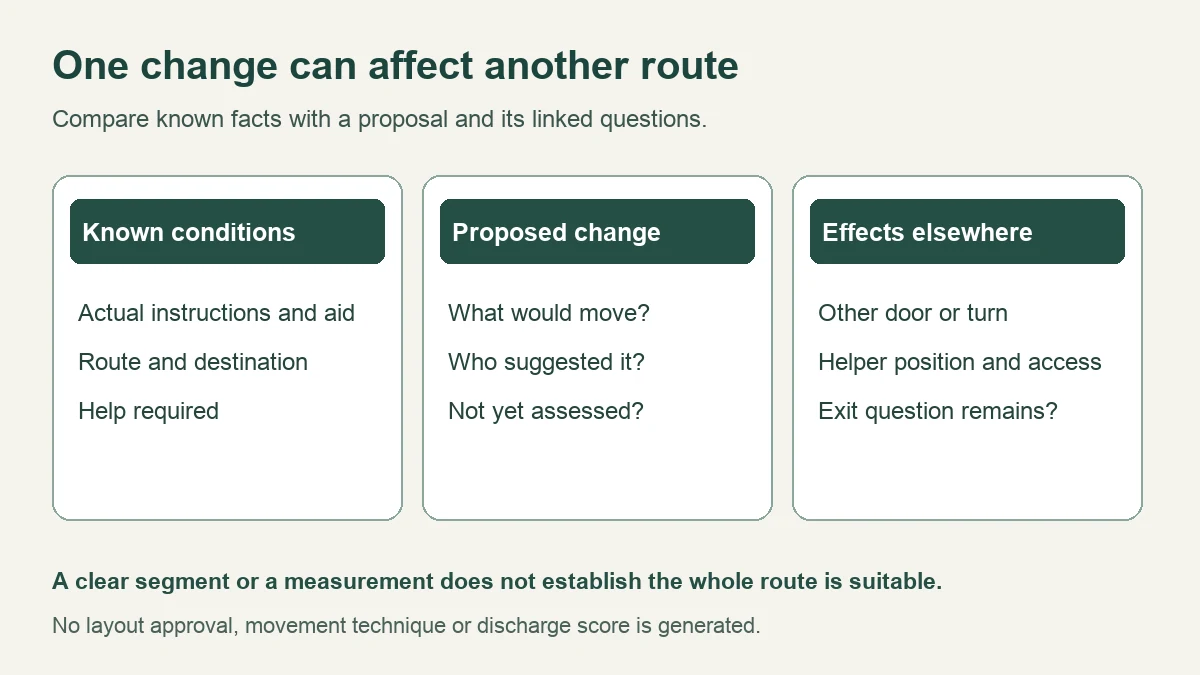
Seven essential knee replacement apartment setup checks
Name the actual route and task
A room label is not enough. Describe the known connection, such as bed to toilet, chair to eating place or room to building entrance. Include the destination, relevant doors and known obstacles without asking for a performance demonstration.
Retain current instructions and actual equipment
Keep actual movement, weight-bearing, aid-use and assistance instructions with their source and uncertainty. A procedure name or familiar device does not establish the whole plan. The worksheet cannot resolve conflicting advice or authorize a narrower aid.
State the change as a proposal
Write what someone suggested and why. A new chair, table move or equipment order is not automatically appropriate. Distinguish movable items from fixed supports or alterations. Do not move a required support, alter an aid or undertake building work based on this page.
Check the effect on other routes and people
Follow the proposed change beyond the first problem: door opening, adjoining turn, helper position, other household access and exit. Record known dependencies and questions. One clear segment is not proof that the linked route works.
Confirm real help and education
Record which task a person actually accepted, when help is available and what teaching was received. A phone check cannot provide hands-on help. Equipment delivered is different from fitting or teaching completed. Do not assume a family member can supply an unconfirmed task.
Retain the actual reply and its scope
Keep the substantive answer, respondent’s role and conditions beside the question. A request received or visit booked is a process update, not a layout assessment. Product or property information does not silently become clinical clearance.
Record implementation and the remaining gap
Write what changed, who acted and what help or education really occurred. Carry forward unresolved effects elsewhere. Do not test a doubtful route, repeat symptoms or invent an interim arrangement to mark the record complete. Needed care comes first.
Keep the useful room checks, then connect them
The practical basics remain useful. Review loose rugs, cords, stored items and lighting along relevant routes. Keep frequently needed items accessible under the actual plan. Describe the real bed, chair, toilet area and shower entrance instead of assuming a product marked “compact” fits. These are prompts for planning, not instructions to raise furniture or install equipment yourself.
MedlinePlus knee-replacement discharge guidance covers household hazards, reachable supplies, prescribed walking aids and practical help. It supports reviewing these concerns. It does not establish a personal clearance width or certify this apartment. Its activity, medicine and recovery schedules are not imported as universal instructions here.
| Known concern | Connection worth retaining | Question for the actual plan |
|---|---|---|
| Night supplies and lighting | A reachable item or lamp position can also affect the adjacent route or cord location. | What arrangement addresses access without leaving another obstacle? |
| Chair or bed change | The item’s position and transfer needs interact with the surrounding route and help space. | Was the actual item and context addressed, rather than only its advertised height? |
| Bathroom equipment | The actual model and installation may interact with the door and assistance needed. | Who addressed suitability, fitting and teaching, and what remains unknown? |
| Meals and storage | Eating near food preparation may change another person’s access or an exit route. | Which task was accepted as help, and which spatial effect still needs review? |
| Delivery or temporary storage | A delivered item may occupy the same limited space needed for movement. | Where will it be kept, and was delivery mistaken for usable implementation? |
Do not replace a prescribed walker with a cane, rely on furniture as an improvised support or attempt a narrow passage to demonstrate the arrangement. Raise the actual mismatch with the relevant team. An empty-space description can begin that conversation without a new physical challenge.
What the sources establish and what remains an individual question
Cambridge University Hospitals’ knee-replacement occupational-therapy guide discusses everyday tasks, home changes, equipment and furniture concerns. It also makes its service pathway conditional on goals and concerns. It supports raising a specific daily-activity problem, not promising every reader a home visit, a device or a particular service.
The NHS recovery guide emphasizes following hospital advice and discussing daily activities with physiotherapy or occupational therapy. Its general recovery information is not an individual instruction for weight-bearing, equipment progression or discharge timing. Do not substitute another patient’s schedule for the actual plan.
These are care-information resources, not comparative studies proving that the layout in an illustration reduces falls or that this seven-check framework improves discharge outcomes. The framework is an editorial way to keep linked questions visible. No product, apartment or method has been tested for this article.
Services and responsibilities vary by location and provider. A U.K. hospital leaflet does not establish U.S. home-care eligibility, coverage or an entitlement to equipment. Ask the actual service what was arranged and what remains unavailable. No approval sequence or guarantee of private or public support is supplied here.
Record actual answers and changes across the whole route
A focused question could be: “This is my current instruction and actual equipment. This change was proposed for one route, but it may affect this door, helper position or other route. What has actually been reviewed, what was answered and who accepted the next action?” Use only the parts relevant to the problem.
| Stage | What counts as an actual record | What it does not establish |
|---|---|---|
| Question / contact | Recipient role, issue sent and response status. | A message received is not a substantive answer. |
| Assessment / explanation | What the relevant person actually reviewed and said, including scope and conditions. | A general checklist is not an assessment of this apartment. |
| Accepted action | Specific change, owner who accepted, teaching and assistance agreed. | A suggestion is not agreement or delivery. |
| Implementation | Layout or equipment action completed; education and help actually provided. | An order, delivery or booked visit is not the whole plan completed. |
| Remaining gap | Unanswered route effect, missing help or action not available, with the real response. | A completed form cannot decide that waiting or home discharge is appropriate. |
For fixed changes, retain questions about the property, permissions, installation and impacts on shared access for the appropriate qualified people. This page does not decide building compliance or permission to alter a rental. Keep that answer separate from individual mobility and assistance advice.
Ask consent before notes or photographs. A short description or sketch can avoid showing a private home. Omit addresses, entry codes, documents, faces and identifying health information from public uploads. No photographs or floor-plan uploads are requested by the tool. Share relevant information through an agreed private route.
Two fictional linked-space planning examples
These are invented writing examples, not real home assessments, clinical answers or approved layouts. They show how a partial response leaves other questions open. No example provides a safe width, movement technique, trial, product choice or waiting period.
Example A: storage proposed for removal, bathroom question remains
| Record | Fictional entry |
|---|---|
| Current situation | Actual aid and help instructions retained privately. Bed-to-toilet route, bathroom door and helper position need review. |
| Proposal / linked effect | Relocate movable storage. This may address one obstacle but leaves the bathroom door and help-space question unanswered. |
| Contact / actual process reply | Therapy/discharge team received the linked question. Reply: review arranged. No assessed method or new clearance supplied. |
| Accepted action / completion | No final layout or teaching accepted. Review booked, not completed; no passage attempted for the note. |
| Remaining gap | Door, required helper position, actual assessment and implementation remain unresolved. |
A note could say: “The storage proposal addresses one location. The door and required help position remain questions. The review is arranged, but I have not recorded an actual assessment answer or completed change.” Do not turn a booked review into permission to use the doubtful route.
Example B: closer eating place proposed, exit review still missing
| Record | Fictional entry |
|---|---|
| Current situation | Actual aid and care instructions retained. A proposed eating place shares space with the room-to-exit route. |
| Proposal / linked effect | Move the table and request meal help. Chair position, shared access and the exit effect need review. |
| Actual reply | A helper accepted bringing meals at an agreed time. This fictional support reply supplies no clinical layout assessment. |
| Implementation | No table move, teaching or actual meal help delivered is claimed. No meal-carrying or walking trial performed. |
| Remaining gap | Layout review and effects on the exit remain unresolved. Accepted help is recorded separately from help actually provided. |
A note could say: “Meal help was accepted, but that does not answer the table and exit question. What was actually reviewed, what change was accepted and what has really been put in place?” No resolved outcome or alternative recovery location is invented.
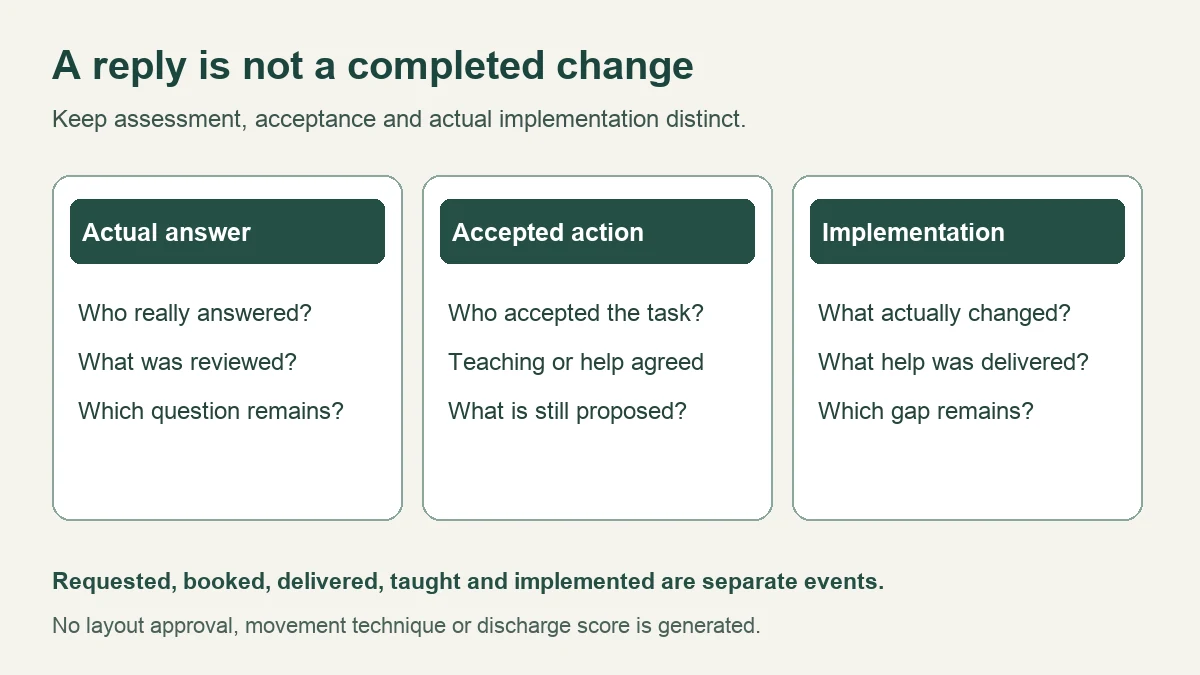
Private apartment route, answer and implementation record
Download the offline tool before entering actual health or home details. Use fictional entries here because surrounding ads and analytics may be present. The tool itself makes no network requests, uses no browser storage and does not automatically save. The offline copy contains no ads, analytics or external assets.
Start with one question. All fields are optional; blanks generate questions, not a clearance score. Omit names, identifiers, addresses, entry codes, private contacts and full reports. Paper with the same headings works. A complete record is never a condition for requesting care or practical help.
Apartment route, answer and change record
Start with one linked-space question. Blank fields remain questions, not a clearance score.
Download the offline tool before entering actual health or home details. Use fictional entries here; surrounding ads and analytics may be present.
Offline copy. No ads, analytics, external assets or automatic network requests.
The tool makes no network requests, uses no browser storage and does not save automatically. Refreshing may lose entries. Omit names, identifiers, addresses, entry codes, private contacts and full reports. Needed care comes first.
Start with the fictional example or download a blank offline copy.
Paper alternative: current instructions; actual aid; route and problem; proposed change; effect on other routes; existing experience; contact; actual answer; accepted action; change implemented; help/teaching delivered and remaining gap.
My apartment route, answer and change record
Unverified personal record for discussion. Entries verify no diagnosis, advice, completed change or treatment outcome.
Guide: living.kioptrix.com/knee-replacement-apartment-setup/
Build, copy, download text or print/save PDF. Editing hides old output until rebuilt. Examples replace entries and mark output fictional. Offline downloads include current entries; keep completed copies private. Refreshing or closing may lose unsaved notes. No recipient is contacted and no assessment or implementation is independently verified.
Common small-apartment planning questions
Does a clear route mean home discharge is appropriate?
No. Current clinical needs, movement instructions, equipment and actual assistance remain individual questions. This form does not assess discharge readiness.
Does the actual walker fitting through a gap answer the whole question?
No. A measurement does not establish individual movement, turning, help space or the rest of the route.
Should we try the new layout to prove it works?
Do not attempt a doubtful route or transfer for this article. Ask the relevant team how the actual situation should be assessed.
Does equipment delivery close the gap?
No. Fitting, teaching, help available and effects on other routes may still be unresolved.
Is every reader guaranteed a therapist home visit or equipment?
No. Ask the actual service what was arranged. Background guidance from another provider does not establish access, coverage or a particular pathway.
Sources, corrections and review limits
Editorial revision and source check: October 31, 2026. Original URL and publication date retained. Room-by-room advice and the paper support record are developed into linked route–instruction–proposal comparisons, real replies and action tracking. The safety-implying representative layout and route arrow are replaced. No invented patient experience, clearance number or independent professional review is claimed.
- MedlinePlus: Knee joint replacement — discharge — general household and support considerations; not a personal layout assessment.
- Cambridge University Hospitals: Occupational therapy after total knee replacement — daily-task, furniture and service context; not a universal care guarantee.
- NHS: Recovering from a knee replacement — hospital-advice and therapy context; not an individual progression timetable.
- NHS: Complications of a knee replacement — selected warning context; not complete online triage.
The representative image is AI-generated and shows a fictional planning discussion, not an approved layout or mobility demonstration. The two diagrams describe editorial distinctions between proposals, effects elsewhere, answers and implementation. Independent occupational-therapy review and reader usability testing would strengthen the guide; neither is claimed. Author background and editorial standards.