

Socks after hip surgery require a dressing plan that matches your actual instructions, garment, aid and available help. This guide helps you check what was taught, what was really answered and whether the agreed help or equipment actually arrived. It does not teach a universal movement sequence or decide that you can dress independently.
Start with the instruction–garment–aid comparison, use seven essential checks, read two fictional writing examples, or download the free offline education-and-help record. Existing information is enough: no bending, balance challenge, repeated dressing attempt or timed test is required.
This page focuses on application AND removal teaching with the actual items, accepted task-specific help, and completion of agreed action. The separate pain and dressing difficulties guide helps describe an existing difficulty during a clinical visit. Here the aim is to connect instructions, equipment, teaching and practical help without turning dressing into a pain or recovery test.
Family-caregiver-written education, not individual medical advice or an independent clinical review. No actual patient, fitted device, teaching session or successful dressing outcome has been verified here. The comparison and record are communication aids, not validated readiness or product-selection instruments.
Table of Contents
Warning symptoms come before a dressing record
Seek emergency help for breathing difficulty or chest pain after surgery, particularly with hip or leg pain and swelling. Use local emergency services, including 911 in the U.S. Do not wait to finish dressing, complete the form or receive an equipment reply. NHS hip-replacement complication guidance identifies these as possible signs of a blood clot in the lungs.
After a recent hip replacement, fever or shivering, wound discharge, throbbing or cramping hip/leg pain, or redness, tenderness, swelling or pain that worsens or fails to improve needs urgent clinical advice. Sudden severe pain after a fall or inability to move also needs urgent assessment. These are selected warnings, not a complete online triage assessment. Do not diagnose the cause from a sock mark or use another dressing attempt to check it.
Follow your actual discharge and contact instructions; emergency concerns take priority. This page supplies no waiting period, home treatment or instruction to change prescribed stockings, medicine or postoperative restrictions. Ask the responsible service about an unavailable plan or conflicting advice rather than inventing a substitute method.
Compare current instructions, actual socks and dressing aids
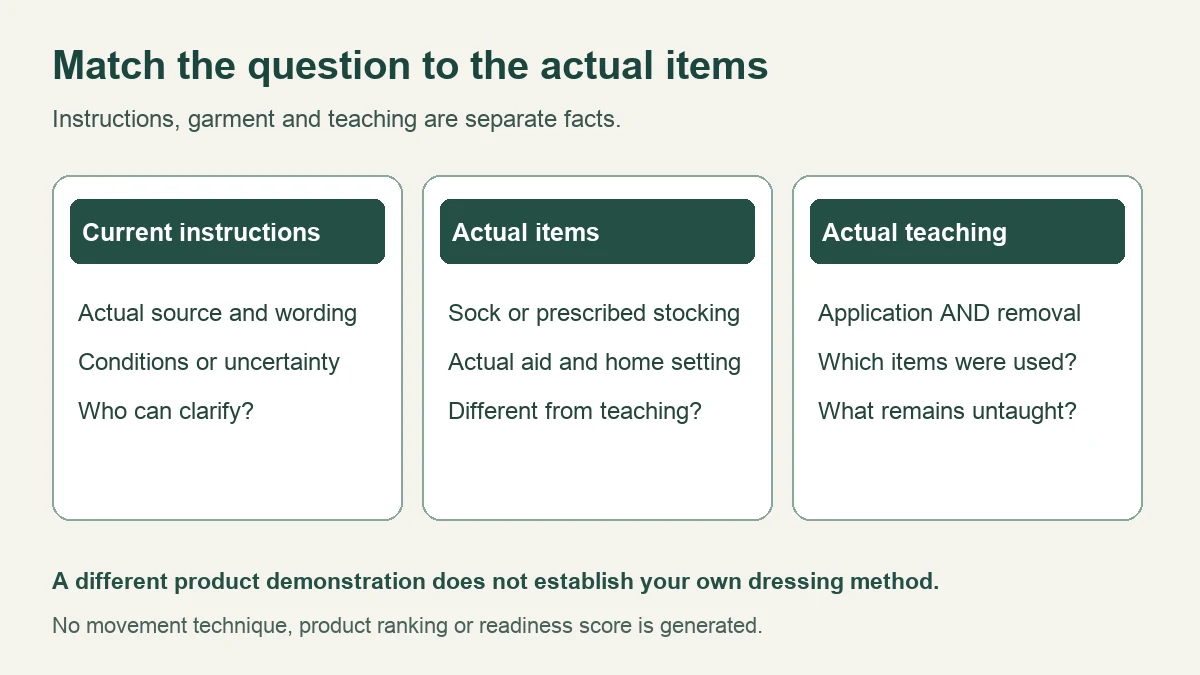
Keep the actual instruction beside the actual item. A generic demonstration, different aid or another person’s experience may leave your own question unanswered. Record uncertainty rather than selecting an angle, chair height or movement rule from this page.
| Item to compare | Actual information to retain | Question still open |
|---|---|---|
| Current hip and dressing instructions | Actual wording, source, date and conditions; conflicting or missing wording. | Which instruction applies to application and removal? Who will clarify the discrepancy? |
| Actual garment | Ordinary sock, compression garment or prescribed anti-embolism stocking; known product and prescription details. | Has advice addressed this exact garment rather than socks in general? |
| Actual aid | Product/model and configuration already known; difference from the item used during teaching. | Is it compatible with the actual garment and the individual plan? |
| Home conditions | Known chair, access to clothing, space and difference from the teaching setting. | Which difference needs review without a self-test? |
| Teaching received | What was actually taught for putting on AND taking off, by whom and with which items. | What remains untaught or unclear? |
| Required help | Task and help described in the actual plan; person who accepted; help delivered. | Has the helper accepted this task and received the needed teaching? |
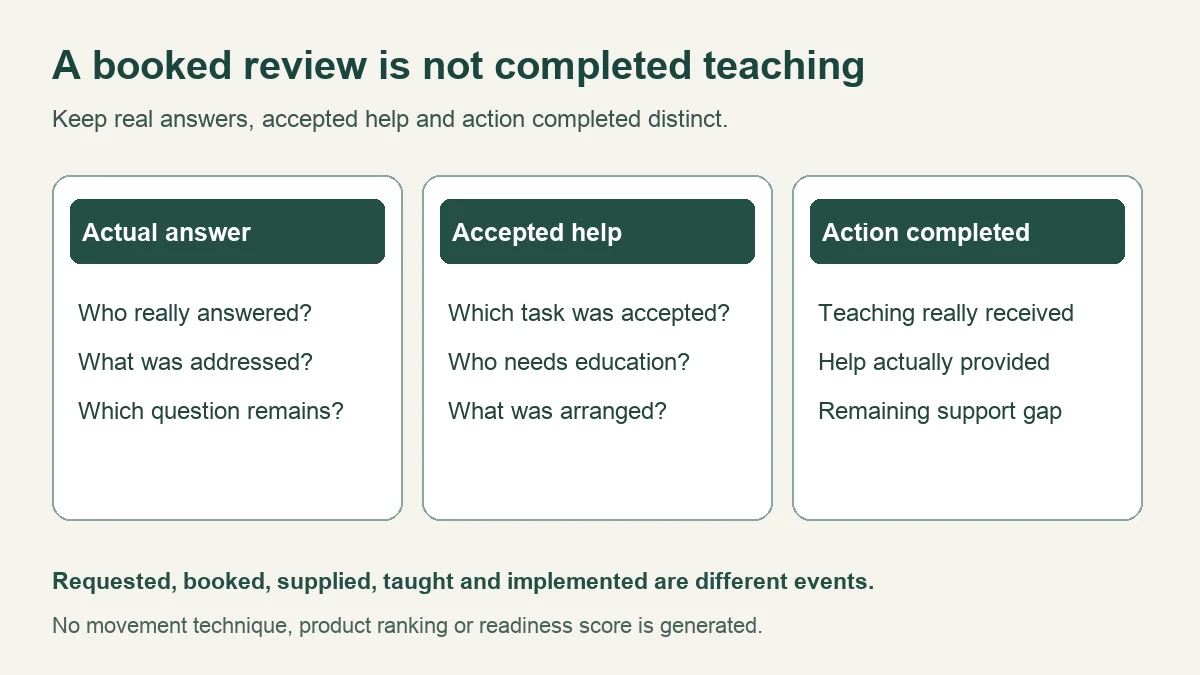
| Actual action completed | Real reply, agreed owner, education or correction delivered and remaining gap. | Was the action completed, or merely requested, booked or ordered? |
Ordinary socks and prescribed stockings are different questions
Do not treat ordinary socks, compression garments and prescribed anti-embolism stockings as interchangeable. Retain the actual garment and the instructions that came from the responsible team. This page does not prescribe a stocking type, pressure, wearing schedule or substitute.
The University Hospitals Dorset hip-replacement booklet, printed page 23, describes a sock/tights aid for ordinary garments and specifically says that the aids it supplies do not work with anti-embolism stockings. That statement concerns the equipment in that hospital’s guide; it does not prove that every aid is unsuitable for every medical stocking. It supports asking about the exact garment–aid combination.
| Actual item | Useful question | What the article cannot conclude |
|---|---|---|
| Ordinary sock and sock aid | Was this actual combination included in application and removal teaching? | A product category or demonstration does not prove individual suitability. |
| Prescribed stocking | Which product instructions, help and education address this garment? | No permission to omit it, change the schedule or substitute another item is generated. |
| Different home aid | How does it differ from the aid used in teaching, and who will address the difference? | A similar appearance or marketing claim does not establish equivalence. |
| Removal device or helper | Was removal addressed separately and was the help actually accepted? | Being able to put an item on does not establish how to remove it under the plan. |
Product information can explain intended use and limitations. It is different from an individual clinical answer. If a prescribed garment cannot be managed under the actual arrangement, report that practical barrier to the responsible service. A shopping recommendation or improvised method is not supplied here.
Seven essential socks after hip surgery checks
Retain the current instruction and unresolved wording
Record what your own team actually supplied and where it came from. A procedure name does not establish every restriction. The worksheet cannot resolve conflicting documents or choose which instruction you should follow.
Identify the actual garment and aid
Describe known items, including any prescribed stocking. Keep product claims beside product facts. No “best sock aid” ranking, price-based choice or compatibility finding is generated from a symptom or operation.
Include known home conditions
Describe the chair and clothing access already known, and any difference from the teaching setting. Do not perform a reaching, standing, balance or bending challenge to complete the description. The relevant professional can address which details need assessment.
Ask about both application and removal education
Record which task was actually taught, with which garment and aid, and to whom. A video, sales demonstration or booked teaching session is not completed individual education. Do not fill an untaught step with a generic movement sequence.
Confirm help was accepted for the actual task
With the person’s consent, establish who actually accepted the help described in the plan. General willingness to help is not the same as agreement to assist with this garment. Record missing teaching, availability or support without assuming a family member can perform the task.
Describe existing experience without testing readiness
Record what already happened, was stopped or was not attempted. Keep pain, sensation, skin concerns, fatigue, difficulty and practical barriers in the person’s own words where possible. Do not rank independence above comfort or treat an unfinished task as failure.
Follow the real answer through to completed action
Retain the answer’s source, scope and conditions. Then record the agreed owner and what teaching, product correction or help was actually provided. A received message, appointment or delivery does not establish completion of the whole plan.
Use sources for their actual scope, not a universal technique
Guy’s and St Thomas’ guidance starts with the surgeon’s individual care plan and any recommended hip precautions. It also describes the occupational therapist’s role in daily tasks and long-handled aids. Its specific movement restrictions and home advice belong to that clinical context. This article does not apply every restriction or duration to all hip procedures or assume that restrictions are absent when paperwork is unclear.
The Dorset booklet is a hospital-specific hip-replacement resource. Its dressing and equipment information helps identify useful questions, but its other schedules and techniques are not imported as everyone’s instructions. The NHS complication page supplies warning context; it does not choose a dressing aid or clear independent activity.
These sources are patient-care guidance, not comparative trials proving that one commercial sock aid is best or that a particular model prevents dislocation. No product has been tested for this article. An individual teaching session and its actual answer remain distinct from these background resources.
Separate actual answers, teaching and help delivered
A focused question could be: “This is the garment and aid I actually have, and this is the instruction I received. Was putting it on and taking it off addressed with these items? What teaching or help remains needed, and who has accepted the next action?” Ask only the parts relevant to the unresolved concern.
| Role or event | What to retain | Boundary |
|---|---|---|
| Patient | Own priorities, consent, pain report and existing difficulty. | Help does not remove the person’s voice or decision-making role. |
| Treating / therapy team | Actual instruction, clarification or education within the respondent’s role. | A referral or acknowledgement is not a substantive answer. |
| Nursing / responsible stocking service | Actual reply about the prescribed garment and support question. | A product seller cannot change a prescription. |
| Supplier / manufacturer | Exact product explanation, intended-use information and limitations. | Product information is not individual clinical clearance. |
| Helper | Task accepted, education received and help actually provided. | Presence at home is not evidence that the task was accepted or delivered. |
Ask permission before observing private dressing, making notes or sharing them. Separate “the person reported pain” from “the helper saw the task stop”; neither establishes a diagnosis. Share relevant information privately with the agreed team. Do not put identifying health details in public comments, this site’s contact form or a screenshot upload.
When a reply arrives, record only what it really addresses. If it schedules a review, write “review scheduled,” not “method approved.” If help is promised but unavailable, retain the gap and the actual response to it. The record cannot supply an interim movement rule, guarantee service access or decide that waiting is safe.
Two fictional dressing education and help examples
These examples are invented and are not real patient stories, clinical instructions or verified outcomes. They show how to separate a process reply from teaching and practical support. Do not borrow the example as a technique, prescription or reason to delay needed care.
Example A: ordinary sock, actual aid differs, removal teaching missing
| Stage | Fictional entry |
|---|---|
| Instruction / actual items | Individual instructions retained privately. An ordinary sock and the home aid differ from the aid reportedly demonstrated. |
| Education / existing experience | Application was reportedly shown with another aid. Removal teaching and review of home conditions are not recorded. No repeated attempt performed. |
| Question | Can the actual sock and home aid be included in teaching for application and removal? |
| Actual process reply | Bring the actual items to the arranged teaching review. This fictional reply provides no technique or clearance. |
| Action / remaining gap | Review booked, not completed. Teaching with the actual combination and accepted help remain unconfirmed. |
A note could say: “A teaching review was arranged. I have not recorded completed application and removal education with my actual items. Please clarify the remaining education and help arrangements.” A booked review does not resolve the task.
Example B: prescribed stocking, general help offered, task not accepted
| Stage | Fictional entry |
|---|---|
| Instruction / actual items | A prescribed stocking is mentioned in discharge information. Compatibility of an ordinary sock aid is unconfirmed. |
| Help / education | A relative offered general help but did not accept this task. No stocking-specific application or removal teaching for the helper is recorded. |
| Question / contact | The responsible nursing/therapy service received the garment and support-gap question. |
| Actual administrative reply | Request received and passed to the relevant team. No clinical answer or alternative method supplied. |
| Action / remaining gap | Clarification, helper acceptance, teaching and delivered help remain unresolved. No prescription change or resolved outcome invented. |
A note could say: “The request was acknowledged, but I still need the actual answer about this garment and the help gap. Who is addressing it, and what has really been arranged?” Needed care takes priority over completing the record.
Private dressing education, help and actual answer record
Download the offline tool before entering actual health or care details. Use fictional entries on this page because surrounding ads and analytics may be present. The tool itself makes no network requests, uses no browser storage and does not automatically save. The offline copy contains no ads, analytics or external assets.
Start with one question. Every field is optional. Blank items generate questions, not permission to dress independently or a product recommendation. Omit names, identifiers, private contacts and full reports. Paper with the same headings works. You do not need a complete record before asking for care or practical help.
Sock dressing education and help record
Start with one unresolved question. Blank fields remain questions, not permission to dress independently.
Download the offline tool before entering actual health or care details. Use fictional entries here; surrounding ads and analytics may be present.
Offline copy. No ads, analytics, external assets or automatic network requests.
The tool makes no network requests, uses no browser storage and does not save automatically. Refreshing may lose entries. Omit names, identifiers, private contacts and full reports. Needed care comes before this record.
Start with the fictional example or download a blank offline copy.
Paper alternative: current instructions; actual garment and aid; home setting; teaching for application and removal; help accepted and delivered; existing experience; question; actual answer; agreed action; completed action and remaining gap.
My dressing education, help and actual answer record
Unverified personal record for discussion. Entries verify no diagnosis, advice, completed change or treatment outcome.
Guide: living.kioptrix.com/how-to-put-on-socks-after-hip-surgery/
Build, copy, download text or print/save PDF. Changing an entry hides the old output until rebuilt. Example buttons replace entries and mark output fictional. Offline downloads include current entries; keep completed files private. Refreshing or closing may lose unsaved notes. No recipient is contacted and no advice or completion is independently verified.
Common dressing education questions
Does this guide teach a universal way to put socks on?
No. It helps prepare questions and track actual education, instructions and help. It supplies no movement sequence or universal angle.
Can an ordinary sock aid be assumed suitable for a prescribed stocking?
No. Retain the exact items and ask the relevant product and clinical questions. This page makes no compatibility finding or prescription change.
Does a teaching appointment mean education is complete?
No. Record which tasks were actually taught, with which items and to whom. Booking and completed teaching are separate facts.
Must I demonstrate the difficulty before requesting help?
No. Use information already available, including a task not attempted or help unavailable. Do not reproduce pain or challenge balance for the record.
Does finishing the form establish independent dressing?
No. Text in every field verifies neither product suitability nor education, help delivered or readiness. Individual assessment remains outside this tool.
Sources, corrections and review limits
Editorial revision and source check: October 31, 2026. Original URL and publication date retained. The short repeated advice is replaced with garment–aid–instruction comparisons, application/removal education, accepted help, actual replies and completion tracking. Universal-sounding prohibitions are reframed around avoiding extra self-tests and clarifying actual instructions. No invented duration, recovery score, personal case or qualified clinical review is claimed.
- Guy’s and St Thomas’: Precautions after hip surgery — individual plan and therapy-team context; not universal permission or restriction.
- University Hospitals Dorset: Your hip replacement surgery, printed page 23 — hospital-specific ordinary-sock aid and anti-embolism stocking distinction; not a compatibility test of all products.
- NHS: Complications of a hip replacement — selected warning and contact context; not complete online triage.
The representative image is AI-generated and shows unused dressing aids in a fictional discussion, not an approved postoperative technique. The two diagrams are editorial process aids, not clinical validation. Independent occupational-therapy review and reader usability testing would strengthen this guide; neither is claimed. Author background and editorial standards.