

A wedge pillow after surgery needs a clear purpose and instructions that address the actual product, bed and help available. A delivery, product photograph or comfortable rest does not establish that the arrangement meets an individual care plan. This guide helps you clarify mismatches and record the real answer, education received and correction actually completed.
Start with the instruction–product–environment comparison, follow seven essential checks, read two fictional writing examples, or download the free offline clarification record. One unresolved point is enough. No trial night, new position or uncertain bed transfer is required.
The focus is reconciling a wedge instruction with the actual equipment and environment, rather than choosing a sleep position or declaring a furniture winner. For the broader night plan, use the separate hip-replacement sleep guide or shoulder surgery bed-versus-recliner guide. This page follows the particular wedge question through to an actual answer and completed action.
This is family-caregiver-written education. The operator is not a medical professional, and no independent clinical review, product testing or patient outcome is claimed. The comparisons and record are communication aids, not validated assessment instruments. An actual surgical or therapy team must address individual questions; filling every box provides no clearance.
Table of Contents
Urgent changes come before wedge clarification
Do not explain a new serious symptom as just a wedge or sleeping-position problem. Sudden breathing difficulty, chest pain, coughing blood or fainting needs immediate medical help. A lung clot can occur without obvious limb symptoms. New limb swelling, pain/tenderness, warmth or redness needs prompt assessment. See CDC clot signs. For U.S. emergencies call 911; do not drive yourself or wait for a routine message reply.
Severe sleepiness, inability to wake or slowed/difficult breathing while using opioid medicine needs emergency help. FDA opioid guidance describes these overdose warnings and immediate emergency action; if overdose is suspected and naloxone is available, give it and obtain emergency help even if the person improves. See FDA naloxone emergency guidance. A wedge is not treatment for this problem. Do not add medicine to tolerate an unassessed position.
A fall or injury, sudden loss of function, rapidly worsening pain or a new wound or skin concern also needs an appropriate clinical response under the actual discharge plan. Pressure-related skin damage can become serious: MedlinePlus pressure-sore information supports early attention. No complete triage assessment is provided here. Needed care must not wait for a product delivery, full diary, teaching appointment or completed form.
Compare the wedge instruction, actual product and environment
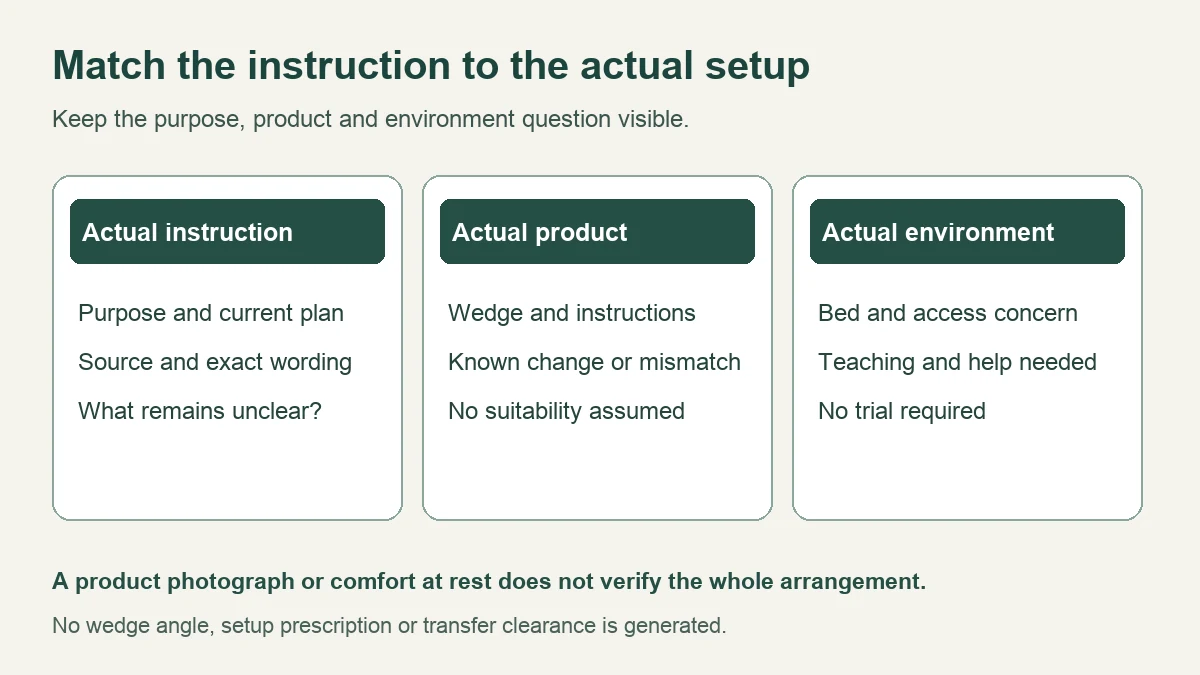
Put the real instruction beside the real product information and known environment. If something is unknown, write unknown. Preserve both sources when wording differs; do not choose whichever seems newer, more comfortable or easier to carry out. A product source can explain its leaflet without deciding what applies to the operation.
| Area | Actual facts to retain | Question when unclear |
|---|---|---|
| Purpose and current instruction | Operation if known, intended support purpose, position or movement instruction and actual source/date. | What purpose and current instruction apply to this person? |
| Actual wedge | Item/model if known, supplied instructions and any known alteration or replacement. | Does the actual clinical instruction address this product? |
| Actual bed and environment | Known bed, controls, access and practical concerns already identified. | What assessment or education is needed for this environment? |
| Conflicting wording | Both statements, their sources and the exact point that does not match. | Which instruction applies now, and who will clarify it? |
| Teaching and help | Education actually received, instructed assistance and who has accepted the task. | What remains untaught or unavailable? |
| Actual use or non-use | Existing observations, discomfort, pressure, sliding or bed-movement concern. | What concern needs review without repeating a difficult task? |
| Reply and completion | Actual answer, agreed correction and what was really carried out. | Which action remains open, and who accepted responsibility? |
A wedge used to support the back, support a limb or serve another prescribed purpose is not automatically the same intervention. Record the stated purpose without assigning one from appearance. A generic elevation label, size or advertised angle does not establish a target for this person. This page supplies no arrangement, layer count, dimensions or installation method.
Seven essential checks for a wedge pillow after surgery
Keep the intended purpose explicit
Ask what the support is meant to accomplish in the actual plan. A request for comfort, a positioning instruction and a pressure-care plan can raise different questions. Do not assume a wedge treats the cause of pain or is required after every operation.
Retain the current instruction and its source
Use wording actually provided, including any movement, support or review conditions. An operation name alone does not establish precautions. When advice is missing or inconsistent, preserve the question rather than assembling a new rule from several leaflets.
Identify the actual product
Retain known product details and the supplied instructions. A purchase, delivery or orthopedic label does not establish individualized suitability. Ask about a replacement or known product change rather than assuming the earlier answer still applies.
Describe the actual environment without a trial
Use existing information about the bed, access, controls and concerns. Do not perform a position, sliding, endurance or bed-exit test to fill the record. An apparently suitable item may still leave an unanswered environment or assistance question.
Confirm teaching and accepted help
Separate a handout, a promised demonstration and education actually received. Identify which positioning or bed-movement task needs teaching and who will provide required help. Being present in the home does not establish training, ability or availability.
Keep observation separate from explanation
Record what already happened and whose account it is. Comfort, pressure, sliding, non-use and difficulty moving can all be relevant. Do not diagnose the cause, repeat an aggravating arrangement or suppress a concern because another aspect felt better.
Follow the real answer through to completion
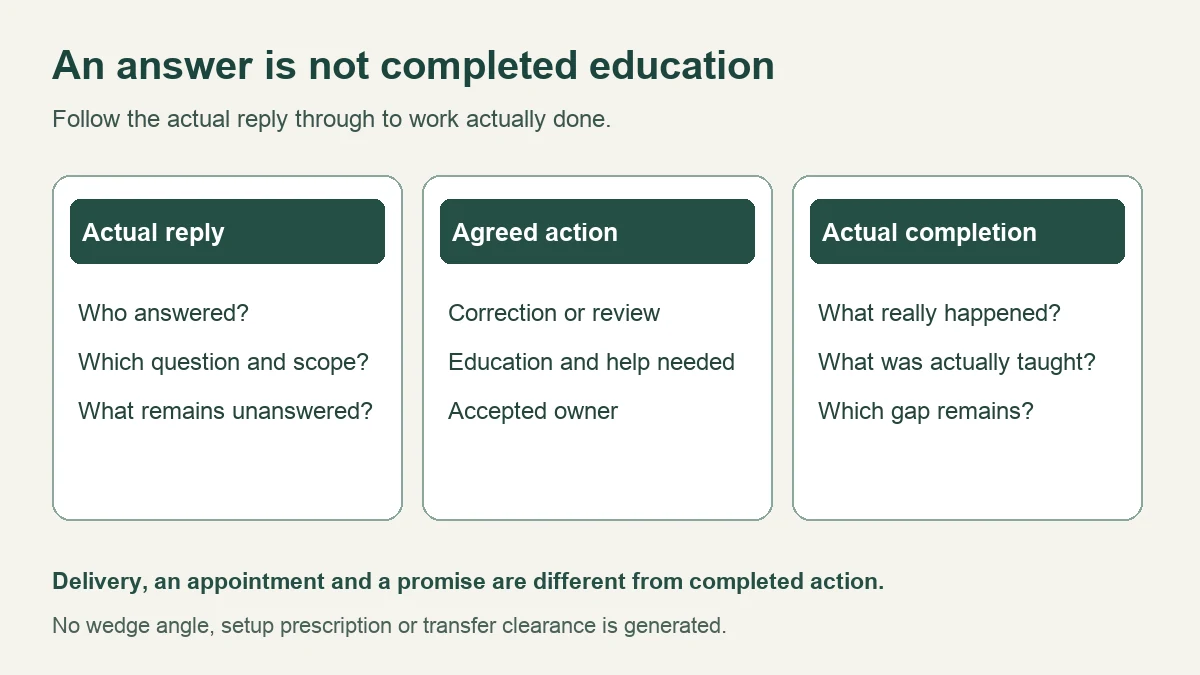
Retain the actual reply, scope, conditions and agreed action. Then record education or correction actually delivered, not just a booking or promise. Keep the remaining gap with an accepted next owner where known; needed care never depends on a future response.
What the sources establish and what they do not
AAOS outpatient joint-replacement guidance mentions a recliner or large wedge for comfort in the shoulder-replacement context. It does not establish a best wedge angle, prove faster recovery, or prescribe the same support after hip, knee, spine or other operations. This source supports a context-specific discussion; it is not a comparative efficacy study or individual setup assessment.
NHS moving-and-handling guidance concerns general assistance, caregiver training and professional assessment, including help around beds. It is not a procedure-specific wedge protocol. Its UK council support arrangements do not establish access or funding elsewhere. The previous article described this source too broadly; this revision corrects that scope.
MedlinePlus pressure-sore information explains that inability to change position can create skin risk. It is background for asking about an individual pressure, skin-observation and repositioning plan. It does not validate a particular wedge, and its general examples should not be turned into a universal postoperative schedule or movement instruction.
The clinical purpose, product instructions and practical environment each need their own relevant answer. None of the cited public pages assesses the reader’s named wedge in their actual bed. No claim that a wedge prevents falls, protects a repair, improves circulation or accelerates healing is made here. A product photograph cannot establish any of those outcomes.
Separate product explanation, clinical reply, teaching and correction
| Event | What it establishes if actually received | What it does not establish |
|---|---|---|
| Product explanation | What the supplier actually says about its item or instructions. | That the arrangement fits the individual surgical plan. |
| Clinical or therapy reply | The question actually answered and its stated scope/conditions. | Every detail of a product or environment not addressed. |
| Teaching received | What was explained or demonstrated, to whom and what remains unclear. | That every intended helper has received or can provide it. |
| Action agreed | The real correction, education or review accepted by a responsible role. | That the action has already happened. |
| Completion reported | What was actually done and the source of that report. | Independent verification by this website or proof of a safe outcome. |
A useful question is: “This is the instruction I received, this is the actual wedge and bed, and this is the point that does not match. What applies now, what education or help is needed, and who will confirm the action completed?” Retain partial answers without stretching their scope. An acknowledgement or scheduled appointment is not a substantive clinical answer.
If comfort at rest coexists with pressure, sliding or difficulty getting out, keep both facts visible. One does not cancel the other. Ask for the appropriate review of the actual concern rather than adding restraints, stacking products or inventing a bed-exit method. The guide offers no temporary configuration while clarification is pending.
Keep the patient’s words distinct from a helper’s observations and share with consent. Ask for education in a form the person and intended helper can understand, including an interpreter or accessible format when needed. Record what was actually provided. An unanswered question is useful information; it is not a failed form.
Two fictional wedge clarification writing examples
These examples are invented. They are not real patients, product assessments, clinical replies or successful outcomes. Neither supplies a permitted angle, transfer sequence, trial night or instruction to delay care. The examples deliberately retain gaps instead of fabricating reassuring answers.
Example A: the instruction and product leaflet do not match
| Record | Fictional entry |
|---|---|
| Instruction / product | A wedge-related instruction was reported after surgery. Exact procedure and instruction wording are omitted. A supplied product leaflet seems different. |
| Environment / education | No actual-bed assessment or setup-specific teaching is claimed. |
| Actual answer | A product source explained the leaflet only. No clinical or therapy clarification supplied. |
| Correction / completion | Delivery occurred. Review, education and corrected arrangement are not claimed complete. |
| Question | Which instruction applies to this actual product and environment, and what education or help remains needed? |
A note could say: “I have a clinical instruction and a product leaflet that appear different. Please clarify the specific point for the actual wedge and bed. I have not treated the delivery or product explanation as completed teaching.” The note records a mismatch without choosing an angle or requiring a test.
Example B: comfort at rest, but help or bed movement remains unresolved
| Record | Fictional entry |
|---|---|
| Existing experience | Comfort at rest was reported alongside an already noticed sliding, pressure or movement concern. |
| Help / teaching | The needed task cannot be supplied by a household member. Additional education is requested but not delivered. |
| Contact / actual reply | A service acknowledged the question and offered review. No substantive clinical answer is supplied. |
| Change / completion | Review or correction is proposed; acceptance, education and completion remain unconfirmed. |
| Remaining gap | Retain the actual concern, real answer and action completed when known. Do not repeat the difficult task to produce evidence. |
A note could say: “Resting comfort did not resolve the movement or help problem. This is what was already noticed, this is the help missing, and this is the reply received so far. What actual plan and teaching are needed, and what has been completed?” No temporary workaround or resolved outcome is invented.
Private wedge instruction, actual answer and correction record
Download the offline tool before entering actual health or personal details. Use fictional entries on this webpage because surrounding ads and analytics may be present. The tool itself makes no network requests, uses no browser storage and does not automatically save. The offline export has no external assets or automatic network requests.
Begin with one unresolved point; every field is optional. Missing entries generate questions, not a suitability score or clinical judgement. Omit names, identifiers, private contacts and full medical reports. Use an agreed private sharing route. Paper with the same headings works, and needed care never depends on completing the record.
Wedge instruction, actual answer and correction record
Start with one unclear point. Blank fields generate questions, not positioning or transfer clearance.
Download the offline tool before entering actual health or care details. Use fictional entries here; surrounding ads and analytics may be present.
Offline copy. No ads, analytics, external assets or automatic network requests.
The tool makes no network requests, uses no browser storage and does not save automatically. Refreshing may lose entries. Omit names, identifiers, private contacts and full reports. Needed care comes before this record.
Start with the fictional example or download a blank offline copy.
Paper alternative: purpose and instruction; product; bed/environment; mismatch; actual education; help; existing observation; contact; actual answer; agreed correction; completed action and remaining gap.
My wedge instructions, actual answer and correction record
Unverified personal record for discussion. Entries verify no diagnosis, advice, completed change or treatment outcome.
Guide: living.kioptrix.com/wedge-pillow-after-surgery/
Build a record, copy it, download text or print/save PDF. Editing hides earlier output until rebuilt. Example buttons replace entries and label output fictional. Offline copies include current entries and should be kept private; closing or refreshing can lose unsaved notes. The tool contacts no service and independently verifies neither an answer nor completed care.
Common wedge instruction questions
Can a product angle tell me what position is allowed?
No. Product specifications do not establish an individual position prescription. Retain actual instructions and ask about the point that is missing or conflicting.
Does comfort mean the plan is suitable?
Comfort is a valid experience to report, but it does not answer the movement, skin, clinical or assistance question. Keep coexisting concerns visible.
Should I repeat a difficult transfer for the record?
No. Existing observations are enough to start. Do not provoke symptoms or attempt an uncertain movement to fill a field.
Does a delivery or appointment mean the issue is resolved?
No. Keep supply, an actual reply, education, an agreed action and completed correction distinct.
Can this replace the operation-specific sleep plan?
No. This page clarifies the particular wedge/product/environment question. Current surgical instructions, night-time support and clinical assessment remain separate.
What if the product or bed changes?
Keep the earlier answer with its original scope and ask whether it addresses the changed arrangement. The form cannot transfer approval by assumption.
Sources, corrections and review limits
Editorial revision and source check: October 30, 2026. The original URL and publication date are retained. The generic preparation card is replaced by wedge-specific comparison and follow-through tools. The source scope and relief/safety-promising imagery are corrected. No unverified personal experience or clinical review is presented as evidence.
- AAOS: Outpatient Total Joint Replacement — shoulder-replacement comfort context, not a universal wedge protocol.
- NHS: Moving, lifting and handling someone else — general assistance and education, not surgery-specific positioning.
- MedlinePlus: Pressure sores — general skin-risk context, not product validation or an individual schedule.
- CDC: Blood clots — selected warning signs, not a complete postoperative triage assessment.
- FDA: Opioid pain-medicine safety — overdose warnings and emergency response, not a medicine adjustment plan.
No actual product, bed arrangement, transfer, clinical answer or patient outcome has been independently assessed here. The representative image is an AI-generated fictional instruction discussion with an unused wedge, not a setup demonstration. Diagrams distinguish instructions, known facts and completed actions. Independent qualified review and reader usability testing would strengthen this guide.