

A joint replacement wait can involve changes that deserve a new conversation even when the operation date has not changed. Pain, sleep, medicine concerns, daily activities, available help and the person’s wishes may differ from the situation considered at the last review. This guide helps you communicate an existing change, retain the team’s actual explanation and distinguish an updated instruction from a change really carried out.
Start with the change-and-review comparison, use seven essential reassessment checks, read two fictional writing examples, or download the free offline review record. One concern is enough. No seven-day diary, movement test or demonstrated failure is required before asking for care.
This page focuses on reassessment and instruction updates while waiting for planned hip or knee replacement. The separate daily-support guide while waiting for joint replacement compares needed help with help actually provided. Here the question is what the treating team actually explained, which instructions now apply, and whether the agreed change was implemented.
The site operator writes from a family-caregiver perspective and is not a medical professional. This is document-based editorial education, not individual treatment, surgical clearance or an urgency assessment. No independent clinical review or validation of this worksheet is claimed. Decisions about the operation and current care belong with the appropriate professionals and the person receiving care.
Table of Contents
Warning symptoms and current care come before a review record
Chest pain, severe breathing difficulty, inability to wake normally, new confusion, stroke-like symptoms, major injury or another serious acute problem need immediate medical help. Use local emergency services—911 for a U.S. emergency. Do not wait for the surgeon’s routine reply, a diary or a cancellation-list call. MedlinePlus emergency guidance supports these selected examples; this is not a complete warning list.
Severe hip pain or inability to walk or bear weight after a fall or injury needs immediate hospital assessment. Do not force walking to prove the problem or drive yourself. See NHS broken-hip guidance. A suddenly very painful, hot, swollen joint or joint pain with fever or feeling unwell needs urgent assessment; infection can occur without fever. See NHS septic-arthritis guidance. Do not assume a new change is ordinary arthritis.
Back pain with new bladder or bowel changes, numbness around the genitals or anus, or pain, weakness or numbness in both legs needs emergency assessment. NHS back-pain warning guidance supports these selected neurological examples. The UK sources provide symptom education here; their service numbers and referral arrangements are not U.S. instructions.
For changed pain, sleep disruption, a medicine-use concern, unsafe movement or necessary help that is unavailable, contact the relevant treating team for appropriate individual advice. A medication error needs medicine-specific advice rather than a diary entry alone. Severe symptoms take the emergency route. No worksheet, unanswered message or unchanged surgery date establishes that waiting is safe.
Compare the previous plan with the change needing review
| Keep distinct | What to record from existing information | Question to clarify |
|---|---|---|
| Previous instruction | Actual advice, source, date/version and known scope. | Does it still apply to the current situation? |
| Person’s account | Pain, sleep, concerns, priorities and changes already experienced. | Which concerns does the person want addressed? |
| Helper’s observation | What was noticed during ordinary life, without recreating a task. | What is observation rather than an assumed cause? |
| Review request | Question prepared, sent, received or clinically reviewed. | Who owns the current unresolved clinical question? |
| Clinical explanation | Actual reply, source and limits, if received. | What remains uncertain or needs further assessment? |
| Instruction update | What was changed, what remains and which conflicts need clarification. | Which source/version should now guide the relevant task or treatment? |
| Implementation | Education/help actually received and agreed action completed. | What is still pending, and what actual plan was supplied for that gap? |
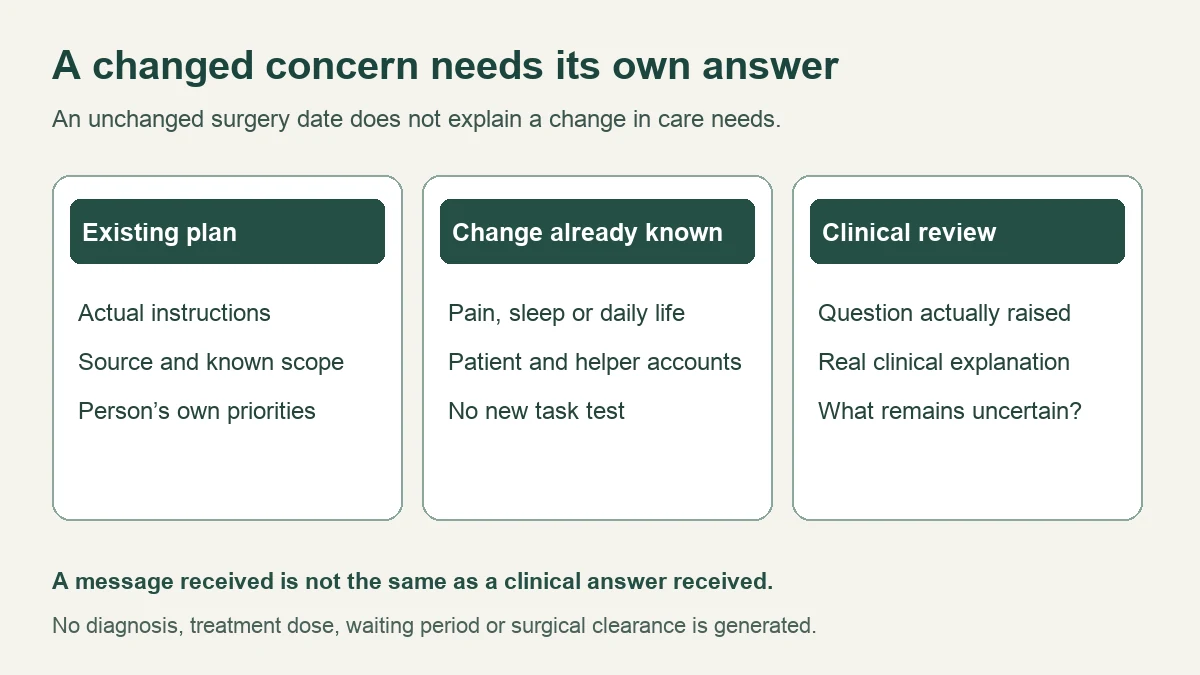
These are communication categories, not a readiness checklist or a progression every person must complete. Some items may be unknown. A message received by an office is different from a clinical answer. A new document is different from education received or assistance available. The record cannot select a medicine, movement method, walking aid or surgery date.
Retain the person’s words separately from an observer’s interpretation. “I slept poorly and want help with pain” and “I noticed more assistance was needed” can both matter. Neither cancels the other. Completing a task does not establish acceptable pain, and a pain number is not required to ask for review. No function-first hierarchy applies.
Joint replacement wait: seven essential reassessment checks
Start with the concern the person wants reviewed
Ask about pain, sleep, activities, worries, medicine concerns and support without replacing the person’s priorities with a family goal. Obtain agreement for sharing relevant notes. The aim is an actual discussion, not persuading someone to exercise, accept a device or appear ready for surgery.
Keep the current instruction and its source
Use what was actually advised, including the source and scope if known. Distinguish the person’s recollection from a written instruction. Do not fill missing details using another patient’s plan, a postoperative guide or a generic home routine. If advice conflicts, preserve both sources and ask the responsible team which applies.
Describe a change already experienced
Record what is different since the earlier review, with approximate timing only if already known. Better, worse, unchanged, mixed and uncertain are all valid descriptions. Do not repeat a sit-to-stand, walk to fatigue, test a bathroom route or alter medication timing to create a useful record. No standard morning-stiffness range or standing limit is supplied.
Send the question to the appropriate role
A scheduling question may go to the surgical office; a symptom, medicine or instruction question needs appropriate clinical advice. Ask who owns the unresolved issue. A cancellation-list request is not reassessment. Contact, acknowledgement and a review actually performed remain separate events.
Retain the actual explanation and unanswered point
Record what the professional actually explained and any remaining uncertainty. Do not diagnose a new symptom as arthritis, overuse, poor sleep or waiting-related decline from timing alone. If the answer is unclear, ask for clarification. An administrative reassurance or appointment booking is not an individual clinical explanation.
Clarify the updated plan before describing it as settled
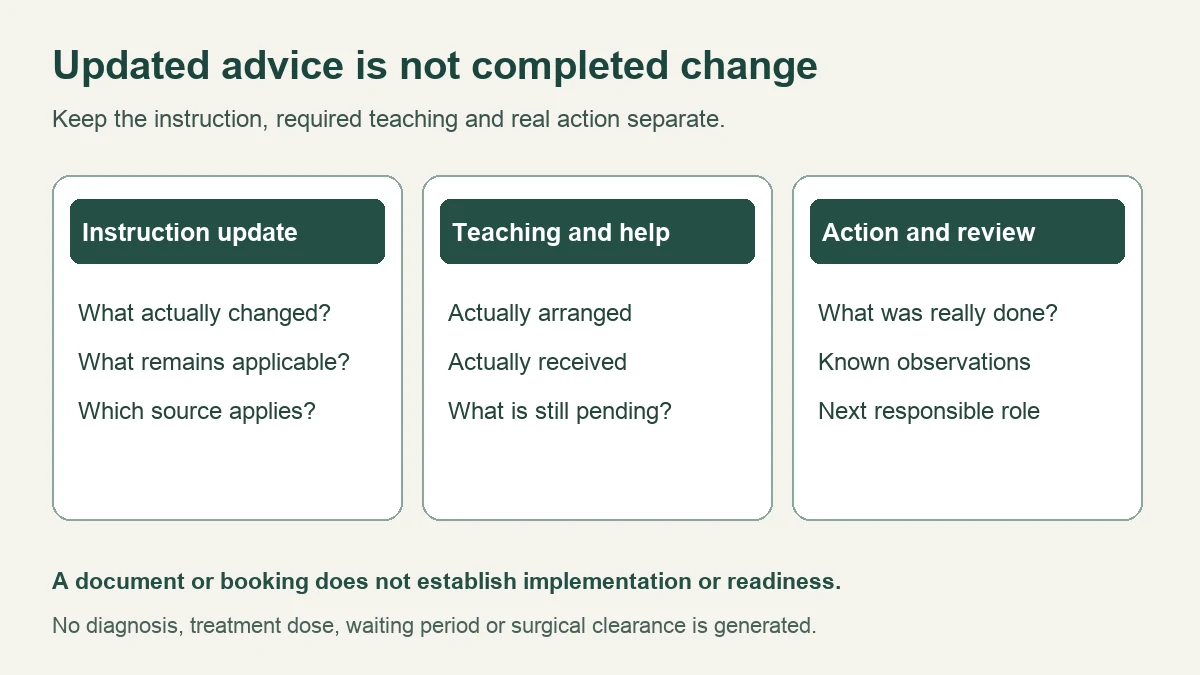
Ask what changed, which earlier advice remains, what education or help is needed and who can clarify a conflict. Keep any real individual instructions accurately; this article supplies no exercise dose, drug stop/start date, pillow arrangement or transfer method. A note labelled updated does not itself show that every practical requirement is met.
Check real execution and the remaining owner
Distinguish a recommendation, an agreed arrangement and work actually completed. Record whether the required teaching, assessment or help really occurred. Keep the actual next arrangement and unresolved issue visible. Do not test a new method, infer improvement or invent an interim plan just to mark a field complete.
Prepare reassessment questions without diagnosing the change
A short question may be enough: “This is different from the situation at my last review. Does the current plan need reassessment, which instructions apply now, and who will explain the next step?” Add existing details that help describe the concern. Do not wait to assemble a complete history before reporting a problem that needs attention.
Timing can help describe an experience without proving its cause. Pain after an ordinary task does not by itself establish that the task caused harm. Better sleep after a change does not establish why it improved. Record the sequence and the person’s account, then retain the actual clinical explanation rather than supplying one from the worksheet.
A medicine concern should keep the current instruction, what was actually used and the concern separate. Use the prescriber or pharmacist’s actual advice. Do not change, combine, stop, delay or add medicine from this article, and do not time activity around an assumed medicine effect. Full medicine details and labels belong in an agreed private clinical conversation, not public-page entries.
A change in movement or required help is information for review, not a home performance test. No chair height, first-step sequence, standing interval, rest schedule or room rehearsal is prescribed here. A family member need not prove that a task failed before asking what assessment and assistance are appropriate.
For physical help, NHS moving-and-handling guidance explains the importance of assessment and training. It is general handling education, not condition- or procedure-specific clearance. Availability of a relative does not establish that a particular lifting or transfer method is appropriate. UK council arrangements described there are not generalized to U.S. services.
Separate a clinical answer, instruction update and action
| Reported event | What is still a separate question | Useful record wording |
|---|---|---|
| The office received the message. | Has the concern had appropriate clinical review? | Receipt confirmed; clinical answer not yet received. |
| The concern was assessed. | What explanation and individual plan were actually provided? | Assessment reported; record the real reply and remaining question. |
| An updated instruction was communicated. | Which previous advice remains, and is clarification needed? | Update received; source, scope and any conflict retained. |
| Education or support was arranged. | Did it actually happen, and was the required help available? | Booked or agreed; completion not yet confirmed. |
| An agreed action was carried out. | What is known now, and what remains unresolved? | Actual action recorded; no causal benefit or readiness conclusion assumed. |
Ask for clarification in a form the person can use. A useful question is: “Can you explain what changed from the previous instructions and what I should do if the plan cannot be followed?” Record the real answer rather than creating a plan from general advice. If none was provided, mark that absence and seek appropriate help for the current need.
Education has its own status. A session offered, appointment booked, handout received and explanation understood are different facts. Do not mark a change fully implemented because a document arrived. If questions remain, retain them and ask the relevant professional to clarify; the worksheet does not assess comprehension or competence.
If circumstances change again, describe the new concern and the source of the instructions being questioned. Do not silently combine old and new documents or choose a convenient instruction from each. A single short update can be useful; no fixed review cycle is imposed by this guide.
An unchanged operation date does not answer a changed care question. Conversely, a changed symptom or a request for reassessment does not automatically mean an earlier operation, cancellation or a different procedure. Those decisions require the responsible team’s assessment and shared discussion. The record supplies no readiness verdict or priority score.
What the evidence supports, and its limits
The 2019 ACR/Arthritis Foundation osteoarthritis guideline supports exercise and self-management within individualized care. That does not establish the old article’s task timing, household sequence or a particular person’s preoperative exercise plan. General osteoarthritis care is not a substitute for the current team’s instructions, and this page makes no claim that a generic prehabilitation routine improves this reader’s surgical outcome.
The ACR/AAHKS guideline on elective hip and knee arthroplasty timing addresses a defined population with advanced disease after nonoperative treatment has been ineffective. It concerns surgery timing and appropriate reasons for delay, not a worksheet score or a universal exercise prerequisite. Do not use this article to start additional treatment, postpone surgery or claim that someone is ready to proceed.
AAOS joint-replacement preparation guidance supports questions about the procedure, medication information, exercise advice and preparations. It does not validate this record, confirm an individual transfer or medication plan, or make an appointment a completed assessment. Ask the team about the actual instructions relevant to the present concern.
These sources support the boundaries of the discussion; they do not prove the new tool improves pain, prevents falls, shortens waiting time or changes surgical outcomes. The tables and questions are editorial organization aids. Individual review, a real reply and practical follow-through are still necessary.
For daily tasks, planned help and help actually provided while waiting for joint replacement, use the separate seven support checks. This page adds the review of changed concerns, the actual clinical explanation, instruction reconciliation and implementation. It does not repeat a household preparation programme.
Two fictional change-and-review writing examples
These are invented records, not real families, clinical advice, assessment findings or successful outcomes. They illustrate incomplete and completed parts of a review process without inventing a treatment instruction. The example buttons in the tool replace current entries and label the result fictional.
Example A: the surgery date is unchanged, but concerns have changed
| Record | Fictional entry |
|---|---|
| Existing plan | Earlier individual instructions exist; their exact content and date are not supplied. |
| Changed concern | The person reports changed pain and disrupted sleep. A helper reports that more assistance was needed in ordinary life. |
| Question | Does the existing plan need reassessment, and which advice applies to the current concern? |
| Actual contact / explanation | A question is prepared. No sent message, clinical review or professional answer supplied. |
| Update / execution | No new instruction, intervention, safe waiting period or improvement is invented. |
A question could read: “Pain, sleep and the help needed have changed since the earlier review, although the operation date is the same. Could the relevant team review these concerns and clarify the current plan?” The note does not claim that the joint has deteriorated or that surgery must be brought forward.
Example B: instructions were updated, education is still pending
| Record | Fictional entry |
|---|---|
| Reported review | The team reportedly reviewed a concern and communicated a plan update. Actual clinical wording is not supplied. |
| Instruction question | What changed, what remains applicable, and which source should be used? No medicine or movement method is invented. |
| Education / help | Teaching is reportedly booked, not yet received. Any required help is not confirmed as available. |
| Implementation | An update was communicated; actual execution is not established. |
| Remaining question | Who will clarify the current plan and arrange the missing teaching/help? No interim technique or readiness outcome claimed. |
A question could read: “We received an update, but the planned teaching has not happened and the practical requirements are unclear. Could you clarify what applies now, what remains pending and who owns the next step?” Receiving advice is acknowledged without being treated as completed care.
Private change, reassessment and instruction-update record
Download the offline tool before entering actual health or care details. Use fictional entries on this webpage because surrounding ads and analytics may be present. The tool itself makes no network requests, uses no browser storage and does not save automatically. Its offline export includes no external assets or automatic network requests.
Begin with one changed concern. Blank items create optional clarification questions, not a diagnosis, urgency score or treatment recommendation. Omit names, addresses, private contacts, identifiers, medicine-label photographs and full reports. Share relevant details only through an agreed private route. A paper record with these headings is an alternative.
Change, reassessment, real answer and instruction-update record
Start with one changed concern. Any field may remain blank; no diary period or task trial is required.
Download the offline tool before entering actual health or care details. Use fictional entries here; surrounding ads and analytics may be present.
Offline copy. No ads, analytics, external assets or automatic network requests.
The tool makes no network requests, uses no browser storage and does not save automatically. Refreshing may lose entries. Omit names, addresses, private contacts, identifiers and full reports. Needed care comes before this record.
Start with the fictional example or download a blank offline copy.
Paper alternative: priorities; existing instructions; change; review question; contact; actual explanation; instruction update; teaching/help; action completed; unresolved question and owner.
My joint replacement change and review record
Unverified personal record for discussion. Entries verify no diagnosis, advice, completed change or treatment outcome.
Guide: living.kioptrix.com/joint-replacement-pain-management/
Build the record, then copy, download text or print/save PDF. Editing hides the previous result until rebuilt. Example buttons replace entries and label output fictional. Offline exports contain current entries and should be kept private. Refreshing or closing may lose unsaved notes. Nothing is sent, assessed, booked or medically cleared by this tool.
Questions about review during a joint replacement wait
Must I collect seven days of notes first?
No. One concern and existing information can begin a conversation. Needed care must not wait for a diary or a routine reply.
Should I repeat the difficult movement for the record?
No task trial is requested. Describe what already happened and ask what assessment is appropriate.
Does an unchanged surgery date mean the current plan still fits?
No automatic conclusion follows. Raise changed concerns and retain the team’s actual answer.
Can this tell me which old or new instruction to follow?
No. Preserve the sources and ask the responsible team to clarify what applies. The tool cannot reconcile clinical instructions.
Is a booked teaching session a completed change?
No. Keep education arranged, education received, required help and actual execution separate.
Does completing the record show readiness for surgery?
No. The record verifies neither clinical advice nor readiness, safe mobility or a treatment outcome.
Sources, corrections and editorial limits
Editorial revision and source check: October 30, 2026. This version removes first-step routines, task-time examples used as guidance, furniture/route tests, chore quotas, a required diary frame, function-first comparisons and unverified first-person stories. The previous promotional artwork and duplicated image are replaced. The NHS handling source is corrected to general education rather than procedure-specific advice.
- MedlinePlus: Recognizing medical emergencies — selected emergency examples, not a complete triage checklist.
- NHS: Broken hip, septic arthritis and back pain — selected injury, joint-infection and neurological warnings; UK service pathways are not U.S. arrangements.
- NHS: Moving, lifting and handling someone else — general assessment and training education; not individual movement clearance.
- 2019 ACR/Arthritis Foundation osteoarthritis guideline — individualized osteoarthritis management; not an instruction dose or preoperative readiness instrument.
- ACR/AAHKS: Optimal timing of elective hip and knee arthroplasty — a defined clinical population and timing question, not a universal waiting or exercise rule.
- AAOS: Preparing for joint replacement surgery — preparation discussions, not validation of this worksheet or individual permission.
No independent clinical review, direct exercise or equipment testing, validated risk assessment or reader-outcome study is claimed. The seven checks and record are editorial communication aids. Qualified review and independent usability evidence would strengthen the resource. A completed form does not establish appropriate care, safe waiting or readiness for an operation.
The new representative image is an AI-generated fictional consultation about documents and changed concerns, not a real patient assessment or promise of safer recovery. Two editorial diagrams explain reassessment and the distinction between updated advice and implemented change.