

Waiting for joint replacement can expose a gap between a care plan and everyday help. A helper may be expected overnight but unavailable when needed. Equipment may be requested but not fitted. A familiar washing or dressing task may become harder after an earlier assessment. Record those differences so the next conversation starts with what actually happened.
This guide helps older adults and consenting family helpers compare daily tasks, current instructions and real support while waiting for planned hip or knee replacement. It includes seven support checks, task and role tables, two fictional writing examples and a free offline record. Jump to the record tool or see the examples. No pain treatment, transfer technique or exercise dose is selected here.
Do not complete a worksheet before seeking urgent help. Call 911 in the U.S. for new chest pain, severe breathing difficulty, collapse, stroke-like symptoms or another emergency. See MedlinePlus: recognizing medical emergencies. Severe hip pain or inability to walk/bear weight after a fall or injury needs emergency assessment; do not force walking to prove the injury is minor or drive yourself. NHS hip-fracture guidance supports immediate hospital assessment for these injury signs; its UK service numbers do not apply to U.S. readers.
A newly hot, swollen, very painful joint or sudden severe joint pain needs urgent medical assessment, even without fever. Do not wait for a routine appointment or a next-morning pain score. See NHS guidance on septic arthritis. New severe confusion, vomiting blood, black tarry stools, fainting, or injury after a fall also requires prompt assessment according to severity; use emergency services for severe illness or instability. Report a head injury and blood-thinner use. This is not an exhaustive warning-sign list or an individual urgency assessment.
For worsening function, new medicine concerns or support that no longer meets everyday needs, contact the relevant treating team promptly and ask for an interim plan and an after-hours route. If timely advice is unavailable and the situation is urgent, use local urgent or emergency services. A portal message awaiting a reply is not care received. Do not wait to collect seven days of observations.
Table of Contents
Seven essential support checks while waiting
| Check | What to keep separate | Useful next question |
|---|---|---|
| 1. Current instruction | Actual advice, source/date and scope versus what the family assumes. | Which movement, weight-bearing, device or exercise instructions apply now? |
| 2. Daily priority | The patient’s own priority versus someone else’s preferred routine. | Which ordinary task is currently difficult or not possible? |
| 3. Planned support | Expected person, time and aid versus actual availability. | Who is available for the relevant part of the task, including at night? |
| 4. Actual performance | A plan versus a task actually completed, changed or not attempted. | What happened under ordinary conditions without a repeat test? |
| 5. Change observed | Patient words versus helper observations; timing versus causation. | What changed since the last assessment and when was it noticed? |
| 6. Contact and answer | A submitted question versus an answer actually received. | Who should review this gap, and what was the real reply? |
| 7. Follow-through | A suggested next step versus an agreed owner and review time. | Who is responsible for the next arrangement and what remains unresolved? |
These are organizing checks, not a pass/fail checklist. One unresolved daily need is enough to begin a conversation. A complete record does not establish safe mobility, sufficient help or readiness for surgery. Use only the sections that help describe your situation. The person waiting for surgery should be involved in choosing priorities and sharing notes whenever possible.
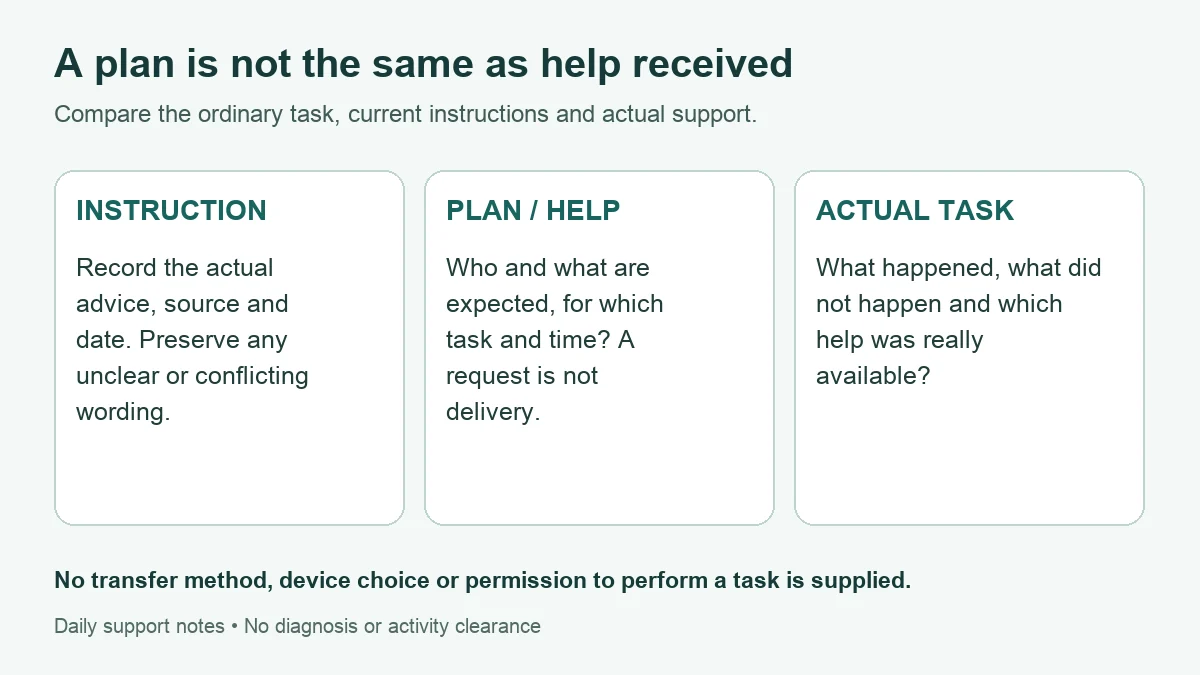
Compare the daily task, instruction and help
Start with one real task rather than trying to redesign the entire day. Record the current instruction as accurately as possible and identify any missing source or unclear wording. An old instruction may not answer a new difficulty. Ask the treating team whether it still applies; the record cannot update it automatically.
| Daily task | Instruction or education to confirm | Help and environment to discuss | Actual record |
|---|---|---|---|
| Bed, chair or toilet transfers | Individual transfer guidance and who has taught or checked the method. | Availability of a trained helper, appropriate equipment and usable space. | Who was there, what was available and whether the task occurred; no lifting method prescribed. |
| Bed-to-bathroom route | Current mobility/weight-bearing and device instructions, if any. | Nighttime availability, lighting, route, doorways and access to the instructed aid. | Actual support gap or change already noticed; do not walk the route as a test. |
| Washing and dressing | Relevant movement advice and individual assistance needs. | Appropriate seating/equipment, access and help at the needed time. | What was completed, changed, postponed or not attempted, without a safety score. |
| Meals and ordinary household needs | Any actual activity advice and which tasks need assistance. | Food preparation, access, delivery or household help that is actually available. | What the person needed and what assistance occurred; no standing-duration limit invented. |
| Appointments and leaving home | Individual mobility and transport requirements. | Steps, entrance/exit, suitable transport and help at each stage. | Confirmed arrangements versus requests or bookings still pending. |
A clearer path or better lighting can be an ordinary household improvement, but it does not solve every transfer or walking problem. Do not install an unapproved support, stack unstable cushions or improvise a lifting method to imitate an illustration. Ask about appropriate fitting, equipment instructions and training when a task requires them. A family member’s presence is not proof that they can safely provide physical assistance.
Nighttime deserves its own availability check. A relative who helps during the day may be asleep, away or unable to assist at night. Write the actual gap instead of assuming that the daytime arrangement carries over. If essential help is unavailable, seek a workable interim arrangement from the relevant care or support service rather than encouraging an unsupported attempt. The tool offers no substitute transfer or device.
For a broader family overview, see Waiting for Joint Replacement: Caregiver Planning. This page has a narrower role: compare current instructions with actual daily support, then preserve the question and real answer. It does not repeat a general catalogue of arthritis treatments.
Who can clarify the waiting-period plan?
| Role | Useful discussion | What a reply does not automatically establish |
|---|---|---|
| Patient | Priorities, experience, preferences and consent to share notes. | A helper’s account is not a replacement for the patient’s own words. |
| Surgeon or treating clinical team | Changes since assessment, current restrictions, interim review and surgical preparation questions. | An appointment request is not an assessment; general advice may not address a newly changed task. |
| Primary care clinician / pharmacist | Medicine list, effects, interactions and questions within their respective scope. | Do not infer a new dose, stop date or surgical instruction from a general article. |
| PT / OT or relevant rehabilitation professional | Individual movement education, task adaptation, equipment assessment and assistance needs. | Reading a table is not a fitted aid, supervised demonstration or completed training. |
| Family / practical support contact | Actual availability, agreed tasks, access and gaps in arrangements. | A promise or service referral is not delivered help or clinical clearance. |
Record the scope of an answer. A support service may confirm an available visit; that does not provide exercise advice. A pharmacist may clarify a product question; that is not confirmation of the surgeon’s procedure-specific plan. If instructions appear to conflict, show the wording, source and date to the relevant team and ask for clarification instead of choosing the more convenient version.
Keep an agreed contact route and after-hours plan where the person and helper can access them privately. Record role and date in this tool rather than full identifying details. If you have not received a response, write “pending,” not “approved.” If an agreed call-back is missed, use the instructed follow-up route; an urgent change should not wait for that administrative process.
What the evidence supports, and what it does not
NIAMS hip-replacement information supports asking the surgical team about preparation, suitable exercises, transport, household help and useful equipment. It is hip-specific education, not a personal plan for every hip or knee patient. The task table here adapts planning questions into a record; it is not a validated clinical assessment.
NICE joint-replacement guidance recommends understandable, procedure-specific information and a point of contact, along with preoperative rehabilitation advice for hip or knee replacement. It supports individualized preparation rather than a universal internet programme. It is UK guidance, not a guarantee of a U.S. service, funding decision or a particular recovery result.
The ACR/Arthritis Foundation osteoarthritis guideline distinguishes joints and interventions. For example, topical NSAIDs are recommended for knee osteoarthritis, whereas the depth of the hip joint limits the expected relevance of topical NSAIDs there. “Topical” therefore does not mean equally useful for every painful joint or automatically safe for every older adult. Ask the clinician or pharmacist about the actual product and medical context; no product or dose is recommended here.
The same guideline discusses cane use and particular knee braces in defined osteoarthritis contexts. Those recommendations are not a general cane-versus-walker algorithm or a direction to buy any brace. Mobility aids and joint braces have different purposes. Device choice, fit, upper-limb ability, the actual route and teaching needs belong in an individual discussion. The old one-sided-pain selection shortcut has been removed.
Follow actual prescribed activity and medicine instructions. Ask the treating team about unresolved exercise, weight-bearing and preoperative medicine or injection questions. Do not stop, combine, borrow or increase medicines, start an exercise programme or change an aid because of this page. There is no “arrive stronger” promise and no exercise requirement created by this guide.
An observation later that day or the next morning can help describe an existing event, but it does not measure safe loading or establish why pain changed. There is no 24-hour payback test, green-zone clearance or mandatory seven-day diary here. Do not deliberately provoke pain, repeat a difficult transfer or postpone assessment to obtain a better comparison. Improvement and a completed form do not rule out a medical problem.
Record actual support and changes without guessing
A short account can be more useful than a long pain diary if it preserves the distinction between expectation and reality. Record information already available. A task not attempted or not completed can be worth discussing; it does not need to be reproduced for proof. Pain scores are optional personal descriptions, not a threshold for deciding whether to seek help.
| Keep this distinction | Example of a useful entry | Avoid converting it into |
|---|---|---|
| Patient words / helper observation | “The patient described difficulty”; separately, “the helper saw the task stop.” | A diagnosis, invented quotation or assumption about motivation. |
| Plan / actual availability | Help was expected, but unavailable at that time. | Proof that the person should manage alone. |
| Education / current performance | Prior education is recorded; an ordinary task is now different. | An automatically updated instruction or a self-test to prove readiness. |
| Event / possible explanation | Describe what happened and its timing; note uncertainty. | A claim that a device, medicine or activity caused the change. |
| Question / real reply | Question sent; no reply yet. Later add the actual answer and source/date. | Assumed permission, equipment delivery or a completed assessment. |
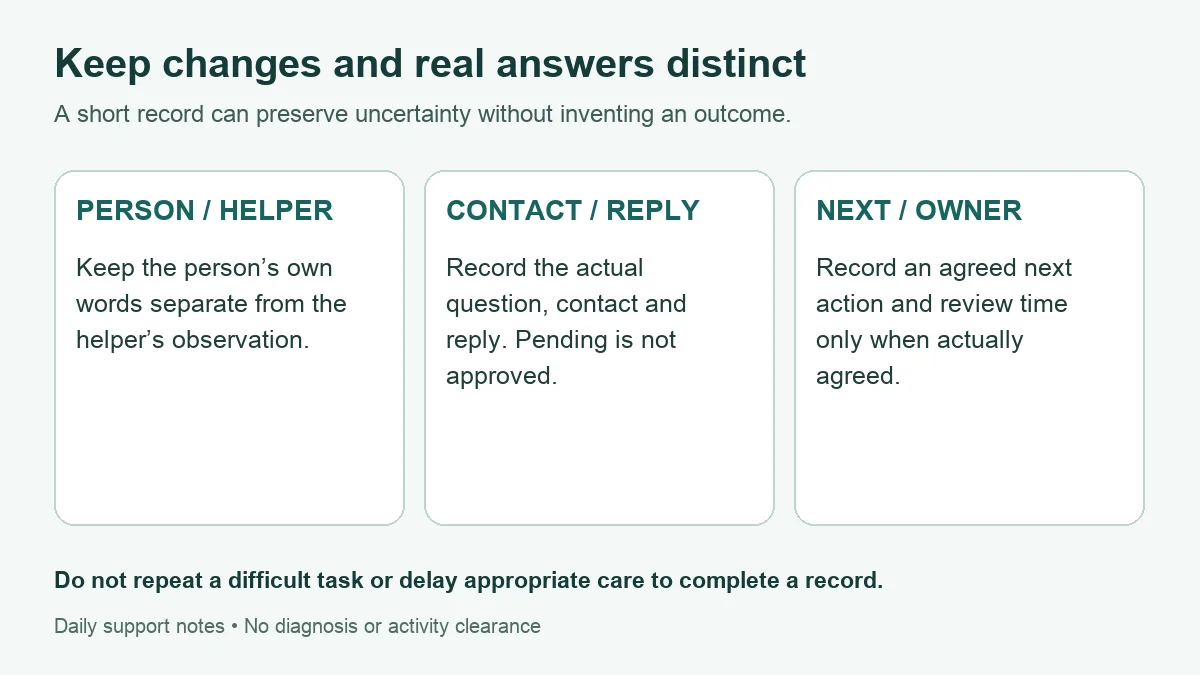
With consent, preserve the patient’s own account separately from a helper’s interpretation. Avoid language such as “would not cooperate” when the observed fact is that a task stopped or help was unavailable. Describe the task, support, timing and effect on daily life without assigning blame. If memory is uncertain, mark it uncertain rather than supplying a precise time or quotation.
When a real answer arrives, add the source, time and scope without rewriting earlier observations to make the plan look successful. Record an agreed next action, responsible person and review time only when actually agreed. If the answer leaves part of the task unresolved, preserve that question. A single contact may not settle equipment, household support and clinical instructions together.
Two fictional waiting-period support examples
These invented examples teach record writing. They describe no real patient, clinical answer, treatment success or personal experience. They do not assign urgency or authorize an activity. Loading an example in the tool replaces existing entries. Follow the warning-sign guidance above and your own team’s instructions for real situations.
Example A: expected nighttime help was unavailable
| Record | Fictional entry |
|---|---|
| Current instruction | Prior team advice is mentioned; exact wording and source/date remain unconfirmed. No transfer technique is supplied. |
| Task / expected help | Bed-to-bathroom need during the night; a family helper was expected. |
| Actual gap | The helper was unavailable at that time. No attempt, safe transfer or outcome is assumed. |
| Contact / actual reply | A question about the interim support gap and individual guidance was submitted. Reply pending. |
| Remaining question | Who can review the gap and provide an actual arrangement? A submitted question is not delivered care. |
Writing example: “The planned overnight helper was unavailable when help was needed. I have not treated the plan as support actually received. The exact current transfer guidance needs confirmation. Our support question is pending; which contact can review the gap and arrange an appropriate interim plan?” This wording gives no permission to attempt the task alone or to improvise lifting.
Example B: a familiar task changed after earlier education
| Record | Fictional entry |
|---|---|
| Previous plan | Movement education and help had previously been arranged; the current scope needs confirmation. |
| Actual task | An ordinary washing or dressing task was not completed as previously managed. No repeat attempt requested. |
| Patient / helper accounts | Record each separately if actually known. The example invents no quotation or cause. |
| Contact / answer | Record the real contact, date and response status. No clinician answer is supplied. |
| Next issue | Seek appropriate review of the change and support needs without waiting for a diary period; add the actual reply when received. |
Writing example: “The ordinary task was not completed as it had been before. We have separated the person’s account from the helper’s observation and have not repeated the task to test it. We need review of what changed and whether the previous plan still applies. Any contact and actual answer will be recorded as they occur.” This example does not decide whether the change is routine or urgent.
Free daily support, change and contact record
The tool has 11 optional fields for instructions, daily task, planned help, open question, actual task, support gap, patient words, helper observation, contact, actual reply and next arrangement. Blank fields produce optional clarification prompts. Full fields remain unverified notes. It produces no symptom classification, exercise dose, device recommendation, activity permission or surgery-readiness score.
Try fictional examples on this page. Download the offline HTML copy before entering actual health or household notes. The live site may use site services. The downloaded file has no ads, analytics, external assets, automatic network requests or browser storage. It requires no email or account. Completed exports contain your notes; keep them private and share only through an agreed channel with consent.
Build a record, copy it, download text or use the browser’s print/save-PDF option. Editing an entry hides the old output until rebuilt. The tool sends nothing to a clinician or service and does not save automatically. Avoid identifying details or full medical records. You can use paper with the same headings if the tool is unavailable; care must not depend on completing the form.
Daily support, change and contact record
Keep current instructions, planned help, actual daily tasks, the patient’s words, helper observations and real replies separate. No diagnosis, urgency score or activity clearance is generated.
Download the offline tool before entering actual health or household notes. Try the fictional examples here. The offline copy has no site ads, analytics or external assets.
Offline copy. This file has no ads, analytics, external assets or automatic network requests.
The tool uses no network requests or browser storage and does not automatically save entries. Refreshing or closing may lose them. Exports contain your entries; keep them private. Avoid names, addresses, full medical records and identifying contact details. Do not delay urgent or emergency care for a record.
Start with the fictional example or download a blank offline copy.
If the tool does not load, use paper: current instructions; daily task; planned help; actual task/support; patient words; helper observations; contact; real reply; next owner and review. Seek care without completing a form.
My daily support, change and contact record
Unverified personal record for discussion. Entries are unverified notes, not medical advice or proof of support, instruction, safety or a clinical answer.
Guide: living.kioptrix.com/pain-management-for-seniors-waiting-on-joint/
Questions about daily support while waiting
Do I need a full week of notes before contacting the team?
No. One unresolved essential need or a meaningful change can be enough to ask for review. Do not wait for a diary period, especially for urgent or emergency symptoms.
Does a better next morning mean the activity was safe?
No. Later observations describe a pattern, not safe loading, a diagnosis or readiness for surgery. Follow current instructions and seek review of changes or uncertainty.
Can this tool choose a cane, walker or brace?
No. Record the task, current instructions, existing aid and unresolved fitting or training needs. Device categories and individual purposes differ; the table is not a purchase or selection algorithm.
What if a helper or piece of equipment is unavailable?
Record the actual gap and seek an appropriate interim arrangement through the relevant care or support contact. Do not assume a request is delivery or substitute untrained physical assistance.
What if two instructions seem to conflict?
Keep each instruction’s wording, source, date and scope, then ask the relevant team to clarify. The tool does not choose between them or replace the team’s answer.
Can a caregiver record everything for the person?
Involve the person and obtain consent where possible. Separate their own account from helper observations. The tool is not a capacity assessment and should not erase the person’s preferences.
Does a complete record mean the support plan is adequate?
No. Entries are unverified. The tool checks neither clinical suitability nor actual delivery. An answer may still leave daily support, equipment or training unresolved.
Sources, corrections and review limits
- NIAMS: Hip Replacement Surgery — hip-specific preparation, questions and support context; not an individual knee or hip plan.
- NICE NG157: Joint replacement recommendations — procedure-specific information, contact and preoperative advice; UK scope.
- ACR/Arthritis Foundation osteoarthritis guideline — joint-specific treatment and device context; not a personal prescription.
- NHS: Septic arthritis — urgent assessment of possible joint infection, including presentations without fever.
- MedlinePlus: Recognizing medical emergencies — general emergency signs and response, not a complete individual assessment.
- NHS: Broken hip — emergency injury signs; use the appropriate local services rather than UK numbers outside the UK.
Editorial correction and source check: October 29, 2026. Removed the two-answer eligibility threshold, 24-hour payback test, color-zone safety map, simplified device selection, unverified improvement story and “arrive stronger” promise. Consolidated repeated advice and removed unrelated cost detours. Rebuilt this page around current instructions, actual support gaps and real replies. The original URL is retained.
Written from a family-caregiver editorial perspective. No independent clinical review, real-user usability study, validated decision aid or improved patient outcome is claimed. The new hero is AI-generated fictional editorial artwork; the body diagrams show record organization, not movement technique. Functional checks establish tool behavior only. Our background and editorial approach.