

Senior recovery while living alone needs more than a scheduled call: an agreed contact plan must connect to a real response and any support actually needed. This guide helps the person and their chosen supporters separate consent, accepted roles, contact attempts, actual replies, local response and completed action. It does not decide whether someone is safe to live alone.
Use the six essential response checks, compare planned contact with actual response, read two fictional examples, or build a private contact-and-response record. Start with the information already known. A complete form, a trial alone or a failed check-in is not required before asking for help.
Known emergencies override a routine contact plan. Breathing difficulty, loss of consciousness or inability to wake normally, new confusion, bleeding that will not stop, or other serious acute symptoms need immediate medical attention. Use local emergency services; call 911 for a U.S. emergency. Do not wait to complete retry steps, reach every named supporter or fill in this form. MedlinePlus emergency guidance provides these selected warning examples, not a complete triage rule.
A missed call alone does not diagnose an emergency, and an answered call does not establish safety. Use the actual information, existing clinical instructions and appropriate emergency or clinical advice. This page supplies no number of minutes to wait, mandatory retry count or safe time alone. If needed support is absent, report that gap rather than treating the next scheduled check-in as a solution.
This is educational preparation from a family-caregiver-run site. The operator is not a medical professional and no independent clinical review is claimed. The person’s wishes, accessible communication and the helper’s actual willingness and ability matter. A worksheet cannot certify home safety, authorize entry or substitute for prescribed assistance.
Table of Contents
Senior recovery while living alone: six essential response checks
| Check | Keep the actual fact | Unresolved point |
|---|---|---|
| 1. Consent | What contact, information sharing and support the person agrees to. | Has the scope changed or been misunderstood? |
| 2. Accepted roles | Primary and backup roles actually accepted, with availability and limits. | Who is only proposed or currently unavailable? |
| 3. Contact attempt | What was actually attempted and what information was already known. | Was there a real reply, rather than an assumed response? |
| 4. Actual response | The person’s own account and any separate helper observation. | What need remains despite contact? |
| 5. Local or clinical response | Attendance, support, clinical contact and real answer actually received. | Who has still not responded or supplied help? |
| 6. Support execution | Action actually completed and what remains unresolved. | Who owns the current next response and plan update? |
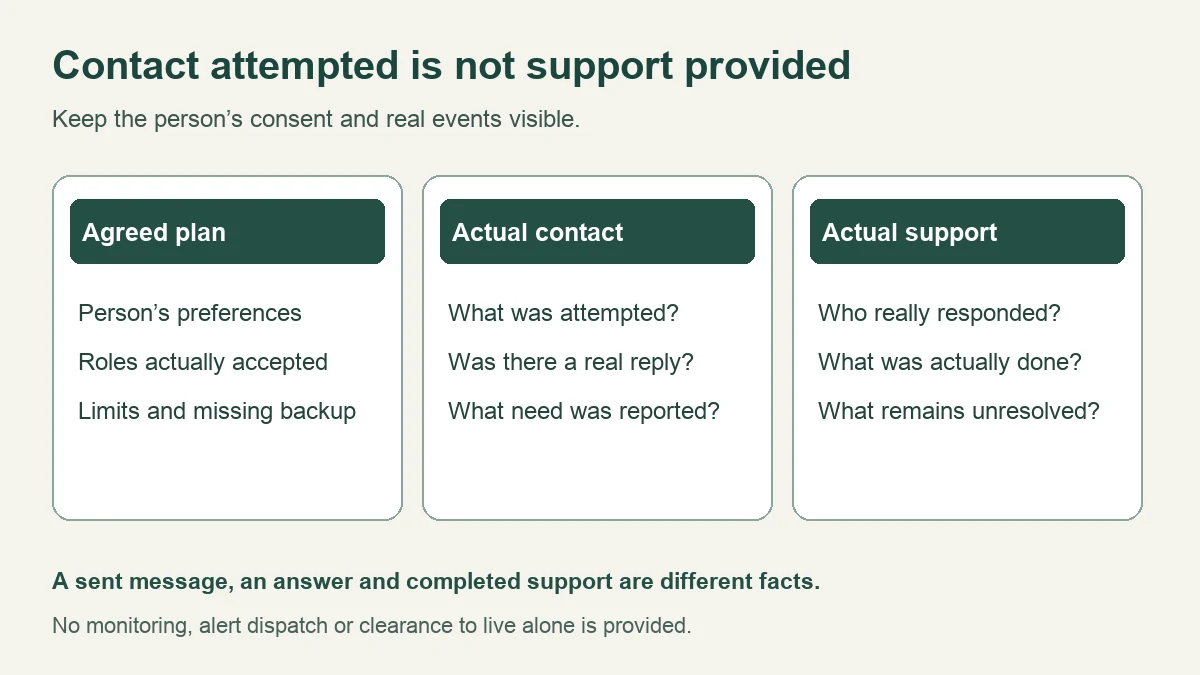
These checks organize facts, not points toward clearance. A named responder is not an accepted responder. A completed call is not completed care. Keep “not confirmed,” “not received” or “not yet carried out” where appropriate; filling every field does not verify a workable arrangement.
Compare planned contact, actual response and remaining support
| Situation | Actual information to record | Gap that must stay visible |
|---|---|---|
| Routine contact planned | Person’s preferred method and actual agreed arrangement. | Primary role and availability not confirmed. |
| Contact not made | Actual attempt, method and what is already known; no assumed cause. | Whether an appropriate response has happened. |
| Primary supporter unavailable | Their actual limits and any accepted alternative role. | A proposed backup is not a person able to attend. |
| Call answered, help needed | Person’s own account of the need, separately from interpretation. | Remote conversation may leave necessary physical help absent. |
| Local response arranged | Who actually accepted the task and what they can provide. | A promise or message is not attendance or skilled care. |
| Clinical question raised | Actual recipient, communication and reply, if received. | A booking or administrative acknowledgement is not clinical assessment. |
| Action reported complete | What actually happened and any need still present. | Contact, attendance and resolution are different events. |
Use one current issue rather than a surveillance log of every activity. An account can be incomplete and still worth communicating. Keep the person’s words separate from another person’s interpretation; do not convert “I have not heard back” into a diagnosis or “they answered” into proof that no help is needed.
Agree consent, accepted roles and realistic limits
Let the person help design the arrangement: what they wish to share, which communication method they can use and which roles they accept from others. Routine supportive contact is not automatic consent to cameras, location tracking, access to medical records or sharing information widely. Keep any such decisions separate and obtain appropriate advice for an actual consent or decision-making question.
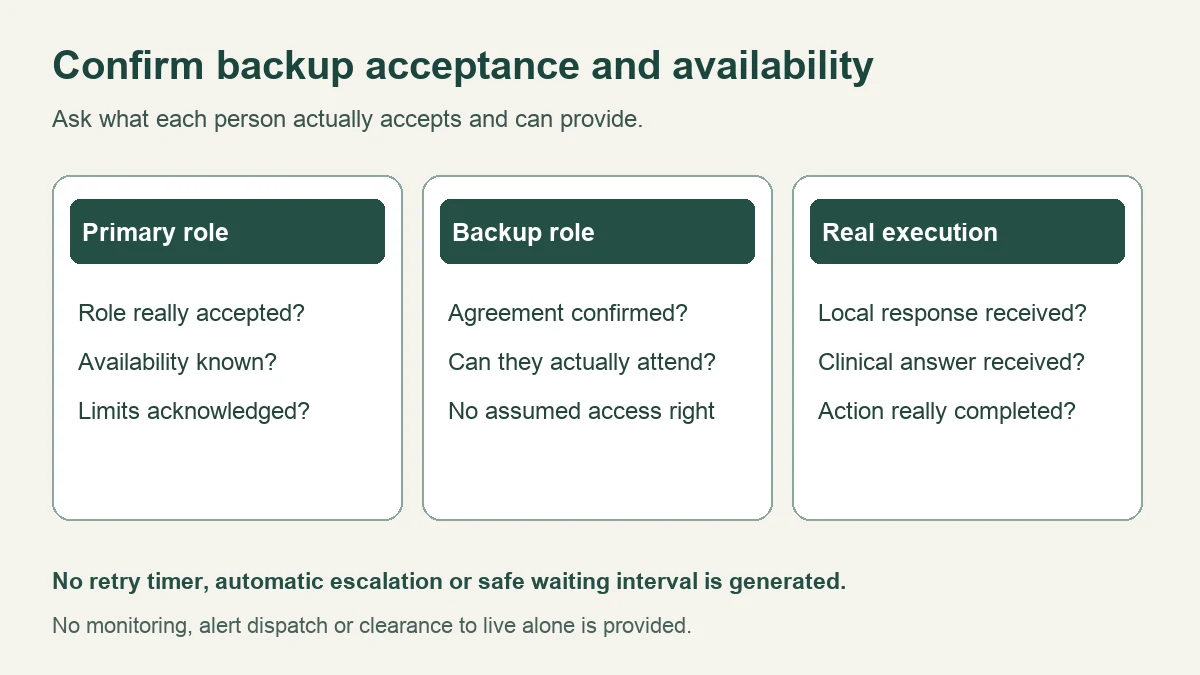
Ask each proposed supporter what they actually accept and can provide. Someone may accept a phone call but be unable to visit, assist with a care task or be available at night. A nearby address, a family relationship or a name on a form does not establish availability, training or agreement.
Record the backup role as accepted only after actual agreement. If no one can provide it, write that openly and discuss the gap with the treating/discharge team or a relevant support coordinator. Do not quietly replace needed hands-on help with a more frequent call. A phone conversation cannot perform a task for the person.
Access arrangements should be agreed privately with the person and the relevant responders or service. This article offers no permission to enter a home or bypass consent. Do not put an address, door code, key location, personal phone number or contact list in this tool, even in its offline copy. Keep necessary operational details in a separately agreed private channel.
Make missed contact and failed backup visible without inventing a timer
Before relying on routine contact, discuss how a missed connection or an unavailable supporter would be handled in the actual arrangement. Keep the agreed roles, alternative method and limitations clear. This guide does not supply a universal escalation sequence or decide that a particular delay is harmless.
If a contact was missed, record only the event already known: an attempt was made, no answer was received, a message was left, or a supporter reported being unavailable. A delivery indicator is not a reply. A silent phone does not explain why contact failed. Do not assign a cause such as sleep, a fall or a technical problem without actual information.
If serious symptoms or an immediate threat are already known, use appropriate emergency help directly. Do not work through a routine retry checklist first. If the situation is unclear or the agreed response cannot be carried out, seek appropriate advice or assistance based on the actual concern rather than relying on a waiting period generated online.
Keep practical communication barriers visible: a method the person cannot use, a contact who is unavailable, or an arrangement that depends on equipment or connectivity. Ask the responsible service what applies to its actual system. Do not make a missed call or alert into a reason to attempt an unsafe transfer or another difficult task to reassure someone.
Distinguish a check-in, an alert service and hands-on help
| Arrangement | What it may provide | What must be separately confirmed |
|---|---|---|
| Agreed family/friend contact | A conversation and communication of a concern. | Actual availability, backup acceptance and response to an unmet need. |
| Alarm sent to chosen contacts | An alert route when the actual device and service support it. | Who receives it, accepts a response role and can act. |
| Monitored alarm service | A connection to a monitoring service within its actual terms. | Service scope, connectivity, user support and actual response arrangements. |
| Local practical help | Specific tasks the person has accepted and can actually provide. | Training, availability and tasks outside that role. |
| Clinical contact or assessment | A professional response within the actual service and encounter. | Receipt, assessment, actual advice and the next responsible person. |
The NHS telecare guide distinguishes alarms that alert nearby people, notify chosen contacts or connect to a monitoring service. Those are different arrangements. The guide is UK information; local access, costs and services differ. No device or service is endorsed here, and no fall-detection or response guarantee is claimed.
If technology is part of the plan, ask the actual provider about compatibility, connectivity, operation and who responds. A purchase or installation is not evidence that everyone understands the service or that a particular person can use it. A monitoring feature also does not supply prescribed physical assistance.
For hands-on movement help, the NHS moving-and-handling guidance supports appropriate education and assessment. It does not establish a missed-contact protocol. A willing visitor should not be turned into an improvised lifting service; this article supplies no floor-recovery or transfer method.
In the U.S., the Administration for Community Living’s Eldercare Locator connects older adults and families to local resources. It is a resource-finding service, not emergency dispatch or proof that a provider has accepted a task. Ask about actual availability, scope, eligibility and costs rather than assuming a referral supplies immediate help.
Keep the actual answer, support provided and unresolved need separate
After contact, preserve what was actually reported, which role responded and what action was agreed or instructed. Attribute a clinical answer to its actual source. A relative’s reassurance, a service acknowledgement and a clinician’s advice are different kinds of response; do not merge them.
A person may answer and still need food access, personal assistance or a clinical response. Keep that need open until the appropriate action is actually supplied or the real plan is clarified. A visit may happen without the visitor being able to perform the needed task. Presence does not prove resolution.
Record what actually occurred next: local attendance, support supplied, professional advice received or a barrier that remained. If an agreed action could not be carried out, keep the reason and current owner visible. Do not mark the arrangement complete because another call is booked or a supporter says they will try later.
This article focuses on consent, contact failure, accepted response roles and whether the response actually reached the person. The separate Orthopedic Home Recovery: 6 Essential Support Checks guide maps daily tasks, service starts, education and broader care gaps. This page does not repeat a medication routine, transfer assessment, home-readiness test or supervision timetable.
Two fictional check-in and backup-response writing examples
These are invented documentation examples, not real people, clinical answers or verified outcomes. The tool marks loaded examples fictional and replaces existing entries. Neither example supplies an emergency classification, safe time alone or a promise of support.
Example A: backup named, role acceptance missing
| Record category | Fictional entry |
|---|---|
| Consent / method | Person agrees to supportive contact; exact schedule not supplied. No monitoring permission inferred. |
| Primary role | Primary supporter reportedly accepts routine contact; availability not fully recorded. |
| Backup role | Possible nearby backup named, but has not accepted. |
| Event / action | No missed-contact event supplied. Backup willingness and availability remain to clarify. |
| Execution | No completed backup arrangement or safety clearance claimed. |
This is a planning gap, not proof of an emergency. It demonstrates why a name on a contact list should not be counted as available help. The record does not invent a waiting interval while the role remains unconfirmed.
Example B: call answered, needed support still absent
| Record category | Fictional entry |
|---|---|
| Actual contact | A routine call occurred; the person answered. |
| Actual need | Person described a practical support need; no diagnosis or emergency status invented. |
| Local response | No attendance or hands-on support confirmed. |
| Clinical answer | Care-team question prepared; no clinical reply supplied. |
| Execution / gap | Call completed, support not confirmed as provided. Need remains unresolved. |
The entry avoids treating contact as resolution. A useful question is: “The conversation happened, but the needed help has not been provided. Who has accepted the response, and what has actually been arranged or carried out?” Known urgent concerns would come before this routine discussion.
Private consent, contact, actual response and support record tool
Download an offline copy before entering actual health or support details. Use fictional entries on this page because surrounding ads and analytics may be present. The tool makes no network requests, uses no browser storage and does not automatically save. Its downloaded file has no external assets or automatic network requests.
Use role labels and one current issue. Do not enter names, addresses, contact numbers, door codes, key locations or full medical records, even offline. Keep exports private. The tool does not monitor anyone, send a message, contact a responder or dispatch help. A paper record with the same headings is equally acceptable.
Consent, accepted roles, actual response and support execution record
Keep an agreed plan, a contact attempt, a real response and support actually provided separate.
Download the offline tool before entering actual health or support details. Use fictional entries here; surrounding ads and analytics may be present.
Offline copy. No ads, analytics, external assets or automatic network requests.
The tool makes no network requests, uses no browser storage and does not automatically save. It does not monitor anyone or send alerts. Omit identifiers, addresses, contact numbers, access codes and key locations, even offline. Needed help must not wait for this record.
Start with the fictional example or download a blank offline copy.
Paper alternative: consent; agreed method; primary acceptance; backup acceptance; attempt; response; reported need; actual local response; clinical answer; action; execution; unresolved gap.
My consent, contact and response record
Unverified personal record for discussion. Entries verify no consent, response, support, clinical answer or resolution.
Guide: living.kioptrix.com/senior-orthopedic-pain-management/
Build, then copy, download text or print/save PDF. Editing hides the old output until rebuilt. Offline exports contain current entries; refreshing or closing can lose unsaved notes. Blank items create optional clarification questions, not an urgency score or response sequence. Filled fields remain unverified. Needed help comes before this record.
Common questions about recovering while living alone
How often should someone check in?
No universal interval is supplied. Agree a workable arrangement with the person and appropriate team; calls do not replace required presence or assistance.
Does a missed call mean an emergency?
It does not establish the cause. Consider the actual known concern and appropriate advice; known emergencies override routine retry plans.
Does an answered call show the person is safe?
No. The person may still need practical or clinical help. Record the response and unresolved need separately.
What if nobody accepts the backup role?
Keep it unconfirmed and discuss the actual support gap with the relevant team or service. Do not record a proposed person as available help.
Is an alarm the same as a response service?
No. Systems and service scopes differ. Confirm the actual recipient, accepted response role and limitations with the provider.
Can the record authorize home access or living alone?
No. It supplies neither entry permission nor a safety decision. Keep access arrangements private and obtain appropriate individualized advice.
Sources, corrections and editorial limits
Sources checked: October 30, 2026. This expansion preserves the earlier consent principle and limits of remote check-ins. It adds contact-to-response distinctions and two fictional examples. The previous sole moving-and-handling source is now used only for its relevant hands-on-help scope, not as evidence for a missed-contact procedure.
- NHS: Personal alarms, monitoring systems and key safes — differences between alert arrangements and practical service questions; UK context, not a product endorsement or U.S. coverage promise.
- ACL: Eldercare Locator — finding U.S. community resources; not emergency response, a service acceptance or a guarantee of care.
- NHS: Moving, lifting and handling someone else — training/assessment for hands-on help; not a missed-contact algorithm.
- MedlinePlus: Recognizing medical emergencies — selected emergency warning examples and immediate help; not a complete triage assessment.
The six checks, comparison and tool are editorial communication aids. No source establishes the exact worksheet as a validated response protocol. No independent clinical review, live monitoring, direct alarm test, verified patient story or reader-outcome study is claimed. The photo is fictional and illustrative; it does not demonstrate that living alone is safe.