

Orthopedic recovery at home after hospital discharge needs more than a written plan: the required help must be accepted, taught, available and actually provided. This guide helps older adults and their chosen supporters compare actual tasks, instructions and support, then keep the real answer and unresolved care gap visible. It does not determine that a person is ready for home, change treatment or guarantee that a service will start.
Use the six essential support checks, compare tasks, instructions, help and actual provision, read two fictional examples, or build a private support and resolution record. Start with the information already available. No walking target, meal count, first-week milestone or complete diary is required before asking for help.
Emergency symptoms and immediate danger come before this worksheet. New chest pain, sudden breathing difficulty, coughing blood or collapse needs emergency help; a lung clot can occur without obvious leg symptoms. New stroke signs such as face drooping, arm weakness or speech difficulty also need emergency action. Call 911 for U.S. emergencies, including uncontrolled severe bleeding. CDC clot warnings and stroke warnings.
Sudden confusion needs immediate medical assessment, rather than a routine message or an assumption that it is aging or medicine-related. Serious slowed or difficult breathing, severe sleepiness or inability to wake/respond while using opioids needs emergency help. If overdose is suspected and naloxone is available, give it and obtain emergency help immediately even if the person improves. NHS sudden-confusion guidance and FDA overdose guidance.
New calf pain or swelling needs prompt clinical assessment. After surgery, wound drainage, spreading redness, fever/chills or worsening pain also needs prompt clinical contact or assessment; do not wait for support arrangements or a completed record. AAOS total-knee-replacement warnings provide procedure-specific examples, not an all-procedure triage rule. These are selected warnings; use appropriate direct care if the team is unavailable or the situation requires it.
This is U.S.-focused educational preparation from a family-caregiver-run site. The operator is not a medical or insurance professional. Patient preferences, consent, actual professional instructions and the helper’s real willingness and ability matter. A worksheet cannot certify home safety, prescribe care, resolve a legal decision or confirm insurance coverage.
Table of Contents
Orthopedic home recovery: six essential support checks
| Check | Actual fact to confirm | Keep the remaining gap visible |
|---|---|---|
| 1. Task and instruction | What task needs support and what the team actually instructed. | Unknown assistance, equipment or conflicting wording. |
| 2. Accepted help | Who accepted which task and what availability/limits were agreed. | Family presence or a request is not acceptance. |
| 3. Teaching | Task-specific explanation actually received and remaining support need. | A handout or attendance is not completed training. |
| 4. Service and equipment | Actual acceptance/start, visit scope, delivery, setup and use instruction. | A referral or order is not actual provision. |
| 5. Uncovered need and contact | Task or period without required support, recipient and real response. | Silence or a booking does not settle the clinical concern. |
| 6. Resolution | Agreed action actually completed and next owner for what remains. | A promise or reschedule does not prove the gap is closed. |
These checks organize facts and questions; they are not a discharge-readiness score. Do not add them up, invent a supervision interval or use a complete-looking record to clear staying alone. The patient and appropriate team assess the actual needs and arrangements. Needed care must not wait for a support trial or a routine callback.
Compare tasks, instructions, help and actual provision
| Task or need | Instruction and required help | Actual provision or unresolved question |
|---|---|---|
| Transfers and permitted movement | Real weight-bearing, aid, brace, assistance and technique instructions. | Was accepted, appropriately taught help actually available for the needed task? No test transfer is requested. |
| Medicine management | Current reconciled instructions, scheduled/as-needed distinction and agreed role. | Was the medicine available and the intended support actually provided? Keep missing or conflicting instructions unresolved. |
| Wound or other skilled task | Actual clinical instructions, required equipment and teaching. | Who was taught, what help was received and what cannot presently be managed? |
| Toileting, washing, dressing and meals | Individual instructions, access and support actually required. | Was the necessary assistance available, including outside a planned visit? No assumed diet, fluid target or bathing clearance. |
| Equipment and home access | Actual order, delivery, setup and instruction requirements. | Did the item arrive, was it made ready and does the team need to address an access problem? |
| Follow-up and communication | Actual appointment, transport/support and clinical contact arrangement. | Was booking confirmed, assistance accepted and essential information received by the next service? |
Describe a task that already needs help rather than setting a new performance target. Depending on the actual plan, mobility may involve supported transfers or a wheelchair instead of walking. The guide supplies no four-hour goal, daily walk count or rule that movement matters more than pain. Pain, sleep, alertness, comfort and practical burden belong alongside safe access to necessary care.
A gap can be stated plainly: “The written plan requires help with this task. No one has accepted that help at the needed time.” That is more precise than marking “family available.” A person can ask for help without knowing the exact assistance level, identifying a symptom cause or collecting a full day of measurements.
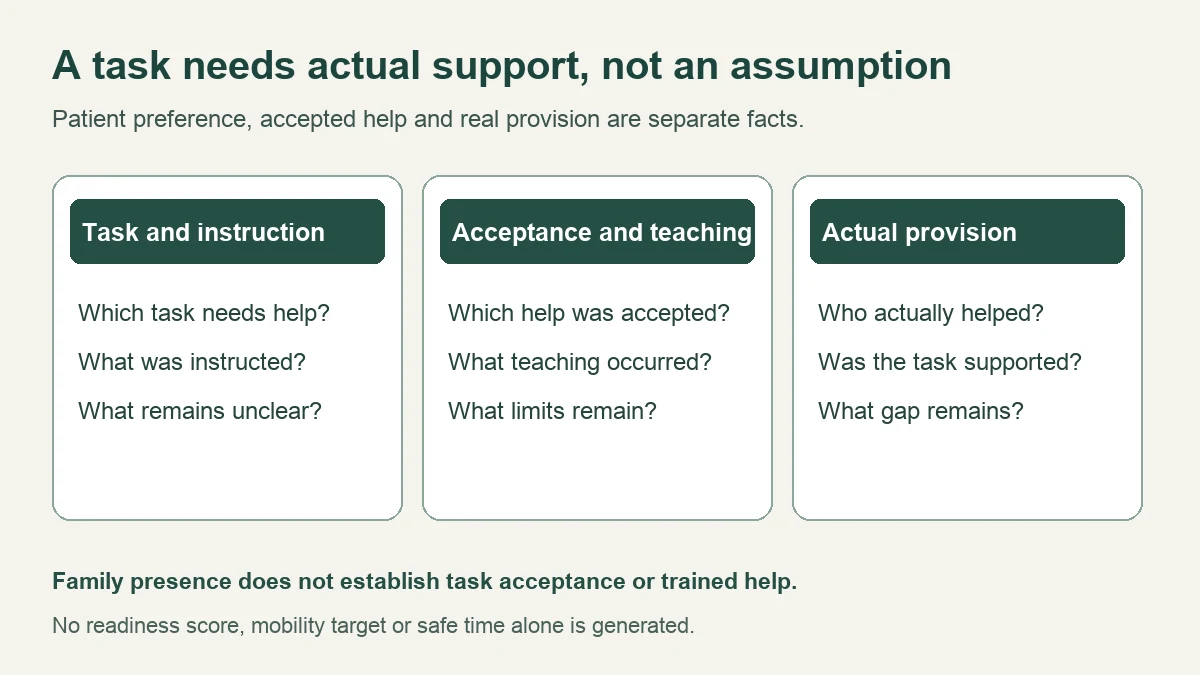
Confirm consent, accepted help and real teaching
Ask what support the patient wants and which role each person has agreed to take. Permission to hear instructions is not agreement to administer medicine, provide physical assistance or cover nights. A family relationship, shared address or attendance at discharge does not establish willingness, availability, physical ability or task-specific competence.
For each necessary task, keep the proposed helper and accepted task scope separate. Record actual limits without blame: work responsibilities, physical difficulty, uncertainty, distance or an inability to provide the required care. A person who cannot accept a task has identified a planning need; they have not failed the patient. Ask the discharge or current care team about the unmet need and appropriate alternatives.
The Medicare discharge checklist supports discussing needed assistance, equipment delivery and special-task teaching with staff. It also asks caregivers to raise their own training and help needs. Use actual supervised education and assessment where relevant; do not practice an unsafe transfer, injection or dressing task merely to complete this worksheet.
Record what was explained, what the person understood and what remains unclear. The patient’s involvement should follow their preferences and appropriate support arrangements; do not presume that difficulty remembering makes a family member the automatic decision-maker. Use relevant private communication routes and share only what the receiving role needs.
Separate a referral from a service that has actually started
| Service or equipment stage | What it establishes | What it does not establish |
|---|---|---|
| Referral / order sent | A request was made, if actually confirmed. | Agency acceptance, visit start, delivery or coverage. |
| Service accepted / visit booked | The agency or service supplied a real arrangement. | That the visit happened or all daily tasks are covered. |
| Visit actually occurred | Actual service, scope and advice received. | Continuous support between visits or a completed onward handoff. |
| Equipment delivered | An item arrived. | Correct setup, teaching, suitability or required help. |
| Teaching / setup received | What was actually explained or made ready. | That support was available later or the task was carried out. |
| Actual provision | The relevant help or service was supplied for the task. | Every remaining task or period is supported. |
Ask the receiving service about acceptance, actual scope, first visit and contact route if it does not occur. A provider list, discharge referral or generic “home health arranged” statement should remain distinct from those confirmations. Retain the actual answer rather than inferring that the service has taken over all concerns.
For Medicare, home health coverage depends on eligibility and applicable requirements. Covered services can include intermittent skilled care; this benefit does not pay for round-the-clock home care, meal delivery or personal care alone when that is the only need. A qualifying home health visit is not continuous daily-life support. Confirm actual service and plan conditions; this article determines no eligibility or cost.
Ask separately about coverage and delivery. An insurance answer does not prove staffing, a visit or equipment is available. Equally, a scheduled visit does not establish coverage. If cost or access blocks necessary support, tell the relevant care/discharge or social-work contact what is missing. Needed urgent assessment must not wait for a plan answer or comparison shopping.
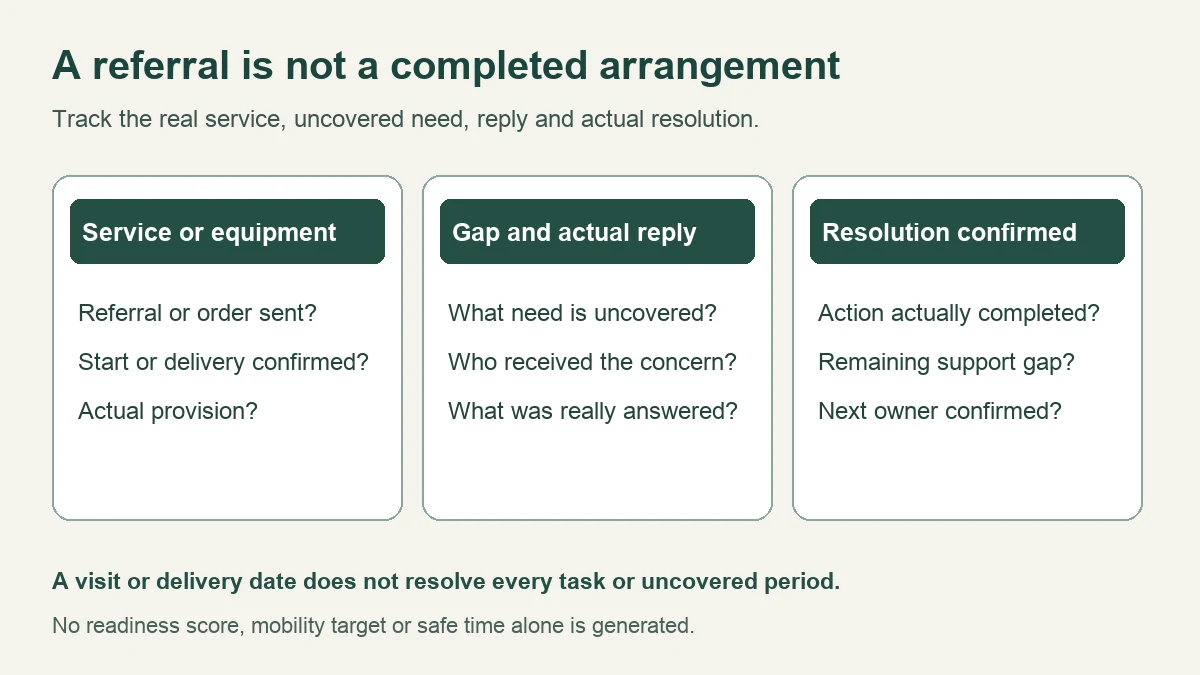
Make uncovered tasks and failed arrangements visible
Consider the real support needed before the first visit, between visits, overnight, during transport or when an agreed helper is unavailable. Do not assume that every period requires supervision or that any particular interval alone is safe. Record the individual need actually explained and the arrangement actually accepted; leave an unknown condition as a question.
A backup needs the same clarity as the main plan: accepted task, availability, teaching and actual contact. “Call a relative” is only a proposal until that person accepts and can provide the necessary help. A telephone check-in is not hands-on assistance; food delivery is not help with a transfer. Keep different needs distinct.
Before discharge, tell staff about unresolved required assistance, missing equipment or inability to carry out the plan. If already home, communicate the actual gap to the discharge/current care contact and ask for an appropriate response. If the next essential task cannot be managed safely, obtain appropriate help instead of attempting it alone, improvising a lifting method or waiting to prove that an arrangement failed.
After an actual missed visit, absent helper or undelivered item, record what failed and which task was left unsupported. Preserve the original arrangement separately from the replacement request. A replacement booking has its own acceptance and actual-provision status; it does not erase the gap that already occurred. If one task is now supported but another remains uncovered, keep the resolution partial rather than marking the whole plan complete.
A clinical concern and a service failure can occur together. Record both without allowing a delivery issue to explain away a symptom. If there is immediate danger or an emergency, use emergency help rather than waiting for an agency’s administrative response. No routine callback, completed form or future visit clears an unsafe current situation.
Keep contact, actual answers and resolution separate
| Record stage | Actual information to keep | Question still open |
|---|---|---|
| Concern communicated | Task/gap and actual recipient/channel; receipt if known. | Was it only drafted or sent, or actually received? |
| Clinical reply | Author/role and real assessment or instruction. | Which clinical concern is unanswered? |
| Service reply | Actual staffing, visit, delivery or access answer. | What does it provide, and what remains outside its scope? |
| Agreed action | Who accepted the specific next action and its actual conditions. | Is it only discussed or really agreed? |
| Resolution in practice | Required support actually provided; what remains missing. | Was the gap resolved or merely rescheduled? |
For example, a delivery date can answer when an item is expected while leaving tonight’s assistance unresolved. A nurse’s acknowledgment may confirm receipt without supplying clinical advice. A visit that occurred can still leave a task outside the service scope. These facts should remain visible together rather than be reduced to a single “done” checkbox.
Retain the current clinical contact, actual after-hours route and next owner. Ask what to do if the arrangement does not occur, and preserve the real answer. No response deadline, safe waiting period, care-location ranking or guarantee against readmission is generated. A new concerning change may need a different assessment regardless of the existing follow-up plan.
This page addresses actual home support and unresolved provision after discharge. Our rehabilitation-setting guide compares onward settings, while the first-month knee-replacement guide connects the surgical pain plan with actual use and the team’s reply. Here the focus is acceptance, teaching, service start and whether a specific support gap was actually addressed.
Two fictional home-support and care-gap examples
These are invented documentation examples, not real patient stories, professional instructions or results. No service approval, safety verdict or recovery outcome is claimed. Example buttons replace entries and mark output fictional. Unknown, pending and not yet confirmed remain valid.
Example A: home service referred, daily support unconfirmed
| Area | Fictional entry |
|---|---|
| Task / proposed help | Help with an essential task is needed. Family assistance was discussed but task scope and availability were not accepted. |
| Service / actual provision | Home service reportedly referred; agency acceptance, first visit and scope unconfirmed. No actual visit recorded. |
| Gap / contact | Support before and between visits remains unconfirmed. A question for the discharge/care contact is prepared, not yet sent. |
| Actual answer / resolution | No real answer or implemented arrangement supplied. A referral is not treated as available support. |
A clear request could say: “Which help is actually confirmed for this task before and between visits, and who will address the remaining gap?” The example does not assume that a family member will cover it, that the patient can safely wait or that home health will provide continuous care.
Example B: equipment absent and task teaching unconfirmed
| Area | Fictional entry |
|---|---|
| Actual need | A necessary transfer reportedly requires help/equipment under an existing plan; exact instructions not supplied. |
| Equipment / education | Equipment reportedly ordered but not delivered. The proposed helper has not received task-specific teaching. |
| Actual action / contact | No trial transfer or improvised method performed for the record. Gap reportedly communicated; clinical receipt and answer unconfirmed. |
| Resolution / next point | No completed arrangement or home-safety verdict supplied. Seek appropriate help for the unresolved task and retain actual replies/provision when received. |
The missing item and missing teaching are separate gaps. Confirming a shipment alone does not supply a safe method or trained assistance. This example records the unresolved need without inventing a technique, substitute device or promised resolution.
Private support acceptance, service and resolution record tool
Download an offline copy before entering actual health or support details. Use fictional notes on this page because surrounding ads or analytics may be present. The tool makes no network requests, uses no browser storage and does not automatically save. Its offline file contains no external assets or automatic network requests. Keep completed files private.
Use one task or related support gap per record. Omit names, addresses, contact numbers, identifiers and complete reports. Keep contact details in your own secure plan instead. Blank fields create optional questions, not requirements or readiness points. Paper with the same headings is an alternative; asking for help does not depend on using the tool.
Home support acceptance, education, service and care-gap resolution record
Connect actual tasks and instructions with accepted help, teaching, service start, real provision, gaps, replies and resolution. No home-readiness or safety score is generated.
Download the offline tool before entering actual health or support details. Use fictional entries here; surrounding ads and analytics may be present.
Offline copy. No ads, analytics, external assets or automatic network requests.
The tool makes no network requests, uses no browser storage and does not automatically save. Refreshing may lose entries. Omit identifiers and full records; keep exports private. Needed care and unsafe support gaps must not wait for this form.
Start with the fictional example or download a blank offline copy.
Paper alternative: task; instruction; accepted help; education; service; equipment; actual provision; gap; contact; real answer; actual resolution; next owner.
My home support, real-answer and resolution record
Unverified personal record for discussion. Entries verify no support acceptance, service, safety, actual answer or resolution.
Guide: living.kioptrix.com/elderly-orthopedic-pain-management/
Build, then copy, download text or print/save PDF. After editing, rebuild the hidden previous result. Offline exports contain current entries; refreshing or closing may lose unsaved work. Nothing is sent, booked or clinically verified, and no support is automatically assigned.
Common questions about home recovery support gaps
Does a home-health referral mean help is available?
No. Confirm actual acceptance, start, scope and provision. A referral does not cover tasks or time outside the actual arrangement.
Does family presence mean a care task is covered?
No. Confirm the patient’s agreed support role and the helper’s actual acceptance, ability, teaching and availability. A relative may be unable to provide the required task.
Do walking counts show that the home plan is working?
No. Record actual instructions, necessary assistance and what occurred. This tool supplies no function-first hierarchy, mobility goal or treatment-adequacy score.
What if an item is delivered but help is still missing?
Keep delivery, setup, teaching and actual help separate. Tell the appropriate team what remains unavailable rather than improvising a task method.
Can a record confirm home safety or Medicare coverage?
No. Actual clinical and service assessment and applicable plan requirements remain necessary. Filled fields are unverified personal notes.
What if nobody answers?
No reply is not reassurance. Seek an appropriate response to the actual support need, and use direct urgent or emergency help when the situation requires it. No waiting interval is supplied.
Sources, corrections and limits of this guide
Sources checked: October 30, 2026. This revision removes the function-first framing, four-hour mobility goal, daily walk/meal calculator, unverified family outcome story and broad claim that a page prevents return visits. Repeated images and the unverified instructional-video embed are replaced. The guide now separates actual instructions, accepted help, teaching, service start, provision, gaps and real resolution.
- Medicare: Your discharge planning checklist — patient/caregiver preparation, needed tasks, instruction, equipment and support questions; not a home-readiness score.
- Medicare: Home health services — benefits, limits and applicable requirements; not a guarantee of individual eligibility, staffing, start or payment.
- CDC: Blood clots and stroke signs — selected urgent/emergency education; not diagnosis by worksheet.
- NHS: Sudden confusion — immediate-assessment education, not a U.S. service route.
- FDA: Opioid overdose and naloxone guidance — emergency recognition/response, not a dose or taper schedule.
- AAOS: Activities After Total Knee Replacement — procedure-specific postoperative warning examples; not instructions for every fracture, spine or other orthopedic discharge.
This is document-based editorial education, not independent medical review or a validated clinical, insurance or discharge decision instrument. No service, support arrangement, readmission reduction or patient outcome has been independently tested here. The fictional representative image illustrates a planning discussion. Actual professionals assess needs; services and helpers must confirm their own roles and actual provision.