
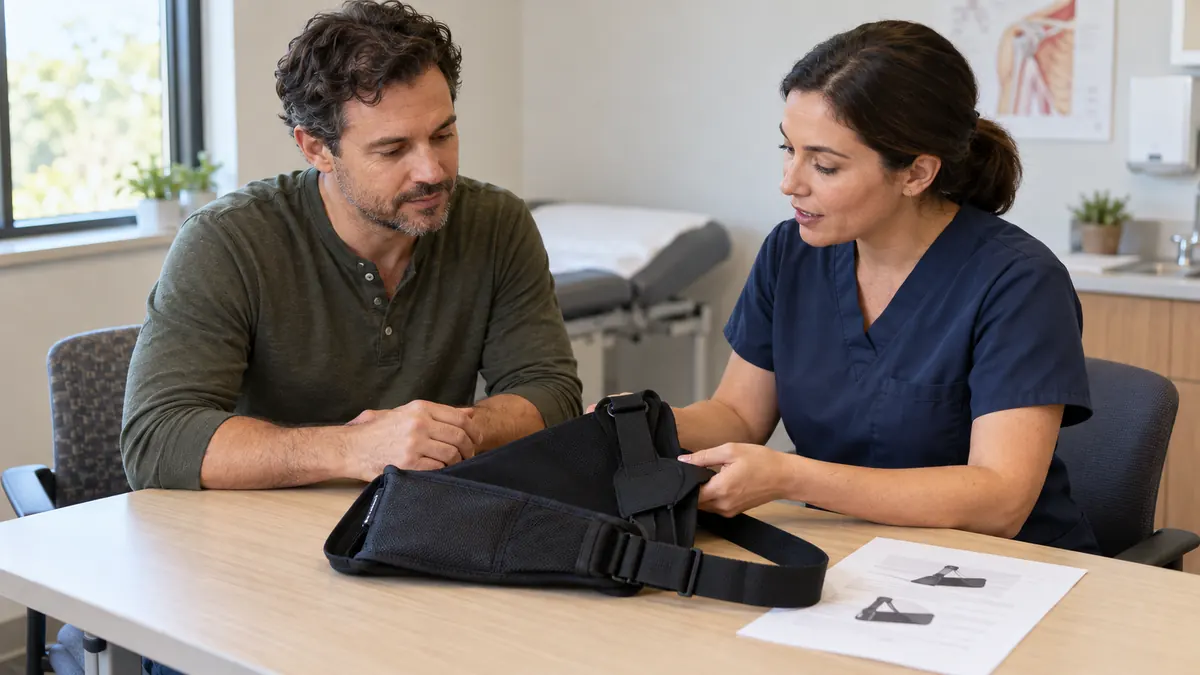
A shoulder immobilizer and a sling are not always separate product categories. Check the actual prescription, supplied device and components, teaching received and real clinical answer. This guide helps you resolve those gaps and record whether an instructed change actually happened. It does not choose a device or supply a fitting method.
Start with six essential device checks, compare components and their limits, read two fictional examples, or use the private prescription-to-implementation record. Existing paperwork and observations are enough to begin. Do not remove components or provoke symptoms to complete the record.
New circulation or nerve concerns must not wait for paperwork or a routine reply. Seek immediate clinical advice or medical care for markedly worsening pain, new tingling, weakness or numbness, a cold or colour-changing hand/arm, or inability to move the arm. Do not test movement against restrictions. A device that feels too tight or a new/worsening swelling concern also needs prompt contact and an appropriate response. University of Kentucky HealthCare lists these kinds of changes in its sling advice. These are selected warnings, not a complete triage checklist; use local emergency services for an emergency, including 911 in the U.S.
The advice against making an unapproved device change is not an instruction to tolerate concerning symptoms while awaiting a callback. Obtain appropriate assessment and follow real-time professional directions. This page provides no strap-release sequence or safe waiting interval. Do not assume that temporary improvement after an adjustment proves the problem resolved.
This is caregiver-written educational preparation. The site operator is not a medical professional, and no independent clinical review or validated fitting assessment is claimed. Keep the patient’s concerns and preferences visible, with consent for any helper’s record. A helper’s observation is not a substitute for the patient’s report.
Table of Contents
Shoulder immobilizer or sling: six essential device checks
| Check | Actual fact to retain | Gap to clarify |
|---|---|---|
| 1. Prescription | Actual device name, instruction source and relevant care context as known. | Which product/components were intended? |
| 2. Supplied product | Model and components actually supplied, without dismantling it. | Has the responsible team confirmed the match? |
| 3. Instructions | Actual wear, removal, reapplication and permitted-adjustment wording. | Which instruction is missing or conflicting? |
| 4. Teaching and help | Education actually received and agreed help actually available. | Can the patient/helper follow the instructed arrangement? |
| 5. Real answer | Question communicated, respondent role and actual clinical reply. | What did the reply resolve, and what remains unanswered? |
| 6. Actual implementation | Change instructed, teaching supplied and what really happened. | Is a barrier still unresolved, and who owns the next response? |
These are communication checks, not a readiness score. A completed form does not verify a prescription match or clinical permission. “Unknown,” “not yet taught” and “answer pending” are useful entries. A person does not need a complete device history before a concern deserves attention.
Compare sling and immobilizer components without choosing a substitute
A sling generally supports the arm. A sling-and-swathe arrangement adds a wrap around the trunk to restrict shoulder motion; commercial immobilizers may incorporate that function. Terminology can overlap, so the name on a package does not by itself prove that the product is right or wrong. University of Kentucky HealthCare describes immobilizers as slings with an additional body strap. Merck Manual explains the support-versus-additional-motion-restriction distinction.
| Actual component or label | General role / limit | What to verify in your prescription |
|---|---|---|
| Arm-support pouch / sling | Supports the arm; does not establish that every shoulder movement is prevented. | Exact prescribed product and how it was fitted for this person. |
| Body strap / swathe / immobilizer | May add restraint around the trunk; labels overlap across products. | Whether this component is prescribed and what actual adjustment instructions apply. |
| Abduction pillow or other added support | An additional component whose intended position and purpose must be confirmed for the actual product and treatment. | Whether it belongs in this prescription; actual teaching and removal/reapplication instructions. |
| Straps, closures and size | Configuration and fit are product-specific; appearance or comfort alone does not verify the fit. | Who fitted it, what was taught and who reviews slipping, pressure or an apparent mismatch. |
| “Sling” versus “immobilizer” wording | A naming difference is not automatically a clinical difference or a dispensing error. | Whether the actual model and components satisfy the actual prescription. |
The table is not a product ranking. Extra components do not automatically mean better care, and a simpler product is not automatically an acceptable substitute. Do not add a strap, remove a support, change routing or buy a replacement to resolve a naming question without the responsible team’s actual guidance.
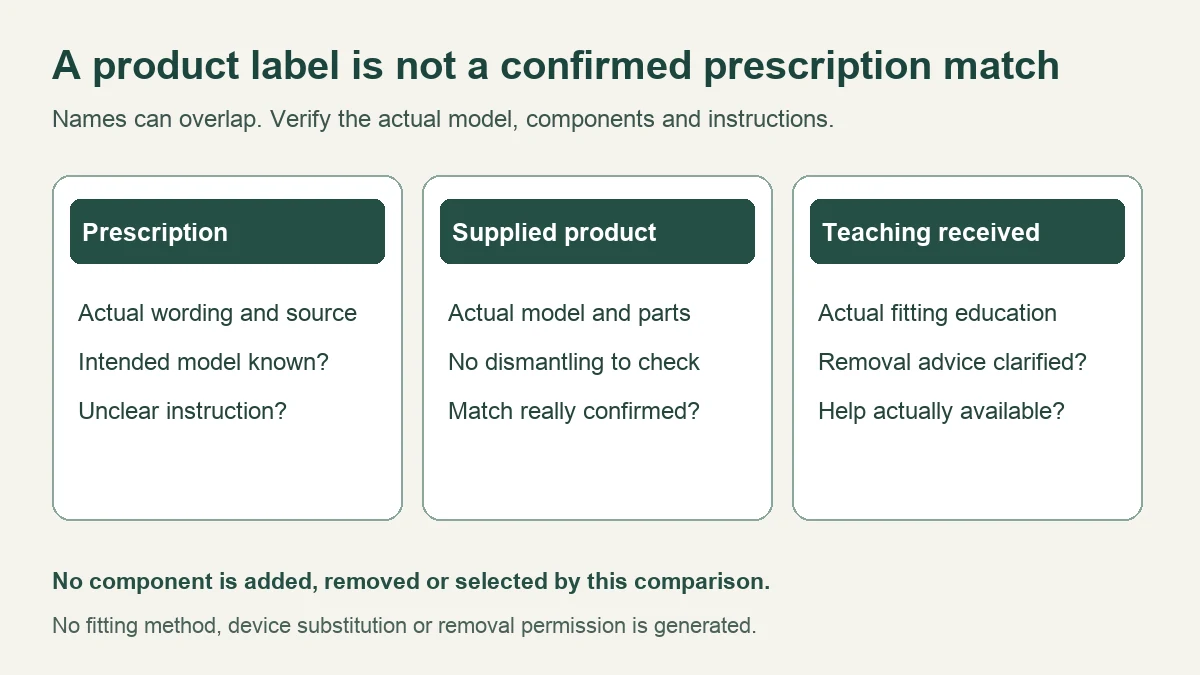
Match the prescription to what was actually supplied
Keep the actual prescription or discharge wording, model information and instructions already available. Record uncertainty if the model or intended component is not known. A receipt can identify a supplied item; it does not establish clinical suitability. A marketing label cannot replace clarification from the responsible care team.
A useful question is: “The instruction uses this name, and the supplied product uses this label. Does this model with these components match what was intended for me?” If the team needs additional information, ask how to provide it through an agreed private channel. Do not post identifiable health information or device photographs with personal details in public comments.
Keep a delivery or sales answer separate from the clinical response. A supplier may clarify an item number or dispatch a missing part; that alone does not authorize a different immobilization plan. If the product seems wrong, damaged or incomplete, report the actual issue and ask for the appropriate interim instructions. This guide cannot choose a temporary substitute.
Comfort matters and should be reported, but it does not by itself determine suitability. Equally, a prescribed product that cannot be used as taught requires a real response. Preserve the practical problem rather than treating “follow the prescription” as the end of the conversation.
Confirm actual wearing instructions, education and help
Record what you were actually told about wearing the device, permitted removal, reapplication, personal care and sleep. Keep any dates or review instructions exactly as supplied; no universal duration, angle, exercise dose or removal schedule is generated here. Do not infer permission from another person’s operation or a generic product page.
The Royal Orthopaedic Hospital daily-activities guide describes professional teaching and practice of sling removal and application after shoulder surgery. It also includes a fitting guide for a named product. That supports asking for teaching with the actual device; it does not make that product’s method everyone’s instructions.
Distinguish education actually received from a handout issued or an appointment booked. Ask which tasks were demonstrated, which remain unclear and whether the intended helper was included with the patient’s agreement. This article does not provide a donning sequence or ask the reader to rehearse removal to prove a difficulty.
For dressing, washing, work and other tasks, explain the task that cannot be managed under the current instructions. Ask what help or teaching is needed. Being at home does not mean a family member is trained or able to assist. Record help accepted and actually available separately from help merely suggested.
If two sources appear to conflict, keep both wordings and ask the responsible clinical team which applies now. Do not choose the most comfortable fragment, combine them into a new rule or assume a generic leaflet overrides an individual instruction. Needed urgent care must not wait for an administrative clarification.
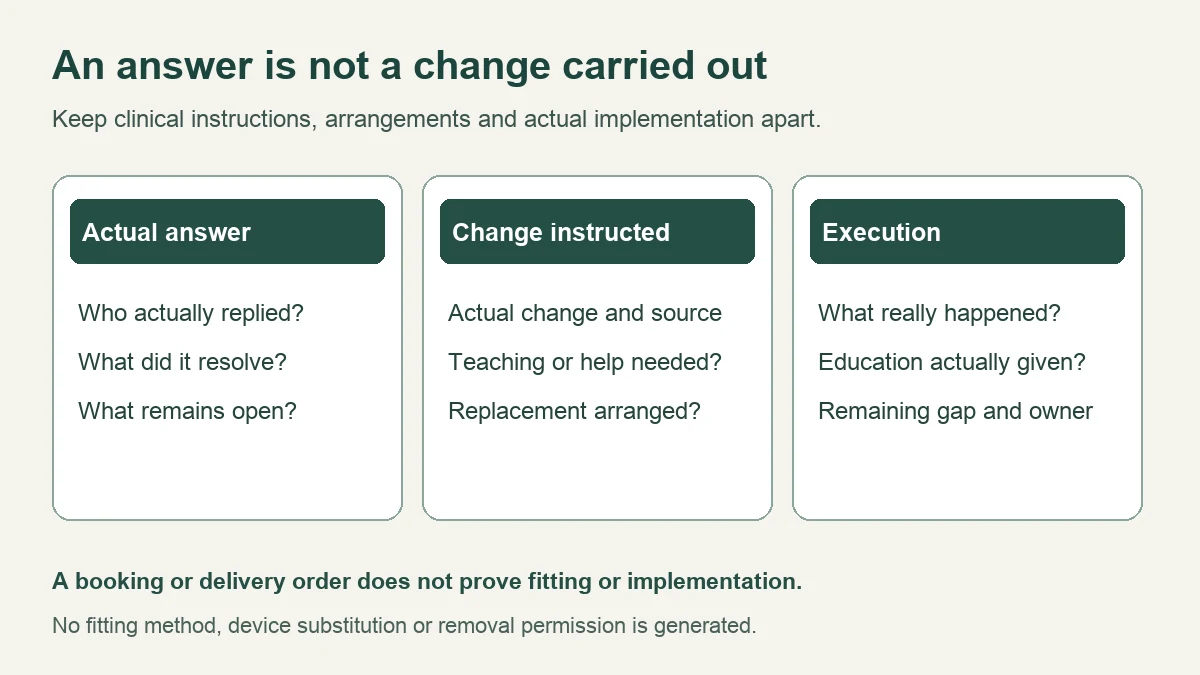
Separate the actual answer from a change really carried out
| Event | What to record | What it does not prove |
|---|---|---|
| Question prepared or sent | Actual question, recipient role and communication status. | Receipt, clinical review or permission. |
| Clinical answer received | Actual reply, author and scope; retain any unresolved issue. | That a delivery answer or remembered suggestion is a new prescription. |
| Change instructed | Specific actual instruction and required fitting/teaching/help. | That the change has been carried out. |
| Education or replacement arranged | Appointment, delivery or teaching actually offered. | That education occurred, the item arrived or a fit was checked. |
| Actual execution | What really changed and by whom, as already known. | Correct fit, safety, recovery or a verified treatment outcome. |
| Next response | Remaining barrier and actual contact/review arrangement. | That silence means clearance or waiting is safe. |
Ask for clarification when the reply answers only part of the question. For example, confirming the model may leave personal-care removal instructions or required help unresolved. Keep the resolution partial. The record should not turn one answered item into a claim that the whole arrangement is workable.
If a change was instructed but teaching, help or the correct item has not arrived, report that gap and obtain an actual response. A future appointment is not present support. There is no requirement to keep trying a painful or unworkable arrangement to demonstrate failure for this worksheet.
This page focuses on prescription–product matching, education and actual implementation. The separate shoulder immobilizer sleeping guide discusses nighttime concerns. Its setup discussion does not establish that a device matches your prescription or replace instructions for the actual product. This article supplies no bed-versus-recliner ranking, pillow arrangement or sleep-position trial.
Two fictional prescription-to-implementation writing examples
These are invented documentation examples, not verified patients, prescriptions, clinical advice or recovery outcomes. Tool example buttons replace entries and mark output fictional. Neither example provides permission to alter the device or assurance that waiting is safe.
Example A: product wording differs, match not confirmed
| Record item | Fictional entry |
|---|---|
| Prescription / supplied product | Instruction sheet says shoulder immobilizer; supplied packaging says sling. Exact model/components not fully recorded. |
| Question | Does the supplied model with its actual components match the prescription? Prepared, not sent. |
| Actual answer | No clinical response supplied. A label alone proves neither match nor mismatch. |
| Change / execution | No substitution or component change instructed; none performed for this example. |
This entry avoids declaring a dispensing error from a category name. It also avoids assuming that the device is correct because it was delivered. The useful next information is the actual confirmation and any instruction, teaching or supply action that follows.
Example B: device supplied, reapplication teaching incomplete
| Record item | Fictional entry |
|---|---|
| Actual product | A device was supplied; exact model not reproduced here. |
| Education / help | Removal and reapplication teaching not confirmed; needed assistance not confirmed as accepted and available. |
| Contact / answer | Question reportedly communicated; clinical review and actual reply not confirmed. |
| Change / execution | No revised instruction, completed teaching, device change or resolution invented. |
The question can read: “I do not understand how to manage this task under the actual instructions. What teaching and help are needed, and how will that be arranged?” The record keeps the education/help gap visible without supplying an improvised method or blaming the patient.
Private prescription, product, teaching, answer and change record tool
Download the offline tool before entering actual health details. Use fictional entries on this page because surrounding ads and analytics may be present. The tool makes no network requests, uses no browser storage and does not automatically save. The downloaded file has no external assets or automatic network requests. Keep exports private.
Use one device-related question. Omit names, identifiers, contact details and full reports. Blank fields produce optional clarification questions, not device recommendations, safety points or treatment instructions. Paper with the same headings works. The record is never a prerequisite for care.
Prescription, supplied product, teaching, real answer and change record
Keep the actual prescription, supplied device, education received, clinical reply and change carried out separate.
Download the offline tool before entering actual health details. Use fictional entries here; surrounding ads and analytics may be present.
Offline copy. No ads, analytics, external assets or automatic network requests.
The tool makes no network requests, uses no browser storage and does not automatically save. Refreshing may lose entries. Omit identifiers and keep exports private. Needed assessment must not wait for this record.
Start with the fictional example or download a blank offline copy.
Paper alternative: prescription; supplied product; actual instructions; conflict; teaching; help; observation; contact; actual answer; instructed change; implementation; remaining gap.
My prescription, device and implementation record
Unverified personal record for discussion. Entries verify no prescription match, fitting, clinical permission or implementation.
Guide: living.kioptrix.com/shoulder-immobilizer-vs-sling/
Build, then copy, download text or print/save PDF. Editing hides the old result until rebuilt. Offline exports include current entries; refreshing or closing may lose unsaved notes. Filled fields remain unverified personal information. Nothing is sent to a clinician or used to authorize a change.
Common questions about a sling or shoulder immobilizer
Are a sling and an immobilizer always different products?
No. Terms can overlap. Verify the actual model, components and prescription rather than deciding from a label.
Does an additional body strap make a device better?
Not automatically. A component’s role must match the actual treatment plan; the article provides no ranking.
Can I remove an abduction pillow or replace the device for comfort?
The page gives no permission to do so. Bring the concern to the responsible team and retain the actual answer. Urgent symptoms require appropriate assessment, not waiting for routine permission.
Does a product fitting video replace teaching?
Do not assume that it applies to your product or restrictions. Ask for education with the actual device and clarify what help is required.
What if I have no record of the model?
Write unknown and ask how to confirm it. Do not dismantle or repeatedly remove the device to complete the form.
Does an answered message mean the problem is resolved?
No. Keep the actual reply, instructed change, education/help supplied and actual implementation separate.
Sources, corrections and editorial limits
Sources checked: October 30, 2026. This expansion keeps the earlier individual-prescription principle but replaces repeated preparation text with component comparison, device-matching questions and an implementation record. The photo depicts a fictional discussion, not a fitting demonstration or endorsed product.
- University of Kentucky HealthCare: Sling immobilization — overlapping sling/immobilizer terminology, individual use guidance and selected changes requiring contact or medical care. Its general application suggestions are not copied as personal instructions.
- Merck Manual Professional: Shoulder sling and swathe — limited background on support and additional motion restriction. This clinician procedure is not a self-fitting protocol; angles, application sequence and examinations are not reproduced here.
- Royal Orthopaedic Hospital: Managing daily activities after shoulder surgery — professional teaching, personal-care context and a named-product fitting guide. Its particular method and surgical instructions are not generalized to all devices or injuries.
The six checks and record workflow are editorial communication aids, not a validated prescribing, fitting or triage instrument. No independent medical review, direct product test, real patient success story or reader-outcome study is claimed. Actual professional assessment, appropriate device teaching and individual instructions remain necessary.