

Sleeping after hip replacement needs an individual position plan and a workable arrangement for the whole night. Keep current instructions, a desired change, the actual clinical answer and what happened at night separate. This guide helps you prepare that conversation and record follow-through; it does not choose a sleep position, pillow arrangement or medicine change.
Start with the six essential checks, compare instructions, proposed changes, actual replies and the night, read two fictional examples, or build a private sleep-plan and implementation record. Existing notes are enough to start; no position trial, full night of observation or completed diary is required before seeking help.
Urgent concerns must not wait for a new pillow, a sleep trial or this form. New chest pain, sudden breathing difficulty, coughing blood or collapse needs emergency help; a lung clot can occur without obvious leg symptoms. Call 911 for U.S. emergencies. New calf pain or swelling needs prompt clinical assessment. CDC clot guidance.
Serious slowed or difficult breathing, severe sleepiness or inability to wake/respond while using opioids needs emergency help. If overdose is suspected and naloxone is available, give it and obtain emergency help immediately even if the person improves. FDA overdose guidance. Do not interpret profound sleepiness as successful sleep or use extra medicine to tolerate an unassessed position.
After hip surgery, a sudden pain increase, a fall or injury to the operated side, new difficulty moving or a feeling that the hip has shifted needs prompt assessment. Wound drainage, increasing redness, fever/chills or worsening pain also needs prompt clinical contact or assessment. Do not test a painful position or movement to complete a note. MedlinePlus hip-discharge warnings and AAOS postoperative guidance. Use appropriate direct care if the team cannot be reached or the situation requires it. These are selected warnings, not a complete triage checklist.
This is U.S.-focused educational preparation from a family-caregiver-run site. The operator is not a medical professional. No independent medical review, personalized clearance or sleep-improvement result is claimed. Your actual operation and current care plan matter; an approach name, time since surgery or another person’s experience does not establish your restrictions.
Table of Contents
Sleeping after hip replacement: six essential checks
| Check | Actual information to keep | Unanswered point |
|---|---|---|
| 1. Current instruction | Operation and position/support/movement wording actually supplied, with source. | Which point is unclear or conflicting? |
| 2. Desired change | Position, support or practical change you want to discuss. | Has a clinician actually answered it? |
| 3. Teaching | Positioning or bed-movement explanation actually received. | Which technique or help level still needs instruction? |
| 4. Actual help | Assistance accepted and available for turning, bed access or bathroom needs. | Who can supply the help the actual plan requires? |
| 5. Actual night | Existing discomfort, sleep disruption, help received and barriers already noticed. | What concern needs a real clinical response? |
| 6. Reply and implementation | Actual answer, instructed change and what was really carried out. | What remains unresolved and who owns the next step? |
These checks organize questions and records, not sleep readiness or urgency points. A comfortable position is not automatically an allowed position. A permitted position may still be difficult to use without suitable teaching or help. Keep both concerns visible rather than deciding that comfort proves safety or that discomfort explains its own cause.
Compare current instructions, proposed changes, real replies and the night
| Area | Current instruction and proposed change | Actual answer and actual night |
|---|---|---|
| Sleeping position | Retain the actual instruction. Record a preferred side or other change as a question. | Exact clinical answer and scope; what position was actually used if already known. No clearance inferred. |
| Pillows or other supports | Actual prescribed/approved support and setup advice, if supplied. | Teaching and actual availability/use; a product photo is not instruction. |
| Turning and bed access | Actual movement/assistance advice and point needing clarification. | Education received, help present and difficulty already experienced. No new sequence generated. |
| Nighttime bathroom needs | Actual mobility/assistance plan, with proposed practical change. | Help actually available and any unresolved gap. No permission to attempt a transfer alone. |
| Medicines and sleep concerns | Actual prescription wording/use and the concern to discuss. | Real prescriber/pharmacist answer and effects already noticed. No sleep aid or extra dose selected. |
| Review and contact | Actual contact route and review advice, if given. | Reply actually received, remaining question and what changed in practice. |
Use unknown or not yet confirmed when appropriate. A precise angle, side-sleeping date, medicine time or pillow height should not be guessed to fill a box. A patient’s description and a helper’s observation are different accounts; retain each with consent rather than replacing the patient’s concern with someone else’s interpretation.
The table is also useful when advice appears to conflict. Keep both sources and the point of conflict, then ask the responsible clinical team which instruction applies now. Do not combine fragments into a new movement rule or assume a newer handout automatically replaces an individual instruction.
Clarify this operation’s position instructions without borrowing a timetable
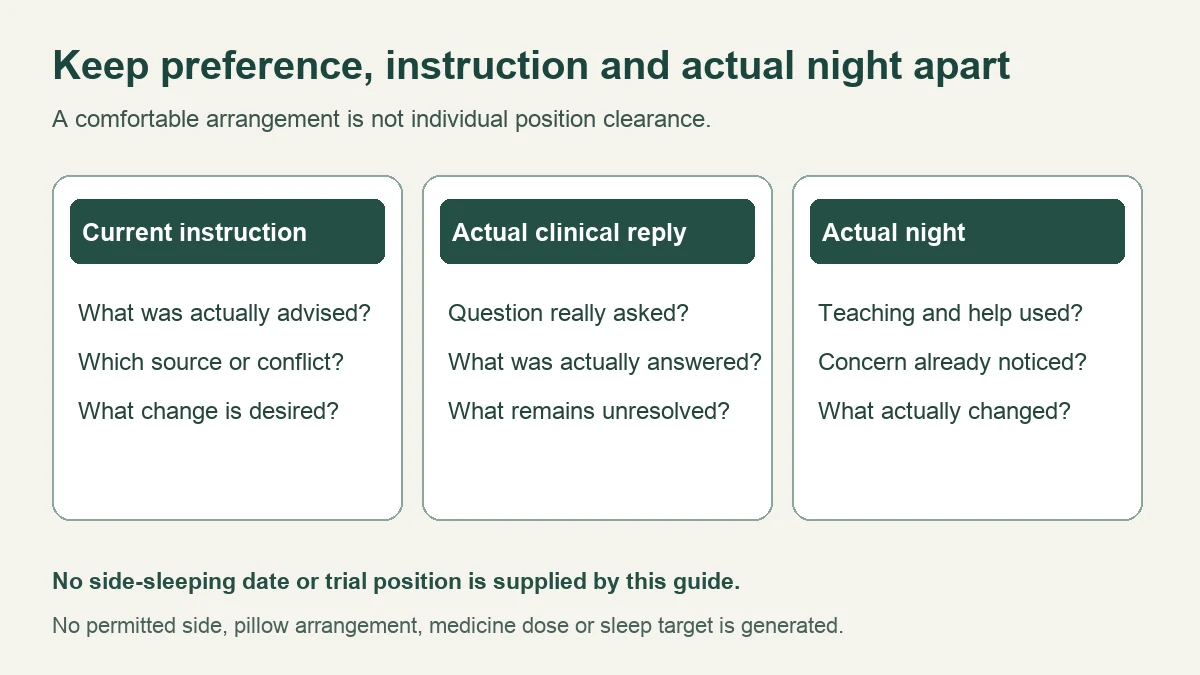
AAOS explains that sleeping-position advice can depend on the surgery and should be discussed with the doctor. Guy’s and St Thomas’ likewise describes an individual surgical care plan and therapist teaching. These sources support clarification; neither supplies your personal clearance from this webpage.
Record the actual procedure and current instructions only as known. Do not infer “no restrictions” from an approach label or assume every person needs the same precautions. Ask which positions and supports apply now, how an unclear instruction should be interpreted and what review arrangement the team actually recommends.
A useful question is: “This is the position advice I received and this is what I cannot manage at night. What applies to my operation now, and what needs to change or be taught?” If your operation details are unknown, say so. You do not need to learn a surgical classification before your concern deserves attention.
This article offers no universal number of weeks, side-sleeping deadline, angle limit or minimum pillow arrangement. Public leaflets may describe different contexts. Preserve the real individualized answer, including any conditions and unresolved point. The record cannot decide that a restriction has expired because a date has passed.
Confirm teaching and help for the whole night
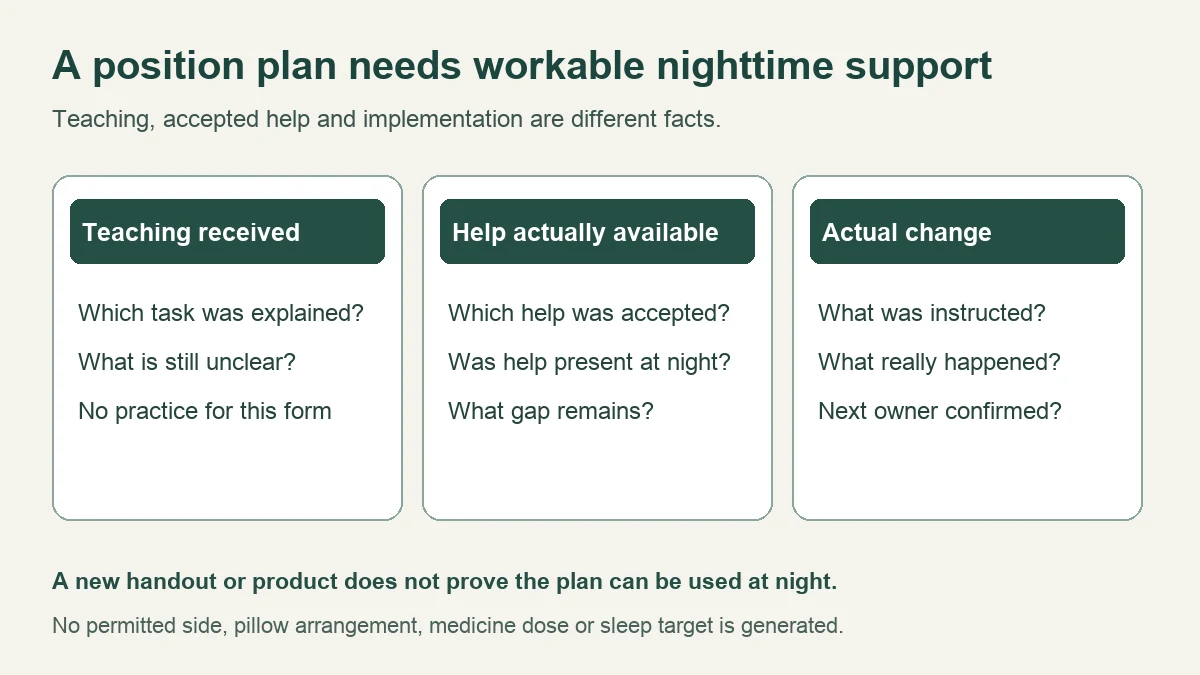
A plan for lying down may not answer how to turn, get into bed, get out or reach the bathroom. Ask the team about the particular task that is difficult and the level of assistance actually needed. A verbal instruction, demonstration, handout and teaching received by the intended helper are distinct facts.
The guide supplies no turning sequence, leg-lifting instruction, transfer method, bed height or permission to use a rail, recliner or other device. Ask about the actual environment and equipment rather than improvising a method. Do not repeat a painful movement or test getting up alone to show what is wrong for this record.
With the patient’s agreement, confirm who accepts the needed help, which tasks they can actually provide and when they are available. Being in the household does not establish that a helper is trained or able to assist. A person who cannot provide the task has identified a support gap, not failed the patient.
Record the help actually present at night separately from help planned for later. If a necessary task cannot be managed safely, obtain appropriate help and a real clinical response instead of trying to complete a night under an unworkable arrangement. No safe interval alone or waiting period is supplied here.
Record existing night observations without testing a position or changing medicine
Start with what was already noticed: discomfort in an existing position, difficulty turning, waking, a support slipping, unavailable help or an unanswered instruction. Timing may be approximate or unknown. No required sleep-hour target, awakening count or number of nights determines whether a concern deserves review.
Keep observation separate from cause. “I woke with discomfort” does not identify the joint, wound, muscle or medicine as its source. “This pillow felt better” does not establish that the arrangement meets the current plan. Do not repeat an aggravating setup, provoke symptoms or compare trial nights to obtain clearance.
Use actual prescription and discharge wording for medicines. Distinguish scheduled from as-needed instructions and ask the prescriber or pharmacist about unclear directions, inadequate relief or unwanted effects. The worksheet does not add a pre-bed dose, sleep aid, sedating product, supplement or new schedule, and does not stop or taper prescribed treatment.
If another condition or existing device affects your sleep plan, bring the actual instructions and concern to the relevant team. Do not assume that a different body position solves breathing, pain or sleep disruption. A possible explanation remains a question until an appropriate assessment; emergency breathing or responsiveness concerns come before routine sleep planning.
Separate contact, a clinical reply and actual change implementation
| Event | What is actually known | What remains distinct |
|---|---|---|
| Question prepared / sent | Concern, recipient role and actual communication. | A draft or sent message is not receipt or review. |
| Clinical answer received | Author, scope, actual explanation and instructions. | A scheduling reply or product claim is not position clearance. |
| Change instructed | Specific change and whether conflicting instructions were clarified. | A discussion or preference is not a new instruction. |
| Teaching / support supplied | Explanation and practical help/equipment actually received. | A new sheet or booking does not prove availability at night. |
| Actual implementation | What was really changed and any existing observation afterward. | No safety verdict, cause or recovery effect inferred. |
| Next owner | Actual contact/review arrangement and unanswered issue. | Silence or a future review does not clear a new concern. |
A real answer may clarify a position while leaving turning help unresolved. Keep the resolution partial where necessary. Do not mark the whole plan complete because one question was answered or a support was purchased. If the instructed arrangement still cannot be used, report that specific barrier and preserve the next actual reply.
There is no required trial of a changed plan before asking again about a concern. Record only observations that already occurred under the actual instructions. Needed urgent assessment must not wait for a routine callback, a diary, delivery or proof that a change failed.
This page focuses on unanswered personal sleep-position instructions after hip replacement and their execution through the actual night. The home-support gap guide concerns actual services and assistance across daily tasks. The wedge-pillow planning guide concerns a proposed support and transfers. A device discussion or service booking does not answer your individual sleep-position question.
Two fictional hip-sleep plan writing examples
These are invented documentation examples, not real patients, clinical instructions or sleep outcomes. The tool’s example buttons replace entries and mark output fictional. Unknown, not asked and pending are valid. No example supplies a permitted side, date, pillow arrangement or movement technique.
Example A: side-sleeping preference, personal answer pending
| Area | Fictional entry |
|---|---|
| Current instruction | Written sleep advice unclear; exact procedure details not supplied. No permitted side inferred. |
| Proposed change | Patient would prefer side sleeping. Personal permission and timing not confirmed. |
| Contact / actual answer | Question about the actual position plan prepared, not yet sent. No clinical reply. |
| Implementation / next point | No new position tried for this record. Obtain actual clarification without inventing a date or safety verdict. |
The question can read: “I would prefer side sleeping, but I do not understand the current instruction. Which positions and supports apply to me now, and what help do I need?” The example does not require trying the position before asking or assume that comfort makes it acceptable.
Example B: position plan exists, but nighttime help is unconfirmed
| Area | Fictional entry |
|---|---|
| Current instruction | An individual plan reportedly exists; exact wording not reproduced here. |
| Teaching / help | Turning/getting-up teaching not confirmed. Required nighttime help not accepted or available. |
| Actual night / contact | Difficulty using the plan reported; the gap reportedly communicated, with clinical receipt/review unconfirmed. |
| Reply / implementation | No clinical answer or revised arrangement confirmed. No improvised lifting or extra medicine used in the example. |
This is an implementation gap rather than proof that the prescribed position is wrong. Ask for an actual response to the missing teaching/help and retain what was really provided. The example claims no resolution, improved sleep or recovery outcome.
Private position, teaching, actual-night and change record tool
Download an offline copy before entering actual health or sleep details. Use fictional notes on this page because surrounding ads or analytics may be present. The tool makes no network requests, uses no browser storage and does not automatically save. Its downloaded file has no external assets or automatic network requests. Keep completed copies private.
Use one current question and related night concern. Omit names, contact details, identifiers and full reports. Blank entries generate optional questions rather than scores or treatment recommendations. Paper with the same headings works. No one needs to complete this form before asking for care or help.
Hip sleep instructions, teaching, help, actual night and change record
Keep actual instructions, a proposed change, real clinical replies and the actual night separate. The tool selects no position or treatment.
Download the offline tool before entering actual health or sleep details. Use fictional entries here; surrounding ads and analytics may be present.
Offline copy. No ads, analytics, external assets or automatic network requests.
The tool makes no network requests, uses no browser storage and does not automatically save. Refreshing may lose entries. Omit identifying details and keep exports private. Needed assessment must not wait for this record.
Start with the fictional example or download a blank offline copy.
Paper alternative: operation; current instructions; desired change; medicine instructions; teaching; actual help; actual night; barrier; contact; real answer; implementation; next owner.
My hip sleep, real-answer and implementation record
Unverified personal record for discussion. Entries verify no position clearance, teaching, help, clinical answer or implementation.
Guide: living.kioptrix.com/sleeping-discomfort-after-hip-replacement/
Build, then copy, download text or print/save PDF. Editing hides the old result until rebuilt. Offline exports contain current entries; refreshing or closing may lose unsaved notes. Filled fields remain unverified personal information. Nothing is sent, prescribed or clinically cleared.
Common questions about sleeping after hip replacement
Which side can I sleep on?
The page cannot choose. Ask which position/support instructions apply to the actual operation now, and retain the real answer and any conditions.
Does a comfortable pillow setup prove it is safe?
No. Comfort is an observation, not personal clearance. A product image or another patient’s experience is not your instruction.
When can I change the plan?
No universal date is supplied. Keep the actual clinical instruction and review arrangement; do not assume that a restriction expires automatically.
What if I cannot turn or get up under the existing plan?
Explain the task, teaching and actual help gap to the team. Do not improvise lifting, attempt an unsafe task alone or use extra medicine to make it tolerable.
Do I need a sleep diary first?
No. Existing notes or an incomplete account are enough to raise a concern. Needed assessment must not wait for a diary or routine response.
Does an answered question mean the changed plan happened?
No. Separate the clinical answer, teaching, help available, actual implementation and any remaining issue.
Sources, corrections and editorial limits
Sources checked: October 30, 2026. This expansion preserves the earlier individual-instruction principle and adds a comparison, real-answer/implementation record and two explicitly fictional examples. The representative image no longer demonstrates a sleep arrangement or promises faster healing. Repeated general preparation text is replaced by task-specific questions.
- AAOS: Activities After Total Hip Replacement — individual sleeping-position advice and postoperative warning context; not personal clearance or a universal timetable.
- Guy’s and St Thomas’: Precautions after hip surgery — individual surgical plan and therapist education; institution-specific examples are not copied as everyone’s restrictions.
- MedlinePlus: Hip replacement discharge — selected changes requiring contact/assessment; no general dose, activity or care-duration instructions are taken from it here.
- CDC: Blood clots — prompt/immediate assessment and the limits of symptom interpretation.
- FDA: Opioid overdose and naloxone guidance — emergency recognition and response, not a sleep-medication schedule.
This is document-based editorial education, not independent medical review, clinical testing or a validated sleep/position decision instrument. No real patient story, sleep benefit, healing advantage or reader usability study is claimed. The representative photo is fictional and illustrative. Actual professional assessment and instructions remain necessary.