

A normal X-ray with ongoing pain calls for an explanation of the completed test alongside the current clinical concern. Keep the actual report, what the clinician said it assessed, what remains uncertain and changes since the examination separate. A normal summary does not explain every cause, clear every activity or automatically mean you need an MRI.
Use the six essential checks, compare examination, explanation and changes, read two fictional examples, or build a result and reassessment record. Start with facts already available. There is no required diary, treatment trial, readiness score or fixed waiting period before seeking needed care.
Emergency needs come before report gathering or routine follow-up. With back pain, new difficulty urinating or bladder/bowel control changes, numbness around the genitals or anus, symptoms such as weakness or numbness in both legs, chest pain or pain after a serious accident need emergency assessment. Use appropriate local emergency services, including 911 for U.S. emergencies. NHS back-pain warning guidance. Do not wait for a normal-result explanation or a completed worksheet.
A suddenly very painful, swollen or hot joint needs urgent assessment even without fever. NHS joint-infection guidance. After injury, inability to bear weight or a continuing concern about a fracture needs clinical reassessment despite a reassuring first image. These are selected examples, not a complete triage list. A stable-symptom label or ability to perform some tasks does not establish that waiting is safe.
This is U.S.-focused education from a caregiver-run site. The operator is not a medical professional. Your clinical team interprets the examination in context and assesses present needs. This guide records facts and questions; it supplies no diagnosis, activity clearance, insurance decision or imaging order. You do not need a polished description or proof of functional loss to ask for help.
Table of Contents
Normal X-ray, ongoing pain: six essential review checks
| Check | Actual information to retain | Question for the relevant clinical team |
|---|---|---|
| 1. Completed test | Exam date if known, region and side, original reason. | What question was this examination intended to answer? |
| 2. Actual report | Available wording, source and any missing report access. | Does the spoken summary match what the report says? |
| 3. Clinical explanation | What was actually explained about findings, limits and uncertainty. | What does this result mean for the current concern? |
| 4. Current instructions | Actual advice, source and unclear or conflicting wording. | Which instruction needs clarification? |
| 5. Existing changes | Pain, sleep, ordinary function or burden already noticed and contact made. | Has this concern been clinically addressed? |
| 6. Real next plan | Reassessment received, further assessment discussed and next owner. | What was agreed, what happened and what remains unanswered? |
These are record categories, not a medical sequence or an imaging-eligibility checklist. You can seek assessment before obtaining a report or filling every field. Preserve the original report privately; the public tool is for fictional notes only.
Examination, clinical explanation and changes are different facts
| Information | What it can actually establish | What should not be inferred |
|---|---|---|
| Told normal | A verbal summary was given by a particular source. | That the complete report was reviewed with you or every cause excluded. |
| Written report available | The stated examination and its recorded findings or impression. | Your own diagnosis, activity clearance or current clinical plan. |
| Clinician explanation received | What that professional actually said about the result and its relevance. | That an unanswered question or a later change has been addressed. |
| Symptoms or daily experience changed | Your account of a change already noticed after the examination. | The cause, an imaging finding or a required test. |
| Further assessment recommended | A real recommendation and stated reason, if provided. | A booked appointment, completed examination or explained result. |
Retain the examined region and side, timing and original question where known. An examination of one area does not describe every other area. If the reason, scope or wording is unclear, ask the team to explain it rather than interpreting technical phrases with a checklist. A brief normal summary is useful context, not a substitute for the actual explanation.
Separate the report from the clinical interpretation and current plan. A portal notification that a report is ready does not show that someone has explained its meaning or resolved your concern. If you cannot obtain it, record access pending and ask the relevant service about its permitted route. Avoid placing complete reports or identifiers into this online page.
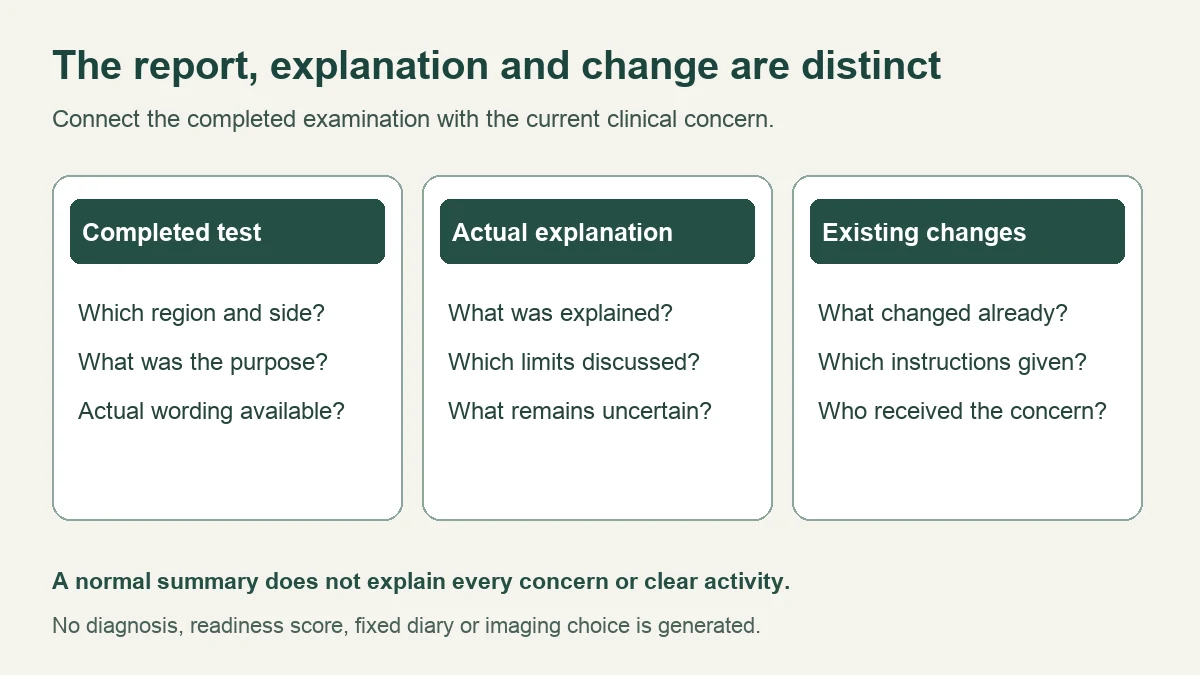
What a normal X-ray can and cannot tell you
Plain radiographs can show important bone and alignment findings. Different imaging techniques provide different information; MRI, CT, ultrasound and repeat radiographs are not interchangeable upgrades. The AAOS overview of X-rays, CT and MRI explains these techniques. It is general education, not a protocol for every person with persistent pain after normal films.
A first radiograph may not reveal some occult injuries or explain certain soft-tissue or other concerns. That limitation does not mean a hidden structural injury must exist, that the first test was useless or that MRI will necessarily explain the pain. The clinical question, examination and context determine the significance of findings and uncertainty. Ask what has been assessed and what remains unresolved rather than choosing a suspected tissue from a symptom list.
Pain is real even when its cause is unclear. MedlinePlus pain information describes assessment through the person’s report, examination and other tests when appropriate. Pain quality and intensity, sleep, daily function and burden are all relevant. A function sentence is not inherently more truthful than a pain description, and an emotional or incomplete account does not make the concern less legitimate.
Use the actual instructions without a conservative-care prerequisite
Keep current instructions and their source, including any advice about loading, movement, devices, medicines or reassessment that you actually received. If an instruction is missing, unclear or conflicts with another, ask the relevant team to clarify it. The worksheet cannot select between conflicting instructions or replace professional advice.
There is no universal sequence of rest, exercise or therapy that everyone must complete after a normal image. The article supplies no exercise dose, brace schedule, activity target, treatment-failure threshold or home test. Do not provoke symptoms or test weight bearing to complete the record. A normal X-ray and temporary pain relief do not themselves clear a return to activity.
Record treatment already performed and effects already noticed without treating a response as your own diagnostic experiment. Relief, maintenance, prevention of decline and burden may all matter to a care discussion. Do not stop prescribed care or extend a trial merely to create evidence for another test. Necessary reassessment does not depend on finishing a diary or demonstrating failed rehabilitation.
Communicate existing changes and preserve the actual clinical reply
Use what is known now: what remains concerning, what changed since the examination, when noticed if remembered, the current instructions and any practical barrier. You can say that you do not know a trigger or cannot describe a pattern. Do not exaggerate or minimize symptoms, label the cause as nerve or mechanical, or repeat a movement to make the account more convincing.
A short question can be: “I was told the X-ray was normal. I need the actual result explained alongside this ongoing or changed concern. These are the instructions I received. What reassessment and contact plan applies?” Share real details privately through the service’s approved route. You do not need a fixed number of notes or days before contacting it.
| Contact fact | What to record | What remains separate |
|---|---|---|
| Prepared | Question or update drafted and intended role. | Actual contact made. |
| Sent / acknowledged | Actual recipient, channel and acknowledgment if received. | Clinical review or advice. |
| Administrative reply | Real information about access, scheduling or records. | Clinical interpretation of symptoms or the image. |
| Clinical reply | Actual professional explanation, advice and scope. | An unanswered question or later change. |
| No reply / partial reply | Pending point and contact arrangement actually known. | Reassurance, normal recovery or a safe waiting interval. |
If concerns require urgent or emergency assessment, a routine message or records request is not a substitute. No response-time promise or safe waiting deadline is created here. Keep the actual next contact and responsible role as explained by the service, with unresolved points visible.
Reassessment, further imaging and result explanation
A new clinical assessment may clarify the existing result, reconsider the current concern or recommend another service or test. No outcome is predetermined. Ask what question a proposed test would address and how its result would affect the actual plan; the worksheet does not choose a modality or decide that imaging is required.
One bounded example: the ACR Acute Hip Pain criteria address adults with traumatic acute hip pain and persistent suspicion of fracture after negative or indeterminate radiographs. Noncontrast CT and MRI are rated appropriate in that scenario. This is a reason not to impose weeks of rehabilitation before investigating a suspected important injury. It is not a rule for every shoulder, wrist, knee, spine or nontraumatic pain problem, and it is not a personal imaging recommendation.
Keep further assessment discussed, recommended, booked and completed distinct. Record which material is needed, what was actually shared and whether access was confirmed. When a new report becomes available, record the clinical explanation actually received and unanswered points. A completed scan, report notification or referral sent does not prove the concern has been resolved.
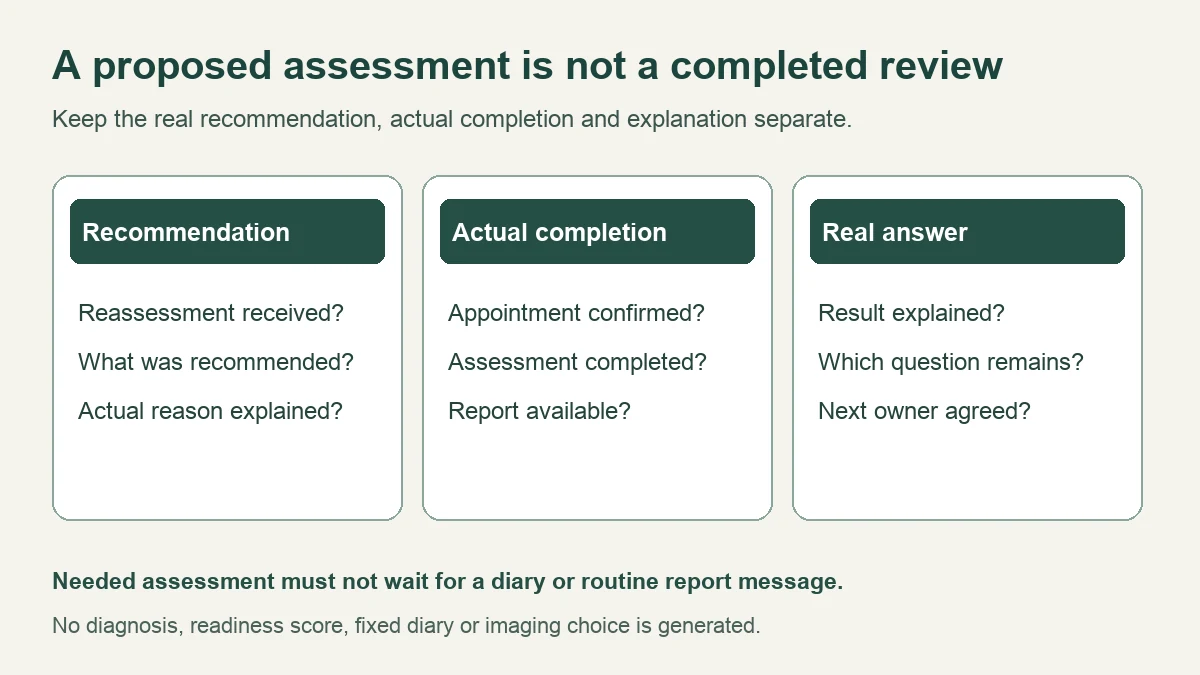
This guide begins with an already completed X-ray and an unresolved clinical concern. Our MRI referral guide organizes an imaging purpose, existing material and referral progress. The specialist referral guide tracks access and clinical contact while awaiting specialist input. This page’s distinct task is connecting the actual result, explanation, later changes and real reassessment answer.
Two fictional result-explanation and reassessment examples
These are invented documentation examples, not real patient stories or clinical instructions. They supply no diagnosis, urgency classification, preferred test or recovery outcome. The tool buttons replace entries and mark output fictional. Unknown and pending are valid entries.
Example A: told normal, actual report explanation unconfirmed
| Area | Fictional entry |
|---|---|
| Completed test / report | An X-ray occurred; exact region, side and original question are not supplied in this example. Normal was reported verbally; full wording unavailable. |
| Explanation / instructions | No clinical explanation of scope or remaining uncertainty recorded. Current instructions need confirmation; no substitute advice supplied. |
| Existing concern / contact | Ongoing pain noted; no cause or new test assigned. Question about the report and concern prepared, not sent. |
| Actual answer / next owner | No real reply supplied. Record the explanation and next action actually agreed; no diary requirement. |
This example does not decide that the report is wrong, that damage was missed or that another scan is necessary. It identifies an explanation gap without requiring a better symptom performance.
Example B: further assessment recommended, arrangements pending
| Area | Fictional entry |
|---|---|
| Existing result / review | A completed examination exists and clinician reassessment occurred in this invented record; no clinical details are supplied. |
| Actual recommendation | Further assessment recommended. Preserve the actual reason; this example chooses no modality. |
| Actual completion / explanation | No booking or completed further assessment confirmed. No new result or clinical explanation supplied. |
| Next owner / barrier | Material access, responsible role and clinical contact need actual confirmation. Needed assessment must not wait for routine administration. |
Recommendation, completion and explanation are separate events. Record what actually happened, with appropriate clinical advice and responsibility, rather than assuming that an order or a future booking closes the question.
Private result-explanation, change and real-answer tool
Download the offline copy before entering real health or examination details. Use fictional notes on this page because the surrounding site may contain ads or analytics. The tool makes no network requests, uses no browser storage and does not automatically save. Its offline copy has no external assets or automatic network requests. Keep completed copies private.
Use one completed examination and related concern per record, with short matching labels if several services are involved. Omit names, account numbers, precise locations and full reports. Unknown, not asked, pending or not applicable according to a real answer are acceptable. A paper note with these headings works; a complete form is not needed before seeking care.
X-ray explanation, change contact, reassessment and real-answer record
Connect an already completed examination with its actual explanation, existing changes and the real next plan. No symptom score or imaging decision is generated.
Download the offline tool before entering real health or examination details. Use fictional entries here; the surrounding page may contain ads and analytics.
Offline copy. No ads, analytics, external assets or automatic network requests.
The tool makes no network requests, uses no browser storage and does not automatically save. Refreshing may lose entries. Omit names, identifiers and complete reports; keep exports private. Needed assessment must not wait for this worksheet, a diary, referral or insurance answer.
Start with the fictional example or download a blank offline copy.
Paper alternative: completed examination; report; actual explanation; current instructions; existing change; contact; real reply; reassessment; proposed plan; actual assessment; result explanation; next owner.
My X-ray explanation, changes and reassessment record
Unverified personal record for discussion. Entries verify no report interpretation, instruction, diagnosis or completed follow-up.
Guide: living.kioptrix.com/normal-x-ray-but-pain-continues/
After an edit, build a new record before copying, downloading text or printing. Offline exports include current entries; closing or refreshing may lose unsaved work. Blank items create optional questions, not readiness points or reasons to delay. Nothing is submitted, booked or clinically verified.
Common questions after a normal X-ray
Does normal mean nothing is wrong?
The meaning depends on the actual report and clinical context. It may not explain the concern or exclude every condition; it also does not establish that hidden structural damage exists. Ask for the actual explanation.
Must I keep a diary before contacting the clinician?
No fixed diary or observation period is required by this page. Bring facts already known and seek appropriate assessment for ongoing or changing concerns. Needed care must not wait for complete records.
Must I try therapy before another test?
No universal prerequisite applies here. The clinical concern determines assessment needs. Record actual care and effects without performing a trial to earn imaging or delaying suspected important injury assessment.
Does ongoing pain mean I need MRI?
Not automatically. A clinician selects any further assessment in context. Ask what question it would address and how results would change the real plan; no modality is recommended by the tool.
Do I need to demonstrate a movement problem?
No. Describe pain, sleep, function, distress and burden already experienced. Do not provoke symptoms, test strength or weight bearing, or invent a trigger.
Does a report notification complete follow-up?
No. Record the actual result explanation, remaining question, instructions and next responsible role. A notification, referral or appointment is different from a clinical answer.
Sources, corrections and limits
Sources checked: October 30, 2026. This revision removes the fixed diary instructions, conservative-treatment-first sequence, readiness points and unverified reader anecdote. It separates the original examination, clinical explanation, existing changes and actual reassessment answer. No recovered patient outcome or directly tested clinic pathway is claimed.
- AAOS: X-rays, CT Scans, and MRI Scans — general explanation of imaging techniques and uses; not a universal normal-X-ray follow-up algorithm.
- ACR: Acute Hip Pain, revised 2024 — specific adult traumatic hip scenarios; the negative-radiograph fracture concern example does not apply to every body region or chronic pain presentation.
- MedlinePlus: Pain — pain reporting, clinical assessment and possible uncertainty; not a single emergency or imaging-selection protocol.
- NHS: Back pain and NHS: Septic arthritis — selected warning-sign education. UK sources do not define U.S. service or coverage arrangements.
This is document-based editorial education, not independent medical review or interpretation of your report. The worksheet is not a validated diagnostic, triage or imaging-decision instrument. A clinician must assess the actual concern. No appointment timing, treatment response, coverage or outcome is guaranteed.